

Trust Building Activities Online: 12 Exercises That Work

The online trust-building activities that work are the ones that get people to share something real, repeat often, and stay voluntary. A five-minute icebreaker at the start of a meeting, a structured pair exercise like Fast Friends, and a recurring coffee chat will do more than a one-off virtual party. Below you will find twelve activities with timing, setup and safety notes, plus how to onboard new hires and check whether any of it is working.
TL;DR
- Trust builds through repeated positive interactions, so a small recurring ritual beats one big event.
- Depth matters more than novelty: exercises that invite real self-disclosure (Fast Friends, “working with me” notes) outperform pure fun.
- Keep everything voluntary, set confidentiality expectations, and let people skip any question.
- Measure with a simple before-and-after rating, then follow up weeks later.
- Pick the format by time available: 5 minutes, 15 to 30 minutes, or a 45-minute session.
Table of Contents
- Why trust is harder to build online, and what helps
- Quick trust builders for the start of a meeting (5 minutes)
- Exercises with real depth (25 to 45 minutes)
- Recurring habits that compound
- Quick comparison: which activity for which situation
- Welcoming new hires: trust from the first week
- Making it psychologically safe and inclusive
- How to tell whether it is working
- Our perspective: make it a habit, not an event
- Running these activities with Gatherilla
- FAQ
- Sources
Why trust is harder to build online, and what helps
In an office, trust grows from small, unplanned moments: a chat at the coffee machine, a lunch, a shared complaint about a meeting. Research on virtual team trust notes that trust typically develops over time through repeated positive interactions, and that physical proximity creates informal chances to connect that remote work removes.
So the job of an online trust activity is to recreate those moments on purpose. Two things follow:
- Frequency beats scale. Ten minutes every week builds more than a two-hour event once a year.
- Disclosure beats entertainment. Games are a good on-ramp, but trust grows when people learn something true about each other. Researchers at Wharton describe how self-disclosure activates reward-related brain regions and may help build cooperation.
The same research summary adds a warning worth remembering: the questions in these exercises should not be diluted into small talk, because their impact relies on depth.
Quick trust builders for the start of a meeting (5 minutes)
These fit into an existing agenda and need no preparation. If you only do one thing this month, do one of these at every team meeting.
1. Share something you are proud of
Ask each person to name a recent achievement, work or personal. Atlassian lists proud achievements, birthplaces, baby pictures, meaningful objects and karaoke picks among its five-minute virtual icebreakers. The proud-moment version works best for trust because it shows people what colleagues value.
2. Bring an object that matters
Everyone grabs one item within reach that means something to them and explains why in 30 seconds. It moves the conversation from job titles to people, and it works in a group of eight in about five minutes.
3. Share a photo or song instead of answering a question
Not everyone enjoys answering questions on the spot. A study comparing icebreaker questions with synchronous media sharing found that media sharing reached equal levels of trust and self-disclosure while improving relatedness, with similar trust formation across levels of agreeableness. Ask people to drop a photo of their desk view, pet or favorite lunch into the chat and say one sentence about it.
4. Four Facts and a Fib
Each person shares several personal facts, one of them false, and the group guesses. Mind Tools says it suits groups of any size and takes around 20 minutes, so keep it for longer meetings or split large teams into small groups.
If you want ready-made prompts, our guides on Zoom icebreakers with scripts and Microsoft Teams icebreakers cover the most common meeting tools.
Exercises with real depth (25 to 45 minutes)
These take planning, but they are where trust shifts most.
5. Fast Friends in breakout rooms
The Wharton Neuroscience Initiative adapted the Fast Friends exercise for remote teams to address distance and distrust in distributed workforces. The format is a sequence of questions that gradually become more personal, answered in pairs.
How to run it, following the Wharton guidance:
- Explain the purpose and agree on confidentiality expectations.
- Assign pairs or trios at random and send them to breakout rooms.
- Share the questions and time each round.
- Let people stop or skip any question.
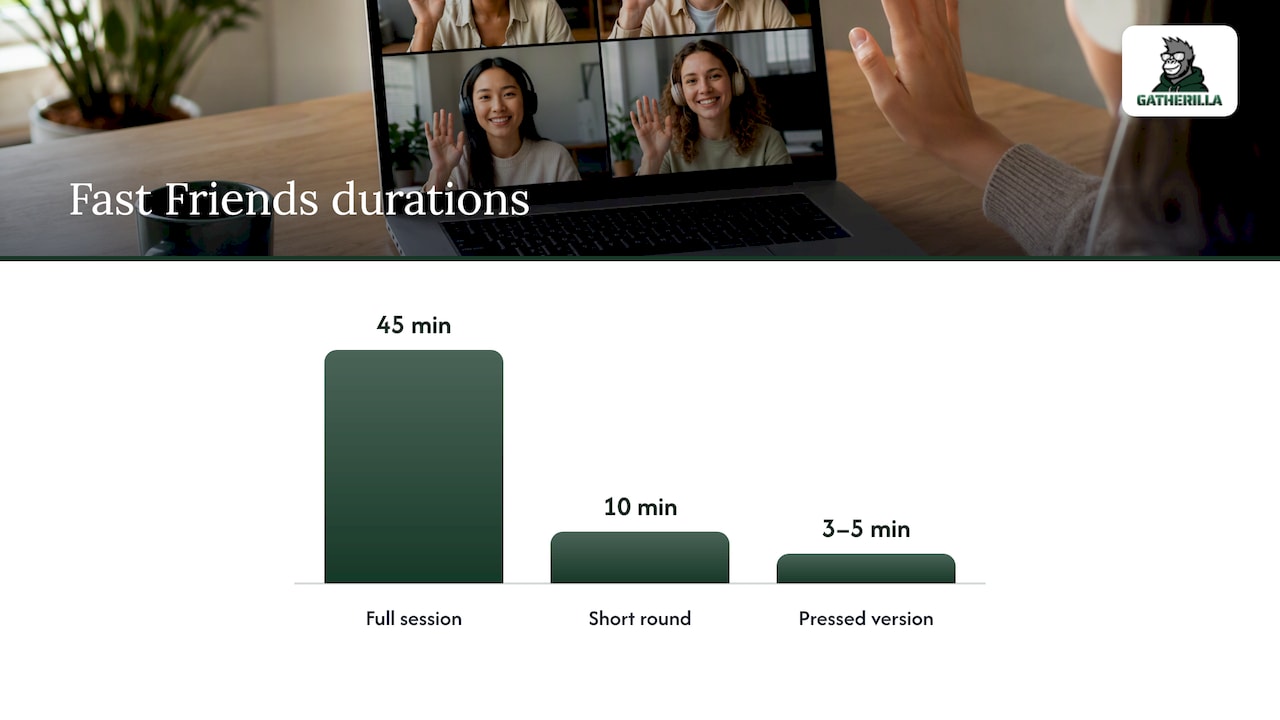
A comprehensive session takes 45 minutes. Shorter versions run in 10-minute rounds, or 3 to 5 minutes if you are pressed. If supervisors and their reports are paired, Wharton advises the supervisor answers the first question, which models the level of openness you hope for.
6. Lost at Sea (survival scenario)
Teams rank survival items after a shipwreck, first alone and then together. Mind Tools describes it as an exercise emphasizing decision-making, collaboration and critical thinking, and suggests 25 to 40 minutes for teams of about five or six. Trust here comes from watching how colleagues reason and disagree under low stakes. Debrief with one question: “When did you change your mind, and why?”
7. The team culture iceberg
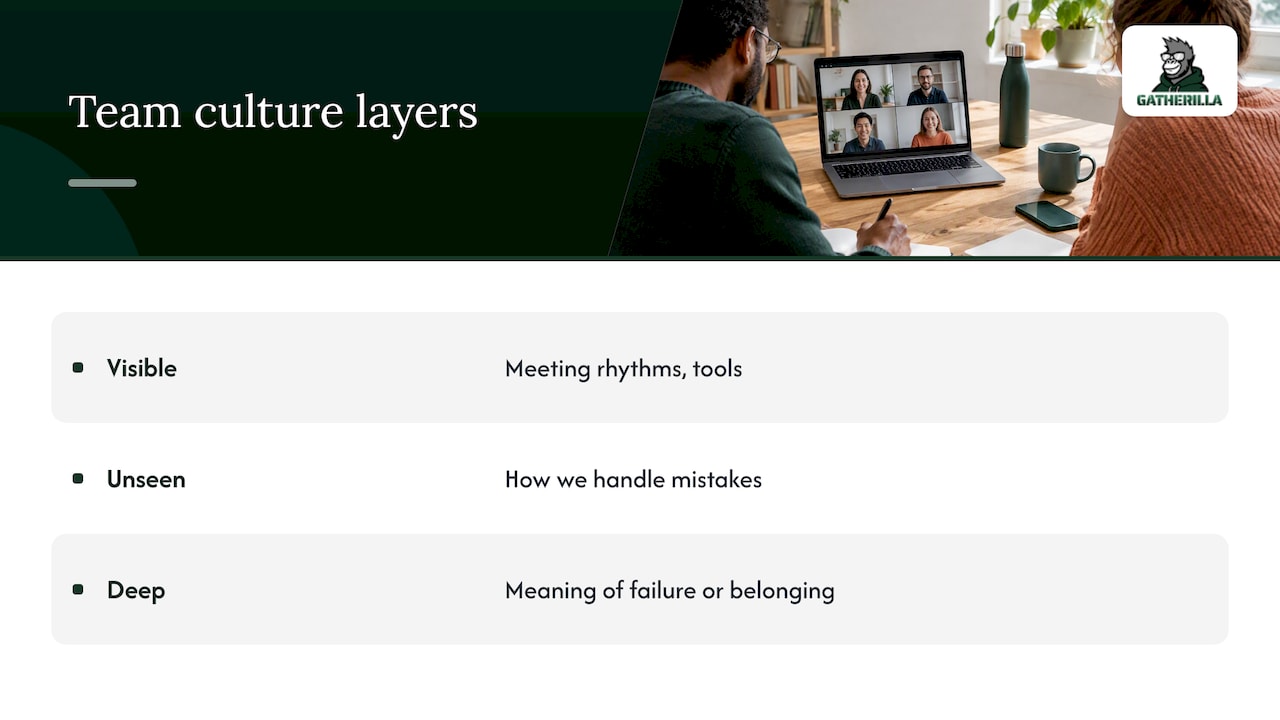
Draw an iceberg on a shared whiteboard with three layers: visible, unseen and deep. Atlassian’s team culture iceberg play helps teams surface assumptions and unspoken norms. Ask what is visible (meeting rhythms, tools), what sits below (how we handle mistakes), and what is deepest (what failure or belonging means here). It suits a team that has worked together for months and wants to talk about how it works.
8. A “working with me” note
Each person writes a short page on how they like to communicate, when they do their best work, and what frustrates them, then shares it in a team meeting. It is a low-pressure form of vulnerability and gives people something to refer back to long after the session.
Recurring habits that compound
Because trust grows through repetition, these rituals matter more than any single exercise.
9. Randomized coffee chats
Pair people at random for short conversations. Engageli describes pairing team members in small groups for 10 to 15 minutes with two or three rotations, while Atlassian mentions coffee chats of 15 to 30 minutes. Give pairs a starter question so nobody opens with an awkward silence. Our coffee chat games article has prompts that keep the conversation moving.
10. Monthly virtual lunch
Atlassian describes a monthly virtual lunch date lasting 60 minutes where team members could expense up to $25 for a meal. The budget is Atlassian’s example, not a rule, but the principle holds: if you want people to give up an hour, make it pleasant and make it cost them nothing.
11. An always-on social channel
An asynchronous group chat for non-work topics lets people connect across time zones without scheduling anything. It also suits quieter colleagues who find live video tiring.
12. A daily shared challenge
A two-minute word or trivia puzzle that the whole team plays and compares scores on creates a small shared moment each day, which is exactly the repeated positive interaction trust needs. Our virtual team trivia playbook shows how to run it without turning it into a competition that leaves anyone feeling stupid.
Quick comparison: which activity for which situation
| Activity | Time | Depth | Best for |
|---|---|---|---|
| Proud moment or object | 5 min | Light | Weekly meetings |
| Photo or media sharing | 5 to 10 min | Light to medium | Teams with shy members |
| Four Facts and a Fib | About 20 min | Light | New or large groups |
| Fast Friends | 10 to 45 min | Deep | Kickoffs, new teams |
| Lost at Sea | 25 to 40 min | Medium | Teams that must decide together |
| Culture iceberg | 45+ min | Deep | Established teams |
| Coffee chats | 10 to 30 min | Medium | Ongoing connection |
| Monthly lunch | 60 min | Medium | Whole-team bonding |
Welcoming new hires: trust from the first week
New employees have no history with anyone, so onboarding is where online trust exercises pay off fastest. A few approaches that fit remote onboarding:
- Pair a buddy with each new hire. Remote onboarding guidance suggests assigning a mentor or buddy and arranging virtual team activities so early interactions build relationships.
- Run a short Fast Friends round with the new hire and one or two teammates rather than the whole team. A group of three feels safer than a screen of twelve faces.
- Ask the new person to write a “working with me” note after week one, and have the manager share theirs first.
- Schedule three coffee chats in the first two weeks with people outside their immediate team.
- Keep the daily challenge open to them from day one, so they are part of a team routine before they know everyone’s name.
Let the new hire opt out of anything personal. Someone in their first week is often anxious already, and forced disclosure does the opposite of building trust.
Making it psychologically safe and inclusive
Trust activities can backfire when people feel pressured. Put these safeguards where you act:
- Make participation voluntary. Say out loud that anyone can pass on any question. This is part of the Wharton guidance, along with agreeing on confidentiality expectations before you start.
- Do not record the session. Atlassian advises against recording, transcribing or using AI notetakers during these sessions, since people share less when they know their words are captured.
- Offer alternatives for anxious participants. A study on social anxiety in video meetings found that for people with higher social anxiety, icebreaker questions may be less effective at building trust and that extra support is needed. Give them the option to share a photo, type in the chat, or join a smaller group.
- Go first as the leader. Your openness sets the ceiling for everyone else’s.
- Choose by objective. A virtual team toolkit from the Partnership for Public Service recommends selecting icebreakers by objective or category and deciding whether participants need to prepare in advance.
Teams often cite a Google study of 180 teams that found psychological safety to be the biggest factor in team effectiveness; Science of People summarizes it and describes a good icebreaker as a low-stakes rehearsal for the riskier interpersonal moments that make meetings productive.
For a deeper look at safety-first formats, see our guide to no-setup icebreakers that build psychological safety.
How to tell whether it is working
You do not need a survey platform. The Wharton approach is to rate trust or connection with an exercise partner before and after on a 1 to 7 scale, without requiring anyone to share their rating, and then follow up later on cohesion, well-being, trust and work outcomes.
A practical routine:
- Before the first session, ask each person to privately rate how connected they feel to the team from 1 to 7.
- Repeat the question right after the exercise, then again four to six weeks later.
- Watch behavior too: more questions in meetings, more people disagreeing openly, more cross-team messages.
- Change the format if scores are flat. Often the fix is more depth or more frequency.
Our perspective: make it a habit, not an event
We build Gatherilla for remote and hybrid teams, and the pattern we see in how teams use online activities is consistent: occasional big events feel good for a day, then fade. What lasts is a routine small enough that nobody dreads it.
That is why we focus on activities that need no downloads, no accounts and no preparation, and on a daily challenge teams can play in a couple of minutes. If setup takes a leader an hour, it will not happen every week. If it takes ten seconds, it will.
We also think trust activities should stay honest about their limits. A game does not create trust by itself. It creates an opening: a shared laugh, a small reveal, a reason to message a colleague afterward. Leaders still have to follow through by listening, admitting mistakes and keeping confidences. Use games to lower the barrier, and use the deeper exercises above when the team is ready for them.
— Thomas
Running these activities with Gatherilla
Gatherilla is a browser-based platform with multiplayer games, icebreakers, daily word and trivia challenges and onboarding games that work with any video conferencing tool. There is a free tier to start with, and the Premium plan is priced per seat: $0.50 to $1.00 per month, or $5 to $10 per year, with more games, reporting and priority support. You can see the details on our pricing page or try the games from our homepage. If you are comparing approaches first, our overview of virtual team building tools for HR teams explains what to look for, and the remote icebreaker games guide gives you a starting list.
FAQ
How long do online trust-building activities take?
Five-minute icebreakers fit into any meeting, coffee chats run 10 to 30 minutes, and a full Fast Friends session takes about 45 minutes. Start small. A short weekly habit usually builds more trust than a long session you run once.
What is the best virtual trust exercise for a new team?
Fast Friends is a strong choice because its graded, personal questions are designed to build closeness between people who barely know each other. Run it in pairs or trios in breakout rooms, set confidentiality expectations first, and let people skip any question.
Do virtual icebreakers really build trust, or are they just awkward?
They can do both, depending on how they are run. Research suggests depth and voluntary participation matter, and that some people, especially those with social anxiety, may do better sharing a photo or song than answering a question live. Offer a choice of format and lead by example.
How often should remote teams do trust activities?
Trust develops through repeated positive interactions, so aim for something every week: a short icebreaker, a rotating coffee chat or a daily challenge. Save longer exercises for kickoffs, new hires and moments after big changes.
How do I know if the activities are working?
Ask participants to privately rate their sense of trust or connection from 1 to 7 before and after, then check again weeks later. Pair the numbers with what you observe in meetings, such as who speaks up and who disagrees openly.
Sources
- Developing team trust: Leader insights for virtual settings
- Create Authentic Connections with Virtual Team Members (Wharton)
- Meeting with Media: Comparing Synchronous Media Sharing and Icebreaker Questions
- Meeting You, Seeing Me: The Role of Social Anxiety, Visual Feedback
- 5-minute team building activities (Atlassian)
- 18 high-impact virtual team building activities and games (Atlassian)
- Build a Team Culture of Trust (Atlassian Plays)
- Virtual Team-Building Exercises (Mind Tools)
- 25 Virtual Team Building Activities to Build Trust (Engageli)
- Virtual Team Toolkit (Partnership for Public Service)
- 80 Fun Meeting Icebreakers (Science of People)
- Remote Onboarding: Requirements, Challenges and Best Practices