

Remote Icebreaker Games for Team Leaders: 2026 Guide

The fastest remote icebreaker game for a daily stand-up is a single typed question in chat — takes 90 seconds, zero prep, and gets everyone talking before the agenda starts. For onboarding, Two Truths and a Lie runs in a browser with no sign-up required. For all-hands meetings, a live poll beats any open-mic prompt. Here’s a quick scenario map to get you started:
- Daily stand-up (1–2 min): Ask one question in chat (“What’s one word for your Monday?”) — everyone types, no one waits.
- Onboarding a new hire (5–10 min): Run Two Truths and a Lie in a browser room; the host shares a link, no accounts needed.
- All-hands or large meeting (5–10 min): Launch a live poll in Zoom, Microsoft Teams, or Google Meet — emoji reactions or multiple-choice keep it fast.
- Cross-functional kick-off (10–15 min): Use a browser-based trivia round or a collaborative drawing game; everyone plays simultaneously on their own device.
- Social hour or team bonding (20–30 min): A structured game with a leaderboard — Gatherilla’s browser-based multiplayer games fit here with no downloads and no IT approval needed.
Table of Contents
- What remote icebreakers are and why they work for virtual teams
- How to choose the right remote icebreaker for your meeting
- Quick 1–2 minute icebreaker prompts you can copy and paste
- Short activities (5–10 minutes) you can run live right now
- Longer games and team challenges (10–30 minutes)
- How to run icebreakers in hybrid settings and for large groups
- What to look for in tools and tech for remote icebreakers
- Facilitator best practices backed by research
- Platform and tech considerations: no-download links, polls, and whiteboards
- Key Takeaways
- Why low-friction games are the only ones worth running
- Gatherilla makes no-download icebreakers effortless
- Useful sources and further reading
What remote icebreakers are and why they work for virtual teams
A remote icebreaker is any short, low-stakes activity that opens a virtual meeting by getting participants to interact before the main agenda begins. The goal is simple: reduce the awkward silence that kills participation and replace it with a moment of genuine connection.
Workhuman research shows that icebreakers reduce psychological distance and improve team communication in virtual environments, with common benefits including higher engagement, better comfort for quieter participants, and stronger team dynamics overall. That last point matters more than most leaders realize. In a room where cameras are off and chat is quiet, the people who never speak in week one rarely start speaking in week four.
For hybrid teams specifically, the stakes are higher. Remote participants can easily become invisible when the in-room group dominates the energy. A structured icebreaker at the start forces parity: everyone answers the same question, everyone’s name appears in chat, and the facilitator has a reason to call on the person joining from their kitchen.
New hires benefit most. A quick activity on day one cuts the time it takes to feel like part of the group. It also signals that the team culture is one where people actually talk to each other, not just present at each other.
When to skip it: Short tactical meetings (under 15 minutes), crisis check-ins, or any session where participants are visibly stressed or time-pressed. An icebreaker that lands badly is worse than none at all.
How to choose the right remote icebreaker for your meeting
The four criteria that matter most are time available, group size, meeting objective, and participant comfort. Get those right and almost any activity works. Get them wrong and even a well-designed game falls flat.
Time available is the clearest filter. Under five minutes? Use a single typed question or emoji poll. Five to ten minutes? A structured activity with a clear start and end. Ten to thirty minutes? A game with rounds, scoring, and a facilitator keeping pace. Slido’s virtual icebreaker resource groups activities the same way and stresses keeping things brief unless the meeting is explicitly social.
Group size changes the format entirely. For groups of five or fewer, open-mic prompts work fine. Six to twenty people need a structured format so not everyone talks at once. Twenty or more requires polls, breakout pods, or browser-based games where everyone submits answers simultaneously rather than waiting for a turn.
Meeting objective shapes the tone. A creative kick-off wants an energizing activity. An onboarding session wants something that reveals personality without pressure. A retrospective wants something light that signals it’s safe to speak honestly.
Participant comfort is the most overlooked criterion. New teams, cross-functional groups, and meetings with senior leadership all call for low-stakes prompts where no one is put on the spot. Avoid anything requiring personal disclosure, physical props, or movement away from the desk.
Pro Tip: Match intensity to familiarity. A team that has worked together for two years can handle a competitive game with a leaderboard. A team meeting for the first time needs a one-question prompt with a typed answer — low pressure, no performance required. Check out team-building games that don’t make people cringe for a practical list organized by comfort level.
Quick 1–2 minute icebreaker prompts you can copy and paste
Drop these into chat or read them aloud at the start of your call. Ask participants to respond in the chat box or react with an emoji — keep the response window to 60–90 seconds and move on. These work best for stand-ups, weekly syncs, and the first five minutes of any meeting.
Mood checks (best for stand-ups and Monday openers):
- “One emoji that describes your energy right now — drop it in chat.” (Chat; all sizes)
- “Rate your week so far: 1 (rough) to 5 (great) — type your number.” (Chat; all sizes)
- “What’s one word for how you’re walking into this meeting?” (Chat; under 20)
- “GIF that matches your current mood — drop the link or describe it.” (Chat; under 15)
Light get-to-know-you (best for onboarding and cross-functional meetings):
- “What’s the last show you actually finished?” (Chat; under 20)
- “Coffee, tea, or something else — what’s in your cup right now?” (Chat; all sizes)
- “What’s one thing in your workspace that tells us something about you?” (Chat or camera; under 15)
- “What city would you live in if you could pick anywhere?” (Chat; under 20)
- “What’s a skill you have that has nothing to do with your job?” (Chat; under 15)
- “What’s the most recent thing you learned that surprised you?” (Chat; under 20)
Fast choices — Would You Rather? (best for all-hands and energy boosts):
- “Would you rather have a four-day workweek or work from anywhere permanently?” (Poll or chat; all sizes)
- “Would you rather give up email or meetings for a month?” (Poll; all sizes)
- “Would you rather always be five minutes early or five minutes late?” (Chat; under 20)
- “Would you rather work in complete silence or with background music?” (Poll; all sizes)
- “Would you rather have a robot do your most tedious task or your most stressful one?” (Chat; under 20)
Single-word or one-highlight shares (best for retrospectives and Friday closes):
- “One word for what you’re proud of this week — type it in chat.” (Chat; all sizes)
- “What’s one thing you’re looking forward to this weekend?” (Chat; under 20)
- “Name one thing that went better than expected this week.” (Chat; under 15)
- “What’s your highlight from the past two weeks — one sentence max.” (Chat; under 10)
- “One thing you’d tell your Monday-morning self — go.” (Chat; under 15)
For large groups (20+ people), use a poll tool built into Zoom, Teams, or Google Meet so responses aggregate visually rather than flooding the chat. Emoji reactions work well too — ask everyone to react simultaneously on a count of three.
Short activities (5–10 minutes) you can run live right now
These activities have clear steps, a defined end point, and work in any video conferencing setup. Each one includes a hybrid note so in-room and remote participants stay on equal footing.
Show and Tell (2 minutes per person, 5–8 minutes total)
Ask two or three participants to hold up one object from their desk or home that means something to them and explain it in 30 seconds. The facilitator picks participants in advance so no one is caught off guard. This works especially well for onboarding because it reveals personality without requiring anyone to answer a personal question cold.

Group size: 4–12. Tech needed: Video call only. Hybrid note: In-room participants hold up their object to the room camera; remote participants hold up to their webcam.
60-Second Scavenger Hunt
The facilitator announces a category (“find something blue,” “grab the oldest thing on your desk”) and gives everyone 60 seconds to find it and return to camera. First person back wins a point. Run two or three rounds for a full five minutes.
Group size: 5–20. Tech needed: Video call only. Hybrid note: In-room participants search the meeting room; remote participants search their space. Keep categories that work in both environments.
Two Truths and a Lie (browser version)
The host opens a browser-based Two Truths and a Lie room and shares the link in chat. Participants join by entering a name — no account, no download. Each person submits two true statements and one lie; the group votes on which is the lie. The browser handles scoring automatically while the video call stays open for reactions.
Group size: 4–20. Tech needed: Browser link shared in chat. Hybrid note: In-room participants use their own phones or laptops to join the browser room alongside remote players.
Paired Breakouts (2 minutes per pair)
Split participants into breakout rooms of two for exactly two minutes with one question to discuss (“What’s one thing you’re working on that the team doesn’t know about?”). Bring everyone back and ask two or three pairs to share one sentence. This works well in Microsoft Teams, which has a built-in breakout rooms feature that the host can manage without leaving the main meeting.

Group size: 6–30. Tech needed: Breakout rooms in Zoom, Teams, or Meet. Hybrid note: Pair in-room and remote participants intentionally so in-room attendees use their laptops for the breakout.
Quick Trivia Round (5 minutes)
Prepare five questions on a light topic (pop culture, geography, team history). Read them aloud and ask participants to type answers in chat. The first correct answer wins a point. Keep the pace fast — one question every 45 seconds.
Group size: 5–30. Tech needed: Chat only; no extra tools required. Hybrid note: In-room participants type into the chat on their own devices rather than shouting answers aloud, keeping it fair for remote players.
Longer games and team challenges (10–30 minutes)
These formats work best for dedicated team bonding sessions, onboarding days, and social hours. Each one has a clear facilitator role, a scoring mechanism, and a variant for large groups.
1. Team Trivia with Breakout Rounds
Objective: Test general knowledge and spark friendly competition across the team.
How to run it: Divide the group into teams of 3–5 using breakout rooms. Each round, the host reads five questions aloud (or shares them in a shared doc). Teams discuss in their breakout room for 60 seconds, then submit one answer in the main chat. The host tallies points after each round. Run four to six rounds for a full 20–25 minutes.
Scoring: One point per correct answer; bonus point for the fastest correct submission. Group size: 10–50. Large-group variant: Split into breakout pods of 5–6 with a designated pod captain who submits answers.
2. Two Truths and a Lie (extended version)
The browser-hosted version scales to larger groups because the platform handles voting and scoring automatically. Run it for 15–20 minutes with the full team submitting statements simultaneously. The host reveals results round by round while the video call captures reactions.
Group size: 6–30. Tech needed: Browser link. Variant: Theme the statements (“two truths and a lie about your career path”) for cross-functional kick-offs.
3. Collaborative Story Building
Objective: Build creative energy and get people laughing together.
How to run it: The facilitator starts a sentence (“It was a Tuesday morning and the entire engineering team discovered…”). Each participant adds one sentence in the chat, in order. The facilitator reads the full story aloud at the end. Run two or three stories for 15 minutes total.
Scoring: No scoring needed — the laughs are the outcome. Group size: 5–20. Large-group variant: Split into teams and have each team build a story in a shared doc, then present it.
4. Virtual Charades
Objective: High energy, no props, works on any device.
How to run it: The facilitator sends a word or phrase privately to one participant via direct message. That participant acts it out on camera for 60 seconds while the rest type guesses in chat. The person who guesses correctly goes next. Prepare a list of 10–15 words in advance.
Scoring: One point per correct guess. Group size: 5–15. Large-group variant: Use breakout rooms with a facilitator in each pod.
5. Competitive Drawing Game (browser-based)
Browser-based drawing games like Doodle Duel use in-browser AI judging so everyone draws simultaneously and results appear instantly. No screen-sharing setup required, no waiting for one person to finish while everyone else watches. The simultaneous format keeps energy high across the full group.
Group size: 4–20. Tech needed: Browser link shared in chat. Time: 15–20 minutes. Large-group variant: Run two parallel browser rooms and compare scores at the end.
6. Guess Who (work edition)
Objective: Surface surprising facts about teammates and build personal connection.
How to run it: Before the meeting, collect one surprising fact from each participant via a Google Form or email. During the session, the facilitator reads facts aloud one at a time and the group types their guess in chat. Reveal the answer after 20–30 seconds.
Scoring: One point per correct guess. Group size: 6–25. Time: 15–20 minutes. Large-group variant: Collect facts from a subset of the team each session so the game stays fresh across multiple meetings.
7. Virtual Escape Mini-Challenge
Objective: Problem-solving under time pressure, strong for cross-functional teams.
How to run it: Share a short puzzle or riddle sequence in a shared doc (three to five clues that lead to a final answer). Teams work in breakout rooms for 10 minutes, then reconvene to share their answer. The facilitator reveals the solution and the logic behind it.
Scoring: First team with the correct answer wins; partial credit for teams that solve some clues. Group size: 8–30. Time: 15–25 minutes. Tech needed: Shared doc plus breakout rooms.
How to run icebreakers in hybrid settings and for large groups
Keep the video call as the primary hub. Everything else — votes, answers, game inputs — runs on a browser layer alongside it. That’s the setup that works, and PartyRoomGames’ workflow guidance describes exactly this: the call stays open for faces and reactions while participants submit inputs through a separate browser tab using a room link or code.
Hybrid meeting checklist:
- Position the in-room camera so remote participants can see all in-room attendees, not just the presenter.
- Use a shared room microphone with echo cancellation so remote participants can hear in-room conversation clearly.
- Ask in-room participants to join the browser game on their own laptops or phones — this prevents in-room attendees from having an unfair advantage.
- Assign a remote co-facilitator who monitors the chat and flags when remote participants are trying to contribute.
- Use typed chat responses rather than open-mic answers for the first round so remote participants aren’t disadvantaged by audio lag.
For large groups (20+ participants):
Pro Tip: Avoid open-mic prompts entirely with groups over 20. The math doesn’t work — if 25 people each take 30 seconds, that’s 12 minutes of sequential talking. Use polls, emoji reactions, or browser-based games where everyone submits simultaneously. For icebreaker games for large groups, breakout pods of 4–6 with a designated pod captain keep energy high without turning the main room into a waiting room.
Common failure modes and quick fixes:
- Audio lag during open-mic: Switch to typed chat responses and set a 30-second timer visible to all.
- Delayed chat reactions: The facilitator reads chat aloud and calls out names — this signals that chat responses are seen and valued.
- In-room participants dominating: The remote co-facilitator calls on remote participants by name before opening the floor to the room.
- Tech confusion at game start: Share the browser link 60 seconds before the activity starts, not at the moment you want to begin.
For Microsoft Teams users, the Teams breakout rooms feature integrates directly into the meeting host controls, making pod splits faster than in most other platforms.
What to look for in tools and tech for remote icebreakers
The one-line rule: prefer browser-based, no-signup experiences that run alongside Zoom, Teams, or Google Meet without requiring participants to install anything or create an account. Even a one-minute signup kills the momentum of a quick opener.
Browser-based team-building games operate independently of any specific video conferencing platform, which eliminates compatibility issues and reduces the startup friction that causes participation to drop before the activity even begins.
Feature checklist for any remote icebreaker tool:
- Room link or room code that participants join by clicking — no account creation
- Works on mobile browsers (participants joining from phones or tablets)
- No software download or browser extension required
- Simple UI that a first-time user can navigate in under 30 seconds
- Works alongside an open video call without requiring full-screen mode
- Accessibility options: readable font sizes, keyboard navigation, no audio-only dependency
- Privacy settings: no persistent data storage of participant names or responses
Practical tool attribute comparison:
| Attribute | Ideal standard | Why it matters |
|---|---|---|
| Join method | Room link or code, no account | Removes the biggest participation barrier |
| Mobile support | Full browser support | Participants on phones can join without friction |
| Account required | No | Eliminates signup delay in live meetings |
| Works alongside video call | Yes, in a separate tab | Keeps facial reactions on the call |
| Accessibility | Captions, keyboard nav | Includes participants with hearing or motor differences |
| Low-bandwidth mode | Available | Covers participants on weaker connections |
Accessibility and logistics notes: If participants are joining from public spaces (coffee shops, shared offices), avoid activities that require speaking aloud or using a microphone. Typed chat responses and browser-based inputs work for everyone regardless of their environment. For participants with hearing differences, ensure the activity doesn’t rely solely on audio cues — display prompts in chat or on screen simultaneously.
Explore Kahoot alternatives if you want browser-first multiplayer formats that go beyond standard quizzes and don’t require participants to create accounts.
Facilitator best practices backed by research
The top facilitator rule is this: match the activity’s intensity to the group’s familiarity, and remove every friction point between the invitation and the first interaction.
Workhuman’s research on virtual icebreakers documents how these activities reduce psychological distance and improve communication in remote teams. The mechanism is straightforward: when people interact before the agenda starts, they’re more likely to speak up during it. That effect is stronger for quieter participants, who often need a low-stakes entry point to feel comfortable contributing.
Research published in Frontiers in Psychology on virtual team dynamics supports the same conclusion: structured social interaction at the start of a session reduces the cognitive distance that remote work creates between colleagues.
Dos and don’ts for facilitators:
| Do | Don’t |
|---|---|
| Set a clear time limit and announce it before starting | Let the activity run over — it signals poor facilitation |
| Explain the purpose in one sentence (“This takes two minutes and gets us warmed up”) | Force personal disclosure or emotional sharing |
| Use typed chat or browser inputs for new or large groups | Require props, movement, or anything participants need to find |
| Keep the video call open as the social hub | Ask participants to switch apps or close the video call |
| Rotate who goes first so the same people don’t always lead | Rely on volunteers — silence reads as disengagement |
| Test the browser link before the meeting starts | Troubleshoot tech live while the group waits |
Pro Tip: Keep the video call open and use the browser game as a quiet background layer. Participants see each other’s reactions on the call while their answers flow into the game simultaneously. This dual-layer setup avoids app-switching fatigue and keeps the human connection front and center. See the remote team building guide for a full breakdown of how to structure this across different meeting types.
For scaling team engagement across a larger HR operation, the same low-friction principle applies: the fewer steps between invitation and participation, the higher the completion rate.
Platform and tech considerations: no-download links, polls, and whiteboards
The platforms your team already uses — Zoom, Microsoft Teams, Google Meet — each have native tools that cover the basics. Zoom’s polling feature lets the host launch a multiple-choice or open-ended poll mid-meeting. Teams has a Forms integration for quick polls and the breakout rooms feature for splitting groups. Google Meet supports emoji reactions and Q&A panels natively.
Where native tools fall short is in game-style interactivity. Polls are useful but passive. Whiteboards (available in Teams and Miro integrations) work for collaborative brainstorming but require more setup than a quick icebreaker warrants. For anything with scoring, rounds, or simultaneous participation, a browser-based game running in a separate tab is faster to launch and more engaging than a whiteboard exercise.
The practical rule: use native platform tools (polls, reactions, chat) for one-question prompts and mood checks. Use a browser-based game link for anything that needs structure, scoring, or more than two minutes of interaction. The two layers work together — the video call for faces, the browser tab for inputs.
No-download links are the critical differentiator. A participant who clicks a link and is playing within 15 seconds will engage. A participant who hits a download prompt will often just wait for the activity to end.
Key Takeaways
The single most effective approach to remote icebreaker games is matching activity length and intensity to your meeting type, then removing every friction point between the invitation and the first interaction.
| Point | Details |
|---|---|
| Match activity to meeting type | Use short prompts for stand-ups, activities suitable for onboarding, and longer games for social hours. |
| Keep it browser-based and no-download | No-signup, link-join games maximize participation; even a one-minute signup kills momentum. |
| Use the video call as the social hub | Keep the call open for reactions; run browser game inputs in a parallel tab to avoid app-switching. |
| Adapt for hybrid and large groups | Use polls and breakout pods for 20+ participants; assign a remote co-facilitator to keep remote voices visible. |
| Gatherilla for turnkey execution | Gatherilla’s browser-based multiplayer games require no downloads, work with all video platforms, and include daily challenges and real-time leaderboards. |
One-week rollout plan:
- Day 1 (Monday stand-up): Drop one typed question in chat — mood check or Would You Rather. 90 seconds, zero prep.
- Day 3 (mid-week sync): Run a 5-minute Show and Tell or Two Truths and a Lie browser room. Share the link 60 seconds before the meeting starts.
- Day 5 (Friday close or social hour): Run a 15–20 minute team trivia round or browser-based drawing game. Use a leaderboard if the group is competitive.
- Measure success: Track chat participation rate (how many people typed at least one response) and attendance. Both tend to increase within two to three weeks of consistent icebreakers.
For broader remote team engagement strategies that pair well with recurring icebreakers, the pattern is the same: consistency beats novelty.
Why low-friction games are the only ones worth running
The conventional wisdom on team building is that the activity itself is what matters. Pick the right game, and connection follows. That’s backwards. What actually determines whether a remote icebreaker works is whether people show up to it mentally, not just physically. A participant who spent 90 seconds fighting a login screen is already checked out before the first question.
The research on remote work and workplace relationships from Harvard Business Review makes this clear: the casual, low-stakes interactions that build trust in an office don’t happen automatically in a remote setting. They have to be designed in. But the design has to be invisible. The moment an icebreaker feels like an obligation or a production, it stops doing its job.
What I’ve seen work consistently is the dual-layer setup: video call open for faces, browser game running quietly in the background for inputs. People stay present on the call. They’re not staring at a shared screen waiting for their turn. The game captures their answers while the call captures their reactions, and those two things together are what actually build connection. The activity is almost secondary to the format.
The other thing most guides underestimate is the value of repetition. A team that does a two-minute chat prompt every Monday for a month will have stronger participation habits than a team that runs one elaborate 45-minute team-building event per quarter. Frequency builds the norm. The norm builds the culture.
Gatherilla makes no-download icebreakers effortless
If you want to run everything described in this guide without building it yourself, Gatherilla is the turnkey option. The platform offers browser-based multiplayer games that require no downloads and no participant accounts — just a room link shared in your meeting chat. HR teams get customizable games, real-time leaderboards, daily word and trivia challenges, and analytics to track participation over time.
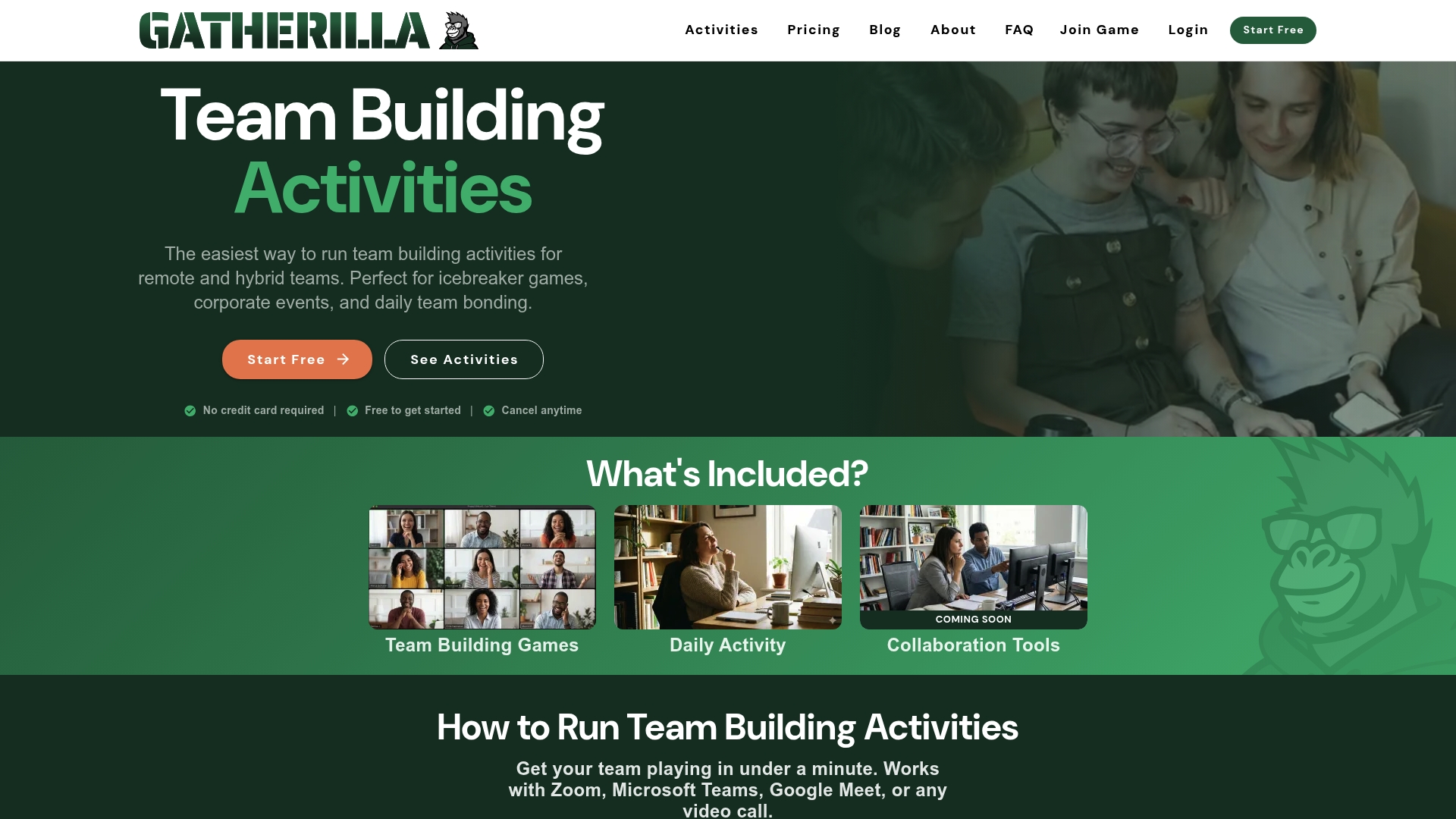
It works alongside Zoom, Microsoft Teams, and Google Meet without any integration setup. Participants click the link, enter a name, and play. For onboarding, recurring stand-ups, or company-wide events, the daily challenge feature keeps teams connected between scheduled meetings. The free tier lets you try the core games before committing to a subscription.
Start a free trial at Gatherilla and run your first browser-based icebreaker in under five minutes.
Useful sources and further reading
- Workhuman — 70 Best Virtual Icebreakers: A categorized list of short prompts, fun activities, games, and question formats organized by meeting type — useful for building a rotating icebreaker library.
- Slido — Virtual Icebreakers: Thirty practical ideas grouped by length and format, with guidance on time-boxing and matching activity type to meeting goal.
- TeamRetro — Two Truths and a Lie: A ready-to-run browser game with no account required; the host shares a link and participants join instantly.
- Doodle Duel — Games to Play on Zoom: Covers browser-based drawing games with simultaneous participation and AI judging, useful for longer social sessions.
- PartyRoomGames — Video Call Party Games: Explains the dual-layer workflow (video call open, browser game in a separate tab) that keeps participation high without app-switching.
- Microsoft Support — Breakout Rooms in Teams: Official documentation for setting up and managing breakout rooms in Microsoft Teams meetings.
- Frontiers in Psychology — Virtual Team Dynamics: Peer-reviewed research on how structured social interaction reduces cognitive distance in remote teams.
- Harvard Business Review — Remote Work and Relationships: Analysis of how remote work affects workplace relationships and why intentional connection moments matter.
- Gatherilla — Browser-Based Team Building Games: Practical guide to running no-download games alongside video calls, with best practices for hybrid setups.
- Gatherilla — Remote Team Building Guide: Long-form guide covering strategy, measurement, and recurring rituals for remote team engagement.