

Virtual Team Trivia: A Ready-to-Run Playbook for HR

Run a virtual team trivia session lasting about a half hour, featuring multiple rounds with speed questions, picture rounds, and some custom company questions. Use a browser-based platform that requires no downloads. Gatherilla is the recommended option: no installs, real-time leaderboards, and a free tier to test with your group before committing to a subscription.
Before you hit “Start Meeting,” confirm these six items:
- Theme — pick one (pop culture, company history, geography, etc.)
- Rounds — plan 3–5 with at least one picture or audio round for variety
- Team size — groups of 3–5 per team keep everyone accountable
- Host — assign one person to run questions and manage the scoreboard
- Backup plan — have a simple chat-based poll question ready if tech fails
- Prize — even a $5 gift card or a Slack shout-out raises the stakes
Share the join link in the meeting chat, run one practice question to confirm audio and cameras, then start Round 1. The Society for Human Resource Management (SHRM) consistently flags employee connection as a top driver of retention — virtual trivia sessions can be a low-cost way to move that needle.
Table of Contents
- Why virtual trivia reliably builds connection on remote teams
- What does a 30–45 minute trivia agenda actually look like?
- What trivia formats and themes actually work for remote teams?
- Free DIY quiz or hosted platform: which one fits your team?
- Tech setup and troubleshooting for Zoom, Teams, and Google Meet
- How to keep everyone engaged and make trivia inclusive
- How Gatherilla supports fast, effective virtual trivia for US teams
- Key Takeaways
- Why the “fun activity” framing undersells what trivia actually does
- Gatherilla makes your first trivia session a five-minute setup
- Useful sources for HR and team leaders
Why virtual trivia reliably builds connection on remote teams
Trivia works because it manufactures a shared social moment that flattens hierarchy. When everyone is racing to answer the same question at the same time, the VP and the newest hire are on equal footing for 20 seconds. That is the mechanic passive icebreakers never replicate.

Quick timers, simultaneous answering, and a visible leaderboard raise social energy in a way that a round-robin “tell us one fun fact about yourself” simply cannot. The competitive element gives people permission to be loud and reactive in a meeting context where they’d normally stay muted.
Specific benefits worth noting for HR stakeholders:
- Fast wins for new hires — a company-custom round during onboarding embeds culture facts in a memorable, social format rather than a static slide deck
- Ritualizable — a recurring Friday trivia slot becomes a cultural touchpoint teams actually look forward to
- Low planning overhead — a prepared host with a script and a question bank can run a session with under 30 minutes of prep
- Measurable — attendance rates and repeat participation are easy to track and report upward
What does a 30–45 minute trivia agenda actually look like?
A prepared script cuts facilitator anxiety and keeps the session moving. Below are three timing variants, followed by a minute-by-minute breakdown of the standard 30-minute format.

Three timing variants
| Format | Total time | Rounds | Best for |
|---|---|---|---|
| Quick energizer | 10–15 min | 1–2 | Meeting warm-up, all-hands opener |
| Standard social | 30 min | 3–4 | Weekly team ritual, Friday social |
| Extended event | 30–45 min | 5–6 | Onboarding, holiday party, all-hands |
Standard 30-minute session (minute-by-minute)
- 0:00–2:00 — Welcome and rules. Host says: “Welcome, everyone. We’re playing [Theme] trivia today — 3 rounds, teams of [X]. Points go to speed AND accuracy, so be fast. Here’s your join link.”
- 2:00–4:00 — Practice question. Run one throwaway question to confirm audio, screen share, and scoring are working.
- 4:00–12:00 — Round 1: General knowledge or theme-specific (6–8 questions). Host reads each question, gives 15–20 seconds, reveals answer, and updates the leaderboard.
- 12:00–13:00 — Leaderboard check. Call out the top three teams. Keep it brief and energetic.
- 13:00–21:00 — Round 2: Picture round or audio clip round. Paste images into the chat or screen-share a slide. Give 20–30 seconds per question.
- 21:00–22:00 — Second leaderboard check. Tease the final round.
- 22:00–28:00 — Round 3: Company-custom or lightning rapid-fire. For onboarding, use 3–5 questions about the company’s history, product, or team culture.
- 28:00–30:00 — Final scores, tie-breaker if needed, and winner announcement. Host says: “[Team name] wins — congratulations. Same time next week?”
Pro Tip: For onboarding sessions, swap Round 2 for a “Meet the Team” picture round where new hires match names to faces. It’s low-stakes and genuinely useful.
Keeping a short archive of past questions makes it easy to rotate hosts and build a question bank over time. Storing 30–50 past questions gives any new host enough material to run a session without starting from scratch.
What trivia formats and themes actually work for remote teams?
Mix formats across rounds to hold attention. A session that’s all multiple-choice text questions goes flat by Round 2.
Format types to rotate:
- Simultaneous multiple choice — everyone answers at once, faster correct answers score more
- Picture recognition — screen-share an image (logo, landmark, historical photo) and teams type answers in chat
- Audio clips — play 10–15 seconds of a song or sound effect; first correct team in chat wins
- Lightning rapid-fire — host reads 10 questions in 90 seconds; teams shout answers in chat
- Breakout team rounds — send teams to breakout rooms for 3 minutes to discuss, then submit one answer
- Company-custom — questions about your product, culture, or team history (3–5 per session max)
25 ready themes for any HR occasion
- Pop culture (movies, TV, music)
- Company history and milestones
- Geography and world capitals
- Science and nature
- Sports and Olympics
- Food and cuisine
- Famous logos and brands
- “Guess the year” historical events
- Animal kingdom
- Tech and gadgets
- Holiday traditions (winter, summer, cultural)
- New hire welcome quiz
- Product knowledge round
- Team “who said it?” (internal Slack quotes)
- Decade-specific (70s, 80s, 90s, 2000s)
- Literature and books
- Art and architecture
- Movie soundtracks
- US states and capitals
- Company values and mission
- Remote work culture
- “Two truths and a lie” trivia hybrid
- Emoji puzzles (decode a movie or phrase)
- Role-based knowledge (engineering, sales, design)
- Retrospective trivia (recap the quarter’s wins)
Sample questions across difficulty levels:
- Easy: “What does the ‘S’ stand for in NASA?” (Space)
- Medium: “In what year did the first iPhone launch?” (2007)
- Hard: “What is the rarest blood type?” (AB negative)
- Company-custom: “What year did [Company] ship its first product?”
- Picture round: Show a cropped company logo and ask teams to identify it.
Writing inclusive questions: Avoid slang, regionally specific references (e.g., a US-only sports team for a global team), and questions that assume a particular cultural background. Visual and audio rounds naturally level the playing field because they reward different strengths than pure recall. For mixed-knowledge teams, aim for roughly one-third easy, one-third medium, and one-third hard questions per round.
Insert company-custom questions at the end of a round, not the beginning. Teams warm up on general knowledge first, which makes the culture-specific questions feel like a fun bonus rather than a test.
Free DIY quiz or hosted platform: which one fits your team?
The short answer: DIY works well for small, frequent, low-stakes rituals. A hosted platform or facilitated service makes sense for larger groups, one-time events with production needs, or when you want guaranteed facilitation and analytics without building it yourself.
Choose DIY when:
- Your team is under 20 people
- You’re running sessions weekly or biweekly and want to keep costs at zero
- You have a willing host who can prep 20–30 minutes ahead
- You don’t need latency-compensated buzzers or branded rounds
Choose a hosted platform when:
- Your group exceeds 30–50 people and coordination gets complex
- You need real-time analytics (participation rates, question performance) to report to leadership
- You want a no-prep option where someone else writes the questions and runs the show
- You’re hosting a one-time event (holiday party, product launch) where production quality matters
Cost and time comparison:
- Free DIY: 20–30 minutes of prep per session, $0 cost, limited analytics, host-dependent quality
- Free-tier platform (e.g., Gatherilla): 5–10 minutes of setup, $0, built-in leaderboard and question bank
- Per-seat subscription: Minimal prep, predictable monthly cost, full analytics and additional game types
Rotating the host role every 2–3 sessions keeps the experience fresh and distributes the prep burden. Build a shared question bank in a Google Sheet or Notion doc so each new host can pull from existing material rather than starting over. For teams exploring quiz-first versus richer game formats, the decision usually comes down to how much variety you want beyond a straight trivia format.
Tech setup and troubleshooting for Zoom, Teams, and Google Meet
The single most reliable setup is a browser-based, no-download flow. Enterprise IT environments frequently block software installs, and signup friction alone can drop participation before the first question.
Pre-session checklist:
- Confirm host has screen-sharing permissions in Zoom/Teams/Meet (check meeting settings 24 hours ahead)
- Test audio and video on the host’s machine before the call
- Open the trivia platform in a browser tab (Chrome or Edge recommended for stability)
- Paste the join link into the meeting chat the moment the call starts — don’t make people hunt for it
- Run a network speed check; anything above 10 Mbps handles screen sharing without lag
- Have a co-host or producer on standby for groups over 25
Troubleshooting common issues:
- Audio delay on answers: Switch to chat-based submissions instead of verbal answers; it’s faster and fairer
- Scoring mismatch: Refresh the leaderboard page; most browser-based platforms sync automatically within seconds
- Someone can’t join: Send the direct URL in chat rather than a room code; direct links have fewer failure points
- Screen share freezes: Stop sharing and restart; ask participants to turn off their own cameras temporarily to free bandwidth
Backup plan: Prepare two or three questions in a simple poll (Google Forms, Mentimeter, or the built-in poll in Zoom/Teams). If the main platform fails, pivot to the poll and keep the session moving. A two-question chat round preserves social momentum even when tech doesn’t cooperate.
Pro Tip: If your company’s IT policy blocks browser extensions or plugins, run the trivia platform in an incognito window. Most browser-based tools work cleanly without any extensions, and incognito sidesteps corporate plugin conflicts.
How to keep everyone engaged and make trivia inclusive
Set scoring rules that reward speed and team collaboration, not just who has the most trivia knowledge. A speed bonus on correct answers keeps the leaderboard dynamic and gives non-experts a real shot at winning.
Dos:
- Encourage cameras on, but never make it mandatory — some team members have bandwidth or privacy constraints
- Use mixed-difficulty rounds (easy/medium/hard) so newer employees aren’t shut out
- Celebrate second and third place, not just the winner
- Give teams 3–5 people so quieter members have cover to participate without being put on the spot
- Rotate themes to reflect different interests across your team
Don’ts:
- Avoid questions tied to a single country’s sports, politics, or pop culture when your team is global
- Don’t run the same format every week — variety is what keeps people coming back
- Skip questions that require specialized knowledge only one department would have (unless it’s a role-based round by design)
Prize ideas that work on any budget:
- $5–$10 digital gift cards (Amazon, Starbucks, DoorDash)
- A custom Slack badge or emoji for the winning team
- A “winner picks next week’s theme” privilege
- Public shout-out in the company newsletter or all-hands
For global teams, skip region-locked prizes and opt for digital gift cards with broad international availability. A short daily question ritual between trivia sessions also keeps the social habit alive without requiring a full meeting slot.
How Gatherilla supports fast, effective virtual trivia for US teams
Gatherilla is built specifically for remote and hybrid teams: browser-based, no downloads required, and ready to run inside any Zoom, Teams, or Google Meet call. The free tier lets you run a first game with a small group in under five minutes.
Key features:
- No-download join links — participants click a link and play; no account creation required
- Real-time leaderboards — scores update live so the host can call out standings between rounds
- Custom question builder — add 3–5 company-specific questions to any built-in game
- Host rotation — any team member can take the host seat without a learning curve
- Analytics (paid tier) — track participation rates, repeat attendance, and question performance for HR reporting
Three-step setup for your first game:
- Create a room on Gatherilla and select a trivia game type from the built-in library
- Add 3–5 custom questions (company history, product knowledge, or team culture)
- Paste the join link into your meeting chat and follow the 30-minute agenda above
Use cases that work well:
- Onboarding welcome quiz — new hires play a company-custom round in their first team meeting
- Weekly Friday social — a recurring 20-minute trivia slot that becomes a team ritual
- Product launch round — a themed quiz tied to a new feature or campaign that reinforces key messages
Gatherilla’s pricing follows a free tier plus per-seat subscription model. The free tier is enough for small, recurring sessions. The paid plan unlocks additional game types, deeper analytics, and priority support — useful when HR needs to report engagement metrics or scale to a larger all-hands.
Key Takeaways
A well-structured virtual trivia session with mixed formats, a prepared host script, and a no-download platform is a reliable way to build remote team connection without heavy planning overhead.
| Point | Details |
|---|---|
| Use a 30-minute blueprint | Three to four rounds with a leaderboard check between each keeps energy high and sessions tight. |
| Mix formats every session | Rotate picture rounds, audio clips, and company-custom questions to hold attention across different learning styles. |
| DIY vs hosted decision | Choose free DIY for small weekly rituals; upgrade to a per-seat platform when you need analytics or larger-group facilitation. |
| Publish a recurring invite | A standing calendar slot turns a one-off game into a team ritual and makes host rotation easy. |
| Gatherilla for no-friction setup | Gatherilla’s browser-based platform requires no downloads, includes a custom question builder, and offers a free tier to start immediately. |
Why the “fun activity” framing undersells what trivia actually does
Most team leaders pitch virtual trivia as a fun break. That framing is accurate but incomplete, and it’s why trivia often gets cut when calendars get tight.
The stronger case is operational: a recurring trivia ritual creates a predictable social touchpoint that new hires can anchor to, gives distributed teams a shared reference point (“remember when Sarah got the emoji round wrong”), and produces measurable attendance data HR can actually use. That’s not a fun break. That’s a lightweight culture infrastructure tool.
The mistake most teams make is running trivia once, getting a positive reaction, and then not scheduling the next one. The value compounds with repetition. A team that plays together every other Friday for three months has a qualitatively different social fabric than one that played once in Q1.
One small tweak that consistently improves participation: let the winning team pick the theme for the next session. It costs nothing, creates anticipation between sessions, and gives the host a built-in conversation starter at the top of the next call. The competitive element carries forward even when the game is over.
Three things to avoid:
- Running the same format back-to-back — variety is the retention mechanism
- Skipping the practice question — it’s the single best way to catch tech issues before they derail the session
- Treating trivia as a one-time event rather than a recurring ritual — frequency is where the bonding actually happens
Gatherilla makes your first trivia session a five-minute setup
Skip the 30-minute prep cycle. Gatherilla gives HR teams and team leaders a browser-based trivia platform that runs inside any video call with no downloads, no IT tickets, and no account required for participants. You get a built-in question library, a custom question builder for company-specific rounds, and a live leaderboard that updates in real time.
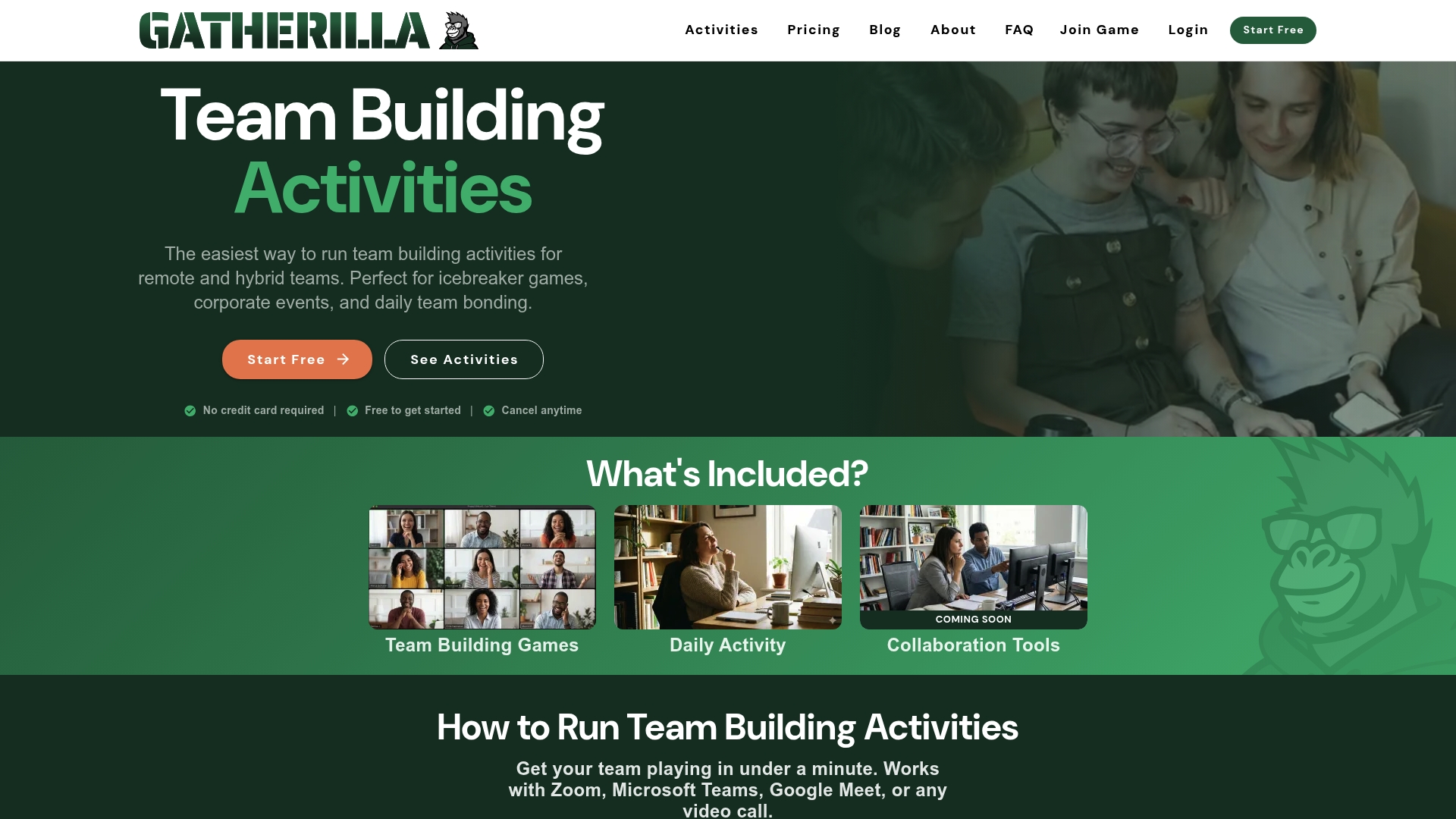
The free tier covers small recurring sessions. When you’re ready to track participation rates, run larger all-hands events, or unlock additional game types, the per-seat subscription scales with your team. Setup takes under five minutes: create a room, add your custom questions, and paste the link into your meeting chat.
Start your first game free on Gatherilla — no credit card required. For larger events or a guided demo, the team can walk you through a custom setup that fits your all-hands or onboarding calendar.
Useful sources for HR and team leaders
- Gatherilla — Team Building Games for Remote & Hybrid Teams: Primary product page covering browser-based game setup, pricing tiers, and feature overview. Start here for platform setup.
- Gatherilla Blog: Virtual Minute to Win It: Practical guide to short timed group games that pair well with trivia energizers; includes question bank and hosting tips.
- Gatherilla: Kahoot Alternatives for Team Building: Useful when deciding between quiz-first formats and richer game types; frames the DIY vs hosted decision clearly.
- SHRM — Society for Human Resource Management: Authoritative source for employee engagement research, retention data, and HR best practices. Use for stakeholder buy-in conversations.
- Gatherilla: Work Question of the Day: Daily micro-ritual ideas that complement recurring trivia sessions and keep social habits alive between meetings.