

Deliver a Project by Day Three: Intern Onboarding Activities HR Can Copy

The best intern onboarding programs blend key elements in the first two weeks: pre-boarding paperwork sent before day one, a quick rapport-building icebreaker, a small but real project assigned early on, a dedicated mentor, and a fixed cadence of check-ins. Below you’ll find ready-to-run activities by category, copy-ready schedules, cohort-size adjustments, mentorship templates, and a measurement framework you can start using this week.
TL;DR:
- Pre-boarding steps like sending a welcome video and mentor introduction are crucial for smooth first-day onboarding, but many programs skip this step.
- Small, early projects with clear deliverables build confidence from day one, rather than delaying meaningful work until later weeks.
- Matching activities to cohort size and format—such as one-on-one mentor pairings for small groups or structured breakout prompts for remote teams—enhances engagement.
- Regular mentor and manager check-ins, starting with daily contacts in week one, ensure timely feedback and support during intern acclimation.
- Quick, recurring connection activities like micro-games and informal feedback surveys help sustain engagement and improve the onboarding experience.
Table of Contents
- Intern Onboarding Activities That Work, Organized by Category
- Copy-Ready Onboarding Schedules: Day One, Week One, and 30-60-90
- Adjusting Activities for Cohort Size and Format
- Mentorship, Manager Check-Ins, and Feedback Cadence
- Measuring Success and Closing Out Strong
- Who’s Behind This Playbook and How Micro-Games Fit In
- Compliance and Legal Training Interns Actually Need
- Company Culture Immersion Activities
- Getting Interns Comfortable With Your Tools and Systems
- Giving Interns a Real Voice in Their Own Onboarding
- What Most Onboarding Plans Get Backwards
- Where Gatherilla Fits Into Your Onboarding Plan
- Sources
- FAQ
Intern Onboarding Activities That Work, Organized by Category
Most internship programs fail the same way: they front-load compliance forms and back-load anything fun, so interns spend week one filling out tax paperwork and week three finally meeting their team. The activities below flip that order, mixing structure with connection from day one.
Icebreakers that actually build rapport
Skip the generic “tell us your favorite hobby” round. Interns already feel like outsiders; a weak icebreaker just confirms it.
- Coffee roulette: Pair interns with a random full-time employee for a 15-minute virtual or in-person coffee chat each week. Script it loosely: “What’s one thing you wish someone told you when you started here?” This works for cohorts of any size and needs zero facilitation once set up.
- Name bingo: Build a 5x5 grid where each square lists a fact (“has a pet,” “worked retail before this,” “speaks a second language”). Interns mingle to fill squares with matching coworkers. Runs 20 minutes, best for cohorts of 8 or more, in person or in breakout rooms.
- Two truths and a lie, team edition: Have each intern share three statements about themselves; the team guesses the lie. Takes 5 minutes per person, works over video with zero setup.
Pre-boarding: the step most programs skip
Pre-boarding is not busywork. It’s the difference between an intern’s first morning being spent hunting for a login versus jumping straight into a warm welcome. SHRM recommends structured pre-arrival communication and early manager involvement as core levers for retention, and that starts well before day one.
Send a short welcome video from the team (2 minutes, informal, shot on a phone is fine), a logistics packet covering dress code, parking, and what to bring, and an email introduction to the assigned mentor a few days before start date. None of this requires new software. It just requires someone owning the checklist.
Skill-building workshops and shadowing
A 45-minute “how our team actually works” workshop in week one, run by a manager rather than HR, teaches interns more about real workflow than any slide deck. Pair it with a half-day shadow session where the intern sits in on a real client call or sprint planning meeting. Outcome: by day five, the intern should be able to explain what the team does in their own words, not just repeat the job posting.
Cohort projects with a real first-week output
This is the piece most programs get wrong. Interns get “shadow this person” and “read this wiki” for two weeks before touching real work. University of Rochester guidance is direct on this point: give interns a small, clearly scoped project by day one rather than filler tasks, because a defined deliverable builds confidence and signals their contribution matters.
A good first-week project is small enough to finish in three to five days and produces something the intern can point to: a competitor audit, a one-page process map, a short data pull with a summary. It should never be a task nobody else wanted.
Recognition and social activities
A welcome lunch on day one (even a $15 grocery store spread works fine) and a Friday “show and tell” where each intern presents one thing they built or learned that week go further than most people expect. Low-cost swag, a name plate, a Slack channel shoutout, cost almost nothing and signal that the intern is part of the team, not a guest.
Pro Tip: Run the Friday show-and-tell even with a cohort of one. Solo interns often feel more isolated than cohort interns, and a standing weekly moment where their work gets seen fixes that fast.
For scripted, ready-to-run versions of these icebreakers, Gatherilla’s icebreaker library has 30 templates built for exactly this kind of mixed remote and in-person group.
Copy-Ready Onboarding Schedules: Day One, Week One, and 30-60-90
Structure removes decision fatigue for everyone involved, not just the intern. A study of 235 medical interns found that a well-organized orientation program was rated useful by 99% of participants, with 94% rating the content excellent to good. The lesson translates well beyond medicine: interns respond to clear structure, not just friendliness.
Day-one, hour-by-hour
- 9:00 to 9:30 AM — Welcome and paperwork wrap-up (HR, manager)
- 9:30 to 10:00 AM — Tech setup: accounts, hardware, software logins (IT, manager)
- 10:00 to 10:30 AM — Team introductions and mentor pairing (mentor, team)
- 10:30 to 11:30 AM — Company overview and culture walkthrough (manager or HR)
- 11:30 AM to 12:30 PM — Welcome lunch with team
- 12:30 to 2:00 PM — First project briefing and scope discussion (manager, mentor)
- 2:00 to 4:00 PM — Shadow a real meeting or workflow session
- 4:00 to 4:30 PM — End-of-day check-in with mentor
Pre-start checklist (send before day one)
- Confirm accounts and system access are provisioned before arrival, not on it.
- Ship or stage hardware (laptop, badge) so it’s ready at the desk or door.
- Send the logistics packet: parking, dress code, first-day agenda.
- Introduce the mentor by email at least three days before start.
- Confirm required tax and employment documents are completed or scheduled.
Week one, balanced
- Monday: Onboarding day-one plan above.
- Tuesday: Skill-building workshop plus mentor check-in.
- Wednesday: Shadowing session plus icebreaker (name bingo or coffee roulette).
- Thursday: Work time on first project, manager touch base.
- Friday: Project progress share plus Friday show-and-tell.
30-60-90 template
By day 30, the intern should complete their first small deliverable, finish required compliance training, and have met one-on-one with their manager at least four times. By day 60, they should own a slightly larger project independently, with weekly (not daily) mentor check-ins. By day 90, they should present a final deliverable to the broader team and complete a self-assessment against SMART goals set in week one. Each checkpoint needs a scheduled 20-minute manager conversation, not just a calendar note.
Adjusting Activities for Cohort Size and Format
Cohort size changes almost everything about what works. A three-person cohort and a thirty-person cohort need entirely different playbooks, and remote versus in-person adds another layer on top.
- Small cohorts (3 to 8 interns): Favor intimacy. One-on-one mentor pairings matter more than group games here, and a single shared Slack channel keeps everyone connected without extra tooling. Gatherilla’s small-group guide covers activity formats that fit tight cohorts without feeling forced.
- Large cohorts (15 or more): Cross-functional mixing matters most. Randomize small teams for group projects so interns from marketing end up working with interns from engineering, rather than clustering by department. Facilitation needs a dedicated point person, not just a manager doing double duty.
- Remote and hybrid tips: Script breakout rooms in advance with a specific prompt and a five-minute time cap, because open-ended “just chat” breakouts tend to go quiet fast. Send async prep (a short video, a one-page doc) before live sessions so remote interns aren’t reading cold. Rotate who speaks first in group settings so the same one or two people don’t dominate every call.
- Time budgets: Plan 15 to 20 minutes for icebreakers, 45 minutes for workshops, and no more than 30 minutes for check-ins, regardless of format. Longer sessions lose attention fast with early-career participants.
Mentorship, Manager Check-Ins, and Feedback Cadence
A mentor is not the same as a manager, and conflating the two roles is one of the most common mistakes in intern programs. Mentors should be one or two levels senior at most, not executives, and ideally someone who was recently in a junior role themselves.
- Mentor responsibilities: answer day-to-day questions, review work before it goes to the manager, and check in daily during week one.
- Meeting cadence: daily 10-minute check-ins in week one, tapering to twice weekly by week three, then weekly through the rest of the internship.
- Assessment tools: a short self-reflection form at the end of week one and week four, plus a five-minute manager mini-evaluation using the SMART goals set at intake.
- Escalation path: if performance issues surface, the manager (not the mentor) should address them directly within 48 hours, documenting specifics rather than vague impressions.
Pro Tip: Give mentors a one-page checklist of what to cover in week one. Even great mentors forget things when they’re juggling their own workload, and a checklist removes the guesswork.
Measuring Success and Closing Out Strong
Track four numbers: time to first completed deliverable, percentage of required training modules finished on schedule, participation rate in optional social activities, and average mentor or manager rating at the 30-day mark. The orientation study cited earlier also found that 97% of participants rated the training methods appropriate when the program followed a structured format, which is a strong argument for measuring adherence to structure itself, not just outcomes.
- Archive all deliverables in a shared folder before the last day.
- Hold a formal exit review meeting covering what was built and what was learned.
- Offer a LinkedIn recommendation or reference letter proactively, not just on request.
- Send a short feedback survey on the program itself, separate from the performance review.
Use week-four metrics to adjust mid-program. If completion rates on training modules lag, that’s a signal to shorten modules, not just nag interns.
Who’s Behind This Playbook and How Micro-Games Fit In
. The activities above work without any tool. But a browser-based micro-game gives a five-minute jolt of connection that’s hard to replicate with a spreadsheet or a Slack poll. and both point to the same pattern: short, recurring touchpoints beat one big kickoff event.
Try a quick trivia round before a daily standup, or a word game as the opener for Friday’s show-and-tell. Implementation checklist: five minutes of prep, one person to launch the session, run it two to three times a week during the first month, and track whether attendance and participation in these sessions holds steady or drops off.
Compliance and Legal Training Interns Actually Need
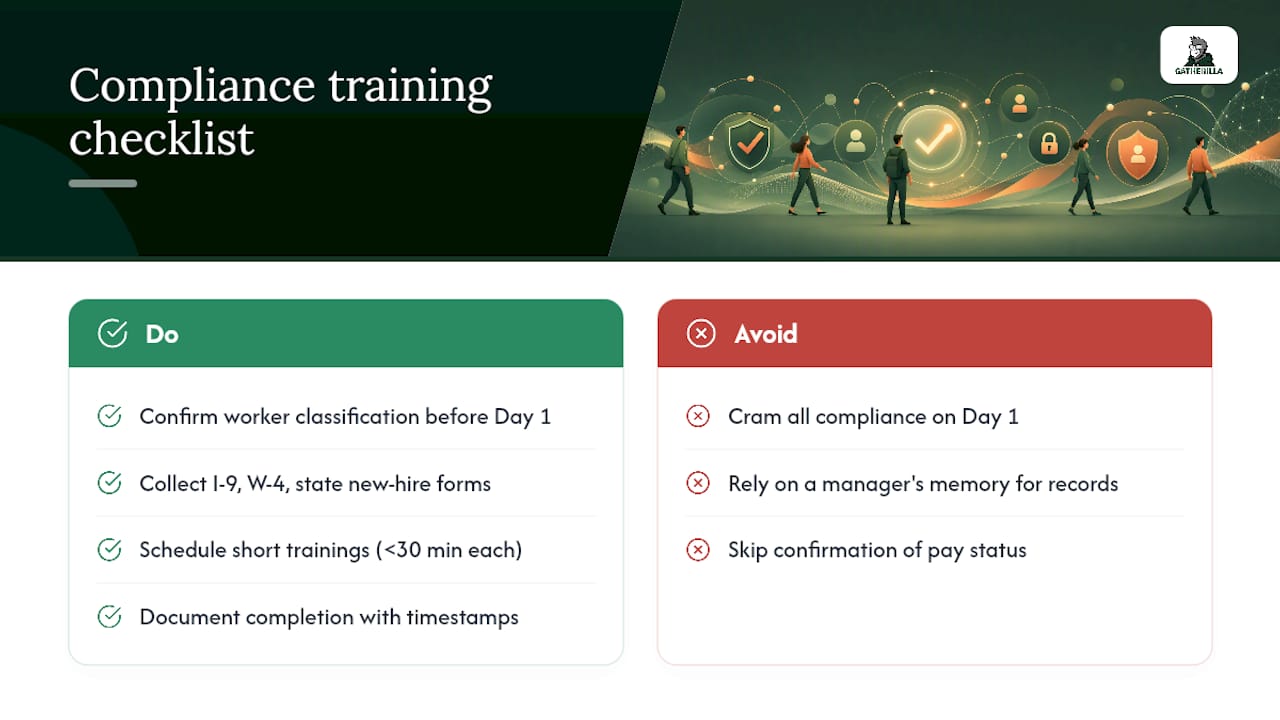
Interns are employees or trainees under federal wage-and-hour rules in nearly every case, and that status carries specific obligations HR cannot skip. Confirm classification (paid versus unpaid, exempt versus non-exempt) before the first day, because getting this wrong creates liability that surfaces months later, not immediately.
Required paperwork typically includes a completed I-9, tax withholding forms, and any state-specific new-hire documentation. The IRS maintains current federal forms and guidance for employer tax documentation, which is worth bookmarking for the HR team handling intake.
Beyond paperwork, schedule short, focused training on workplace conduct, harassment policy, data security, and any industry-specific compliance (HIPAA for healthcare interns, FINRA basics for finance interns, and so on). Keep these sessions under 30 minutes each and spread across the first week rather than crammed into day one alongside everything else. Cramming compliance training into a single overwhelming session is a common reason retention of the material is poor.
Document completion of every required module. If a regulator or auditor ever asks, “did this intern complete harassment training,” the answer needs to be a timestamped record, not a manager’s memory.
Company Culture Immersion Activities
Culture doesn’t transfer through a handbook. It transfers through small, repeated exposures to how people actually behave, which is why the “culture” piece of the Four Cs framework, alongside compliance, clarification, and connection, deserves its own dedicated activities rather than a single slide in orientation.
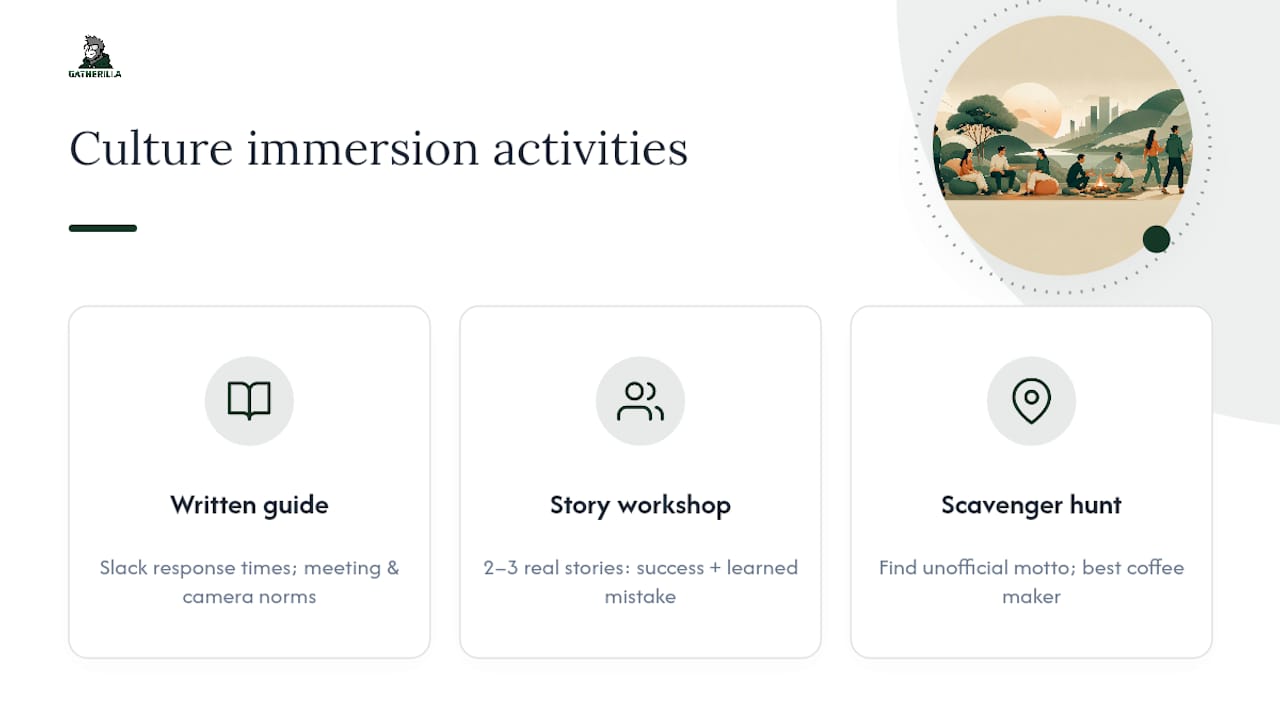
HBR makes a strong case for writing down a company’s unwritten rules explicitly rather than assuming new hires will absorb them by osmosis. A short “how things really work here” document, covering things like typical response time on Slack, how meetings actually run versus how they’re scheduled, and unspoken norms around camera-on video calls, does more for culture transfer than a values poster.
Pair the written guide with a short workshop where a manager walks through two or three real examples: a past project that went well and why, a mistake the team learned from and how it was handled. Real stories stick better than abstract values statements.
For a lighter touch, a “culture scavenger hunt” where interns find answers to questions like “what’s our team’s unofficial motto” or “who makes the best coffee” works well as a low-stakes way to get interns talking to people outside their immediate team. Gatherilla’s scavenger hunt template adapts easily for fully remote cohorts.
Getting Interns Comfortable With Your Tools and Systems
Tool overload hits interns harder than full-time hires, because they’re learning company-specific workflows and the underlying software at the same time, and AI productivity workflows can help simplify these onboarding steps. Sequence it: cover only the two or three tools an intern needs for their first task on day one, and layer in the rest across week one as tasks require them.
A short recorded walkthrough (5 to 10 minutes per tool) that interns can replay beats a live group training session, because interns can pause and follow along at their own pace rather than falling behind in a group setting. Pair the recording with a “test task,” something low-stakes that forces the intern to actually use the tool rather than just watch someone else use it.
Assign a go-to person for tech questions who isn’t the manager. Interns often hesitate to ask their direct supervisor “how do I share a document” for fear of looking unprepared, but they’ll happily ask a peer or mentor the same question. That go-to person can be the assigned mentor, provided the mentor knows the tools well enough to answer quickly.
Giving Interns a Real Voice in Their Own Onboarding
Most onboarding feedback happens once, at the very end, when it’s too late to fix anything for that cohort. Build in check-ins that happen while there’s still time to adjust.
A short anonymous pulse survey at the end of week one (three questions: what’s confusing, what’s working, what do you need more of) surfaces problems while they’re still fixable. Follow it with a similar check at week four. Keep both under five questions; long surveys get skipped or rushed.
Beyond surveys, give interns an explicit, low-pressure way to flag problems outside the formal review structure, an open office hour with HR, a shared doc where questions can be dropped anonymously, or a standing “ask me anything” slot with a mentor who isn’t their direct evaluator. Interns often won’t raise concerns to the person grading them, but they will raise them to someone else in the building.
Close the loop publicly when you act on feedback. If week-one surveys flagged that the tech setup was confusing, say so at the week-two team meeting and explain what changed. That visible response is what turns a survey from a formality into something interns actually trust.
What Most Onboarding Plans Get Backwards
The mistake I see most often isn’t a missing icebreaker or a skipped welcome lunch. It’s programs that spend the entire first week building rapport and delay real work until week two, as if confidence and contribution are sequential rather than the same process.
Give the intern something small and real to build by day three. Not a shadow assignment, an actual deliverable with their name on it. The checklist item HR forgets most: confirming, in writing, exactly who reviews that first deliverable and by when. Without that, even a great project idea stalls in someone’s inbox.
— Thomas
Where Gatherilla Fits Into Your Onboarding Plan
Most of the activities above need nothing but a calendar invite and a willing team. But the icebreakers, daily challenges, and quick connection moments get a lot easier when you’re not building them from scratch every week. Some platforms offer browser-based multiplayer games that run directly inside whatever video tool your team already uses, simplifying team engagement activities.
If your intern cohort is spread across a few offices or fully remote, a five-minute daily challenge before standup does more for cohesion than a single big kickoff event ever will. Two places to start:
- The Gatherilla homepage covers the full platform, including how the daily challenge and leaderboard features work for onboarding cohorts specifically.
- The Gatherilla activities catalog has ready-made templates you can drop into week one without building anything yourself.
Set up a session for your next intern cohort’s first week and see how the daily challenge lands before committing to a full quarter of it.
Sources
- Effectiveness of an orientation program for interns (PMC)
- SHRM: Don’t underestimate the importance of effective onboarding
- HBR: Why you should write down your company’s unwritten rules
- University of Rochester: Creating meaningful internship experiences
FAQ
What are some examples of onboarding activities?
Common examples include pre-boarding welcome packets, coffee roulette pairings, name bingo, mentor introduction calls, and a small first-week project the intern can complete and present.
What are some fun activities for interns?
Two truths and a lie, Friday show-and-tell sessions, and culture scavenger hunts tend to work well because they’re short, low-pressure, and require no special equipment.
What are the 5 C’s of new hire onboarding?
Definitions vary across sources; the more commonly cited framework in intern-specific onboarding is the Four Cs, compliance, clarification, culture, and connection, which structures most of the activities in this guide.
What is the 30-60-90 onboarding rule?
It’s a framework for setting goals across an intern’s first 30, 60, and 90 days, typically moving from a small completed deliverable and finished training by day 30 to a larger independent project by day 60 and a final presentation by day 90.