

Interoffice Competition Ideas That People Want to Join
The best interoffice competitions are short, easy to explain, and low on stakes: a trivia round between floors, a photo contest between cities, a two-week department bracket. Pick a format that fits how your offices actually work, keep the prize small, make joining optional, and let the scores be visible. This guide gives you 20 ideas sorted by effort, the rules that keep them friendly, and a plan for running one across offices or time zones.
TL;DR
- Start small: a one-week contest with a clear scoreboard beats a quarter-long program nobody finishes.
- Compete as teams, but let people socialize first. Research on team-based contests found the team advantage depends on that.
- Keep participation voluntary. Gamification studies flag well-being risks, and a sense of choice reduces them.
- Mix quick daily games with one bigger event per month so remote and on-site staff can both take part.
- Use a browser-based tool so nobody has to install anything or learn new software.
Table of Contents
- What makes an interoffice competition work
- Quick contests: under 30 minutes of effort
- Mid-size contests: one to two weeks
- Bigger events: a month or a quarter
- Rules that keep it friendly
- How to run an interoffice competition in five steps
- Adapting for remote and hybrid offices
- Our perspective: make it a habit, not a one-off event
- Running it without the logistics: where Gatherilla fits
- Choosing a contest: a quick comparison
- FAQ
- Sources
What makes an interoffice competition work
An interoffice competition pits offices, floors, departments or regional teams against each other for a short period. The point is rarely the winner. It is the conversation that happens on the way: the Austin team trash-talking Chicago in a channel, or two departments that never meet finally learning each other’s names.
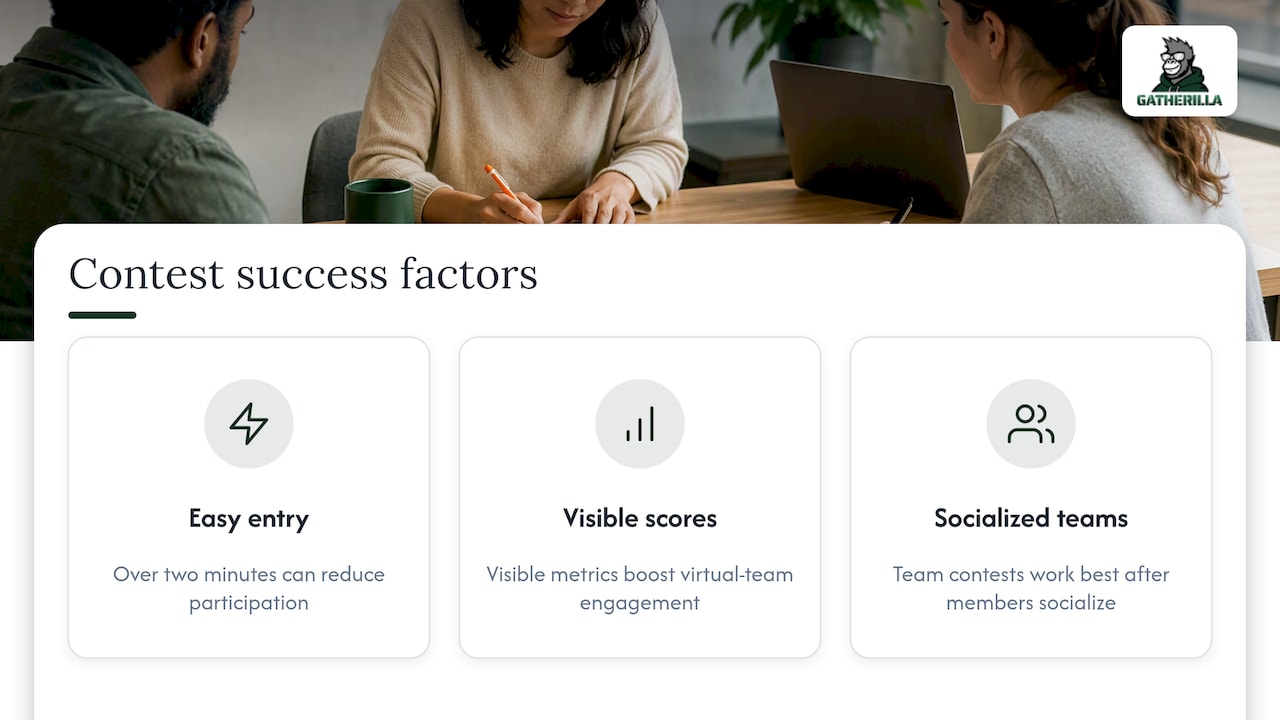
Three things separate the contests people remember from the ones that fizzle.
Low effort to join. If entering takes more than a couple of minutes, participation drops. A widely shared example of a workplace contest that backfired involved employees putting in hours of hard work for tiny prizes. Effort should match the reward, and for most contests the reward is bragging rights.
A scoreboard people can see. An experiment on virtual teams found that explicit elements such as leaderboards boost engagement because the metrics are visible. If nobody can see who is ahead, nobody cares who wins.
Teams, not just individuals. Team formats give people a reason to show up for colleagues. A Management Science study found that team contests can beat individual ones because people hate letting teammates down, but only when team members have had a chance to socialize beforehand. That is why the first idea below is a warm-up, not a contest.
Quick contests: under 30 minutes of effort
These suit teams that want a spark without a project plan. Most run inside a regular meeting.
- Office-versus-office trivia. Ten questions, one per team captain buzz-in, scored live. Mix work trivia (company history, product facts) with general knowledge so tenure does not decide the winner.
- Desk photo challenge. Each office submits a photo on a weekly theme: favorite mug, view from the window, best pet cameo. Vote by emoji reaction. It works for hybrid teams because home setups count too.
- Caption contest. Post one odd stock photo or a screenshot from an old company video. Everyone writes a caption, and each office’s top-voted caption earns a point.
- Two-minute scavenger hunt. Call out an item (something blue, a book with a one-word title, a company-branded object) and the first office with five people holding it up on camera wins the round.
- Team name contest. Before any bigger event, let each office or department vote on its own team name. It costs nothing and creates identity fast.
- Word puzzle of the day. A daily word challenge with offices ranked by total solves. This is the format we built around at Gatherilla, because a five-minute habit survives busy weeks.
Mid-size contests: one to two weeks
These need an owner and a scoreboard, but not a budget.
- Bracket tournament. Offices or departments face off in a March-style bracket across any topic: best lunch spot, best movie, best product feature. One matchup per day keeps momentum.
- Values showdown. Teams earn points when colleagues nominate them for acting on a company value. It rewards behavior you want more of rather than raw output.
- Step or movement challenge. Offices log steps or walks. Make it opt-in and offer an alternative activity so people with different abilities can join.
- Recipe or potluck cook-off. Each office shares a signature dish or a local snack. For distributed offices, ship nothing: share recipes and photos, and vote.
- Innovation sprint. Each office gets one week to propose a small improvement to a process. A gamified internal crowdsourcing contest at a German sportswear company saw submitted ideas rise from 31-38 to 69 per quarter, so a structured idea contest can produce real output, not just fun.
- Customer-story contest. Offices submit short stories of a customer win. Colleagues vote. It connects back-office staff to the customer in a way a memo never does.
- Trivia league. Instead of one trivia night, run a weekly league across six weeks with a season table. Repeat play builds rivalry and keeps people checking the standings.
Bigger events: a month or a quarter
Use these sparingly, once or twice a year, and plan them properly.
- Office Olympics. A series of small events (trivia, puzzle, photo, step count, a speed round) with cumulative points. Variety lets different personalities shine.
- Escape-room style puzzle race. Teams work through linked puzzles in a shared browser session. Cap teams at roughly four people; more than that and a few people do the work while others watch.
- Reality-show format. Short challenges with elimination rounds can break the transactional feel of work. MIT Sloan Management Review reported that these formats worked best with small, manageable teams of around four to limit free-riding.
- Department goal race. If you want a competition tied to business metrics (support response time, error rates, onboarding completion), compare each team against its own baseline rather than against other teams. That keeps a small office from losing to a big one every time.
- Charity challenge. Offices compete to hit a fundraising or volunteering goal. The prize goes to a cause, which shifts the mood from beating colleagues to beating a target together.
- Mentor swap showdown. Pairs from different offices solve a case or puzzle together, then offices are scored on the pair’s combined result. It blends competition with cross-office networking.
- Company-wide game day. A half-hour session where every office joins the same live game. This is the easiest format to run on a video call, because the platform handles scoring and nobody downloads anything.
Rules that keep it friendly
Competition at work can go wrong. Researchers studying gamification have described a “dark side” in which gamified tasks hurt well-being, and found that how much freedom employees feel to take part voluntarily is a key moderator. In practice, that means a few simple rules.
- Make it opt-in, and never tie it to performance reviews. If a manager is checking who played, it is no longer a game.
- Keep prizes symbolic. A trophy emoji, a funny traveling award, a coffee voucher. Large prizes raise the stakes and the resentment.
- Balance teams. Mix tenure, seniority and roles. Avoid pairing a 200-person office against a 12-person one on a raw count.
- Score participation as well as wins. Give each office points for how many people join, not only for how well they score. This rewards the shy office that shows up in force.
- Mix competition and cooperation. The I PLAY AT WORK principles describe effective gamification as a balance of both, and say it transforms work processes rather than just playing games. A shared team goal alongside the rivalry does that.
- End it on schedule. Announce the finish date up front and stop there. A contest that drags on becomes a chore.
How to run an interoffice competition in five steps
- Pick one goal. Do you want people to meet across offices, to practice a skill, or to surface ideas? The goal decides the format. A trivia league builds familiarity; an innovation sprint produces proposals.
- Set the teams and the calendar. Four to eight teams is plenty. Pick a start and end date, and put the schedule in a shared channel.
- Let teams socialize first. Give each team ten minutes to pick a name and say hello before the first round. Per the team-contest research above, this pre-contest bonding is where the advantage of team play comes from.
- Publish rules and the scoreboard on day one. One page, plain words: how points work, how ties break, who decides disputes.
- Close with a recap. Share final results, a few highlights, and the next date. People remember how it ended.
Adapting for remote and hybrid offices
A contest designed for a shared breakroom will leave remote staff watching from the side. Adapt it from the start.
- Choose activities that work on a screen. Trivia, word puzzles, photo challenges and drawing games work for any location. Scavenger hunts that need a physical office do not.
- Account for time zones. Run asynchronous daily challenges that people can finish any time in a 24-hour window, and reserve one live session for the finale.
- Avoid tool sprawl. Asking people to create accounts and install software loses a share of them before the first round. Browser-based games that work in any video conferencing tool remove that friction.
- Structure the social part. Wharton’s guidance on virtual teams notes that deeper connection needs structured self-disclosure, with sessions of at least 15 minutes and questions that become progressively more personal. A competition opener can borrow this: one light personal question per team before round one.
For more formats in this vein, see our guides to remote team challenge ideas and friendly competition ideas at work.
Our perspective: make it a habit, not a one-off event
We build Gatherilla for HR managers and team leaders, and the pattern we see most often is the same: a company runs one big competition, people enjoy it, and then nothing happens for six months. The energy was real, but there was no routine to carry it.
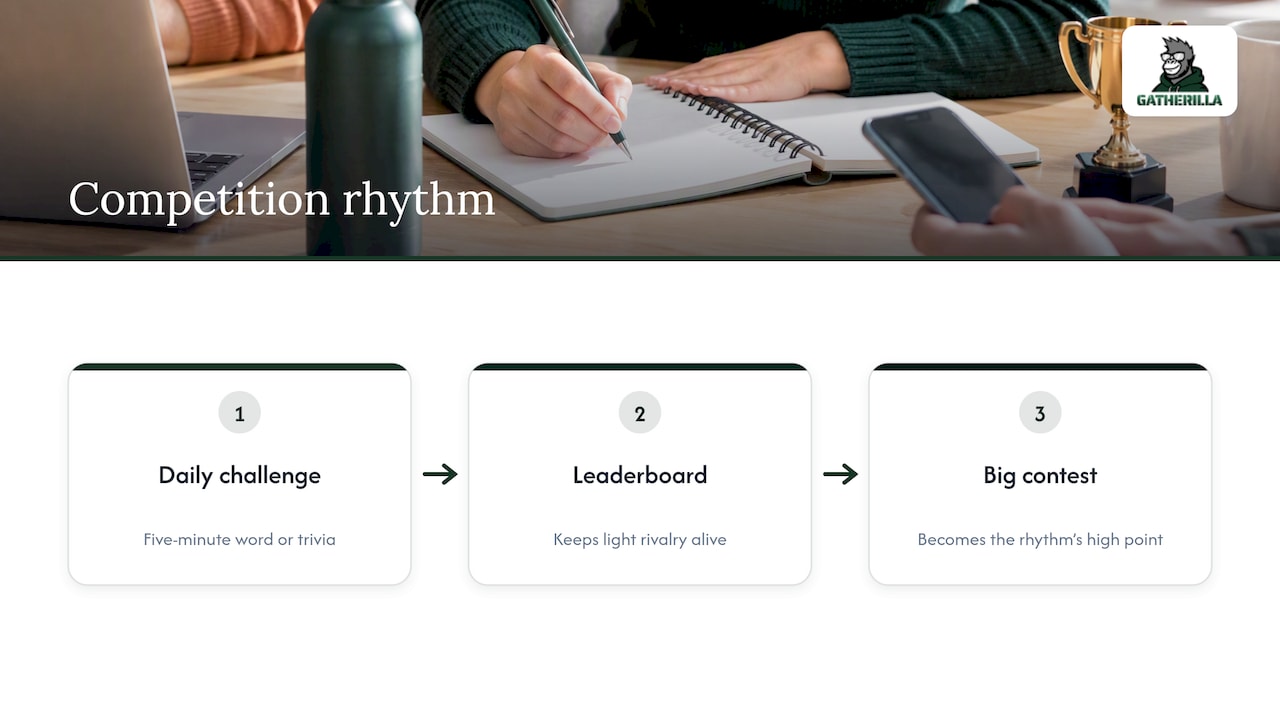
Our view is that engagement works better as a small daily habit than as an occasional event. A five-minute word or trivia challenge that people can open in a browser, with no download and no account to set up, costs almost nothing to join. A leaderboard that shows how each team is doing keeps a light rivalry alive between the bigger moments. The big contest, whether an office Olympics or a company game day, then becomes the high point of a rhythm that already exists, not an effort to start from zero.
We also think the voluntary part matters more than most organizers admit. People should be able to skip a round without anyone noticing. If you want a deeper look at the thinking behind this, our gamification playbook for remote teams covers how we approach it.
— Thomas
Running it without the logistics: where Gatherilla fits
If you would rather not build scoreboards in a spreadsheet, Gatherilla runs the games for you. It is a browser-based platform with customizable multiplayer games, daily word and trivia challenges, icebreakers, and real-time leaderboards. It works with any video conferencing tool, and nobody has to download anything.
There is a free tier to try a few games with your team. The Premium plan adds more games, reporting and priority support, and costs $0.50 to $1.00 per seat per month, or $5 to $10 per seat per year, as listed on the pricing page. Offices can start with the free games for a first trivia round and upgrade once the habit has stuck.
Choosing a contest: a quick comparison
| Situation | Good fit | Effort | Time |
|---|---|---|---|
| First contest, mixed offices | Trivia round or desk photo challenge | Low | 20-30 minutes |
| Want an ongoing habit | Daily word puzzle with office ranking | Low | 5 minutes a day |
| Want business ideas | Innovation sprint | Medium | 1 week |
| Want cross-office relationships | Mentor swap or trivia league | Medium | 2-6 weeks |
| Annual celebration | Office Olympics or company game day | High | 1 day to 1 month |
If your contest is meant to welcome new hires, our piece on onboarding games HR can copy shows how to adapt these formats. Research on a virtual water cooler experiment with newcomers also suggests that unstructured peer-only groups often fail to lift productivity, so give new hires a structure and a senior colleague, not just a chat room.
FAQ
What are some good interoffice competition ideas for a small budget?
Trivia rounds, desk photo contests, caption contests, bracket tournaments and a daily word puzzle cost nothing beyond a few minutes of organizing. Use a symbolic prize, such as a traveling trophy or the right to pick the next team lunch. Spend your effort on the scoreboard and the announcements, not on prizes.
How do you run a competition between offices in different time zones?
Use asynchronous challenges that stay open for 24 hours, so every office can play at a convenient time. Keep one live session for the finale, and rotate its time so the same office is not always joining late. A shared leaderboard keeps results visible between sessions.
How long should an office competition last?
For most teams, one to two weeks is the sweet spot. Quick formats like trivia take under 30 minutes, while a season-style league can run six weeks if it has a weekly rhythm. Announce the end date at the start and close on time.
Should interoffice competitions have prizes?
Small ones are fine, but they are not the main draw. Visible standings and recognition do most of the work. Avoid large prizes, since they raise the stakes and can sour relationships, and never make participation mandatory.
Do team contests work better than individual ones?
Often, yes, but with a condition. Research in Management Science found team contests can outperform individual ones when people don’t want to let teammates down, provided the team members had a chance to socialize first. Let teams chat or pick a name before the first round.
Sources
- Should Managers Use Team-Based Contests? Management Science
- Uncovering the dark side of gamification at work
- Enhancing Virtual Teamwork through Competitive Gamification, CBS Research Portal
- How to Design an Engaging Online Crowdsourcing Contest in Organizations
- Bringing Fun and Creativity to Work, MIT Sloan Management Review
- I PLAY AT WORK: ten principles for transforming work processes through gamification
- Create Authentic Connections with Virtual Team Members, Wharton Executive Education
- Virtual Water Coolers: A Field Experiment on Organizational Newcomer Performance, Harvard Business School