

3–5 Minute Daily Riddle Warm Up for Teams (40 Ready to Run Puzzles)

Run a 3 to 5 minute facilitator-led riddle at the start of a meeting, using a simple prompt, solve, reveal, and debrief flow. You get sharper focus, looser creativity, and a small daily hit of team connection for almost no setup cost. The structure matters more than the puzzle: post the riddle, give the group two to three minutes to work it out together, reveal the answer, then spend 30 to 60 seconds asking what approach got them there.
TL;DR:
- Group solving speeds up problem-solving and improves team collaboration skills through lateral thinking under time constraints.
- Riddles should be carefully selected based on difficulty, cultural neutrality, and relevance to avoid frustration or alienation.
- Using a daily riddle within a tightly scheduled five-minute window maximizes engagement without disrupting meeting flow.
- Tracking participation, contribution frequency, and response time helps measure if the riddles strengthen team dynamics over time.
- Scalable digital platforms can facilitate remote and hybrid team participation, providing real-time analytics and reducing manual tracking efforts.
Table of Contents
- What Is a Daily Riddle for Work, and Why Does It Work?
- How Do You Run a Daily Riddle in Under Five Minutes?
- Which Riddle Type Fits Your Meeting Goal?
- 40 Ready-to-Run Riddles You Can Copy Into Tomorrow’s Meeting
- Facilitator Tips: Keeping It Tight and Inclusive
- Running Daily Riddles With Remote and Hybrid Teams
- How Do You Know if Daily Riddles Are Actually Working?
- What Happens When the Team Pushes Back?
- Author Perspective: How Gatherilla Runs Daily Riddles and What We Learned
- Turn Your Daily Riddle Into a Full Engagement System With Gatherilla
- Sources
What Is a Daily Riddle for Work, and Why Does It Work?
A daily riddle for work is a short brain teaser a team leader or HR professional shares at the start of a meeting, in a Slack channel, or as part of a morning ritual, solved by the group in under five minutes. It’s not a trivia quiz and it’s not a personality icebreaker question. It’s a puzzle with a definite answer, which is exactly what makes it useful: there’s a clear finish line, so the exercise never drags.
The mechanism behind it is simple. Riddles force lateral thinking under a light time constraint, and groups solving them together tend to reach the answer faster than individuals working alone, because different people test different angles in parallel. That collective problem-solving is a rehearsal, in miniature, for how the same team should behave in a real planning meeting or a stuck project.
The habit part matters just as much as the puzzle part. Riddle-of-the-day formats sustain engagement because they combine novelty with routine: a new answer every day, inside a predictable slot everyone already expects. Bolt it onto a ritual that already exists, like a standup or a Monday digest, instead of scheduling it as a separate meeting nobody wants on their calendar.
How Do You Run a Daily Riddle in Under Five Minutes?
Here’s the template we recommend, built around a hard 5 minute ceiling so it never turns into a 20 minute tangent:
- 0:00 to 0:20, intro. The facilitator reads the riddle aloud or drops it in chat, states the category (logic, wordplay, lateral thinking), and sets the clock.
- 0:20 to 2:30, group solve. The team talks it through out loud or in a shared thread. No one solves silently and announces the answer; the point is watching the group reason together.
- 2:30 to 3:00, reveal. The facilitator gives the answer, whether or not the group got there.
- 3:00 to 4:00, debrief. One quick question: “What clue actually cracked it?” This is where the real value shows up, because it surfaces how different people think.
Before you run it, a short facilitator checklist keeps the format from falling apart after week two:
- Pick tomorrow’s riddle the night before, not five minutes into the meeting.
- Set a visible timer so the group polices its own pace.
- Decide the reveal method in advance: spoken, typed in chat, or unveiled on screen.
- Log which riddles land and which fall flat, so the rotation improves over time.
A weekly rotation prevents the exercise from going stale. Try logic puzzles on Monday, wordplay on Tuesday, a collaborative multi-step riddle on Wednesday, something funny on Thursday, and a harder challenge on Friday when energy is lower but attention spans can stretch further.
Pro Tip: Keep a shared doc of riddles you’ve already used with a checkmark next to each one. Nothing kills momentum faster than a team leader repeating last month’s riddle and getting a groan instead of a guess.
Which Riddle Type Fits Your Meeting Goal?
Not every riddle belongs in every meeting. A logic puzzle that takes ten minutes to untangle has no place in a five-minute standup, and a groan-worthy pun might be exactly wrong for a tense retrospective. Matching riddle difficulty to the group’s mood and goal matters: puzzles that are too hard frustrate people, and puzzles that are too easy get solved in silence and add nothing.
Here’s how the five main categories break down:
- Easy or short riddles: solvable in under a minute, work for a whole group at once, best for standups where you need a quick spark without eating the agenda.
- Logic riddles: require sequential reasoning, run 3 to 5 minutes, best in breakout pairs during ideation sessions where you want people already thinking in steps.
- Collaborative riddles: need multiple people contributing different clues to solve, run 5 to 7 minutes, best for retrospectives where the goal is surfacing varied perspectives.
- Funny or wordplay riddles: pun-based or absurd, solvable in under two minutes, best for Friday all-hands or after a heavy news week when the room needs to loosen up.
- Hard riddles: multi-step, sometimes require a diagram or written-out steps, run 7 to 15 minutes, best reserved for dedicated team-building sessions, never squeezed into a standup.
Naboo’s playbook backs a three-tier system along these same lines, pairing each difficulty level with a suggested group size, and that structure is worth stealing wholesale rather than reinventing.
One statistic worth building your rotation around: curated workplace riddle collections consistently pair every entry with a time limit, because an open-ended riddle without a clock is how a 4-minute warm-up quietly becomes a 25-minute derail.
Before you add any riddle to your rotation, run it through a short screening checklist:
- Does it rely on cultural references, idioms, or wordplay that only lands for native English speakers?
- Does it assume knowledge tied to a specific religion, region, or holiday?
- Could the “trick” be read as mocking a disability, accent, or stereotype?
- Is the humor punching at a group rather than at the puzzle itself?
Workplace riddle roundups consistently flag this as a real failure point: riddles that lean on culturally specific knowledge or stereotypes tend to alienate exactly the people a daily riddle is supposed to include. When in doubt, swap it out. There’s no shortage of neutral logic puzzles.
40 Ready-to-Run Riddles You Can Copy Into Tomorrow’s Meeting
Each riddle below is labeled by category, difficulty, suggested time, and best format. Answers are noted after a short pause so the group gets a real shot at solving them first.
Easy / short (solo or whole group, under 2 minutes)
- What has to be broken before you can use it? (An egg.)
- I’m tall when I’m young and short when I’m old. What am I? (A candle.)
- What has hands but cannot clap? (A clock.)
- The more you take, the more you leave behind. What am I? (Footsteps.)
- What month of the year has 28 days? (All of them.)
- What has a neck but no head? (A bottle.)
- What gets wetter the more it dries? (A towel.)
- What has one eye but cannot see? (A needle.)
Logic (breakout pairs, 3 to 5 minutes)
- A man is looking at a photo and says, “I have no brothers or sisters, but that man’s father is my father’s son.” Who is in the photo? (His own son.)
- You have two ropes; each takes exactly 60 minutes to burn, but they burn unevenly. How do you measure 45 minutes? (Light one rope at both ends and the other at one end. When the first burns out, 30 minutes have passed. Light the second rope’s other end then. It finishes in 15 more.)
- Three switches outside a room control one bulb inside. You get one trip into the room. How do you determine which switch controls the bulb? (Turn on two switches. Wait, then turn one off. Enter: the bulb that’s on matches the switch left on, warm and off matches the second, cold and off matches the third.)
- A farmer needs to cross a river with a wolf, a goat, and a cabbage, but the boat only holds him and one item. What’s the order? (Take the goat first, return alone, take the wolf, bring the goat back, take the cabbage, return alone, take the goat.)
- What comes next in the sequence: 1, 1, 2, 3, 5, 8? (13, following Fibonacci.)
- Two coins add up to 30 cents but one isn’t a nickel. What are they? (A quarter and a nickel; the quarter isn’t a nickel.)
Collaborative (small groups, 5 to 7 minutes)
- Five people know a secret. Each call reveals it to one more person. What’s the minimum number of calls for everyone to know everything everyone knew? (A classic gossip-network problem; groups usually land near 8.)
- A team has four tasks with different durations and only one person free at a time. In what order should they finish to minimize total wait? (Shortest job first.)
- Divide a team of nine into three groups so no two people from the same original department are in the same group. (Requires mapping department sizes before assigning.)
- You’re stranded with three items: a rope, a flashlight, a map. Which do you use first, and why? (No single right answer, built to surface reasoning styles.)
Funny / wordplay (whole group, under 2 minutes)
- Why don’t scientists trust atoms? (Because they make up everything.)
- What do you call a bear with no teeth? (A gummy bear.)
- Why did the scarecrow get promoted? (He was outstanding in his field.)
- What do you call a fish with no eyes? (A fsh.)
- Why don’t skeletons fight each other? (They don’t have the guts.)
- What did the coffee report to HR? (It got mugged.)
- Why did the email break up with the inbox? (It found someone else to reply to.)
- What’s a computer’s favorite snack? (Microchips.)
Hard (dedicated sessions, 7 to 15 minutes)
- A snail climbs 3 feet up a well each day and slides back 2 feet each night. The well is 30 feet deep. How many days until it escapes? (28 days.)
- You have 12 identical-looking balls, one is a different weight, and a balance scale with three uses. How do you find the odd one? (Requires splitting into groups of four, three, and testing.)
- A jailer has 100 prisoners and 100 boxes with numbered slips. Each prisoner may open 50 boxes to find their own number. What strategy maximizes survival odds? (Follow the loop from the box matching your own number.)
- Two guards, one always lies, one always tells the truth. You may ask one question to find the safe door. What do you ask? (Ask either guard what the other would say, then choose the opposite.)
- A king has 1,000 bottles of wine, one poisoned, and 10 prisoners to test it with a slow-acting poison. How many prisoners does he need to identify the bottle? (All 10, using binary encoding of bottle numbers.)
The remaining nine slots in your rotation are easy to fill with variations on these patterns: swap numbers in the logic puzzles, swap the punchline in the wordplay set, and rotate collaborative riddles based on whatever cross-department mix your team currently has.
Facilitator Tips: Keeping It Tight and Inclusive
Time-boxing only works if the facilitator actually enforces it. Set a visible countdown, and when it hits zero, reveal the answer regardless of whether the group solved it. The one exception: if the whole group is audibly close, a single 60-second extension is fine. Making a habit of extending, though, trains people to expect a longer runtime every time.
- Call on quieter voices by name after the loud guesses run out: “What’s the read from the folks who haven’t spoken yet?”
- Rotate who leads the riddle each week so it’s not always the same manager’s job.
- Skip riddles with more than two steps for a group newer to the format; save multi-step puzzles for teams already comfortable with the exercise.
- Never use a riddle tied to a sensitive current event, even one that seems lighthearted on the surface.
The most common mistake is overcomplicating the pick. A team leader spends fifteen minutes searching for the “perfect” riddle and ends up running five minutes late before the actual work starts. Grab something from your rotation list, run it, move on.
Pro Tip: If a riddle stumps the whole group and the clock runs out, don’t just give the answer and move on. Ask “what would you try next if we had two more minutes?” It captures the thinking without blowing your time budget.
Running Daily Riddles With Remote and Hybrid Teams
Distributed teams need a slightly different mechanic than an in-person huddle, since you can’t rely on everyone being in the room at 9am sharp.
- Async Slack format: post the riddle first thing in the morning in a dedicated channel, let people react with guesses in thread, and reveal the answer at a fixed time like 3pm so nobody feels rushed across time zones.
- Synchronous video standup: read the riddle aloud, use chat for guesses so quieter team members can type instead of speak, and reveal on screen.
- Poll-based reveal: for multiple-choice-style riddles, a quick poll (thumbs, emoji reactions, or a built-in meeting poll) surfaces the group’s confidence before you give the answer.
- Async posting paired with a scheduled afternoon reveal keeps a distributed team engaged across time zones without forcing everyone into the same synchronous slot.
For teams already juggling video calls, tucking a riddle into the first five minutes of a scheduled meeting is easier than adding one more calendar invite. Guidance on running efficient virtual meetings applies directly here: anything you bolt onto an existing meeting survives longer than anything you schedule separately.
A no-download platform is worth adopting once you’re running riddles daily across more than one team, since manually posting, tracking answers, and building leaderboards in a spreadsheet gets tedious fast at that scale.

How Do You Know if Daily Riddles Are Actually Working?
Engagement is easy to fake and hard to measure honestly. A raucous first week means nothing if participation quietly drops to three people by week four. Track a few concrete signals instead of going on gut feel.
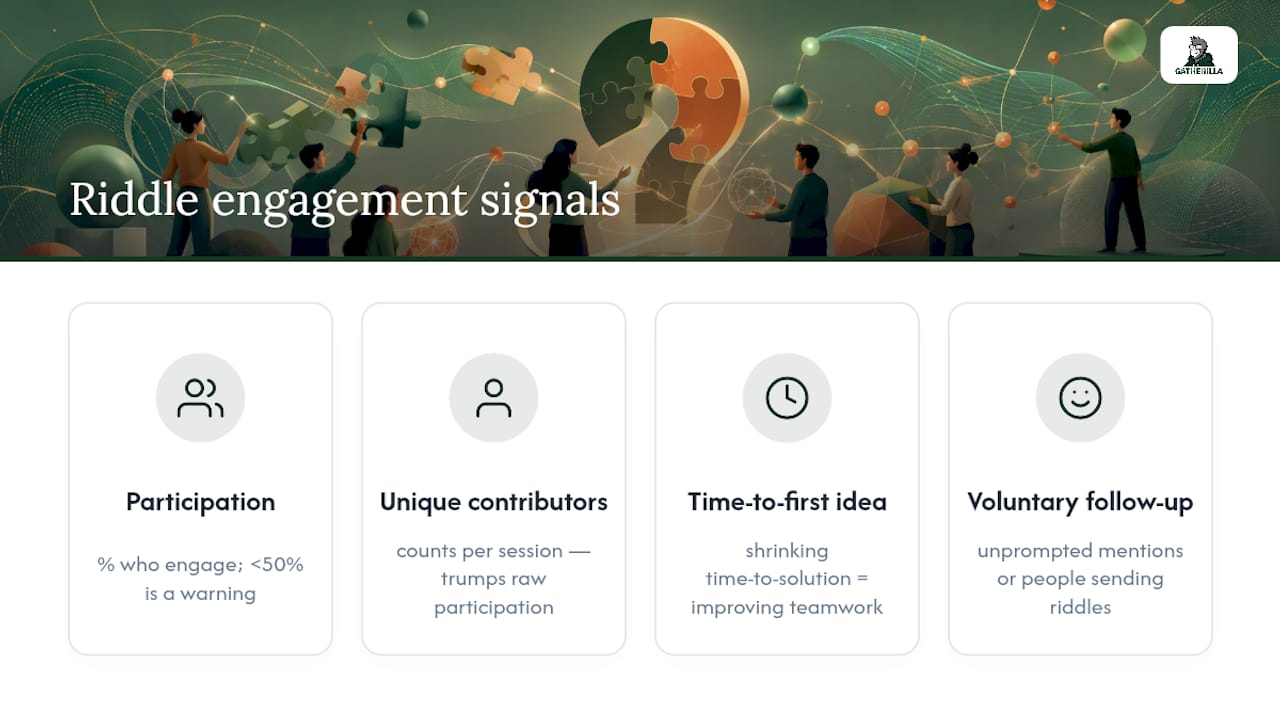
Participation rate is the simplest: what percentage of the team actually engages, whether that’s typing a guess, reacting, or joining the group solve, versus staying silent. A drop below half your team is the first real warning sign.
Number of unique contributors per session matters more than raw participation. Five people guessing every day while ten stay quiet tells you the format has become a spectator sport for most of the room, not a team exercise.
Time to first correct idea is a subtler signal borrowed from how MindTools frames group problem-solving exercises: a shrinking time-to-solution over several weeks suggests the team is actually getting better at collaborating, not just getting lucky.
Voluntary follow-up is the strongest signal of all. If people start bringing up yesterday’s riddle unprompted, or sending you a new one to use, the habit has taken root past the point of feeling like an obligation.
Run a two-week baseline before changing anything. Note which riddle categories produce the most contributors and the fastest time-to-solution, then adjust your weekly rotation to lean into what’s actually working for your specific team, rather than what worked for someone else’s.
What Happens When the Team Pushes Back?
Some resistance is close to universal in the first two weeks. The most common objection is time: “We’re already running long, we don’t need another five minutes.” The fix isn’t cutting the riddle, it’s cutting something else on the agenda to make room, and saying so out loud so the team sees the trade-off was deliberate.
A second objection comes from people who feel put on the spot, especially in a synchronous format where guessing out loud feels risky. Give them an escape hatch: typed guesses in chat, or an async version they can engage with on their own time, removes the performance pressure entirely.
A third pattern shows up with harder puzzles. If the same two people solve every logic riddle in under thirty seconds, everyone else disengages fast. Rotate difficulty deliberately, and occasionally hand the hardest slot to a smaller breakout group instead of the whole team, so the same voices don’t dominate every session.
The quiet-team problem is different from outright resistance. Sometimes silence just means the format hasn’t earned trust yet. Stick with it for the full two-week baseline before deciding it’s not working. A format this short rarely fails because of the riddle. It fails because it got dropped after one flat Tuesday.
Author Perspective: How Gatherilla Runs Daily Riddles and What We Learned
We treat the daily riddle less like a game and more like a pulse check. If a team solves fast and jokes around during the debrief, that’s a healthier signal than any survey we’ve run. Smaller teams do best with collaborative riddles that force everyone into the conversation; larger teams need the easy and funny categories more often, simply because a ten-person breakout on a hard logic puzzle leaves too many people watching instead of participating.
— Thomas
Turn Your Daily Riddle Into a Full Engagement System With Gatherilla
A spreadsheet of riddles and a Slack reminder get you through the first month. Scaling that across ten teams, three time zones, and a leadership team that wants to see actual engagement numbers is where the DIY version starts to crack. Gatherilla is built for exactly that gap: a browser-based platform with customizable multiplayer games, no downloads, and a daily challenge format that works inside whatever video tool your team already uses.
The features map directly onto everything covered above. Quick setup means you can launch a rotation in minutes instead of building it from scratch. Real-time leaderboards give you the competitive framing MindTools ties to faster group problem-solving without you manually tracking scores. Built-in analytics answer the participation and contributor questions from your measurement plan automatically, instead of you eyeballing a chat thread.
DIY works fine for a single team running a light rotation. Once you’re managing multiple teams or need onboarding-ready content on day one, a platform earns its keep. Visit the Gatherilla team building platform to see the current game library and start a free session with your team today.
Sources
For deeper facilitation guidance, see MindTools’ team problem-solving exercise, and Gatherilla’s virtual team trivia playbook and remote icebreaker games guide.