

Remote Team Challenge Ideas That Actually Work in 2026

Here are the best remote team challenge ideas you can run today, grouped by time and goal:
- Two Truths and a Lie | 10 min | Icebreaker | Best for: new teams
- Virtual Trivia Battle | 20–30 min | Fun + competition | Best for: all groups
- Collaborative Puzzle Sprint | 20 min | Problem-solving | Best for: cross-functional teams
- Photo Prompt Challenge | Async | Creativity | Best for: time-zone-spread teams
- 30-Day Step Streak | Multi-day | Wellness | Best for: large groups
- Escape Room Lite | 30–45 min | Collaboration | Best for: mid-size teams
- Weekly Learning Streak | Async/ongoing | Growth | Best for: all remote teams
- Sketch-It Pictionary | 15 min | Creativity + laughs | Best for: any size
- Micro-Help Exchange | Async | Peer connection | Best for: cross-functional
- All-Hands Trivia Series | 30 min | Engagement | Best for: large groups
- GIF Battle | 5–10 min | Low-stakes fun | Best for: quick meeting openers
- Virtual Scavenger Hunt | 20–30 min | Energy + teamwork | Best for: onboarding
Each entry below includes step-by-step instructions, the tools you need, group-size guidance, and a flag for when to skip it.
Table of Contents
- What actually makes remote challenges work
- How to plan and host a remote challenge without the friction
- Ready-to-run challenge ideas grouped by goal
- How to run async challenges across time zones
- How to measure whether a challenge actually worked
- The research case for making challenges a repeatable system
- Key Takeaways
- Why most remote teams are doing this wrong
- Gatherilla makes running team challenges faster
- Useful sources and further reading
What actually makes remote challenges work
Remote challenges work when they replace spontaneous office moments with intentional, repeatable rituals that build belonging and align people to shared goals. That single design principle separates a challenge people look forward to from one they quietly dread.

Four principles do most of the heavy lifting:
Low-stakes inclusion. Every participant should be able to contribute without performing on camera or disclosing personal details. Forcing personal sharing or putting someone on the spot risks anxiety and shuts down quieter team members before the activity even starts; alternatively, local hybrid and remote setups can benefit from multiple efficient team leadership strategies to keep everyone aligned. Collective-outcome tasks, where the team wins or loses together, remove that pressure entirely.
A clear objective. “Let’s do something fun” is not an objective. “We want new hires to learn three colleagues’ names before Friday” is. When the goal is specific, you can pick the right format, measure whether it worked, and repeat it with confidence.
Predictable cadence. Sociabble recommends building scalable, repeatable rituals rather than isolated events, and testing for six weeks to see measurable lift. A weekly trivia round at the same time every Thursday does more for team cohesion than a quarterly virtual happy hour.
Fast feedback and recognition. Peer-to-peer recognition integrated with team activities creates a cycle of feeling valued and connected. Post results the same day. Name contributors publicly. Small, visible wins compound.
Asynchronous options. Not everyone is in the same time zone. Any challenge that requires simultaneous attendance by default excludes someone. Build an async path into every activity from the start, not as an afterthought.
“Remote team challenges are most effective when they intentionally replace spontaneous office interactions with structured rituals that provide clarity and belonging.” — Coursera for Enterprise
Pro Tip: Never open a challenge with a question that requires personal disclosure (“Share your biggest fear” or “Tell us something embarrassing”). Start with a low-stakes, work-adjacent prompt instead — “What’s your go-to productivity hack?” gets the same warmth with none of the anxiety.
How to plan and host a remote challenge without the friction
The six-step runbook: set your objective → choose a format → run a tech check → send the invite → run the session → close with recognition. That sequence takes most challenges from idea to execution in under two hours of prep.
Facilitator checklist
- Define the goal (icebreaker, collaboration, wellness, fun) and pick a format that matches it.
- Set timing — block 10% extra time for tech issues; a 20-minute activity needs a 22-minute slot.
- Assign roles — one host (runs the activity), one timekeeper (keeps energy up, watches the clock).
- Check accessibility — confirm all tools work on participants’ devices; offer a text-based fallback for anyone with bandwidth issues.
- Send the invite at least 48 hours ahead with a one-line description of what to expect and any prep needed.
- Plan recognition — decide how winners or contributors get acknowledged before the event, not after.
- Prepare a fallback — if the primary tool fails, have a backup (a shared Google Doc or a Slack thread) ready to go.
- Close with a follow-up — post results, tag contributors, and announce the next event within 24 hours.
Low-cost rewards and public recognition lift participation when combined with consistent rituals. You don’t need a budget for prizes; a pinned Slack message naming the winner often does more than a gift card.
Tools quick-reference

| Purpose | Tools |
|---|---|
| Video conferencing | Zoom, Microsoft Teams, Google Meet |
| Collaborative whiteboard | Miro, FigJam, Google Jamboard |
| Trivia and games | Gatherilla, Kahoot, Mentimeter |
| Async submissions | Slack channel, Google Forms, Notion |
| Leaderboards | Gatherilla, Google Sheets, Notion |
| Polls and pulse checks | Slido, Typeform, Google Forms |
Pro Tip: For browser-based team activities that need zero IT approval or downloads, Gatherilla runs entirely in the browser — participants join with a link, no installs required.
Sample scripts
Kickoff: “Welcome, everyone. Today’s challenge is [name]. The goal is [one sentence]. You have [X] minutes. Here’s how it works: [one sentence]. Let’s go.”
Scoring announcement: “Here’s where we stand: [Team/Person A] is leading with [X] points. Two rounds left — anything can happen.”
Closing/recognition: “That’s a wrap. Huge shoutout to [name] for [specific contribution]. Results are going in the channel right now, and our next challenge is [date]. See you then.”
Ready-to-run challenge ideas grouped by goal
These are templates, not suggestions. Each one includes what you need, how to set it up, and when to skip it.
Quick icebreakers (5–15 minutes)
1. Two Truths and a LieGoal: Introductions | Duration: 10 min | Group size: 4–20 | Tools: Video call
- Each person shares two true statements and one false one about themselves.
- The group votes on which is the lie (use Zoom polls or a quick chat vote).
- The person with the most successful “lies” wins.
- Skip it when: your team has privacy concerns about personal disclosure. Alternative: use work-related prompts only (“Two things I’ve shipped, one I haven’t”).
2. GIF BattleGoal: Low-stakes fun | Duration: 5–10 min | Group size: Any | Tools: Slack or Teams
- Post a prompt in the channel (“Describe your Monday morning in a GIF”).
- Everyone replies with a GIF; the most-reacted one wins.
- Runs entirely async or as a live meeting opener.
- Skip it when: your company has strict content policies around GIFs.
3. Sketch-It PictionaryGoal: Creativity + laughs | Duration: 15 min | Group size: 6–30 | Tools: skribbl.io or Miro
- Split into two teams; one person draws, others guess.
- Use a custom word list tied to your industry or current projects for extra relevance.
- Skip it when: team members have motor-skill accessibility concerns. Alternative: switch to a verbal description round instead of drawing.
4. Virtual Scavenger HuntGoal: Energy + teamwork | Duration: 20–30 min | Group size: 8–50 | Tools: Video call + Slack
- Give teams a list of 10–15 items to find around their home or workspace.
- First team to post photos of all items in the Slack channel wins.
- Works well for onboarding: include items that require reading the company handbook.
- Skip it when: team members work from shared or public spaces and can’t share their environment.
Collaboration and problem-solving (15–30 minutes)
5. Collaborative Puzzle SprintGoal: Problem-solving | Duration: 20 min | Group size: 4–16 | Tools: Miro or Google Jamboard
- Drop a visual puzzle or logic challenge onto a shared whiteboard.
- Teams have 15 minutes to solve it together; the facilitator reveals the answer at minute 16.
- No single person can solve it alone — the puzzle should require at least three distinct pieces of information distributed across the team.
- Skip it when: your team is under deadline pressure; save this for lower-stress weeks.
6. Escape Room LiteGoal: Collaboration | Duration: 30–45 min | Group size: 8–30 | Tools: Zoom breakout rooms + shared doc
- Build a simple 5-clue puzzle chain in a Google Doc; each clue unlocks the next.
- Split into teams of 4–6 in breakout rooms; first team to solve all five clues wins.
- You can theme it around a company milestone or product launch for extra relevance.
- Skip it when: you have fewer than 8 people; the breakout-room dynamic loses energy below that threshold.
7. Decision SprintGoal: Cross-functional alignment | Duration: 20 min | Group size: 6–20 | Tools: Miro + video call
- Present a real (low-stakes) business scenario: “We have $500 and 30 days to improve onboarding. What do we do?”
- Teams brainstorm on a shared board for 10 minutes, then pitch their top idea in 90 seconds.
- The group votes; the winning idea gets a shoutout in the all-hands.
- Skip it when: the scenario touches on sensitive organizational topics.
Creative builds (30–60 minutes)
8. Photo Prompt ChallengeGoal: Creativity | Duration: Async, 3–5 days | Group size: Any | Tools: Slack or a shared album
- Post a daily photo prompt (“Your workspace at 3 PM,” “Something that made you smile today”).
- Participants submit photos to a dedicated channel; the team votes on favorites at the end of the week.
- Entirely async, no camera-on requirement, and scales to 200+ people with no extra facilitation.
- Skip it when: team members work in sensitive environments where photos aren’t appropriate.
9. Meme-Making ContestGoal: Humor + culture | Duration: 20–30 min | Group size: Any | Tools: Imgflip or Canva + Slack
- Give everyone 10 minutes to make a meme about a shared team experience (a recent sprint, a product launch, a recurring meeting).
- Post to Slack; most reactions wins.
- Skip it when: your team culture skews more formal; a caption contest is a lower-stakes alternative.
10. Virtual Art DropGoal: Creative expression | Duration: 30–45 min | Group size: 6–30 | Tools: Miro or Google Slides
- Each person gets a blank slide or Miro frame and 20 minutes to create anything: a sketch, a collage, a mood board.
- The group does a silent gallery walk (everyone views without commenting), then each creator gets 60 seconds to explain their piece.
- Making art activates reward circuits in the brain and reduces stress, which makes this one of the better wellness-adjacent activities in the toolkit.
- Skip it when: time is tight; this one needs a full 45 minutes to land well.
Wellness and health streaks (multi-day / ongoing)
11. 30-Day Step StreakGoal: Wellness | Duration: 30 days | Group size: Any | Tools: Google Form + Sheets leaderboard
- Participants log daily steps in a Google Form; a shared Sheet auto-calculates a leaderboard.
- Celebrate weekly milestones in Slack; recognize the top mover and the most-improved.
- Set a team aggregate goal that encourages collective achievement to shift focus from individual competition to collective achievement.
- Skip it when: team members have mobility limitations. Alternative: replace steps with any daily movement (stretching, cycling, yoga) and let participants self-report their activity type.
12. Mindfulness Minute StreakGoal: Stress reduction | Duration: 21 days | Group size: Any | Tools: Slack + Google Form
- Each day, post a 60-second guided breathing or mindfulness prompt in a dedicated Slack channel.
- Participants react with an emoji to confirm they completed it; track streaks on a shared leaderboard.
- Skip it when: participation feels coerced; make this strictly opt-in.
Large-group adaptations (all-hands, 50–200 people)
13. All-Hands Trivia SeriesGoal: Engagement + culture | Duration: 30 min | Group size: 50–200 | Tools: Gatherilla or Kahoot
- Run a competitive trivia game with 15–20 questions across 3–4 rounds.
- Use a mix of company-culture questions (“What year did we ship our first product?”) and general knowledge.
- Real-time leaderboards keep energy high; announce the top three at the end and post results company-wide.
- Skip it when: the event is right after a difficult company announcement; read the room.
14. Company-Wide Photo ContestGoal: Culture + belonging | Duration: 1 week async | Group size: 50–500 | Tools: Slack + Google Forms
- Post a weekly theme (“Your remote office setup,” “Best local coffee shop view”).
- Employees submit photos; a panel of three volunteers picks finalists; the company votes.
- Scales to any size with no live facilitation required.
Ongoing series (weekly / monthly)
15. Weekly Trivia RoundGoal: Recurring engagement | Duration: 15–20 min weekly | Group size: Any | Tools: Gatherilla
- Run the same format every week at the same time; rotate the topic (industry news, pop culture, company history).
- Publish a running leaderboard so participants track their standing over time.
- Consistency is the point: repeatable rituals outperform one-off events for long-term remote team engagement.
16. “Teach Me Something” SeriesGoal: Learning + connection | Duration: 10 min per session | Group size: Any | Tools: Video call or Loom
- One team member teaches a 5–10 minute micro-lesson on anything they know well (a coding shortcut, a recipe, a language phrase).
- Rotate presenters weekly; archive recordings in a shared folder.
- Async-friendly: presenters can record a Loom video instead of going live.
How to run async challenges across time zones
The fastest path to async team building is a three-template system: a learning streak, a photo prompt series, and a micro-help exchange. Each runs without a single synchronous meeting.
Three ready-to-copy async templates
Template 1: Learning Streak
- Cadence: Daily, Monday–Friday
- Format: Post one question or prompt in a dedicated Slack channel each morning (8 AM in the earliest time zone). Participants reply by end of their workday.
- Scoring: 1 point per day completed; bonus point for the most-upvoted response. Post the weekly leaderboard every Friday.
Template 2: Photo Prompt Series
- Cadence: Three prompts per week
- Format: Post a prompt Monday, Wednesday, Friday. Participants submit photos to the channel anytime that day.
- Scoring: Most reactions at end of week wins; no tie-breaking needed.
Template 3: Micro-Help Exchange
- Cadence: Weekly
- Format: Each participant posts one thing they need help with and one thing they can offer (a skill, a review, a connection). Matches happen organically in thread replies.
- Scoring: No points; track participation rate instead. Recognize the most-helpful contributor in the weekly all-hands recap.
Async submission workflow
- Create a dedicated Slack channel (e.g.,
#team-challenge-weekly). - Pin the current challenge prompt and submission deadline at the top.
- Participants post submissions as replies or direct messages to a shared Google Form.
- A designated tracker (rotates weekly) compiles results into a Google Sheet leaderboard by Friday noon UTC.
- The host posts results and recognition in the channel; no live meeting required.
Pro Tip: Set submission deadlines in UTC and list two or three local-time equivalents in the prompt (e.g., “Submit by Friday 5 PM UTC / 1 PM ET / 10 AM PT”). One extra line eliminates the most common async participation drop-off.
Celebrate winners with a pinned Slack post, a shoutout in the company newsletter, or a small digital reward (an extra PTO hour, a gift card). None of these require a live meeting, and all of them land better than a generic “great job” in a thread.
How to measure whether a challenge actually worked
Start measuring the moment the challenge ends. The four metrics that matter most: participation rate, qualitative sentiment, repeat participation, and peer recognition count.
Metrics to track
- Participation rate: Number of participants divided by total invitees. Anything above 70% for a voluntary activity is strong.
- Qualitative sentiment: A two-question pulse survey immediately after (“Did you enjoy this? Would you do it again?”). Keep it to emoji reactions or a 1–5 scale so it takes 10 seconds to complete.
- Repeat participation: Track whether the same people show up week over week. Declining repeat participation is the earliest signal that a format has gone stale.
- Peer recognition count: How many times did participants publicly acknowledge a colleague during or after the challenge? This is the metric most leaders skip, and it’s often the most predictive of long-term team engagement.
Follow-up checklist
- Post results and a leaderboard within 24 hours.
- Send a two-question pulse survey (use Google Forms or Typeform).
- Recognize top contributors publicly in Slack or Teams.
- Distribute any small rewards within 48 hours.
- Schedule the next challenge before the current one’s energy fades.
- Review participation data and adjust format or timing if rate drops below 50%.
Coursera recommends prioritizing clear communication, community-building, and regular measurement for remote employee engagement. The follow-up step is where most teams drop the ball. Running a great challenge and then going silent for two weeks erases most of the goodwill it built.
Privacy note: If your wellness challenges collect health data (steps, sleep, heart rate), be explicit about what is tracked, who sees it, and how long it’s stored. Make participation genuinely optional. Health metrics are personal, and employees who feel surveilled disengage faster than those who feel trusted.
The research case for making challenges a repeatable system
The evidence is consistent: repeatable, digital-first engagement outperforms one-off synchronous perks for remote teams. Here’s what the research and practitioner data show.
- Management actions explain a large share of variance in team engagement. Transparent communication and autonomy, not perks, drive the biggest shifts.
- Structured activities that create genuine human moments — shared laughter, collaborative problem-solving — improve trust and downstream decision-making speed.
- Sociabble’s practitioner guidance recommends testing a new ritual for six weeks before evaluating it. Most teams abandon activities after two rounds, which is exactly when the habit would have started forming.
- Peer-to-peer recognition tied to challenge outcomes sustains motivation better than top-down rewards alone.
- Async and multi-day challenges scale across time zones without forcing anyone to attend a live session, which removes the single biggest barrier to global team participation.
“Design engagement as a repeatable system. Avoid forcing long synchronous events that ignore time zones and work-life balance.” — Sociabble
The practical translation: pick one challenge format, run it for six consecutive weeks, measure participation, and adjust. Don’t rotate formats every week chasing novelty. Familiarity with a format is what lets people focus on connection instead of figuring out the rules.
Teams that want a ready-built system for this, without building leaderboards and submission workflows from scratch, can explore remote team culture strategies that cover the full ritual-building playbook.
Key Takeaways
The most effective remote team challenges are short, repeatable, and built around collective outcomes rather than individual performance.
| Point | Details |
|---|---|
| Match format to goal | Icebreakers need 5–15 minutes; collaboration challenges need 15–30; wellness streaks run multi-day. |
| Cadence beats novelty | Running the same format weekly for six weeks builds more cohesion than six different one-off events. |
| Async by default | Build a time-zone-safe submission path into every challenge so no one is excluded by geography. |
| Measure participation rate | Track who shows up, who repeats, and how many peer recognitions happen — those three numbers tell you if it’s working. |
| Gatherilla as turnkey option | Gatherilla’s browser-based platform offers ready-made trivia, daily challenges, and leaderboards with no downloads required. |
Why most remote teams are doing this wrong
The conventional wisdom says remote team building is about making people feel included. That’s true, but it misses the mechanism. Inclusion is the outcome; the mechanism is predictability. When people know a challenge is coming at the same time every week, they mentally prepare for it. They look forward to it. They tell a colleague about it. That anticipation is what converts a one-off activity into a cultural ritual.
The other thing most guides underestimate: the cost of a bad activity is higher than the cost of no activity. A forced icebreaker that makes someone uncomfortable doesn’t just fail. It actively damages psychological safety and makes the next attempt harder. The activities to avoid are as important as the ones to run. Start with the lowest-stakes format your team will actually complete, run it consistently, and raise the bar gradually as trust builds.
Gatherilla makes running team challenges faster
If building leaderboards, managing submissions, and sourcing new challenge formats every week sounds like a second job, that’s because it is. Gatherilla is a browser-based team-building platform built specifically to remove that overhead for HR managers and team leaders.
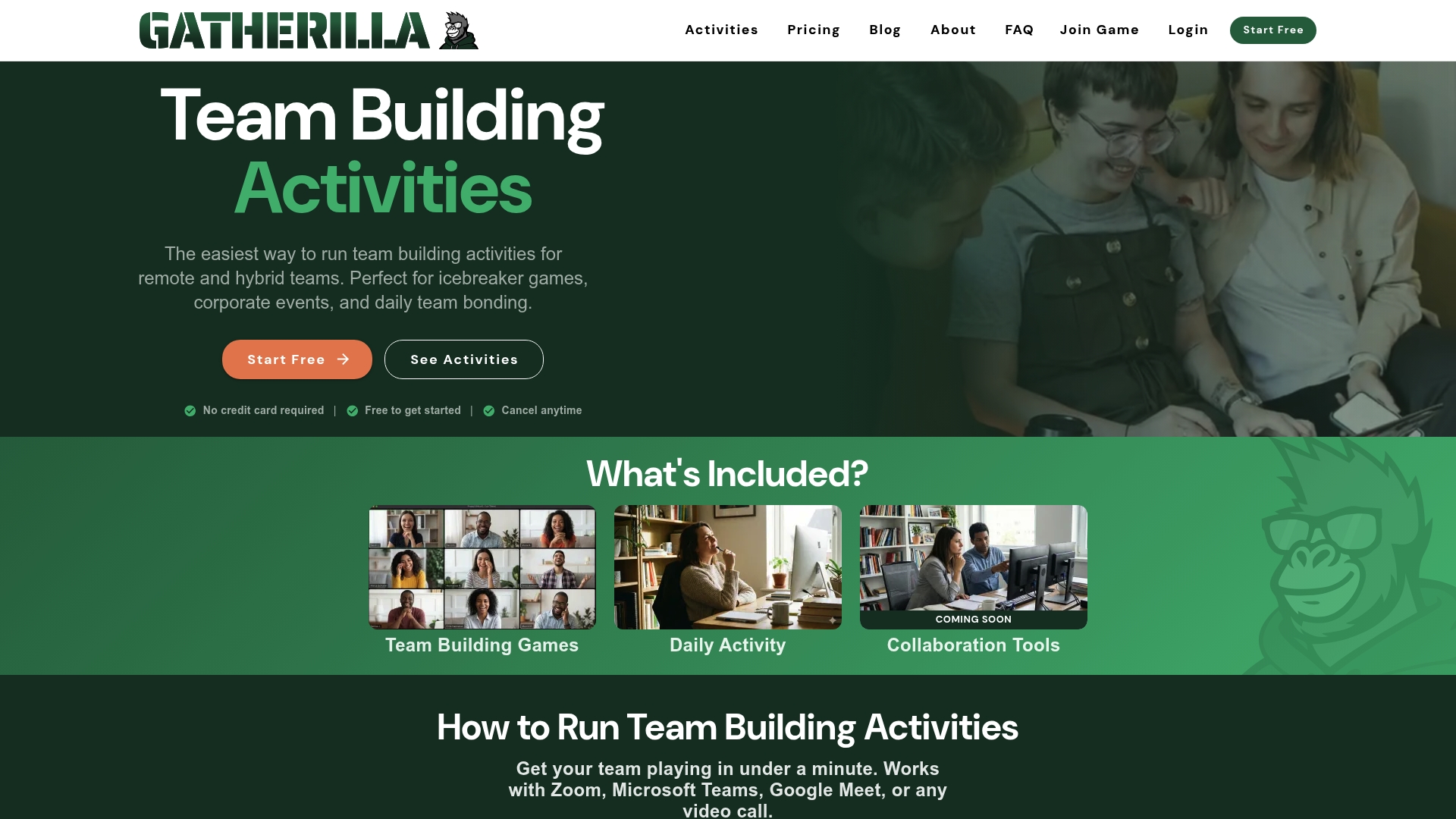
No downloads, no IT tickets, no setup calls. Participants join with a link, and the platform handles scoring, leaderboards, and game flow automatically. Gatherilla’s catalog covers daily micro-challenges for recurring engagement, onboarding games that help new hires learn the team before their first all-hands, and company-wide events that scale to large groups without extra facilitation work. The subscription model includes a free tier to start and a per-seat premium plan that unlocks additional games, analytics, and priority support.
HR teams and people managers who want a managed, ready-to-run solution can browse all team-building activities or go straight to the Gatherilla platform to start with a free game today.
Useful sources and further reading
- What Is Remote Employee Management? | Coursera for Enterprise — Covers the core pillars of remote engagement: clear expectations, the right tools, recognition, and measurement. Useful for building a measurement framework.
- 10 Employee Engagement Ideas for Remote Workers | Sociabble — Practitioner-level advice on building repeatable rituals and async-friendly challenge formats. Includes a six-week testing recommendation.
- Creating a Remote Work Culture That Keeps Employees Engaged | Forbes — Focuses on peer-to-peer recognition as a driver of sustained motivation in distributed teams.
- How to Organize a 30-Minute Team Building Challenge | Offsiteio — Practical 30-minute planning timeline with sample logistics, activity ideas, and budget guidance.
- 10 Virtual Team-Building Activities Your Remote Team Will Actually Enjoy | Gather.town — Groups activities by time and energy level; useful for matching format to team mood and meeting context.
- Remote Team Engagement: How to Build Connection | eBillity — Explains the managerial levers (autonomy, transparency, trust) that drive engagement independent of activity choice.
- Feeling Artsy? Here’s How Making Art Helps Your Brain | NPR — Research-backed context on why creative activities reduce stress and activate reward circuits; supports the Virtual Art Drop entry.
- The Complete Guide to Remote Team Building | Gatherilla Blog — A deeper planning playbook with platform recommendations and a full activity timeline for teams that want more than a single challenge format.
- Async Team Building Across Time Zones | Gatherilla Blog — Practical strategies for designing challenges that work for globally distributed teams without requiring live attendance.