

See Results in 6–12 Weeks: SDT Based Onboarding Games HR Can Copy

Employee onboarding gamification works when it’s built on behavioral theory, not just badges and leaderboards slapped onto a training module. Done right, it can lift engagement, speed up time-to-productivity, and cut early turnover. Start small: pick one mission-style challenge, track one metric like week-four retention, and pilot it with a single cohort before rolling it out company-wide. The examples and checklist below show exactly how.
TL;DR:
- Employee gamification in onboarding can increase engagement by 48% and reduce early turnover by 36%, according to industry benchmarks.
- To succeed, designs should focus on psychological needs like autonomy, competence, and relatedness, rather than simply adding rewards or badges.
- Starting with a small pilot involving 20 to 30 hires, using simple mechanics like checklists and recognition walls, helps measure impact before scaling company-wide.
- Incorporating social tasks, such as buddy challenges and team recognition, improves relatedness, especially for remote employees or those less familiar with gaming.
- Ongoing feedback and metrics, including onboarding completion, time to contribution, and 90-day retention, are essential to refine and justify gamification efforts.
Table of Contents
- What Employee Onboarding Gamification Actually Means
- Why Bother: The Evidence Behind Onboarding Gamification
- Design It Around Self-Determination Theory, Not Just Fun
- Onboarding Games and Mechanics You Can Copy This Week
- Building a Low-Risk Pilot: Your Implementation Checklist
- Measuring Impact: What ROI Actually Looks Like
- Common Pitfalls That Sink a Gamification Pilot
- Ready-to-Use Templates from Real Onboarding Programs
- How Different Employee Groups Actually Respond to Onboarding Games
- Data Privacy and Fairness in Gamified Onboarding
- Scaling Gamification Across Company Sizes and Cultures
- Keep Iterating: Feedback Loops That Actually Improve the Program
- What to Expect in Six to Twelve Weeks
- Try Gatherilla for Your Next Onboarding Cohort
- Sources
- FAQ
What Employee Onboarding Gamification Actually Means
Employee onboarding gamification means applying game mechanics, points, missions, progress tracking, social recognition, to the process of getting a new hire ready to do their job well. It’s distinct from customer onboarding gamification, which nudges users toward product adoption and usually optimizes for activation metrics and upsell paths. Employee onboarding has different stakes: legal compliance, internal culture, and long-term retention.
The mechanics show up across four stages of the employee journey:
- Preboarding (offer to day one): progress bars showing paperwork completion; welcome missions that introduce team members before the start date.
- Day one: checklist-style quests for badge access, desk setup, and system logins, often gamified with a simple point count.
- Week one: quizzes on policy and product knowledge, scavenger hunts that map the physical or virtual workplace.
- Month one: skill-based badges, peer recognition walls, and leveling systems tied to actual competency milestones.
The differences from customer-facing gamification matter for HR specifically. Employee data sits inside HR information systems and is subject to workplace privacy law, not just a consumer terms-of-service agreement. Compliance tasks like safety training or code-of-conduct sign-off can’t be skipped just because someone’s disengaged with the game layer, so gamification has to support required steps, never gate them behind optional play. And the goal isn’t conversion. It’s building role clarity and connection fast enough that a new hire doesn’t quit in week three.
Why Bother: The Evidence Behind Onboarding Gamification
Organizations that use structured gamification in onboarding report a 48% increase in engagement and a 36% improvement in turnover compared to traditional onboarding methods. Those numbers come from industry benchmarking, and they line up with what academic research has found in smaller, more controlled settings.
Benchmark to remember: Structured onboarding gamification correlates with a 48% jump in engagement and a 36% drop in early turnover versus conventional onboarding, according to industry data. That’s the number to put in front of your CFO before you ask for pilot budget.
Beyond the headline figures, the benefits show up in ways that are easier to observe day to day:
- Faster time-to-productivity, because chunked missions with immediate feedback help new hires build competence in smaller, testable steps.
- Better socialization, since scavenger hunts and buddy challenges force interaction that would otherwise take weeks to happen organically, especially on remote teams.
- Higher completion rates on mandatory training, when compliance modules are wrapped in a quest structure instead of a static slide deck.
A quasi-experimental case study on a solution called OnboardTogether found improved social interaction, job understanding, and motivation when gamification was grounded in psychological theory rather than bolted on as a feature. That’s the caveat that matters most here: these gains aren’t automatic. A separate study on video-game elements in onboarding found that outcomes depend heavily on program design and employee background. The same mechanics can land differently across teams, so treat any benchmark as a directional signal, not a guarantee.
Design It Around Self-Determination Theory, Not Just Fun
Self-Determination Theory, developed by psychologists Edward Deci and Richard Ryan, holds that people are intrinsically motivated when three psychological needs are met: autonomy (control over how you work), competence (feeling capable and improving), and relatedness (feeling connected to others). Gamification that ignores these three needs tends to feel gimmicky. Gamification built around them tends to stick.
A dissertation studying gamified onboarding through an SDT lens found measurable improvements in relatedness and role clarity when programs were designed with these needs explicitly in mind, not just decorated with game visuals after the fact.
Here’s how each need maps to concrete mechanics:
- Autonomy: Let new hires choose their own path through optional side-quests, pick which peer to shadow first, or select the order they complete non-critical modules.
- Competence: Use leveling systems that unlock harder tasks only after mastery is demonstrated, quizzes with instant feedback and a retry option, and badges tied to a specific skill rather than a login streak.
- Relatedness: Buddy challenges, team-based scavenger hunts, recognition walls where peers can shout out a new hire’s contribution, and small-group missions instead of solo grinding.
Researchers who study gamified systems generally recommend theory-driven design over feature-driven design, warning that badges or leaderboards deployed on their own, without a link to a real psychological need, often fail to move the needle. The fix is bundling: pair a progress bar (competence) with a team leaderboard (relatedness) and a choice of which mission to tackle next (autonomy), rather than shipping any one mechanic in isolation.
Pro Tip: Before you build a single game mechanic, write down which SDT need it’s supposed to serve. If you can’t answer that in one sentence, the mechanic is probably decoration, not design.
Keep rewards meaningful, too. A badge that says “Completed Module 3” doesn’t mean much to anyone. A badge that says “Certified to Handle Client Escalations” tells a new hire, and their manager, something real about what they can now do.
Onboarding Games and Mechanics You Can Copy This Week
You don’t need a game studio to gamify onboarding. Most of the mechanics below can be built in a spreadsheet, a Slack channel, or a browser-based platform, and each one maps back to a specific SDT need.
- Mission-based checklists for role onboarding. Break the first 30 days into three or four themed “missions” (Set Up, Learn the Business, Meet the Team, First Contribution) instead of one long generic checklist. Missions feel like progress; checklists feel like chores.
- Progress bars and micro-quests. Chunk a long training curriculum into visible stages with a bar that fills as each stage completes. Small wins with immediate feedback build momentum faster than a single end-of-month evaluation.
- Competency badges, not participation badges. Award a badge for demonstrating a skill (closing a mock ticket, passing a product quiz at 90%) rather than for simply clicking through a module.
- Quizzes with instant feedback and remediation. A wrong answer should trigger a short explanation and a retry, not just a red X. That turns a test into a learning loop.
- Onboarding scavenger hunts. Send new hires hunting for information hidden across your intranet, org chart, or a live video call, a strong fit for remote teams who can’t wander a physical office to find the same things organically.
- Buddy challenges. Pair each new hire with a peer and give them a joint mini-task, like producing a two-minute video intro or solving a small cross-team puzzle together.
- Social recognition walls. A shared channel where managers and peers post specific praise (“Jordan caught a bug in the onboarding doc on day two”) builds relatedness faster than a generic welcome message.
- Team-level leaderboards, used carefully. Rank teams or cohorts, not individuals, on onboarding completion. Individual leaderboards can backfire by making slower learners feel exposed; team leaderboards keep the competitive energy without the shame.
- Points and streaks for onboarding rituals. Reward consistent habits, daily standup attendance, completing a short daily check-in, with a simple streak counter rather than a complicated point economy.
- Referral-style social tasks. Ask new hires to “introduce” three colleagues from different departments within their first two weeks, turning networking into a trackable, gamified task.
- Adaptive difficulty for skill-building. Let faster learners unlock advanced modules early while slower learners get more scaffolding, instead of forcing everyone through the same pace.
- Daily challenges to sustain momentum after week one. Onboarding gamification often dies after the first week because the novelty wears off. A recurring daily or weekly challenge, even a five-minute trivia round about company history or product features, keeps the game layer alive past the initial burst.
Each of these works better in combination than alone. A scavenger hunt paired with a recognition wall covers competence and relatedness in the same activity; a mission checklist with an optional side-quest covers competence and autonomy. That’s the bundling principle from the design section in practice.
Building a Low-Risk Pilot: Your Implementation Checklist
Treat your first gamified onboarding push as an experiment, not a rollout. Here’s the sequence that keeps risk low while still producing a real signal.
- Set one objective and one primary KPI. Pick something specific, like “improve 30-day retention” or “cut time-to-first-contribution by a week,” rather than a vague goal like “make onboarding more fun.”
- Choose a bounded pilot cohort. Run it with one department or one new-hire class, not the whole company, so you can compare against a baseline group going through the standard process.
- Record a baseline before you launch. Pull last quarter’s completion rates, 90-day retention, and manager satisfaction scores so the pilot has something to beat.
- Pick minimal mechanics for the MVP. Start with two or three mechanics, a mission checklist and a recognition wall, for example, rather than trying to launch badges, leaderboards, quizzes, and scavenger hunts all at once.
- Map your integration points. Decide where the game layer lives: your LMS for quizzes, your HRIS for tracking completion, and Slack or Microsoft Teams for social recognition and daily challenges. A browser-based platform that works inside your existing video calls avoids adding a new tool nobody logs into.
- Assign four roles. A program owner who sets goals, a content creator who writes the missions and quiz questions, a technical integrator who connects the tools, and an analytics lead who tracks the KPI against baseline.
- Build in privacy and accessibility from day one. Decide what onboarding-game data you’ll store, how long you’ll keep it, and confirm every mechanic works for someone using a screen reader or joining by phone instead of video.
- Set a feedback cadence. A short survey at day 7, day 30, and day 90 tells you whether the game layer is landing or annoying people, before you’ve scaled it to the whole company.
Pro Tip: Run your pilot for one full onboarding cycle before changing anything. Tweaking mechanics mid-cohort makes it impossible to tell whether a dip in engagement came from the game design or from the change itself.
Measuring Impact: What ROI Actually Looks Like
Track a short list of metrics, not a dashboard full of them. Completion rate, time-to-productivity, 90-day and 180-day retention, and a simple engagement score (logins, quiz attempts, recognition-wall posts) cover most of what stakeholders will ask about.
- Primary metrics: onboarding completion rate, time-to-first-contribution, 90-day retention.
- Secondary metrics: quiz pass rates on first attempt, participation in optional missions, manager-reported readiness at day 30.
- Attribution method: compare your gamified cohort against a baseline cohort from the prior quarter or a parallel non-gamified group, the quasi-experimental approach used in most of the academic research on this topic.
For the ROI math, translate a retention improvement into cost avoided. If your average cost-per-hire runs into the thousands once you count recruiting time, training hours, and lost productivity, even a modest drop in 90-day turnover pays for a pilot many times over. Use the 48% engagement and 36% turnover benchmark as a reference point, not a promise, since your own baseline and workforce will move that number up or down.
One statistical caveat worth respecting: a pilot cohort of ten new hires won’t give you a reliable signal. Aim for at least 20 to 30 people per arm if you want a comparison that survives a skeptical finance conversation, and be honest that a single quarter’s data is a first read, not a final verdict.
Common Pitfalls That Sink a Gamification Pilot
Most failed onboarding gamification programs share the same handful of mistakes.
- Overjustification. Stacking on points and badges for trivial actions can actually undermine intrinsic motivation, since excessive extrinsic rewards crowd out the internal drive you’re trying to build. Fix: tie recognition to demonstrated skill, not activity volume.
- Feature-first thinking. Buying a badge plugin because a competitor has one, without connecting it to a learning objective, is how gamification earns its bad reputation. Fix: start from the SDT need you want to serve, then pick the mechanic.
- Complexity barriers. A points economy with five currencies overwhelms new hires who aren’t gamers. Fix: offer a “light” path with fewer mechanics for anyone who opts out of the full game layer.
- Accessibility gaps. A leaderboard that only works on desktop excludes remote or mobile-first employees. Fix: test every mechanic across devices and connection speeds before launch.
Ready-to-Use Templates from Real Onboarding Programs
You don’t have to design mechanics from a blank page. Gatherilla’s browser-based platform runs onboarding games directly inside video calls, no downloads, no accounts to create, which removes one of the biggest adoption barriers for a first pilot.
Two starting scripts:
- Remote pilot script: Kick off week one with a virtual onboarding scavenger hunt where new hires screen-share to find clues hidden in your intranet, wiki, and org chart, adapted from Gatherilla’s remote scavenger hunt templates. Follow with a daily five-minute trivia challenge about the company through week two.
- Hybrid pilot script: Run a mission checklist through your LMS for solo tasks, then use a live, in-call orientation game from Gatherilla’s orientation game collection for the in-office days, so remote and on-site hires get the same social touchpoint.
For a look at what a short measurement window can show, Gatherilla’s six-week engagement case study walks through how one HR team framed its reporting cadence, useful as a template for your own pilot readout.
How Different Employee Groups Actually Respond to Onboarding Games
Gamification doesn’t land the same way across your workforce, and treating it as a one-size-fits-all layer is a fast way to alienate part of your new-hire class. Research on stakeholder effects in gamified onboarding found that outcomes vary meaningfully by employee background and require mixed-method evaluation rather than a single satisfaction score.
Employees with prior gaming experience tend to engage quickly with points, levels, and leaderboards, and often push for more complexity once they’ve mastered the basics. Employees without that background respond better to simplified mechanics and human-led social tasks, a buddy check-in matters more to them than a badge does. Generational differences show up too, though less predictably than most articles assume: plenty of experienced hires enjoy a well-designed scavenger hunt, and plenty of younger new hires find leaderboards stressful rather than motivating.
Adoption improves when you give employees a choice in how much game layer they engage with. Making every mechanic optional except the compliance-critical steps respects people who find gamification silly or distracting, without losing the enthusiasm of people who love it. It also helps to have a manager or buddy explain the “why” behind the game elements on day one, framing missions as a faster path to competence rather than a gimmick layered onto real work. Skeptical employees tend to come around once they see a badge translate into an actual capability their manager recognizes, not before.
Data Privacy and Fairness in Gamified Onboarding
Gamified onboarding generates a new kind of workplace data: who completed which mission, how fast, how many quiz attempts it took, and where they ranked on a leaderboard. That data lives differently than a typical training record, and HR teams need to treat it with the same care as any other employee information stored in an HRIS.
Set clear boundaries on what gets collected and how long it’s kept. A quiz score that measures product knowledge is reasonable to retain for a performance conversation; a log of exactly how many seconds someone spent on each screen probably isn’t necessary and creates exposure with little upside. Tell new hires upfront what’s being tracked and why, the same transparency standard you’d apply to any other HR system.
Fairness matters just as much as privacy. A leaderboard that ranks individuals by speed can quietly disadvantage employees with disabilities, non-native English speakers working through more complex material, or anyone joining mid-cycle with less ramp time. Team-based leaderboards spread that risk across a group rather than exposing one person. And no mandatory compliance task, safety certification, harassment training, legal sign-off, should ever be gated behind a game mechanic that could exclude someone who opts out or struggles with the format. Keep required steps accessible through a plain, non-gamified path as a fallback, always.
Scaling Gamification Across Company Sizes and Cultures
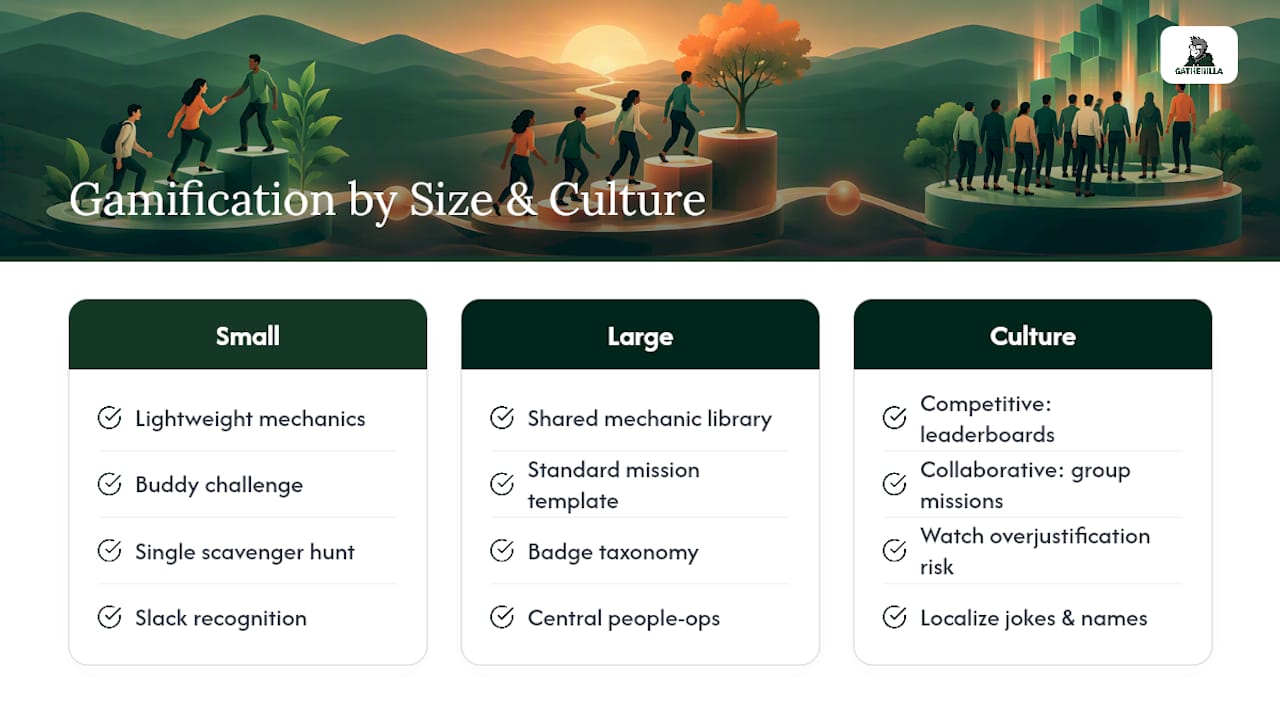
A 12-person startup and a 5,000-person enterprise need different versions of the same idea. Company size and culture change what “gamified onboarding” should actually look like, even when the underlying SDT framework stays constant.
Small teams often do best with lightweight, high-touch mechanics: a single buddy challenge, one scavenger hunt through the (real or virtual) office, and a recognition channel that’s really just a Slack thread. There’s no need for an LMS integration or a formal analytics lead when the whole company can watch a new hire’s progress in one channel.
Larger organizations need more structure to keep gamification consistent across departments that onboard people differently. That usually means a shared mechanic library (a standard mission-checklist template, a standard badge taxonomy) that regional or departmental HR teams can customize without building from scratch each time. It also means clearer ownership: a central people-operations team setting standards, with local managers adapting specific missions to their function.
Culture matters as much as size. A sales-heavy culture that already runs on leaderboards and competition will take to gamified onboarding fast, sometimes too fast, so watch for the overjustification risk showing up sooner. A culture built around quieter, more collaborative work might respond better to cooperative missions than competitive ones, team scavenger hunts instead of individual leaderboards, shared badges for group milestones instead of solo achievement tracking. Global companies also need to check that game references, mission names, humor, translate across regions instead of assuming a joke that lands in one office lands everywhere.
Keep Iterating: Feedback Loops That Actually Improve the Program
Onboarding gamification isn’t a one-time build. The programs that keep working past their first quarter treat every cohort as a new data point, not a finished product.
Build feedback collection into the calendar from the start: a short pulse survey at day 7 asking what felt useful and what felt like busywork, a longer one at day 30 tied to your primary KPI, and an open comment field that doesn’t force a rating scale onto qualitative feedback. Ask new hires which mechanics they’d cut, not just which ones they liked, since polite feedback tends to skip the second question unprompted.
Watch behavior alongside opinions. If a badge nobody’s completing sits at the bottom of your dashboard for two cohorts running, that’s a design signal even if nobody complains about it directly. If a scavenger hunt gets finished in ten minutes flat, it’s probably too easy to build any real competence. Compare each new cohort’s numbers against the one before it, not just against your original baseline, so you catch a slow decline in engagement before it becomes a full-blown fade-out.
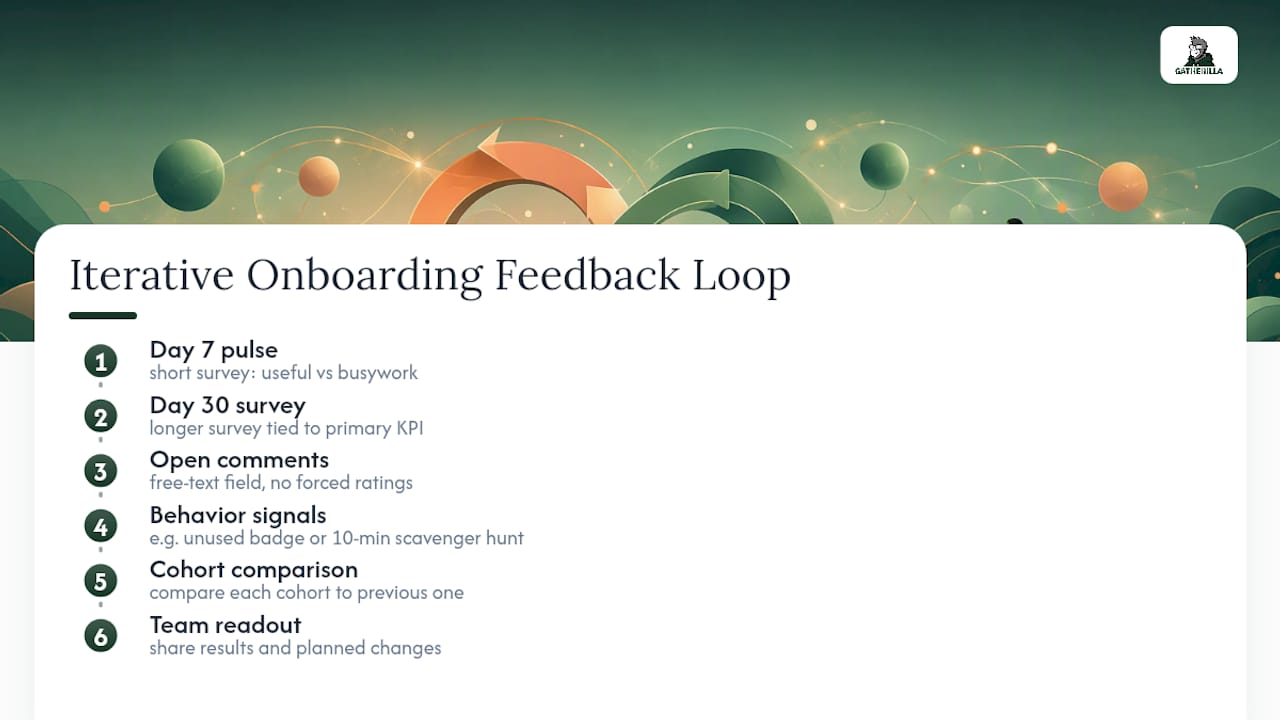
Share results internally, even the mixed ones. A short readout to the team that built the pilot, what improved, what didn’t, what changes next, keeps the program alive politically as much as practically. Programs that go quiet after the initial launch tend to get quietly defunded at budget time.
What to Expect in Six to Twelve Weeks
Run a focused pilot for six to twelve weeks and you should see directional movement on your primary metric, faster mission completion, a bump in day-30 survey scores, maybe an early signal on retention if your cohort is large enough. Don’t expect a finished program. Expect a first read worth sharing with your team, then a second cohort that’s noticeably better than the first because you fixed the two things that clearly weren’t working.
— Thomas
Try Gatherilla for Your Next Onboarding Cohort
Some platforms offer ways to run onboarding games directly inside the video calls new hires already join, with no downloads or new accounts required, lowering barriers to get started. That matters most in the pilot phase covered above, where the biggest risk isn’t picking the wrong mechanic, it’s picking a tool nobody actually opens.
The platform’s library covers the scavenger hunts, missions, and daily challenges described throughout this piece, browsable on the activities page, so you can borrow a template instead of building one from scratch for your first cohort. Pricing runs on a free tier plus a premium plan billed per seat, letting you test with one department before committing budget company-wide. Run your baseline pilot first, measure it against the metrics covered earlier in this article, and use that data, not a vendor’s promise, to decide whether to scale it. Check the pricing page for current plan details and start a pilot with your next new-hire cohort.
Sources
- Gamify your onboarding and see retention and engagement improve
- Dissertation: gamified onboarding and psychological need satisfaction (SDT)
- OnboardTogether: A Gamified Approach to Enhancing Employee Motivation and Connection During Onboarding
- Theory-driven design recommendations for gamified systems
FAQ
What Are the 5 C’s of Employee Onboarding?
The 5 C’s most commonly cited are compliance, clarification, culture, connection, and check-back, covering everything from legal paperwork to ongoing feedback after the formal onboarding period ends. Gamification touches most directly on connection and clarification, since missions and scavenger hunts speed up both role clarity and relationship-building.
What Are Some Examples of Gamification in HR?
Common HR gamification examples include onboarding missions with progress bars, competency badges, quizzes with instant feedback, peer recognition walls, and team-based leaderboards for training completion. Beyond onboarding, HR teams also gamify wellness challenges and internal referral programs using similar point and streak mechanics.
What Are Some Fun and Engaging Activities for Onboarding New Employees?
Onboarding scavenger hunts, buddy challenges, and short daily trivia rounds about company history or products consistently rank among the most engaging low-effort activities. A browser-based platform like Gatherilla can run several of these directly inside a video call without asking anyone to download an app.
What Are Some Great Examples of Onboarding Activities?
Strong onboarding activities combine a clear objective with a social element, a mission checklist paired with a recognition wall, or a scavenger hunt that ends with a team debrief call. The strongest examples tie back to a real competency, like closing a mock support ticket, rather than rewarding participation alone.
How Long Should an Onboarding Gamification Pilot Run?
Most HR teams see directional results within six to twelve weeks when running a pilot with a bounded cohort of 20 to 30 new hires. That window gives enough time to compare completion rates and early retention against a baseline group without waiting a full year for a signal.