

People Ops Engagement Activities: What to Run and How to Measure It

The engagement activities that work for people ops teams are short, optional, repeated often and tied to a number you can track. Think five-minute daily games, randomized coffee chats, structured onboarding pairings and open office hours, then a small set of metrics (participation, pulse scores, eNPS and retention by cohort) to see whether any of it moves. Below you’ll find the activities, how to run them, and how to measure them without turning connection into surveillance.
TL;DR
- Pick activities that are low pressure and optional. Required social time tends to feel like one more meeting, according to SHRM’s April 2026 reporting.
- Frequency beats scale. A daily five-minute habit usually does more for connection than one big annual event.
- Onboarding is the highest-leverage moment: pair new hires with teammates in the first week and keep the cadence going for the first month.
- Measure with a mix: participation in optional activities, short pulses, quarterly eNPS and retention by cohort. No single number tells the whole story.
- Report at team level, not individual level, so people keep trusting the data.
Table of Contents
- Why engagement activities matter for people ops right now
- Principles that make an engagement activity work
- Engagement activities by goal
- Onboarding activities that build relationships fast
- How to measure remote employee engagement
- A simple 90-day plan
- Our perspective
- Run these activities with Gatherilla
- FAQ
- Sources
Why engagement activities matter for people ops right now
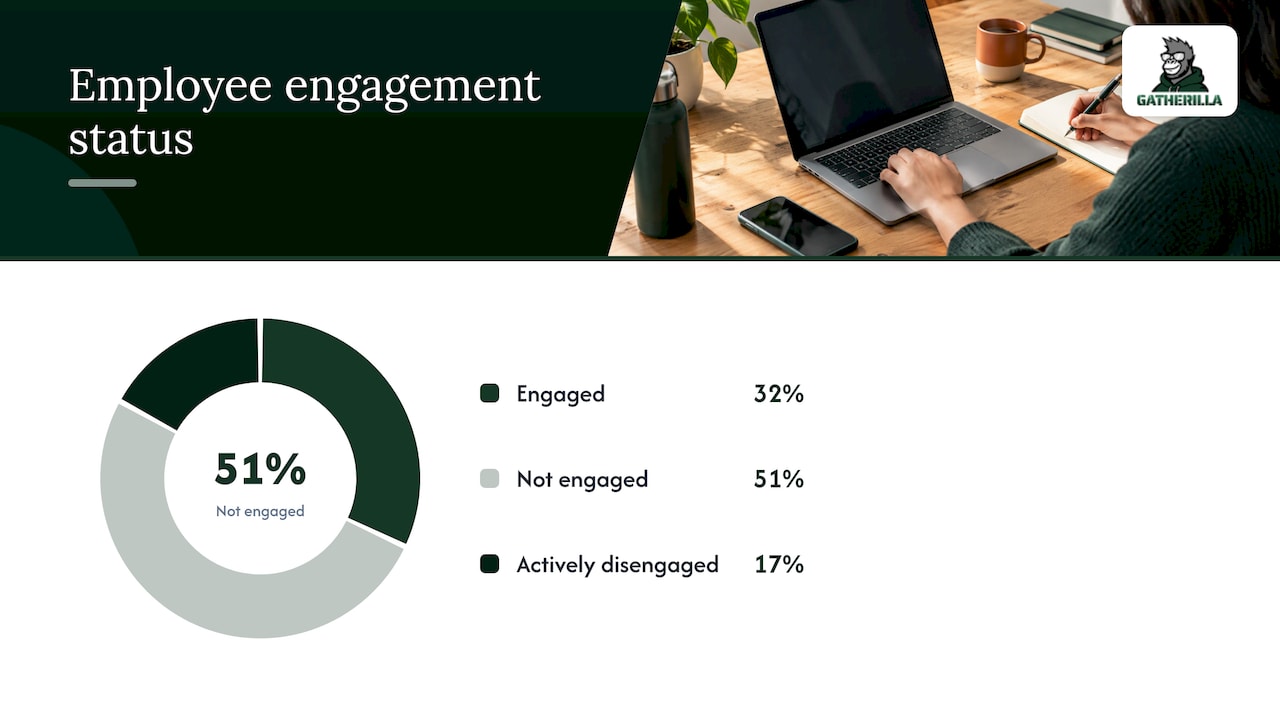
Engagement has been flat for a while. Gallup’s 2026 State of the Global Workplace data puts 32% of U.S. employees as engaged, 51% as not engaged and 17% as actively disengaged. Gallup’s July 2026 poll found 31% engaged in the first half of the year, and each percentage point represents roughly 1.6 million U.S. employees.
The work setting has also settled. According to Gallup’s August 2026 hybrid work data, 54% of U.S. employees work hybrid, 25% are exclusively remote and 21% are on-site. In the U.S., exclusively remote employees are 32% engaged and hybrid employees 31%, against 28% for on-site employees in remote-capable jobs. Distributed work is not the engagement problem. The gap is in how teams create connection when no one shares a hallway.
That is the job of people ops engagement activities: build small, repeatable moments of contact, recognition and shared fun, and make them easy enough that employees actually show up. If you want the wider market picture, our employee engagement trends write-up covers where HR leaders are putting attention.
Principles that make an engagement activity work
Before the list, four design rules. Most failed programs break one of them.
Keep it optional and low-pressure
SHRM’s Nana Jackson explains that rigid expectations and required attendance turn social time into another meeting, while autonomy over participation makes authentic engagement more likely and helps avoid burnout. Practically: invite, don’t mandate, and never penalize someone for skipping a game.
Make it short and recurring
A 10-minute activity that happens every day builds more familiarity than a two-hour event once a quarter. Short formats also survive busy weeks and time zone spread.
Remove setup friction
If the organizer needs a slide deck and the participants need to install something, adoption dies. Browser-based activities with no downloads and no accounts remove the two most common excuses.
Protect attention
Kelly Services’ guidance says virtual activities work when everyone agrees to be fully present, not multitasking or checking email during the event. Keep sessions short enough that this is a reasonable ask.
Engagement activities by goal
Here is a practical menu organized by what you are trying to achieve. Durations come from published guidance where noted and from our own experience otherwise.
| Goal | Activity | Typical length | Cadence |
|---|---|---|---|
| Daily connection | Question of the day or quick word/trivia challenge | 3 to 5 minutes | Daily |
| Meeting energy | Icebreaker at the start of a call | 2 to 5 minutes | Every meeting |
| Serendipity | Randomized coffee pairings | 15 to 20 minutes | Weekly or biweekly |
| Deeper trust | Structured question exchange | 15 minutes per set | Monthly |
| Team bonding | Multiplayer team game | 20 to 45 minutes | Monthly |
| Onboarding | Buddy pairings and new-hire chats | 15 minutes each | Several in week one |
| Recognition | Peer shout-outs tied to company values | 2 minutes | Weekly |
| Leader access | Open virtual office hours | 30 to 60 minutes | Weekly |
Daily habits: questions, word games and trivia
Daily micro-activities are the backbone of a sustainable engagement program because they cost almost nothing per day. A shared word puzzle or a light trivia round gives people a reason to open the same page at the same time. A simple prompt in the team channel does the same job in text form. We cover prompt ideas in our guide to a work question of the day, including questions that stay professional but still get people talking.
A leaderboard adds friendly competition, but keep it team-based or rotating if you have one competitive person who wins every time. The goal is participation, not a champion.
Icebreakers that take under five minutes
Kelly Services suggests opening gatherings with simple check-in questions, such as asking people to rate how they are feeling on a scale of 1 to 10. It is fast, it gives a manager a read on the room, and it normalizes saying “I’m a 5 today.”
For larger calls, use a quick multiplayer game instead of a round-robin where 20 people each talk for 30 seconds. Everyone plays at once, nobody waits, and the energy carries into the agenda. Our post on team building games that don’t make people cringe goes through what separates a game people like from one they endure.
Deeper connection: structured self-disclosure
The Wharton Neuroscience Initiative adapted the evidence-based “Fast Friends” exercise for remote teams. Two or more people answer a series of increasingly thought-provoking questions, about 15 minutes per set. Wharton’s 2024 Nano Tool explains that self-disclosure activates brain regions linked to reward processing and can strengthen trust and cooperation.
Use this one monthly rather than daily, and let people pick their depth. Starting with “What was your first job?” and ending at “What are you proud of this year?” works better than jumping straight to the personal. For a longer set of formats, see our online trust building activities.
Randomized coffee chats and interest groups
SHRM recommends randomized pairings to mimic the serendipity of an office, plus interest-based groups such as virtual book clubs and hobby channels. Keep pairings to 15 to 20 minutes and give people a prompt to start. Let anyone pause their participation without explanation.
Open office hours for leaders
SHRM also notes that connection grows when leaders are approachable and visible through open, informal office hours without fixed agendas. It costs a manager an hour a week and gives people a low-stakes way to talk to someone senior. Rotating the time slot helps teams across time zones, as does offering an asynchronous option for people who cannot attend live.
Hybrid meeting engagement
In hybrid setups, the risk is two classes of participant: the people in the room and the faces on screen. Give remote attendees the first question, run polls and games on a shared browser page everyone can access equally, and avoid side conversations in the room. Our guide to keeping remote participants engaged in hybrid meetings goes into the mechanics.
Onboarding activities that build relationships fast
New remote hires have no organic way to meet people, so the program has to create it.
- Randomized chats in week one. Foothold America recommends pairing new hires with teammates at random for 15-minute chats, with 3 to 4 chats in the first week and two per week for the rest of the first month, with conversation prompts.
- A buddy with scheduled check-ins. Great Place To Work’s remote onboarding guide recommends a buddy system with regular check-ins, virtual coffees with people in varied roles, and 30-, 60- and 90-day development checklists.
- A structured first day with breaks. SHRM’s description of virtual onboarding at ServiceNow includes a six-hour Day 1 session with built-in breaks and chances to connect, a 90-minute Day 2 session, one-on-ones with the manager and buddy, and a virtual happy hour with the team.
- A light, shared game. A quick multiplayer game in the first week lets a new hire be playful with the team before they have to be impressive.
The common thread: onboarding connection should be scheduled, not left to chance.
How to measure remote employee engagement
Activities without measurement are guesses. Measurement without context is noise. Here is a layered approach.
Start with the core metrics
A widely used set of remote engagement KPIs from Skima’s 2026 framework includes engagement score or eNPS, pulse response rate, participation rate, manager NPS, recognition frequency, turnover and retention by cohort, time to productivity, meeting hours per employee, internal mobility and a wellbeing index. You don’t need all ten. Start with four or five.
| Metric | What it tells you | Suggested cadence |
|---|---|---|
| eNPS | Overall advocacy for the company as a workplace | Quarterly |
| Pulse score | Wellbeing, workload, manager connection | Weekly to monthly |
| Participation in optional activities | Whether people want what you offer | Weekly |
| Recognition frequency | Whether appreciation is flowing | Weekly |
| Retention by cohort | Whether engagement holds over time | Quarterly |
| Onboarding check-in scores | Early belonging | Day 30, 60, 90 |
eNPS, explained
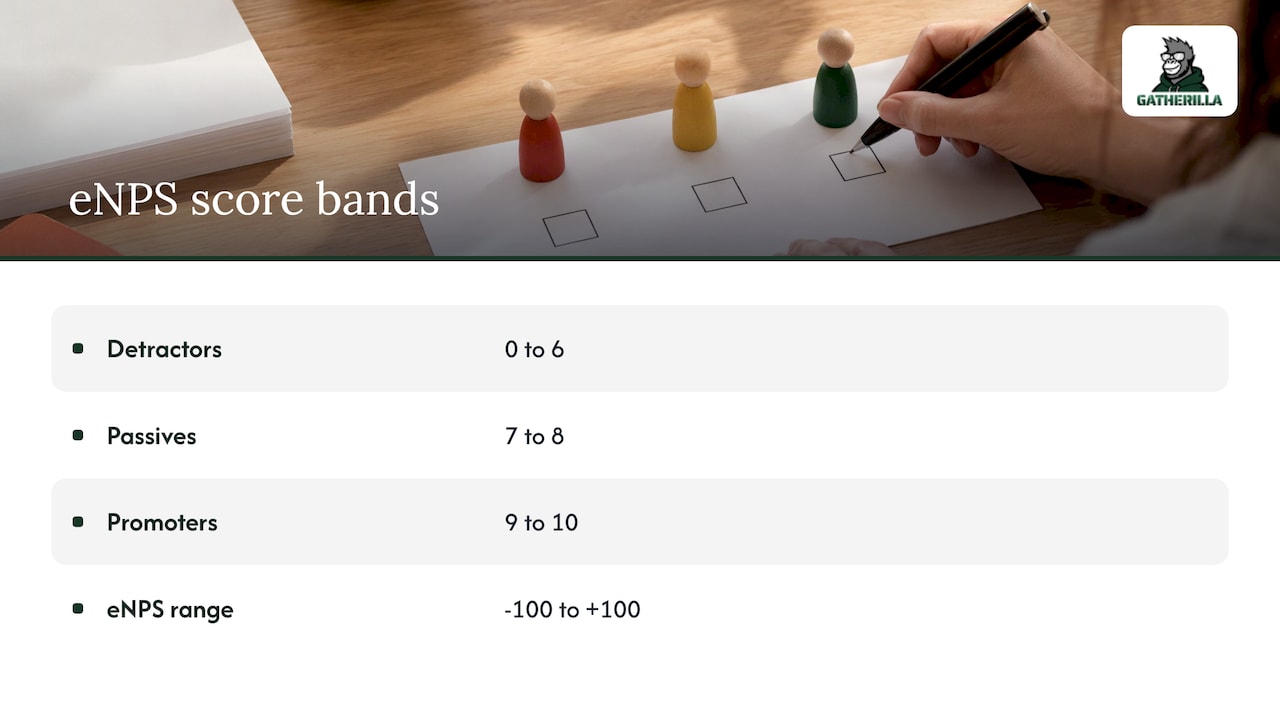
According to MiHCM, eNPS uses one question, how likely you are to recommend the company as a place to work, scored 0 to 10. Scores of 0 to 6 are detractors, 7 to 8 passives and 9 to 10 promoters. Subtract the percentage of detractors from the percentage of promoters and you get a number between -100 and +100.
The same source suggests a pulse rhythm for hybrid and remote teams: a weekly micropulse with one question on wellbeing or workload, a monthly pulse of 3 to 5 questions on manager connection, role clarity, tech enablement and stress, and a quarterly eNPS or composite pulse.
Watch your response rate
Happeo’s analytics guidance says participation above 70% for major surveys is important for trusting the data, and that low participation points to survey fatigue, doubts about anonymity or a belief that feedback changes nothing. When it dips, investigate those causes first before assuming people are disengaged.
Add behavioral signals
Surveys tell you what people say. Behavior tells you what they do. Useful signals for remote teams include:
- Participation in optional activities and daily challenges
- Manager one-to-one attendance
- Response times in async channels
- Peer recognition volume
- For new hires, the number of peer introductions in their first weeks
MiHCM recommends combining short recurring pulses with behavioral signals, which is a good rule of thumb: when the two agree, trust the trend; when they conflict, ask people.
Measuring engagement inside a virtual meeting
If your platform supports it, in-meeting analytics can help. Zoom’s Meeting Coach reports talk time percentage, live presence, chats sent and reactions, and notes that teams with more evenly distributed speaking time show higher collective intelligence. For large all-hands, a practical set of signals is live Q&A participation, replay viewing time and follow-up conversation afterward.
One caution that protects your data: report at the meeting or team level rather than naming individuals. Camera-on rate as a performance score will teach people to turn cameras on, not to engage.
Read the numbers in context
No single metric captures remote employee experience. A team logging consistent 11-hour days can look productive this month and be heading toward burnout next quarter. Pair quantitative trends with manager conversations, and look for leading indicators: sentiment that falls a quarter before resignations rise is a signal worth acting on.
A simple 90-day plan
- Weeks 1 to 2: baseline. Run a short pulse and record current participation in whatever activities already exist.
- Weeks 2 to 4: launch the daily habit. Choose one five-minute daily activity and one weekly pairing. Announce it as optional.
- Month 2: add depth. Introduce a monthly structured question session and a leader office hour. Start recognition tied to company values.
- Month 3: review. Compare pulse, participation and onboarding check-ins to the baseline. Keep what people use, drop what they ignore, and tell the team what you changed because of their feedback.
That last step matters. Employees stay willing to answer when they see feedback lead to action.
Our perspective
We built Gatherilla around one belief: engagement is a habit, not an event. The teams we see struggle are not short on good intentions. They are short on something that takes zero preparation and still feels worth showing up for.
That is why our platform runs in the browser, needs no downloads or accounts to join, and works with whatever video tool your team already uses. A manager shouldn’t need an afternoon to set up a five-minute game. When the friction is gone, a daily word or trivia challenge becomes part of the routine instead of one more initiative.
We also think recognition belongs next to play. Peer-to-peer shout-outs tied to your company values, plus real-time leaderboards and activity reporting on the Premium plan, give people ops something concrete to look at when you ask whether engagement is moving. Our aim is simple: make connection easy enough that it happens every day.
Thomas
Run these activities with Gatherilla
Gatherilla is a browser-based platform for remote and hybrid teams, with customizable multiplayer games, daily word and trivia challenges, meeting icebreakers and onboarding games. No downloads are needed, and it works with all video conferencing tools.
The Free plan lets you try it with your team. Premium is published at $0.50 to $1.00 per seat per month, or $5 to $10 per seat per year, and adds more games, reporting and priority support. See the current details on the Gatherilla pricing page, or look at the platform overview. If you are comparing formats first, our roundup of virtual team building tools for HR teams and our post on engagement games for HR are good next reads.
FAQ
What are good engagement activities for remote and hybrid teams?
Short, optional and recurring ones: a daily question or word challenge, a quick icebreaker at the start of meetings, randomized coffee chats, interest-based groups and open leader office hours. Add a monthly game or structured question session for depth. Our team engagement guide shows how to combine them into a lasting routine.
How do you measure remote employee engagement?
Combine a quarterly eNPS, short weekly or monthly pulses, participation in optional activities, recognition frequency and retention by cohort. Add onboarding check-ins at 30, 60 and 90 days for new hires. Read them together, because no single number captures the full picture.
How do you measure engagement in a virtual meeting?
Look at talk time distribution, chat and reaction use, live Q&A participation and follow-up conversation after the event. Many video platforms report some of these natively. Aggregate by meeting or team rather than by person, so the data stays trustworthy.
Should engagement activities be mandatory?
Generally no. Invitations with a low barrier tend to produce more authentic participation than required attendance, which can make social time feel like another meeting. Track who opts in as a useful engagement signal in its own right.
How often should people ops run engagement activities?
A tiny daily habit, a weekly pairing or office hour and a monthly deeper session is a sensible rhythm for most teams. Adjust based on participation data and what your team tells you in pulses.
Sources
- Gallup: State of the Global Workplace, United States
- Gallup: Employee Engagement Remains Flat as AI Adoption Accelerates
- Gallup: Global Indicator, Hybrid Work
- SHRM: Why Most Virtual Team-Building Fails and What HR Can Do About It
- SHRM: Virtual Onboarding of Remote Workers
- Wharton Neuroscience Initiative: Create Authentic Connections with Virtual Team Members
- Foothold America: Virtual Onboarding, 10 Ways to Engage New US Hires
- Great Place To Work: Remote Employee Onboarding
- Skima: Remote Employee Engagement, Ideas, Tools and KPIs
- MiHCM: Employee Engagement Metrics, Benchmarks and Key KPIs
- Happeo: Employee Engagement Analytics
- Zoom: Using Meeting Coach with AI