

25 Friendly Competition Ideas at Work for Any Team
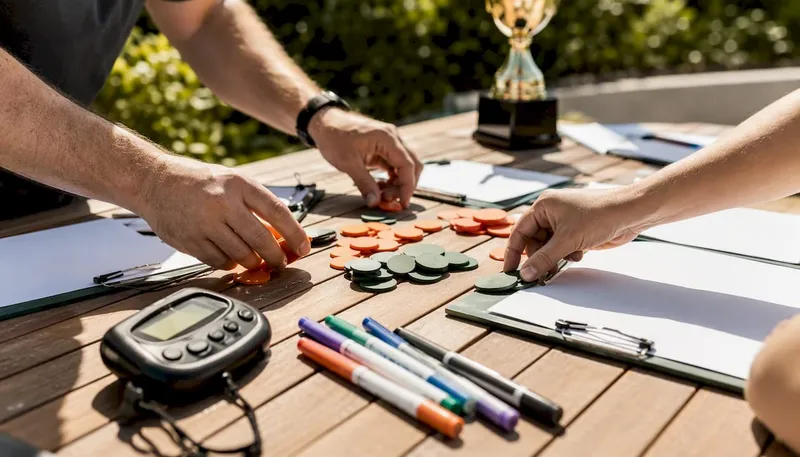
If you need something to run this week, here are the highest-impact options, each taking under 15 minutes to set up:
- Trivia sprint (5–10 min, any format): one round of five questions in a shared chat or video call. Works in-person and remote. Builds energy fast.
- Photo caption contest (single-day): post a funny or work-relevant image in Slack or Teams; team votes on the best caption. Zero prep, high laughs.
- Steps challenge (extended duration): track daily steps via a shared spreadsheet or a free app. Pairs well with wellness goals and CDC-backed workplace health programs.
- Virtual scavenger hunt (30–60 min): participants find household or office items matching a prompt list. Runs entirely over video. See 50 virtual scavenger hunt ideas for ready-made item lists.
- Micro-hackathon (single-day): small teams solve one real work problem in two hours. Judged on creativity, not polish.
- Values recognition bracket (multi-week): employees nominate peers who demonstrated a company value; the team votes each round. Reinforces culture without a leaderboard.
- Wellness bingo (multi-week): a 5x5 card of healthy habits. First to complete a row wins. Fully self-paced and accessible.
- “Wrong answer only” brainstorm (10–15 min): teams compete to give the most absurd answer to a real work question. Builds psychological safety and gets people laughing before a serious meeting.
Key Takeaways
Friendly competition at work builds cohesion, psychological safety, and morale most reliably when contests are low-stakes, recurring, and team-based rather than individual and high-pressure.
| Point | Details |
|---|---|
| Keep contests low-stakes and frequent | Recurring micro-competitions compound into measurable culture change more reliably than rare large events. |
| Match rewards to effort | A multi-week challenge deserves a half-day PTO or learning stipend; a 10-minute trivia round earns a shout-out or small gift card. |
| Opt-in and accommodate | Always make participation voluntary and state accessibility alternatives in the announcement so no one has to ask. |
| Track three metrics | Measure participation rate, short-term sentiment via pulse survey, and one behavior-linked metric tied to the contest goal. |
| Gatherilla reduces setup friction | Browser-based, no downloads, built-in leaderboards and daily challenges — ready to run for remote and hybrid teams. |
Table of Contents
- Why friendly competition at work actually helps your team
- A full list of friendly competition ideas, organized by context and effort
- How to run a fair, inclusive competition from start to finish
- Prizes and recognition that actually motivate people
- Ready-to-use templates and remote setup options
- How to measure whether your contest actually worked
- What actually changes when you run these consistently
- Gatherilla makes it easier to run these contests without the setup headache
- Sources
Why friendly competition at work actually helps your team
The core finding from organizational research is simple: low-stakes, recurring contests build cohesion and psychological safety more reliably than occasional large events. A monthly trivia round compounds into inside jokes, easier cross-team communication, and a team that actually looks forward to Monday standups. A once-a-year offsite rarely does the same.
The psychological mechanism behind this is well-documented. Harvard Business Review’s research on curiosity shows that small wins and curiosity-driven experiments produce measurable improvements in creativity and engagement. Friendly contests at work trigger exactly that loop: a low-pressure challenge, a small win or a funny loss, and a reason to try again next week.
Play also matters for adult well-being in ways leaders often underestimate. HelpGuide’s overview of adult play links regular playful activity to reduced stress, stronger social bonds, and better mental health. That is not a soft benefit. Poorly designed competitions, by contrast, carry real costs: work stress has measurable financial and productivity consequences, and a badly run contest can add to that load rather than relieve it.
Common pitfalls to watch for:
- Zero-sum formats where one person wins and everyone else loses publicly
- Rewards that feel trivial relative to the effort required
- Activities that favor specific roles, physical abilities, or time zones
- Leaderboards that stay visible too long and create anxiety instead of motivation
- No opt-out path, which turns a fun idea into a mandatory performance
Pro Tip: Keep the default format team-based rather than individual. When a small group wins together, the social reward is shared and the sting of losing is softer. Individual rankings work best when participation is genuinely voluntary and the stakes are low.
A full list of friendly competition ideas, organized by context and effort
In-person ideas
Department Olympics (medium effort): divide the office into teams across departments. Run multiple short events including paper airplane distance, fastest typing test, best desk decoration, trivia round, and a relay race if space allows. Score each event and post a running tally. Works best for teams of 10 or more. For accessibility, offer seated alternatives to any physical event and let participants choose their events from a menu rather than requiring all of them.
Lunch cook-off (single-day, medium effort): each participant brings a dish; the team votes anonymously on taste, presentation, and creativity. Three categories mean more winners and fewer hurt feelings. Accommodate dietary restrictions by listing them in the sign-up form.
Desk decoration contest (single-day, low effort): pick a theme (season, movie, company value) and give teams 20 minutes to decorate. A panel of three judges scores on creativity and theme adherence. Prize: bragging rights plus a small gift card.
Virtual ideas
Trivia tournament (30–60 min, low effort): use a free tool like Kahoot or a shared Google Form. Five to ten questions per round, three rounds. Rotate the topic each session so different people have home-field advantage. Slack’s team-building guide recommends matching activity format to team size and location, so for a distributed team of 20+, break into smaller pods of four to six for the first two rounds before a final.
Photo caption contest (single-day, minimal effort): post one image in your team channel Monday morning; collect captions by end of day; run a poll Tuesday. Takes under five minutes to set up. Works for any team size.
Virtual scavenger hunt (45–60 min, low-medium effort): participants find items from a list within their home or office. Timed rounds keep energy up. For a team of 3–6, run it live on a video call. For 7–25, use breakout rooms with a shared scoring sheet. Full item lists and remote adaptations are available at Gatherilla’s scavenger hunt resource.
Minute-to-win-it games (15–30 min, low effort): short, silly physical challenges done on camera. Stack cookies on your forehead, move a cotton ball with a spoon, sort colored objects in 60 seconds. Virtual Minute to Win It formats are specifically designed for remote teams and require no special equipment.
Hybrid ideas
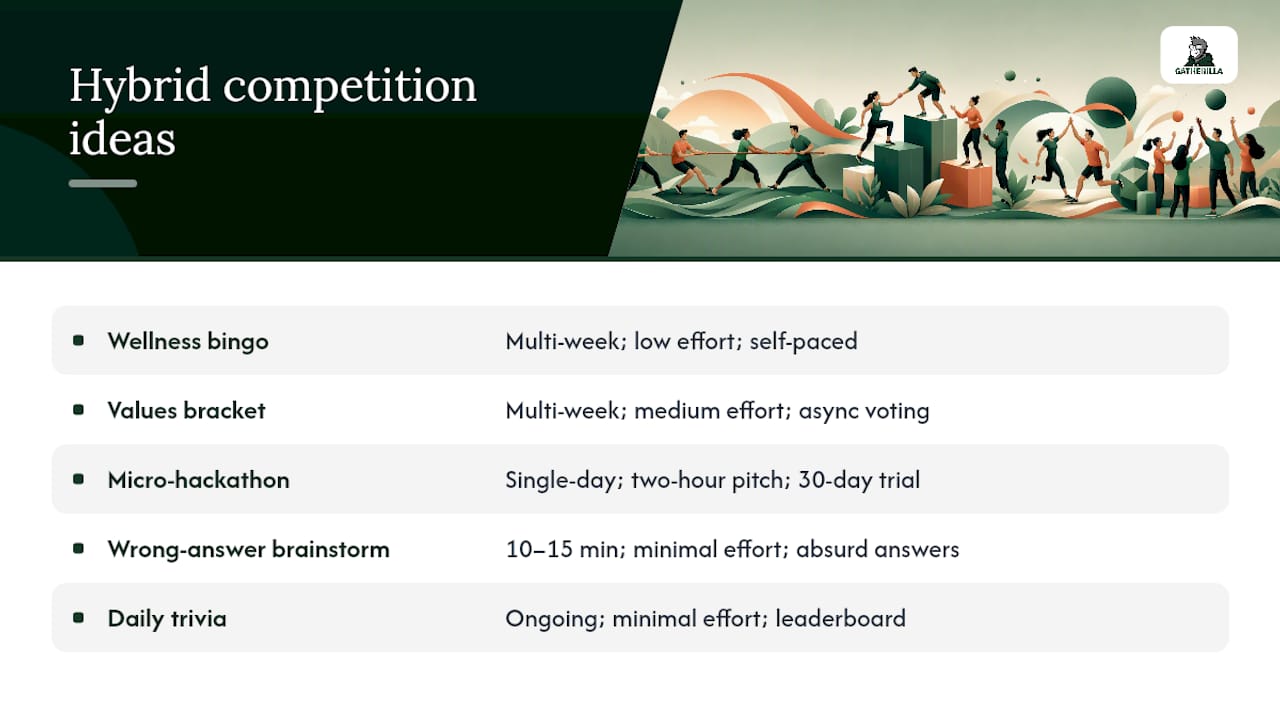
Wellness bingo (multi-week, low effort): distribute a digital bingo card via email or a shared doc. Each square is a healthy habit: drink eight glasses of water, take a 10-minute walk, eat a vegetable at lunch. Participants mark their own cards on the honor system. First to complete a row in each location cohort wins. Fully self-paced, no synchronous time required, and accessible regardless of physical ability since the card can be customized.
Values recognition bracket (multi-week, medium effort): employees nominate peers for demonstrating a specific company value. Each week, the team votes on two nominees; the winner advances. Final four are recognized in an all-hands. This format works across time zones because voting is asynchronous and requires no live participation.
Micro-hackathon (single-day, medium-high effort): form cross-functional teams of three to five. Give them a real, bounded problem (improve one internal process, redesign one customer touchpoint) and two hours to produce a short pitch. A panel of three judges scores on feasibility, creativity, and clarity. Remote participants join via video; in-office participants can present from a conference room. Reward: the winning team’s idea gets a 30-day trial run.
“Wrong answer only” brainstorm (10–15 min, minimal effort): pose a real work question and ask teams to compete for the most absurd answer. The facilitator reads the best ones aloud. This format, highlighted in low-stakes challenge research, normalizes failure and builds psychological safety before a serious creative session.
Daily word or trivia challenge (ongoing, minimal effort): post one question each morning in a shared channel. First correct answer gets a point; weekly totals go on a simple leaderboard. Takes 30 seconds to post and creates a daily ritual that pulls people back to the team channel. Daily challenge prompts designed for remote and hybrid teams are a good starting point.
How to run a fair, inclusive competition from start to finish
Running a contest badly is worse than not running one at all. A few non-negotiable steps prevent most problems.
Pre-launch checklist:
- Define the objective (morale, wellness, creativity, cross-team connection).
- Choose a format that matches your team’s size, location, and accessibility needs.
- Make participation opt-in, with a clear, no-judgment way to decline.
- Write the rules in plain language before you announce anything.
- Decide on scoring before the contest starts, not during.
- Announce the prize before people commit effort.
- Designate one person to monitor for stress signals or complaints.
Sample announcement template (copy and adapt):
Scoring fairness: for role-diverse teams, avoid metrics that only one function can win. A sales contest based on call volume excludes engineers. Either score within role cohorts or use a format where everyone starts from the same baseline (trivia, creative challenges, wellness habits).
Accessibility accommodations: offer alternative ways to participate for anyone with mobility, vision, or neurodiversity considerations. A steps challenge can include a “mindful minutes” track for participants who cannot walk. A visual contest can include a written description option. State accommodations in the announcement so no one has to ask.
Pro Tip: Rotate formats every two to three contests. A team that always runs trivia will eventually plateau in participation. Switching between physical, creative, and knowledge-based formats keeps different people in the spotlight and prevents the same five people from winning every time.
Prizes and recognition that actually motivate people
The principle here is straightforward: reward value should match the effort required. A high-effort, multi-week contest that pays out a $5 coffee card will feel insulting. A five-minute trivia round that pays out a half-day of PTO will feel disproportionate and create resentment among people who did not participate.
Tiered prize ideas by effort level:
- Micro (5–15 min): public shout-out in the team channel, a digital badge, a $10–$15 gift card, or a “traveling trophy” (a silly physical or digital award that gets passed each week)
- Single-day: a team lunch (in-person or a credit for remote work), an extra hour off on Friday, a company-branded item, or a feature in the company newsletter
- Multi-week: a half-day or full PTO day, a $50–$100 learning stipend, a donation to the winner’s chosen charity, or a “skip one meeting” pass
Non-monetary recognition that lands well:
- A dedicated Slack channel post with the winner’s photo and a one-line description of what they did
- A leaderboard shout-out during the all-hands
- Career exposure: the winning team presents their hackathon idea to leadership
- A “golden keyboard” or equivalent digital trophy that lives in the team channel for a week
The poor-reward trap: imagine a multi-week wellness challenge requiring daily habit tracking, peer accountability, and a final report. The prize: a branded pen. That mismatch signals that leadership does not value the effort it just asked for. Fix it by working backward: estimate the total time investment, then ask whether the prize would feel fair to someone who put in that time. If the answer is no, either raise the prize or reduce the effort required.
Ready-to-use templates and remote setup options
You can launch most of these contests in under five minutes with the right scaffolding. Here are three templates to copy directly.
Template 1: Announcement message
Template 2: Simple scoreboard layout (paste into a shared Google Sheet)
Update it once a day. Pin the link in your team channel so it stays visible without being intrusive.
Template 3: Judging rubric for creative contests
| Criterion | Points available |
|---|---|
| Creativity | 10 |
| Relevance to theme | 10 |
| Execution / clarity | 10 |
| Crowd favorite (peer vote) | 5 |
Three judges score independently; average the scores to reduce bias.
For anything requiring real-time scoring or a live leaderboard, a browser-based platform removes the friction. Gatherilla runs entirely in the browser with no downloads, integrates with any video conferencing tool, and includes built-in leaderboards and daily challenges. Browser-based team building means no IT approval tickets and no “can everyone see my screen?” delays.
Pro Tip: Automate your leaderboard update reminder. Set a recurring calendar event for whoever owns the scoreboard: 60 seconds to update, then post the link in the team channel. Contests die when the leaderboard goes stale for three days.
How to measure whether your contest actually worked
Track three things: participation rate, short-term sentiment, and at least one behavior-linked metric tied to the contest’s objective.
Pulse survey template (send within 48 hours of contest end):
- Did you participate? (Yes / No / Watched but didn’t play)
- How did the contest affect your mood at work this week? (1–5 scale)
- Did the contest help you connect with a colleague you don’t usually work with? (Yes / No / Unsure)
- Was the prize appropriate for the effort? (Yes / No / Didn’t care about the prize)
- Would you participate in a similar contest next month? (Yes / No / Maybe)
Recommended metrics:
| Metric | What it measures | Target / frequency |
|---|---|---|
| Participation rate | Reach and voluntary buy-in | 50%+ of eligible team; check after each contest |
| Pulse survey score (Q2) | Short-term morale impact | Positive shift vs. baseline; run before and after |
| Cross-team connections (Q3) | Social bonding beyond immediate team | Track trend over 3–4 contests |
| Repeat participation rate | Sustained engagement | Rising trend over first four contests |
| Behavior metric (contest-specific) | Actual habit or output change | Defined per contest (e.g., steps logged, ideas submitted) |
Common pitfalls and quick mitigations:
- Overcompetition: a team that runs contests every week without breaks will burn out. Cap frequency at two to three per month and rotate effort levels.
- Gaming the system: if a metric can be gamed (e.g., logging fake steps), switch to a self-reported honor system with a “fun, not audited” framing. Most people won’t cheat when the stakes are low.
- Unequal role advantages: if the same people keep winning, the format is probably favoring a specific skill set. Rotate formats deliberately. Remote team engagement strategies cover this in more detail.
- Participation drop-off mid-contest: send one mid-contest reminder with the current standings. One nudge is enough; more feels like pressure.
Workplace health promotion research from the CDC supports tracking productivity-linked metrics for wellness contests specifically, since the connection between health behaviors and output is measurable when you define the metric before the contest starts.
What actually changes when you run these consistently
Running recurring low-stakes contests as a people leader produces results that are harder to see in a single event but unmistakable over a quarter. Participation in optional team activities tends to climb after the second or third contest, not the first. The first one is a test: people are watching to see whether leadership follows through, whether the prize materializes, and whether it is actually fun. By the third contest, the skeptics have usually joined.
The behavior change worth watching is not who wins. It is whether people who rarely spoke in standups start dropping answers in the trivia channel. Whether the engineer who never attended optional events shows up for the scavenger hunt. Those small shifts in participation signal a change in psychological safety, and that change carries over into regular work. Teams with higher psychological safety surface problems earlier and collaborate across functions more readily.
One concrete lesson: the format matters less than the consistency. A mediocre trivia round run every two weeks beats a brilliantly designed hackathon run once a year. The compound effect of small, frequent, low-pressure moments is what low-stakes challenge research points to, and it matches what you observe in practice.
Gatherilla makes it easier to run these contests without the setup headache
Running friendly competitions for remote and hybrid teams usually means juggling a video call, a shared spreadsheet, a scoring system, and a way to keep people engaged between rounds. Gatherilla handles all of that in one browser-based platform, with no downloads and no IT approval required.
The platform includes customizable multiplayer games, real-time leaderboards, daily word and trivia challenges, and icebreaker activities that work inside any video conferencing tool. For HR teams and people leaders who want to run a contest this week rather than next quarter, the quick setup and built-in analytics mean you spend your time on the contest itself, not the logistics. Onboarding new employees? Gatherilla includes games specifically designed for that moment too.
Start a free trial at Gatherilla and run your first team challenge today.
Sources
- Low-Stakes Team Challenges That Build High Performance | SUCCESS
- 29 Team-Building Activities for Work | Slack
- Employee engagement contest ideas (Tango Card resources)
- Workplace Health: Chronic Disease and Work | CDC
- The business case for curiosity | Harvard Business Review