

New Manager Icebreakers: 15 Ideas for Your First Team Meetings

The best icebreakers for a new manager are short, easy to answer and low on personal risk: a one-line prompt round, a light game like Two Truths and a Lie, or a paired introduction. You go first, you say exactly what to share, and you let people pass. Below you’ll find 15 ideas sorted by situation, rough timing, and the mistakes that make people dread these moments.
TL;DR
- Pick light prompts (a favorite coffee order, a first job, a recent book) over anything personal. Simple, quick and unlikely to make people feel vulnerable is the standard to hold.
- Go first, state exactly what people should share, and set the speaking order so nobody is surprised.
- Budget about one minute per person for round-robin introductions, plus roughly 10 extra minutes if you use pairs.
- Keep participation optional and watch for dominant voices, so quieter people get the floor.
- Use the icebreaker to serve the meeting’s purpose, then move on to your vision, working style and the real agenda.
Table of Contents
- Why icebreakers matter more when you’re the new manager
- Before you pick one: four decisions
- Quick prompt rounds (1 to 3 minutes)
- Games that get people talking (5 to 15 minutes)
- Group introductions that don’t drag
- Quick icebreakers for huddles and standups
- Running icebreakers for remote and hybrid teams
- How to keep icebreakers comfortable and optional
- What to do right after the icebreaker
- Our perspective: make it a habit, not a one-off
- A low-effort way to run these on video
- FAQ
- Sources
Why icebreakers matter more when you’re the new manager
When you join a team, or take over one, everyone is watching how you run the room. An icebreaker is a small, visible signal: you care who is on the call, and you want people to speak. It is also a cheap way to learn names, humor and energy before you ask for anything harder.
One framing is worth borrowing. A good icebreaker is a low-stakes way to rehearse interpersonal risks. Sharing a silly answer today makes it a little easier to share a concern or disagree next month. That is the real payoff for a new manager, and it is also why a badly chosen icebreaker backfires.
Psychological safety, the shared belief that it is safe to take interpersonal risks at work, is the thing you are quietly building. If you want a deeper look, our guide to building psychological safety in your team goes further than a single meeting can.
Before you pick one: four decisions
Most icebreaker failures come from skipping these questions, not from picking the wrong game.
- Who is in the room? If people don’t know one another, use the opening for introductions. If they have worked together for years, skip introductions and use a prompt that surfaces something new.
- How much time do you have? Ten minutes of games in a 30-minute meeting is too much. A single question fits almost anywhere.
- Is it in person, remote or hybrid? Silent or movement-based activities need adapting for a video call. Prompt rounds work everywhere.
- What is the meeting for? Introductions should be relevant to the meeting’s purpose. A kickoff earns a longer activity than a budget review.
Quick prompt rounds (1 to 3 minutes)
These need no setup. Ask one question, give people a few seconds to think, and go around the room or call.
- Free hour. What would you do with a free hour today? New managers can use this one alongside prompts like what someone is excited about or where they’d go in a time machine.
- Weekend highlight. One thing from your weekend, in one sentence. Columbia’s HR team lists a weekend highlight, a recent book or article, current music or the origin of a name among its simple openers.
- First job. What was your first job? Atlassian includes this among its quick prompts for when time is short, along with a go-to coffee order, a best vacation and a nostalgic song.
- Childhood dream job. Asana lists this as a simple, light-hearted example, next to a productivity hack and a fictional mentor.
- Name story. Where does your name come from, or what nickname did you have growing up? It also helps you learn pronunciation early, which a new manager should want to get right.
- Productivity hack. What small trick makes your workday better? This one is useful because the answers are things you can actually steal.
A rule of thumb for all of these: if the answer needs more than one sentence of context, the question is too heavy for an icebreaker.
Games that get people talking (5 to 15 minutes)
Use these for a kickoff, an offsite or the first meeting after a reorganization.
- Two Truths and a Lie. Each person shares two true statements and one false one, and the group guesses. It is one of the most commonly recommended starters, and it works on video with no tools. Tell people the truths should be work-safe.
- Similar and Unique. In small groups, find what everyone has in common and one thing only one person has. It shows overlap across roles and rewards curiosity.
- A Cold Wind Blows. A standing, in-person activity where people change places if a statement applies to them. It is lively, but check that the statements stay light and that everyone can physically take part.
- Silent Introductions or drawing. People draw something about themselves and others guess. It suits quieter teams, since no one has to perform out loud.
- Storytelling. Ask for a two-sentence story about a small win or a funny work moment. Keep a timer visible.
The NH Destination Imagination team lists all of these among its ways to help people feel comfortable and practice collaboration and creativity. It is written for youth team managers, but the mechanics carry over to adult teams.
Group introductions that don’t drag
Introductions are the icebreaker you will run most as a new manager. Here are two formats and what they cost in time.
| Format | How it works | Time | Best for |
|---|---|---|---|
| Round-robin | Name, role, plus one hobby or personal fact | About one minute per person | Teams under about 10 |
| Paired introductions | Pairs talk, then each introduces the other | Round-robin time plus about 10 extra minutes | Teams where people have never met |
| Champions | Pairs interview each other for five minutes, then each person introduces and positively champions their partner | About 5 minutes of interviewing plus the introductions | Groups up to about 20, per the American Management Association |
- Champions for larger teams. For bigger groups, the AMA suggests adapting the exercise by splitting into smaller teams. Its broader view is that connection works better when people first meet a manageable number of colleagues instead of trying to learn every name at once.
A worked example: a new manager inherits a team of 12. Round-robin introductions take about 12 minutes. Paired introductions take roughly 22. In a 45-minute first meeting, the round-robin leaves room for your own introduction and a real agenda. Save pairs for a dedicated team session.
Quick icebreakers for huddles and standups
Huddles are short by design, so the icebreaker has to be a single beat. Rotate a question owner so it isn’t always you.
- One-word check-in. Describe your morning in one word.
- This or that. Coffee or tea, mountains or beach, early bird or night owl. People answer in two seconds.
- Small win. One thing that went right yesterday, work or not.
If your team is on scrum, our list of scrum icebreakers for standups, retros and planning matches prompts to each ceremony. For teams that meet on a call, under-two-minute Zoom icebreakers come with short scripts you can read aloud.
Running icebreakers for remote and hybrid teams
A remote team loses the hallway conversations where people learn about each other. The icebreaker has to carry more of that load, and it has to work for people on screens and people in a room.
- Use chat as a second channel. Ask for answers in text so people who think slowly or speak less still contribute.
- Set the order. Call names in a fixed sequence, or have each speaker pick the next one. No awkward silences.
- Check the hybrid imbalance. Start with remote participants, not the people in the room, so they aren’t an afterthought.
- Keep it camera-friendly. Skip activities that depend on shared physical space or props.
We’ve collected more formats in our guides to remote icebreaker games and hybrid meeting icebreakers. If your company runs on Microsoft Teams, there is a version for that too: Microsoft Teams icebreakers.
How to keep icebreakers comfortable and optional
This is where new managers can do real damage. Icebreakers that are too personal or not inclusive can create anxiety or division, or make it harder for people to contribute.
The facilitation basics, drawn from Lucid Meetings’ advice on introductions:
- State exactly what people should share.
- Go first, and model the length and tone you want.
- Specify the speaking order and include everyone.
- Avoid potentially sensitive questions.
There is a case for caution beyond manners. In a Canadian survey reported by the Canadian Institute of Management, 89% of employees say psychological safety is essential, yet 23% say their workplace is not psychologically safe. The same article reports that 45% of women business leaders have difficulty speaking up in meetings. Those figures are Canadian, but they point at a pattern any US manager will recognize: not everyone feels free to talk, and a forced icebreaker can make it worse.
Practical guardrails:
- Say “pass is always fine” out loud, and mean it.
- If one person is dominating, step in and call on people who haven’t spoken yet.
- Avoid questions about family, religion, health, money or politics.
- Offer a choice of two prompts so people can pick the one they’re comfortable with.
- Check for accessibility: not everyone can stand, draw or see a screen easily.
For HR leaders who want no-prep options built around safety, see our piece on icebreakers that build psychological safety.
What to do right after the icebreaker
The icebreaker earns you attention. Spend it. In a first meeting, managers can share their leadership philosophy, team vision and working and communication style to build trust. Keep it to a few minutes and invite questions.
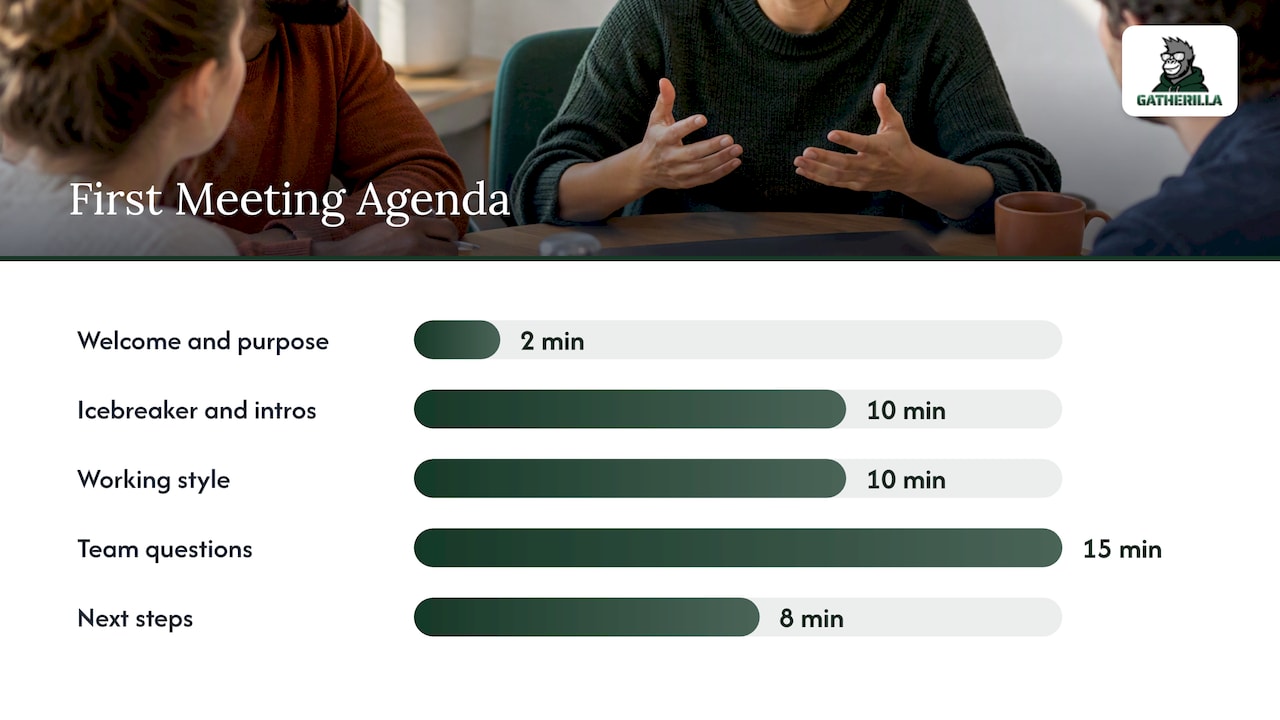
It helps to build the whole session around a written plan. A simple meeting agenda template can give you a structure to adapt: icebreaker, your introduction, team input, next steps. Timebox each part so the icebreaker doesn’t eat the meeting.
A sample 45-minute first meeting:
- 2 minutes: welcome and purpose.
- 10 minutes: icebreaker plus introductions.
- 10 minutes: your working style and what you’ve heard so far.
- 15 minutes: team questions and priorities.
- 8 minutes: next steps and one-on-one scheduling.
Our perspective: make it a habit, not a one-off
We build Gatherilla for remote and hybrid teams, and one thing keeps coming up: the first-meeting icebreaker is the easy part. The hard part is the third month, when the novelty is gone and people have gone back to muting and multitasking.
Our view is that connection works better as a small daily habit than as an occasional event. A five-minute game at the start of a call, a daily word or trivia challenge, a quick round that needs no preparation from you. That is why we focus on zero-prep, browser-based activities with no downloads, so a new manager spends their energy on the people instead of the logistics.
If you take only one thing from this article: be consistent and keep it light. Icebreakers work when people trust that they are safe, short and optional.
— Thomas
A low-effort way to run these on video
If you’d rather not manage prompts and timers yourself, Gatherilla runs multiplayer team games, icebreakers and daily challenges in the browser, with no downloads, and works with any video conferencing tool. There is a free plan to try it with your team. Premium is priced per seat: $0.50 to $1.00 per seat per month, or $5 to $10 per seat per year, and it adds more games, reporting and priority support. See the Gatherilla pricing page for current details, or start from the team building games overview.
FAQ
What are good icebreaker questions for a new manager to ask?
Stick to light, quick prompts: what you’d do with a free hour, a first job, a favorite book or a go-to coffee order. Pick questions that are simple to answer and don’t require vulnerable disclosure. Answer first yourself so people see the expected length and tone.
What is the 3 Ps icebreaker?
We couldn’t find an established icebreaker game by that name. The 3 Ps usually refer to purpose, process and people, which are a framework for supporting team collaboration and for making meetings more effective. You can use them as a meeting opener by stating the purpose, agreeing the process and then introducing the people.
How do I do group introductions without it taking forever?
Ask for a name, role and one light fact, and allow about one minute per person. If you want deeper connection, pair people up, but budget around 10 extra minutes. For larger groups, break into smaller teams rather than having everyone introduce themselves to everyone.
Should icebreakers be optional?
Yes. Some people find forced sharing stressful, and inappropriate activities can make it harder for them to contribute. Offer a pass, give a choice of prompts, and keep the questions work-safe.
How long should an icebreaker take?
A single prompt takes one to three minutes. A game like Two Truths and a Lie takes 5 to 15 depending on team size. Match the length to the meeting: a standup gets one beat, a kickoff can take longer.
Sources
- Best in Flex, Columbia University Human Resources
- Icebreakers, NH Destination Imagination
- New Managers: How to Run Your First Team Meeting, Meetingnotes
- 148 icebreaker questions, Atlassian
- Facilitating Effective Meetings, University of Florida HR
- 5 Ways to Ace Your First Meeting with Employees as a New Manager, Niagara Institute
- 20 Techniques to Improve Meeting Productivity
- Three Icebreaker Activities for Your Next Meeting, American Management Association
- (More) Icebreakers for meetings and workshops that don’t suck
- When Ice Breakers Freeze Out Introverts, Canadian Institute of Management
- How to Lead Introductions in Business Meetings, Lucid Meetings
- 150+ Team Icebreaker Questions, Asana
- Psychological Safety Icebreakers, Neurolaunch
- 80 Fun Meeting Icebreakers, Science of People
- Purpose, Process, and People, New Leaders
- Make your meetings more effective with 3Ps, Markovitz Consulting
- Meeting agenda template, BIZORYN