

One-on-One Icebreakers: 30 Questions and Formats That Work

A good one-on-one icebreaker is short, voluntary and tied to the conversation you are about to have. It takes one to three minutes. It asks something a little more specific than “How was your weekend?” And it lets the other person decide how much to share. Below you will find 30 questions sorted by situation, five formats you can run on a video call, and the research on why depth beats small talk when it is optional.
Most icebreaker lists are written for groups. Two people is a different problem. There is no crowd to hide in, no one to go first, and the power dynamic (manager and report, mentor and mentee, new hire and buddy) is out in the open. That changes what works.
TL;DR
- Pick the icebreaker for the relationship: a first meeting, a recurring check-in, a new-hire buddy chat and a skip-level all need different questions.
- Move from light to more personal, and always let the other person pass. Wharton’s guidance stresses voluntary participation.
- Keep it to one to three minutes and link it to the agenda when you can.
- Go first, and answer honestly but at the depth you want to receive.
- Repeat a small ritual weekly instead of inventing something new each time.
Table of Contents
- Why one-on-one icebreakers need a different approach
- What the research says about doing this well
- Five rules before you ask the first question
- 30 one-on-one icebreaker questions, by situation
- Five formats you can run on a video call
- One-on-one icebreakers for onboarding
- What we have learned about this at Gatherilla
- Making it a habit instead of a one-off
- When a one-on-one icebreaker is the wrong move
- Adding games without making it awkward
- FAQ
- Sources
Why one-on-one icebreakers need a different approach
In a group icebreaker, the energy comes from the room. In a pair, it comes entirely from the two of you. If you ask a stiff question, the silence is obvious. If you ask something too personal, there is nowhere to deflect it.
Remote work adds another layer. Research in the Academy of Management Proceedings on hybrid workers found that people report higher momentary psychological safety when they are collocated with their team, mainly because of more informal, unstructured interactions. On video, those hallway moments do not happen on their own. A one-on-one is often the only contact two remote colleagues have, so the first minute carries more weight.
The goal of an icebreaker here is not entertainment. It is to make the next 30 minutes easier: more candid feedback, more honest status updates, more willingness to say “I’m stuck.”
What the research says about doing this well
Two findings shape everything below.
Small talk can stay shallow. Wharton’s remote-team guidance, based on work from its Neuroscience Initiative, recommends structured self-disclosure questions in the style of Fast Friends, which build from light to more meaningful. It also says people must feel free to skip any question or stop at any time. That voluntary part is what keeps trust intact.
Mutual disclosure matters. A paper in Organization Science describes mutually humanizing self-disclosure as a way remote workers can build psychological safety. The word “mutually” is the point: if you ask and never answer, it feels like an interview. Share something first, and keep your own answer at the level you hope to get back.
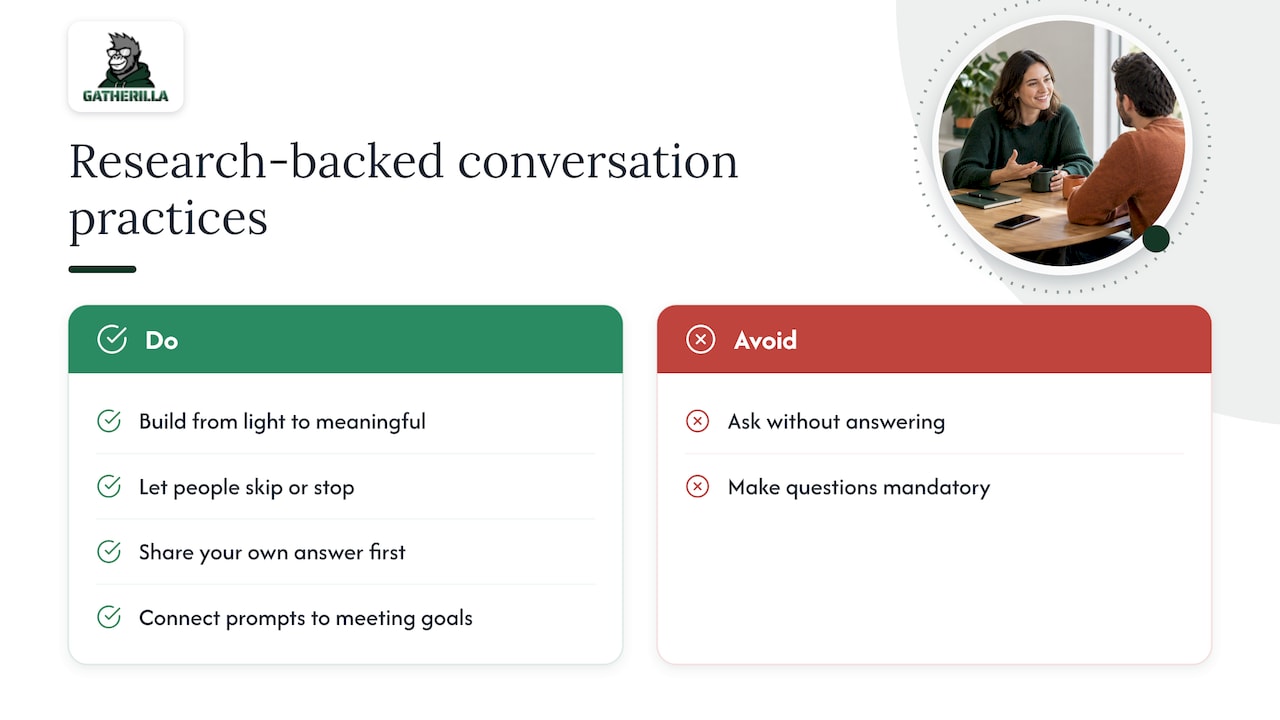
There is also a practical angle. Practitioners who write about remote meetings suggest that icebreakers work best when connected to the meeting’s goal, for example a prompt about staying calm before a conflict-resolution conversation. Tie-ins like this reduce the sense that the exercise is a waste of time.
Five rules before you ask the first question
- Go first. Answer your own question in two or three sentences. It sets the length and the depth.
- Offer an exit. Say “Pass is a fine answer” once, early. You rarely have to say it again.
- Keep it under three minutes. If the conversation takes off, great. If not, you have not burned the meeting.
- Avoid anything a person could feel obliged to answer. Skip questions about family plans, health, religion, politics, age or finances. In the US, some of these topics can also create legal risk for a manager, so check with your HR team if you are unsure where the line sits for your company.
- Match the power dynamic. A manager asking a report “What is your biggest fear?” is a different act from two peers asking it. When you hold the power, choose lower-stakes questions.
30 one-on-one icebreaker questions, by situation
First meetings and new relationships
Use these when you barely know each other, such as a new manager, a new buddy or a cross-team intro.
- What did you work on before this, and what part of it do you miss?
- What is the best thing you have learned in the last month?
- What is your ideal working day, start to finish?
- Is there a small thing about how you like to work that people usually do not guess?
- What is one thing you are looking forward to in this role or project?
- What does a good first 30 days look like to you?
- Where did you grow up, and what is one thing about it you would recommend?
Weekly check-ins with a direct report or peer
These work as a repeating opener. Rotate through a handful and let the person pick.
- What is giving you energy this week, and what is draining it?
- On a scale of 1 to 10, how full is your plate, and what would move it one point?
- What is one small win from this week that nobody saw?
- What are you looking forward to outside of work this week?
- What is something you read, watched or listened to that stuck with you?
- If this week were a weather forecast, what would it be?
- What is one thing you would like me to do more of, or less of?
Light and fun, for a low-stakes opener
Good for peers, mentors or a Friday catch-up.
- What is your go-to meal when you do not feel like cooking?
- What is a skill you would learn instantly if you could?
- What is the best purchase under $50 you have made recently?
- What was your first job, and what did it teach you?
- Which app on your phone would you hate to lose?
- What is a hobby you started and quietly abandoned?
Deeper, for established trust
Only use these when the relationship is solid, and say out loud that skipping is fine.
- When did you last feel really proud of your work, and what made it feel that way?
- Who taught you the most about how to work, and what did they do?
- What is something you have changed your mind about in the last year?
- What would you want to be known for on this team?
- What is a risk you would take if you knew it would be well received?
Work-linked primers
These prime the conversation you are about to have.
- Before a feedback conversation: when was the last time feedback helped you, and what made it land?
- Before a planning session: what is one thing that would make this quarter feel successful?
- Before a career conversation: what part of your job would you do for free?
- Before a hard topic: how do you prefer to hear difficult news, in writing first or live?
- Before a project kickoff: what is the one thing that has derailed you on similar projects?
Five formats you can run on a video call
Questions are one tool. These formats work when you want a change of pace.
One Word
Each of you answers with a single word, such as “How are you arriving today?” Then each of you can add one sentence if you want. It takes under a minute and it is easy to skip the explanation.
Rose, thorn, bud
One good thing, one challenge, one thing you are looking forward to. It doubles as a status check and works well in weekly check-ins.
Two truths and a lie, one-on-one edition
It works with two people if you keep it light and skip the work-related facts. Choose a theme like “travel” or “food” so it takes two minutes.
Show and tell
Ask the other person to hold something up to the camera: a mug, a desk object, a book on the shelf. People tell the story behind an object more easily than they answer a question. It is also a good reminder that you are both in real rooms.
Pick a number
Prepare a numbered list of five or six questions from above. Ask the other person to pick a number. It adds a touch of chance and lets them feel they chose.
One-on-one icebreakers for onboarding
A new hire’s first conversations with a manager and buddy shape how they feel about the job. Research on onboarding supports leaning on the social side: a study in the Academy of Management Proceedings found that supportive, social-focused socialization tactics are linked to better outcomes than bureaucratic ones. Its authors also warn that the aversive end, such as hazing, goes with higher turnover intentions and strain. In plain terms: icebreakers for new hires should be welcoming, not a test.
A few onboarding rules:
- Avoid “fun fact” pressure. Many new hires have not yet decided how much they want to share. Offer a menu of three questions and let them choose.
- Share your own first-week story. It signals that awkwardness is normal.
- Mix work and personal. Pair one personal question (“What did you do to unwind after your first week?”) with one practical one (“What is still confusing?”).
- Make it a series. A buddy pairing that meets for 15 minutes twice a week for a month does more than a single big welcome call.
A 2026 paper on a gamified onboarding approach, OnboardTogether, reports improved psychological need satisfaction and social connection among new hires. That is a study of one specific design, so treat it as a sign that structure and play can help, not as a guarantee for any tool.
What we have learned about this at Gatherilla
We build a browser-based team-building platform, so we spend a lot of time thinking about why teams do not bond. One pattern stands out: connection fades when it depends on a big event. Quarterly offsites and one-off welcome calls are nice, but a pair of coworkers who have never spoken outside of tickets will not become comfortable with each other on the strength of a single session.
That is why we focus on small, frequent, low-friction moments. A one-on-one icebreaker is the simplest form of that. It needs no preparation, no download and no account, only a good question and a willingness to answer first.
Our advice, from watching how teams use short activities:
- Tiny and regular beats big and rare. Two minutes a week for a year is more connection than a two-hour event.
- Let people choose. Opt-in depth is what keeps it from feeling like forced fun.
- Make it about the work too. If the icebreaker has a link to the agenda, nobody feels they are wasting time.
- Do not turn it into a performance. The aim is a warmer conversation, not a score.
— Thomas
Making it a habit instead of a one-off
One-on-ones are recurring by design, which is an advantage. Here is a simple way to build the habit:
- Pick a short set of five or six questions you like.
- Put the first question in the meeting agenda so both of you can think about it in advance.
- Alternate who chooses the question each week.
- Every month or so, replace one question with a new one.
- If a question flops, drop it without comment.
If you manage a group and want to give your whole team a shared warm-up too, our guides on remote icebreaker games, two-minute Zoom icebreakers with scripts and zero-prep five-minute icebreakers cover the group version. For HR leaders who care about the safety angle, see our guide to icebreakers that build psychological safety.
When a one-on-one icebreaker is the wrong move
Not every conversation needs one. Skip it when:
- The other person has just arrived with urgent bad news or is clearly stressed.
- You are about to deliver a performance review or a layoff notice. A light icebreaker before heavy news can feel dismissive.
- You have already met twice this week and the rapport is clearly there.
- The other person has told you, directly or indirectly, that they prefer to get straight to business. Respect it.
In those cases, a simple “How are you doing, really?” followed by a real pause is enough.
Adding games without making it awkward
Some pairs, especially peers or a mentor and mentee, enjoy a quick game as an opener. A daily word or trivia challenge works well because both people can play on their own time, then compare answers in the call. It also gives you a built-in conversation starter that is not about either person’s private life.
Gatherilla’s free tier gives you access to a set of games to try. The Premium plan is listed at $0.50-1.00 per month per seat or $5-10 per year per seat, and adds more activities, reporting and priority support. Games run in the browser with no downloads, and they work with any video conferencing tool. You can see the current options on the Gatherilla pricing page.
FAQ
How long should a one-on-one icebreaker take?
One to three minutes is enough. If the conversation naturally takes off, let it, but do not plan on more. The point is to warm up the next 30 minutes, not to replace them.
What if the other person does not want to answer?
Let them pass without comment and move on to the next question or the agenda. Wharton’s guidance says participants must feel free to skip questions or stop at any time. Forcing an answer undoes the trust you are trying to build.
Should a manager use icebreakers with direct reports?
Yes, if they are light, optional and mutual. Pick lower-stakes questions, go first, and avoid anything personal enough that a report would feel they have to answer to look cooperative. Weekly work-linked prompts, such as a small win or what is draining energy, are the safest place to start.
Do icebreakers work on video calls?
They can. Remote workers miss the informal interactions that happen more naturally in person, and a short, structured prompt is one way to replace a little of that. They work best when they are brief and connected to what you are about to discuss.
What are good icebreakers for a first meeting with a new coworker?
Ask about the work they have done before, what a good first month looks like, or what they are looking forward to. These feel natural and reveal useful information. Avoid anything that asks for private details until you know each other better.
Sources
- Create Authentic Connections with Virtual Team Members, Wharton Executive Education
- The Daily Dynamics of Informal Interactions and Psychological Safety, Academy of Management Proceedings
- Repatterning Interactions in Remote Work Environments, Organization Science
- 30 Icebreakers to Kickstart Your Remote Team Meeting, Routine
- Until You’re One of Us: Comparing Workplace Hazing and Conventional Onboarding, Academy of Management Proceedings
- OnboardTogether: A Gamified Approach to Enhancing Employee Motivation and Connection During Onboarding