

Virtual Birthday Games for Work: 12 Ideas That Aren't Awkward

The best virtual birthday games for work are short, optional and built around the person being celebrated, not around a competition. Think a 10-minute trivia round about the birthday person’s favorite things, a collaborative card, or a quick “guess the baby photo” game, all run in the browser so nobody has to install anything. Below you’ll find 12 games that work on any video call, a simple 15-minute format, and the etiquette that keeps a birthday from turning into forced fun.
TL;DR
- Keep it to 10 to 15 minutes, and let the birthday person opt in, opt out or choose the format.
- Pick games that lower the barrier to talking, such as trivia, guessing games and word challenges, rather than ones that rank people against each other.
- Make the game about the person: their favorite things, their stories, their teammates’ guesses.
- Don’t let a birthday be your only moment of appreciation. Pair it with regular recognition throughout the year.
- Browser-based games with no downloads or accounts save the organizer the setup hassle.
Table of Contents
- Why birthdays are harder to get right on video
- Before you pick a game: ask first
- 12 virtual birthday games for work
- A 15-minute run of show
- Choose games that lower the barrier, not raise the stakes
- What makes a birthday feel real instead of performative
- Our perspective: make it a habit, not an event
- Running these games with Gatherilla
- Common mistakes to avoid
- A quick setup checklist for the organizer
- FAQ
- Sources
Why birthdays are harder to get right on video
In an office, a birthday means a cake in the kitchen and a slightly off-key song. People drift in, take a slice and drift out. On a video call, there is no drifting. Everyone is on screen at once, and the birthday person is the center of attention for as long as the call lasts.
That is why a lot of remote birthday celebrations go wrong. Forbes contributor Benjamin Laker notes that workplace birthdays have become complicated: some employees thrive on public attention while others find it deeply uncomfortable. His advice is to avoid mandatory public celebrations and to let people choose their own level of participation.
A game helps because it moves attention off the individual and onto an activity. Instead of 12 people staring at one person while they blush, everyone is guessing, drawing or answering. The birthday person gets celebrated, and nobody has to perform.

Before you pick a game: ask first
The most useful step costs nothing and happens before the party. Ask people how they want to celebrate.
The same Forbes piece recommends asking employees during onboarding about their preferred celebration style, including whether they want to opt out entirely. That respects personal and cultural boundaries, and it saves you from guessing. Some people don’t celebrate birthdays for religious or personal reasons. Others simply don’t want a spotlight.
A simple form works. Offer four choices:
- A live game with the team on a call
- A shared card or message thread, no call
- A private note from the manager
- Nothing at all
Store the answer next to the birthday date, and honor it every year. If you’re an HR lead setting this up for a new hire, put it in the onboarding checklist with the T-shirt size and the preferred name.
12 virtual birthday games for work
Every game below can run on a standard video call with 4 to 25 people. Times are for the game itself, not setup.
Games where the birthday person is the star
1. Guess the birthday person’s answer (5 to 8 minutes). Before the call, collect five answers from the birthday person: favorite snack, dream vacation, first job, a film they’d watch on repeat, a skill they’d love to learn. During the call, teammates guess. Whoever matches the most wins a round of applause. It’s trivia, but personal, and it shows you know your colleague.
2. Baby photo or old photo match (8 to 10 minutes). Ask the birthday person to share a childhood photo, or ask for three photos from different eras. Teammates guess which photo goes with which clue. Only do this if they said yes in advance.
3. Two truths and a lie, birthday edition (10 minutes). The birthday person writes three statements about their year: two true, one invented. The team votes. It surfaces stories that never come up in standups.
4. The “how well do you know them” quiz (10 minutes). A teammate who works closely with the birthday person writes eight multiple-choice questions. The group answers, and the birthday person reveals the right answer to each one.
5. Birthday year trivia (5 to 8 minutes). Build a quick quiz around the year they were born: music, films, tech, headlines. Keep it light. Skip it if the age might be a sensitive subject for the person or the group, which is another reason to ask first.
Games for the whole team
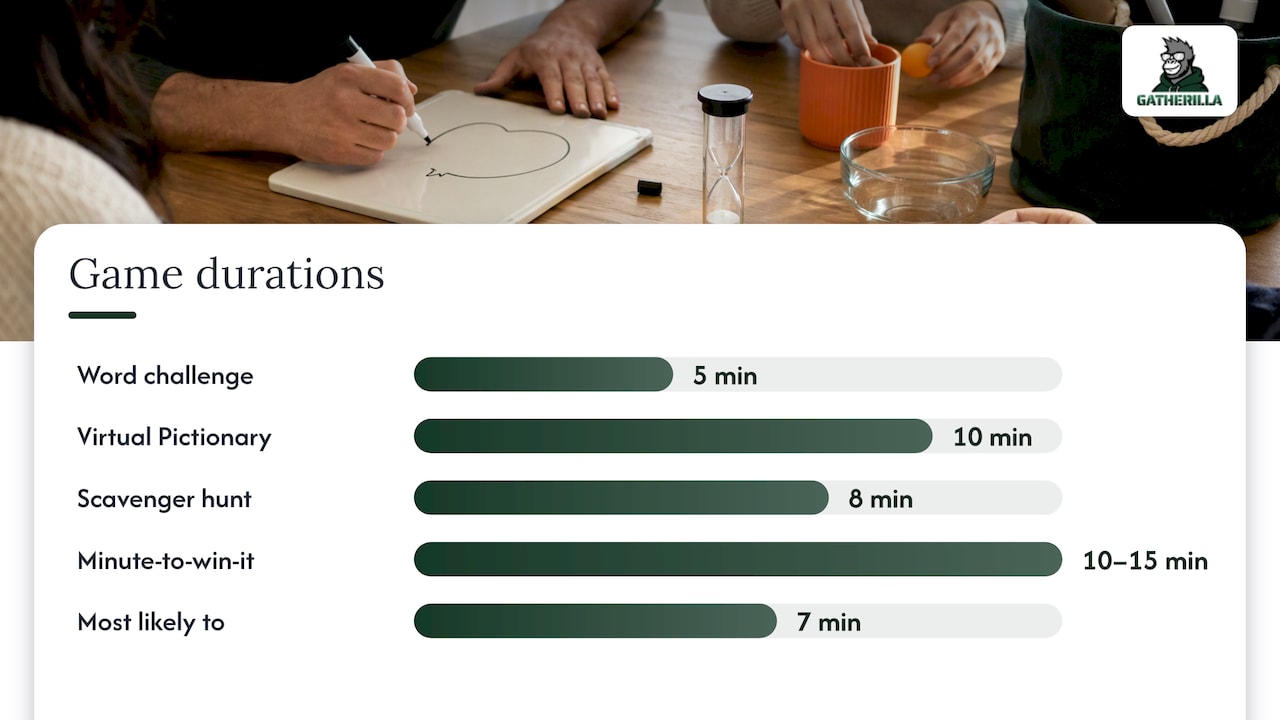
6. Word challenge with a birthday twist (5 minutes). Run a word-guessing game where every answer relates to celebration: cake, candle, balloon, confetti. It’s fast, nobody needs to be artistic, and quieter teammates can participate by typing instead of speaking.
7. Virtual Pictionary (10 minutes). Use a shared whiteboard. Teammates draw things from the birthday person’s world: their hometown, their favorite food, their pet. Drawing badly is part of the fun.
8. Scavenger hunt from home (8 minutes). Call out items: something yellow, your oldest mug, something that makes you smile. Teams have 60 seconds each round. The items reveal a bit of everyone’s home without anyone giving a tour.
9. Minute-to-win-it challenges (10 to 15 minutes). Short physical challenges using household items, such as stacking cups or balancing a pen. Our guide to virtual Minute to Win It games has setups that work on camera.
10. Most likely to (7 minutes). Teammates vote on who is most likely to do something silly or kind. Keep prompts positive and avoid anything about appearance, age or personal life. Make it opt-in for votes, too.
Low-key options when a call isn’t the right fit
11. Collaborative card with a game inside (asynchronous). Each teammate adds a message, and the card includes a short prompt: “Describe our colleague in three words” or “Share a favorite memory working together.” The birthday person opens it on their own time.
12. Daily challenge dedicated to the birthday person (5 minutes, asynchronous). Run a daily word or trivia challenge with questions about the colleague, and let teammates play whenever they have a break. The team shares scores in chat, and the birthday person sees the whole thread afterward. This suits distributed teams across several time zones.
A 15-minute run of show
Short meetings are underrated. Gallup’s 2026 workplace findings point out that 15 to 30-minute sessions focused on recognition or personal connection are often more impactful than 30 to 60-minute ones when they happen regularly. A birthday call fits that shape well.
Here’s a format you can copy:
| Minute | What happens |
|---|---|
| 0 to 2 | Host welcomes everyone, shares one sentence about why the birthday person matters to the team |
| 2 to 10 | One game from the list above, ideally Guess the birthday person’s answer or the how-well-do-you-know-them quiz |
| 10 to 13 | Each person who wants to says one thing they appreciate about the birthday person, in the chat or aloud |
| 13 to 15 | Birthday person says thanks, or doesn’t, and the call ends on time |
Ending on time is a courtesy. Nobody should feel they have to stay for an extra round of silence.
Choose games that lower the barrier, not raise the stakes
Games can backfire if they feel like a performance review in costume. A Swedish study on gamification in digital workplaces argues that successful games should not center on competition or individual performance. They should lower the barrier for social interaction and prioritize safety, voluntariness and meaningfulness.
In practice, that gives you a few rules:
- Make winning meaningless. Prizes of applause or a funny emoji are enough. If you use a leaderboard, keep it team-based or just for laughs.
- Offer more than one way to participate. Chat, voice and drawing should all be valid.
- Let people pass. A “pass” button, spoken or typed, removes the dread.
- Skip anything that depends on physical ability, language fluency or personal disclosure.
The evidence that social games help is encouraging, though you should read it with care. A 2025 study of 323 people found that team-based challenges and structured contact points promote social interaction in virtual teams. That supports using games for connection. It doesn’t tell you any one birthday game works for every group.
What makes a birthday feel real instead of performative
A game is the vehicle. The message is “we know you and we’re glad you’re here.”
Forbes makes a point that surprises many managers: employees are more engaged by thoughtful gestures that show they’re known, such as a personal message from a leader or time off to celebrate with family, than by expensive gifts or complex events. You don’t need a catering budget or a courier service.
Gallup draws a useful distinction between recognition and appreciation. Recognition rewards performance. Appreciation acknowledges someone’s intrinsic value. A birthday is an appreciation moment, and the game should reflect that: questions about who they are, not what they delivered last quarter.
The same Gallup piece warns against relying only on special occasions. Birthday celebrations feel hollow if people get no feedback the other 364 days. If your team has no regular recognition habit, start there. Our list of 50 employee recognition ideas is a good place to pick from, and our guide to weekly five-minute rituals shows how to make it stick.
For HR leaders thinking about how celebrations connect to the bigger retention picture, this overview of talent retention practices for HR leaders is worth a read alongside your culture plans.
Our perspective: make it a habit, not an event
We build a browser-based platform for remote and hybrid teams, so we see the same pattern again and again. A team runs one big, well-intended celebration, and then nothing for months. People remember the awkward moment more than the effort.
We think birthdays work best as one beat in a daily rhythm. When a team already plays a quick word or trivia challenge every morning, a birthday game is not a special production. It’s the same habit with a personal twist. Nobody has to learn a new tool, create an account or download anything, and that matters when the person organizing is an HR manager with 40 other tasks.
Our advice for anyone planning these:
- Ask each person how they want to be celebrated, and treat “nothing” as a perfectly good answer.
- Keep the game under 10 minutes and the whole call under 15.
- Use games where the answers come from the people, not from a script.
- Pair birthdays with regular peer recognition, so appreciation isn’t tied to the calendar.
A celebration should make someone feel seen. If it makes them feel watched, change the format.
— Thomas
Running these games with Gatherilla
If you want to skip the spreadsheet, the slide deck and the shared-screen fumbling, Gatherilla gives remote and hybrid teams browser-based multiplayer games that work with any video conferencing tool. There’s nothing to download, and daily word and trivia challenges keep the habit going between birthdays. Teams can start on the free plan. Premium adds more games, analytics and priority support, at $0.50 to $1.00 per seat per month or $5 to $10 per seat per year. See plans and pricing or try the games with your team.
For more ideas that fit the same 15-minute window, see our guide to virtual meeting games that build real connection fast, or our work question of the day ideas for the days between celebrations.
Common mistakes to avoid
Making attendance mandatory. A birthday call that people must attend is a meeting with cake emoji. Let people join or skip without explanation.
Surprising someone on camera. A surprise can be lovely for one person and mortifying for another. If you haven’t asked, don’t ambush.
Turning it into a roast. Humor that works in a group of close friends may not land in a team with different cultures, ranks and senses of humor. Keep jokes gentle and aimed at situations, not at the person.
Forgetting time zones. If your team spans coasts or continents, a live call at 9 a.m. Pacific is the middle of the afternoon on the East Coast and evening in Europe. Use asynchronous options like the shared card or daily challenge for some birthdays.
Skipping the people who work in the office. On hybrid teams, people in the room will naturally gather around a cake and leave remote colleagues out. Run the game for everyone on their own screens so the experience is equal.
Celebrating only the birthday. Work anniversaries, finished projects and personal wins deserve the same attention. Our guide to online employee appreciation covers a 30-minute format for managers.
A quick setup checklist for the organizer
- Confirm the person’s preference at least a week ahead.
- Pick one game and one fallback.
- Gather the content: five answers, a few photos, or a prompt list.
- Send the invite with the exact length, such as “15 minutes, optional.”
- Test the link yourself in a browser.
- Assign a co-host to watch the chat.
- Afterward, send the highlights and screenshots only to those who want them.
That’s about 20 minutes of prep for a celebration people will remember. Rotating the organizer role among teammates makes it fairer and spreads the effort around.
FAQ
How do you celebrate a coworker’s birthday virtually?
Ask the coworker how they’d like to celebrate, then pick the lightest format that fits: a 10-minute game on a team call, a shared card with messages, or a private note from the manager. Keep the call short and optional. Personal touches matter more than expensive gifts.
What are good virtual games to play with coworkers?
Trivia, word challenges, Pictionary on a shared whiteboard, two truths and a lie, and quick scavenger hunts all work well. Choose games where everyone can participate through chat or voice and where winning isn’t a big deal. Games about the birthday person’s favorite things add a personal touch.
How long should a virtual birthday celebration last?
Aim for 10 to 15 minutes. Gallup’s findings suggest that short, regular recognition and connection meetings are often more impactful than longer ones. End on time so the celebration doesn’t become an obligation.
What if someone doesn’t want their birthday celebrated?
Respect it without asking why. Collect preferences during onboarding, including an option to opt out, and apply the answer every year. A simple private message from their manager on the day can acknowledge them without a public moment, if they’re comfortable with that.
Sources
- The Right Way To Celebrate Birthdays At Work, Forbes
- A Great Manager’s Most Important Habit, Gallup
- The Remote Workplace Needs Recognition Rituals Too, Gallup
- Den digitala kaffemaskinen: Spelifiering för spontan interaktion i digitala arbetsmiljöer
- Employee Engagement in Virtual Teams