

12 Scrum Icebreakers That Fit Standups, Retros, Planning, Remote Ready

Use short, ceremony-matched icebreakers that run a brief amount of time, stay optional, and adapt to remote setups. Scrum Alliance frames these as trust-building transitions, not fluff, and a tool like Gatherilla can run them without downloads or setup time. Below are 12 you can run today, plus rules for picking the right one and fixing the mistakes that kill engagement.
TL;DR:
- Use visual prompts or asynchronous questions for remote teams, as these increase engagement and reduce the need for live videoconferencing.
- Avoid making icebreakers mandatory, overly personal, or repetitive to prevent disengagement and maintain psychological safety.
- Stick to short, timeboxed prompts, and model responses yourself to set an honest tone and encourage participation.
- Gatherilla offers a no-download platform that simplifies running diverse icebreakers, supporting remote, hybrid, and multiple-team management.
- Regularly review and rotate prompts to keep icebreaker effects fresh and implement quick feedback to prevent fatigue and dropout.
Table of Contents
- 12 Scrum Icebreakers You Can Run This Week
- How to Choose the Right Icebreaker for Your Ceremony
- Running Icebreakers for Remote and Hybrid Scrum Teams
- Mistakes That Kill Icebreaker Engagement
- What Actually Works, According to Practice
- Run These Icebreakers Without the Setup Hassle
- Sources
12 Scrum Icebreakers You Can Run This Week
Every one of these icebreakers fits inside a real sprint schedule. Pick based on the ceremony, not on what feels fun to you as the facilitator.
One-word check-in. Each person says a single word describing their current mood or energy. Purpose: surface hidden friction fast. Timebox: brief. Fits: standup. Tip: model your own word first so the tone stays honest, not performative. Remote-friendly: works in chat or on camera.
Visual check-in. Everyone holds up (or screen-shares) an object near them that represents how they feel. Purpose: quick emotional read without forcing words. Timebox: short. Fits: standup, retro. Remote-friendly: strong for remote icebreaker games where cameras are already on.
Weather report. “If your week were weather, what would it be?” Purpose: emotional check-in with a light metaphor. Timebox: short. Fits: retro opener. Tip: rotate who asks the question each sprint.
Two-minute puzzle. Drop a quick logic riddle or lateral-thinking question into the chat. Purpose: warms up problem-solving brains before planning. Timebox: a couple minutes. Fits: planning. Remote-friendly: post it in the thread five minutes early.
Gratitude round. One sentence: something a teammate did that helped this sprint. Purpose: builds trust and surfaces unsung work. Timebox: brief. Fits: retro. Tip: keep it optional; forced gratitude reads as fake.
Two truths, one lie (work edition). Share three “facts” about a recent bug, tool, or project. Team guesses the lie. Purpose: playful bonding without personal disclosure. Timebox: a few minutes. Fits: kickoff. Remote-friendly: works well async in a Teams thread.
Engineering bingo. A shared card tracks sprint folklore: deploy delays, recurring blockers, “it works on my machine” moments. Teams tally hits during the sprint and review the card at the retro. This turns inside jokes into signal about what’s actually slowing the team down. Timebox: short review time. Fits: retro.
Today I learned. Each person shares one small thing they picked up this week, technical or not. Purpose: normalizes learning out loud. Timebox: brief. Fits: standup or retro.
What’s one risk? Quick round on a risk nobody’s said out loud yet about the current sprint. Purpose: surfaces blockers before planning locks in. Timebox: brief. Fits: planning.
Emoji poll. Post a question, everyone reacts with an emoji instead of typing. Purpose: fast temperature check with zero pressure. Timebox: brief. Fits: standup. Remote-friendly: built for async tools.
Async question of the day. Post a prompt in Slack or Teams the night before; people answer whenever. Purpose: includes people across time zones without meeting time. Fits: any ceremony, especially kickoff. Remote-friendly: this is the core pattern behind a good question-of-the-day ritual.
Creative prompt. “Describe your current sprint as a movie genre.” Purpose: injects humor and reveals mood indirectly. Timebox: brief. Fits: kickoff, retro.
How to Choose the Right Icebreaker for Your Ceremony
Match the depth of the icebreaker to the ceremony’s purpose. TeamRetro’s guidance recommends quick check-ins for standups, reflective prompts for retros, and slightly longer ones for kickoffs, where teams have room to actually connect.
Before picking one, run through three questions:
- How much time do you actually have? A standup icebreaker dies at 30 to 60 seconds; a retro opener can stretch to 5 minutes.
- How much psychological safety does the team have right now? New teams need lower-stakes prompts than teams that have shipped three sprints together.
- What effect do you want? Energize a sluggish Monday standup, help a retro settle into reflection, or build connection at a kickoff.
Four rules keep any icebreaker from falling flat: model an answer yourself first, rotate who picks the prompt each sprint, timebox strictly and stick to it out loud, and never make participation mandatory. TeamRetro’s research ties these exact behaviors to higher psychological safety and uptake.
Pro Tip: Keep a running list of many prompts instead of reusing your favorite few. Centercode’s research on rotating question banks found that repetition is what kills an icebreaker’s effect over time, not the format itself.
Running Icebreakers for Remote and Hybrid Scrum Teams
Distributed teams need a slightly different toolkit. Visual and async formats do the heaviest lifting.
- Use visual prompts (an object, a photo, a screen-share) instead of relying on verbal answers only.
- Post async questions in a Slack or Teams thread the night before, so contributors across time zones can answer without staying up late.
- For low-bandwidth participants, use a shared doc or simple form instead of requiring live video.
- Run a two-step flow: post the prompt 24 hours early, then surface three or four highlights live to keep the meeting itself short.
- Add emoji reactions or a quick poll for teams that are camera-shy or in back-to-back calls all day.
If your Scrum team already uses Microsoft Teams, tool-native formats tend to get more participation than a separate app; see how that plays out with these Microsoft Teams icebreaker formats.
Mistakes That Kill Icebreaker Engagement
- Making it mandatory. Forced participation turns a trust exercise into another chore. Keep it opt-in every time.
- Picking overly personal topics. “What’s your biggest fear?” has no place in a 9am standup. Stick to work-adjacent or low-stakes prompts.
- Repeating the same three prompts. Predictability breeds silence. Rotate from a larger bank regularly.
- Ignoring the timebox. A 60-second check-in that runs 8 minutes trains the team to dread it next time.
- Skipping accessibility. Add captions for video prompts, alt text for images, and always offer a text-only option instead of leaning on audio alone.
Ask for quick feedback every few sprints and change the format if people start disengaging. A slight cadence adjustment, weekly to biweekly, often fixes fatigue before it becomes resentment.
What Actually Works, According to Practice

Most teams overthink icebreakers, then abandon them after two awkward tries. The fix is not a better icebreaker. It’s a shorter one, run consistently, with the facilitator going first.
Engineering teams in particular respond better to shared problem-solving formats, like engineering bingo, than to party-style prompts borrowed from HR training decks. That is not a small distinction. A retro that opens with a tally of the sprint’s recurring blockers gets more honest engagement than one that opens with “what’s your spirit animal.” A tool like Gatherilla’s no-download setup removes the friction that usually kills these rituals: no app to install, no five-minute delay before the meeting even starts. For HR leads and team leads managing multiple squads, that setup speed is often the difference between a ritual that survives past week two and one that quietly disappears from the calendar.
— Thomas
Run These Icebreakers Without the Setup Hassle
Gatherilla gives Scrum teams a way to run every icebreaker on this list without installing anything or fumbling with a new tool mid-standup. Open a link, start the game, done, whether your team is fully remote, hybrid, or split across three time zones.
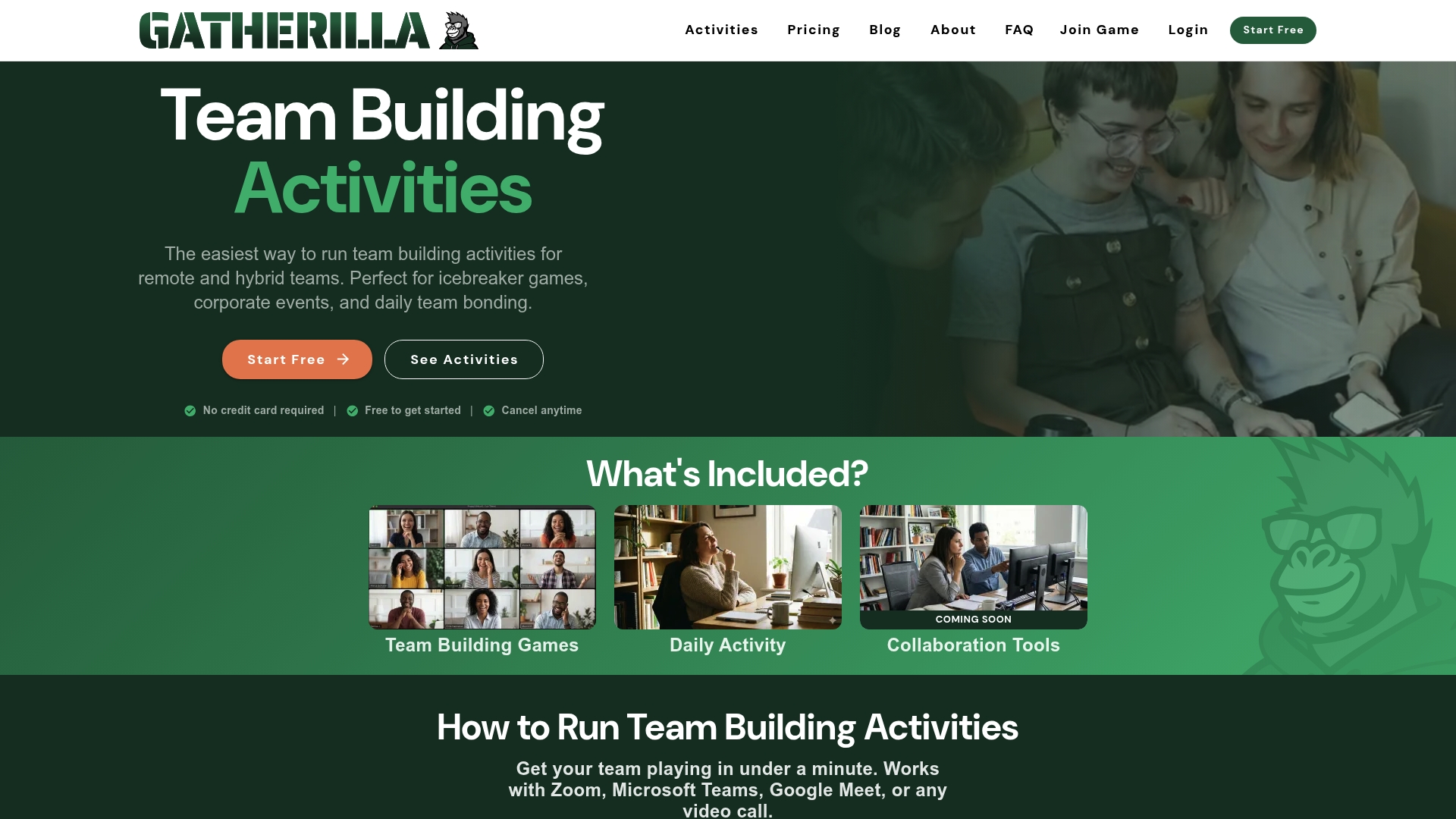
The free tier gives you access to daily challenges and a solid set of quick multiplayer games, enough to test whether your team actually engages before you commit to anything. Upgrading unlocks more activities, participation analytics, and priority support, useful once you’re running icebreakers across multiple squads. Teams that swap ad-hoc Zoom games for a dedicated platform tend to see icebreakers survive past the first few sprints instead of quietly dropping off the calendar. If you’re managing team culture across several squads, this kind of scalable team management approach pairs well with a consistent icebreaker cadence. Check out Gatherilla and start a free session with your team today.
Sources
- Five Icebreakers Scrum Alliance Scrum Masters Use to Build Trust on Teams
- Icebreaker questions for agile and scrum teams | TeamRetro
- 100 Icebreaker Questions for Product and Development Teams
- 10 Fun Async Icebreakers for Remote Agile Teams