

Daily Team Challenge Ideas for Remote and Hybrid Teams

The best daily team challenges take five minutes or less, need no prep, and ask for one small move: guess, answer, vote or share. Below are 15 you can start this week, grouped by what they do for your team. You’ll also find a scoring approach that keeps things friendly and a four-week plan for making the habit stick.
TL;DR
- Keep each challenge to five minutes or less and put it at the same time every day. Consistency matters more than cleverness.
- Mix three types: knowledge (trivia, word puzzles), sharing (questions, photos) and recognition (shout-outs).
- A 2025 study of hybrid employees links daily team rituals to small gains in trust, creativity and psychological safety that add up over time.
- Make it optional, low-stakes and easy to join from any device, or the people who need it most will skip it.
- Track participation, not winners. A challenge that 70% of the team joins beats a clever one that 15% joins.
Table of Contents
- Why a daily challenge beats an occasional event
- What makes a daily challenge worth repeating
- 15 daily team challenge ideas
- Scoring and leaderboards without the awkwardness
- A four-week rollout plan
- Making it safe to take part
- Daily challenges for new hires
- Our perspective: make it a habit, not an event
- Run daily challenges without the setup
- Seasonal twists to keep it fresh
- FAQ
- Sources
Why a daily challenge beats an occasional event
A quarterly virtual happy hour is easy to schedule and easy to forget. A daily challenge works differently. It gives people a reason to interact in the gaps between meetings, which is where remote teams lose the most.
The gap is real. An EY survey reports that 63% of fully remote workers go at least one full workday a week without a single real-time conversation, against 35% of fully in-office workers. The same report names psychological safety as the top factor people say boosts their sense of belonging.
That is the case for small, repeated moments. The 2025 hybrid-work study mentioned above, covering 323 employees, found that at least one daily team ritual was positively associated with self-reported creativity, trust and psychological safety. The authors note the effect per day is small. The value comes from stacking those days.
Trust has two parts, according to collaboration research in PMC: cognitive trust (I know you deliver) and affective trust (I feel connected to you). Remote work builds the first easily and starves the second. Daily challenges feed the second.
What makes a daily challenge worth repeating
Before the list, five filters. Run any idea through them.
- Five minutes, hard stop. If it regularly runs over, people start skipping it.
- Zero prep for the host. If someone has to build slides every morning, it dies by week three.
- Low skill barrier. A new hire and a ten-year veteran should both be able to take part.
- Opt-in and low stakes. Prizes should be bragging rights. Pressure kills the social glue.
- Works in any setting. It should run in chat, on a call or in a browser, so remote and hybrid staff play on equal terms.
15 daily team challenge ideas
Knowledge and brain challenges
These suit teams that are not yet comfortable sharing personal things. They give people something to talk about without exposing anyone.
- Daily word puzzle. Everyone solves the same word puzzle and posts their result without spoilers. Comparing guess counts creates instant banter.
- Three-question trivia. One category a day (geography Monday, movies Tuesday, company history Wednesday). Rotate who picks the category. Our virtual team trivia playbook has ready-to-run formats.
- Guess the coworker. Collect one odd fact from each person ahead of time, then reveal one a day and let the team guess who it belongs to.
- Minute-to-win-it round. One 60-second physical or desk challenge, such as stacking cups or sorting paper clips by color. Several options are in our guide to virtual Minute to Win It games.
- Mini scavenger hunt. “Find something blue within 60 seconds.” Quick, silly and camera-friendly. For bigger sessions, see these virtual scavenger hunt ideas.
Sharing and connection challenges
These build the affective trust mentioned earlier. Start light and go deeper as the team warms up.
- Question of the day. A single prompt in chat: best meal this week, a skill you wish you had, the first job you ever had. We collected prompts that fit the workplace in work question of the day ideas.
- Desk or window photo. Post the view from where you work today. It helps remote and hybrid colleagues see each other’s real context.
- Two truths and a lie, one person per day. Rotate through the team alphabetically so everyone gets a turn without being put on the spot.
- Desert island pick. Each day, a new constraint: one app, one snack, one song. People defend their choices in a thread.
- Show and tell. A thirty-second look at a mug, a plant, a pet or a tool someone loves. Simple, and it often leads to real conversation.
Recognition and values challenges
Gallup’s guidance for remote managers is to go beyond checking in and instead intentionally help people connect and use their strengths. These challenges put that into practice.
- Daily shout-out. One person thanks one colleague for something specific and links it to a company value. Rotate the giver.
- Strength spotting. Name one strength you saw in a teammate this week. Over a month, everyone hears theirs.
- Win of the day. One line: something that went right, however small. It is the cheapest morale boost on this list.
- Ask-me-anything for newcomers. A standing thread where anyone can ask a “dumb” question about how things work, and anyone answers.
- Weekly awards roundup. Friday, vote on the week’s funniest, most helpful and most creative moments. See virtual awards ceremony ideas for formats that need no production crew.
For more formats beyond daily five-minute ones, our roundup of remote team challenge ideas covers longer, weekly challenges.
Scoring and leaderboards without the awkwardness
Leaderboards motivate some people and shut down others. A few ways to keep them healthy:
- Reward streaks, not wins. Count days participated. Everyone can climb, regardless of trivia knowledge.
- Use team scores. Add up results across the team and compare to last week. You compete against yourselves.
- Rotate the stakes. The winner picks tomorrow’s category or the next meeting’s icebreaker. That’s a prize with no cost.
- Keep a quiet mode. Let people join without appearing on a board if they prefer.
Competition works best when it is visible but not the point. If you notice a few people dominating, change the format to something luck-based or opinion-based for a week.
A four-week rollout plan
| Week | Focus | Example challenges | What to measure |
|---|---|---|---|
| 1 | Easy wins | Word puzzle, three-question trivia | How many people join on day one, day five |
| 2 | Light sharing | Question of the day, desk photo | Replies per prompt |
| 3 | Recognition | Daily shout-out, win of the day | Number of different people giving thanks |
| 4 | Mix and vote | Rotating formats, Friday vote | Ask the team what to keep and drop |
At the end of week four, keep the two formats people actually used and replace the rest. A daily habit that the team picked works better than one handed down.
Making it safe to take part
Virtual teams have fewer chances to read the room, so leaders have to work harder to make space. Research on virtual team effectiveness in the American Journal of Health Promotion says leaders must proactively create room for everyone to speak up, because they see fewer cues than in a physical office.
In practice:
- Always allow a pass. “Skip today” is a valid answer.
- Avoid prompts about family, health, religion or politics unless people choose to share.
- Go first yourself. When a manager answers a question honestly, the rest follow.
- Watch time zones. If the challenge lives at 9 a.m. Eastern, your Pacific and offshore teammates are either early or out. Use an async format that stays open for 24 hours.
Daily challenges for new hires
New employees often hesitate to ask for help or feel they are disturbing others, a pattern that came up in a study of remote onboarding of software developers. A daily challenge gives a newcomer a low-risk way to speak in front of the team in week one.
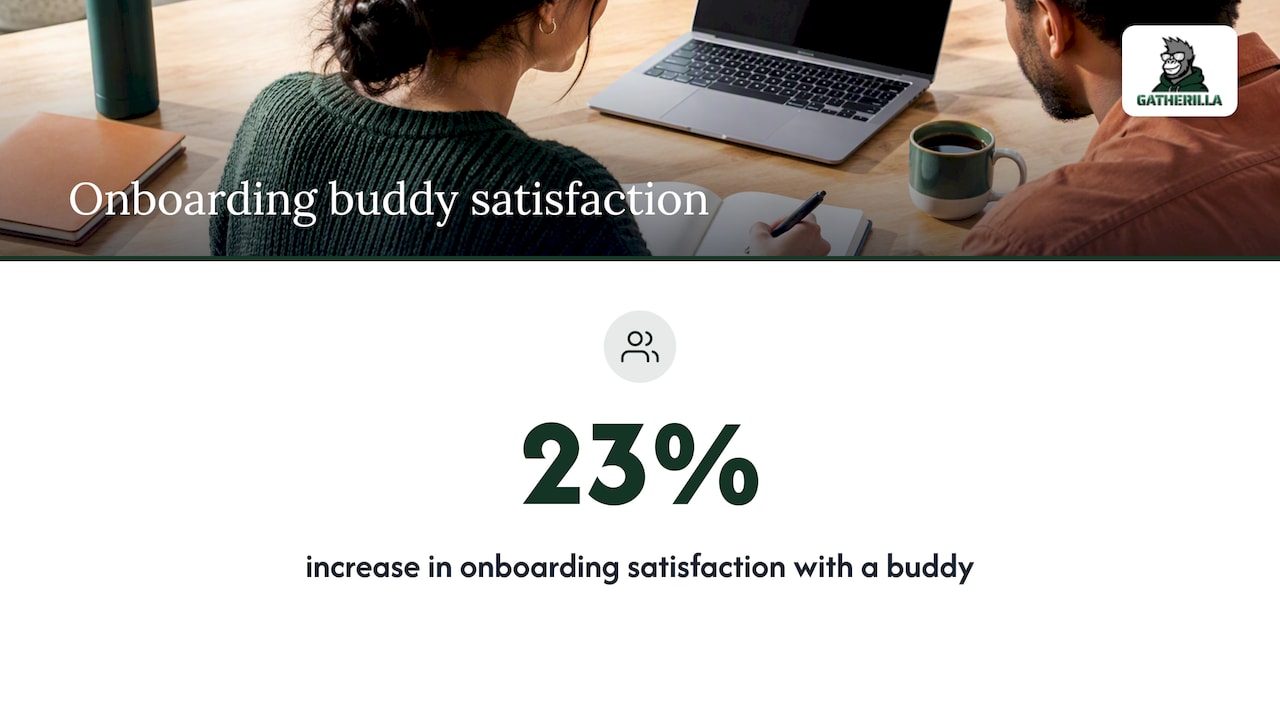
Pair it with a buddy. Research summarized by tinyteam reports that new hires with an onboarding buddy report a 23% increase in satisfaction with onboarding, and that the buddy works best when from a different team, which widens the newcomer’s network. A shared daily puzzle is a natural thing for a buddy pair to do together. For a broader view, see these onboarding best practices for HR, and our own list of onboarding buddy activities for the first 90 days.
Our perspective: make it a habit, not an event
We built Gatherilla around one belief: team culture is made of small repeated moments, not big annual ones. The teams that stay connected are rarely the ones with the most elaborate offsite. They are the ones where something light happens every day and nobody has to organize it.
That is why we focus on zero-preparation games that run in the browser, with no downloads and no accounts needed to join. Every extra step costs participation, and participation is the whole game. It is also why we pair daily word and trivia challenges with peer recognition tied to company values: fun gets people in the door, and recognition gives them a reason to return.
One caution from the research and from what HR leaders tell us: keep expectations honest. The effect of a single daily ritual is small. Do not expect one trivia round to fix a disengaged team. Expect it to make the next hard conversation a little easier, and the one after that.
— Thomas
Run daily challenges without the setup
If you would rather not build and host these yourself, Gatherilla runs them for you. It is a browser-based platform with daily word and trivia challenges, icebreakers for meetings, onboarding games and real-time leaderboards. It works with any video conferencing tool.
There is a free tier to try it with your team. Premium, which adds more games, analytics and priority support, is listed at $0.50 to $1.00 per seat per month, or $5 to $10 per seat per year. See plans and pricing or start from the Gatherilla home page. If you are comparing options first, our guide to virtual team building tools for HR lays out the criteria.
Seasonal twists to keep it fresh
After a couple of months, even good challenges get stale. Seasonal variations reset interest without changing the habit. In October, a virtual Halloween game round works well. In November, try Thanksgiving games that fit into 30 minutes. Keep the daily slot and the format, and change only the theme.
FAQ
How long should a daily team challenge take?
Five minutes or less. Anything longer starts competing with real work and people drop out. If a challenge is popular and people want more, move the longer version to a weekly slot.
Should daily challenges be mandatory?
No. Voluntary participation keeps the tone friendly, and forced fun tends to backfire. Make joining easy, celebrate those who do and never track individual absences.
What are good daily challenges for a team that has never met?
Start with knowledge-based formats such as word puzzles and trivia, then move to light sharing like the question of the day. They give people something to talk about without asking for personal details. Add deeper prompts once people are replying regularly.
How do I measure whether daily challenges are working?
Track participation rate over time first, since it shows whether people want it. Then add a short monthly pulse question about connection to teammates. Treat results as a trend, not a verdict, because the per-day effect is small.
Can hybrid teams do these challenges together?
Yes, if every format works for people at home and in the office. Have office staff join from their own laptops rather than gathering in a room, so remote colleagues are not left watching.
Sources
- EY Global Belonging Barometer 4.0
- Everyday Team Rituals and Work Performance in Hybrid Work (Academy of Management Proceedings)
- Collaboration and Team Science: From Theory to Practice (PMC)
- Can You Manage Employees You Rarely See? (Gallup)
- Optimizing Team Effectiveness: Key Takeaways From the Science With a Focus on the Virtual Context
- Remote onboarding of software developers during a pandemic
- Remote Onboarding: A Guide for Small Teams (tinyteam)