

Virtual Company Event Ideas: Copy Agendas for 30, 60, or 90 Minutes

The best virtual company events mix short, repeatable social rituals with a handful of larger, interactive sessions, and the planners who pull this off well prioritize consistent engagement rituals, accessibility built in from the start, and tech simple enough that nobody spends the opening of the event troubleshooting. Below, you will find ideas sorted by prep level, copyable agendas, and the planning checklist we use to match an idea to a goal.
TL;DR:
- Use low stakes activities for new groups, reserve competitive games for established teams, and assign a host when activities need breakout rooms or scoring.
- Collect accommodation needs during registration, offer captions and transcripts by default, and let attendees participate by voice, chat, reactions, or written follow up.
- About 80% of people who use live captions are not hard of hearing, so captions also help attendees process information in noisy or distracting settings.
- Place brief rituals at the start of recurring meetings and pair them with one larger quarterly event; end of meeting slots lose attention.
- Track poll responses, chat activity, or camera use across events, then adjust future formats based on participation rather than relying on the platform’s features.
Table of Contents
- Categorized Virtual Company Event Ideas by Prep Level and Goal
- How to Choose the Right Idea for Your Team and Time Budget
- Tech Setup That Keeps Virtual Events Running Smoothly
- Accessibility and Inclusion Checklist for Virtual Events
- Ready-to-Use Agendas for 30-, 60-, and 90-Minute Events
- Daily Rituals and Micro-Activities That Sustain Engagement
- What Reliably Works Once You Have Run a Few of These
- Running These Ideas with Less Prep Using Gatherilla
- FAQ
- Sources
Categorized Virtual Company Event Ideas by Prep Level and Goal
Not every event needs a budget or a week of planning. The trick is matching the idea to the time you have, the group you are working with, and what you actually want to happen afterward: laughter, learning, or just a sense that people remember each other’s names.
Low-prep quick wins work when you have a short amount of time and almost no setup time.
- Two truths and a lie, speed round: use small groups and keep the round brief; it works because it forces active listening without requiring cameras to be perfect.
- Caption this: share a quirky stock photo in chat and have people submit captions anonymously; it suits any group size, needs little prep, and rewards humor over polish.
- Show-and-tell desk tour: give each person a brief turn to show something on their desk; it humanizes remote coworkers without demanding a story.
- One-word check-in: each person shares a single word for how their week is going; it scales to any size and respects time while still opening a door.
Games and competitions carry more energy and suit teams that already have some rapport.
A virtual trivia session built around company history, pop culture, or department-specific inside jokes can work well for groups, and needs medium prep if you are writing your own questions. Our Virtual Team Trivia playbook lays out a ready-to-run structure. Minute-to-win-it style challenges, using household objects and a timer, work well in breakout teams and translate well online; our Virtual Minute to Win It guide covers the logistics. Scavenger hunts, where participants retrieve an object from home within a time limit, suit groups looking for a tighter pace and need little prep.
Creative workshops give teams something to make together, which tends to produce more lasting conversation than games alone.
Collaborative mural building using a shared digital whiteboard works for groups and needs medium prep since someone has to set up the canvas and prompts beforehand. Cooking or mixology demonstrations, where a host walks the team through a simple recipe, can suit groups of different sizes and need high prep because ingredients and kits often have to be shipped in advance. A guided sketch or doodle session, using nothing but paper and a pen, works for any group size with low prep and tends to lower the stakes for people who feel self-conscious about creative skill.

Celebrations and socials mark milestones and give remote teams a reason to show up without an agenda hanging over the meeting.
Virtual happy hours work for smaller groups so conversation does not fragment, and need little prep. Themed costume or background contests tied to holidays suit any group size as part of a larger meeting, and need little prep. Milestone celebrations, recognizing work anniversaries or project completions with a short tribute video or shout-out round, fit teams of any size and need medium prep to gather the material in advance.
Learning and speaker formats serve teams that want development alongside connection.
A lunch-and-learn with an internal expert covers a skill or project retrospective, works for groups of different sizes, and needs medium prep for the speaker to prepare slides or a demo. An “ask me anything” session with leadership, run as an open Q&A, fits any group size and needs little prep beyond collecting a few seed questions in advance to avoid dead air.
Hybrid-friendly ideas matter because many teams now split time between an office and home, and the format has to work for both.
Synchronous trivia or scavenger hunts translate directly if remote participants join via a large screen with their own device for chat and polling. Asynchronous options, like a photo challenge submitted to a shared channel, let in-office and remote employees participate on their own schedule, then get a brief live reveal and recap during a regular meeting. Mixed-format town halls, where leadership presents live and the chat or a live poll tool carries remote questions, keep both groups genuinely involved instead of making remote attendees passive viewers.
Across all of these, the research on virtual event engagement is consistent: technology alone does not drive participation. Integrating attendee behavior data and real-time adjustments into event planning increases engagement more than the platform or features used, according to a study on virtual event engagement. That means watching what people actually respond to, chat activity, poll completion, camera use, and adjusting the next event accordingly rather than running the same format on autopilot.
Pro Tip: Pair one low-prep ritual with one larger quarterly event rather than trying to run big productions every month: consistency beats scale.
How to Choose the Right Idea for Your Team and Time Budget
Picking an idea without a clear filter is how planners end up running a long trivia night for a team that just wanted a brief check-in. Work through this sequence before you commit to a format.
- Define the objective: are you building familiarity among new hires, celebrating a milestone, or just restoring some social contact after a stretch of heads-down work?
- Gauge audience familiarity: a team that has never met in person needs lower-stakes icebreakers before a competitive game; a tight-knit team can jump straight into something more chaotic.
- Set the time and budget: confirm whether you have a short slot inside a standing meeting or a longer block carved out, and whether you can ship physical kits or need something screen-only.
- Check facilitator capacity: a game with breakout rooms and scoring needs a dedicated host; a show-and-tell round can run itself.
- Flag accessibility needs: ask about camera comfort, hearing or vision accommodations, and time zone constraints before locking the format.
- Plan the follow-up: decide in advance how you will gauge whether it worked, a one-question poll, a reaction count, or a quick comment thread.
Typical durations depend on the format and setting. Group size usually dictates structure more than content: for larger groups, breakout rooms can help make interactive activities manageable.
A short invite template helps set expectations before anyone logs in: “Join us for [event name] on [date] at [time]. This is a camera-optional, come-as-you-are session, no prep needed. We will use breakout rooms for part of the time, and you are welcome to participate by voice, chat, or reaction emoji if that is more comfortable. Expect it to run [duration] minutes.”
Pro Tip: Send the invite with the participation options spelled out; ambiguity about whether cameras are mandatory is one of the biggest reasons people skip optional events.
Tech Setup That Keeps Virtual Events Running Smoothly
The platform choice matters less than how deliberately you use its features. A standard meeting tool works for groups where everyone might speak; a webinar format fits one-to-many presentations like town halls; a dedicated conference platform can make sense for multi-track, company-wide events.
- Breakout rooms: assign a rotating discussion lead per room, cap discussion time visibly with a shared countdown, and rotate groupings between activities so the same people are not always paired together.
- Chat moderation: designate a co-host whose only job is monitoring chat and surfacing questions, since a single host running the main activity will miss most of it.
- Polling: use live polls to check understanding or vote on options rather than relying on unmuted voice responses, which favor louder or more confident participants.
- Redundancy: have a backup join link and a secondary host ready in case the primary connection drops, especially for company-wide events.
- Audio clarity: verify microphone and speaker quality ahead of time rather than just checking room volume, since a clean audio feed matters more for assistive technology than raw loudness.
- Engagement tracking: log simple metrics, like poll response rate, chat message count, or camera-on percentage, so you can compare events over time instead of guessing whether one landed better than another.
Our guide to hybrid meeting engagement covers additional specifics for teams splitting time between an office and remote setups.
Accessibility and Inclusion Checklist for Virtual Events
Accessibility is not a separate project layered on top of your event plan, it is part of the plan itself, and building it in from the start tends to improve the experience for every attendee, not just those who requested an accommodation.
- Gather accommodation needs at registration, including a field for invisible disabilities, so requests do not arrive as a scramble on event day.
- Budget for ASL interpretation or CART captioning when the audience or occasion calls for it, and offer captions and a transcript by default rather than on request.
- Assign a dedicated co-host, sometimes called an access point person, whose job during the event is purely accommodation support.
- Minimize sensory triggers like flashing graphics or sudden loud audio, and build in multiple ways to participate: voice, chat, reactions, or written follow-up.
- Allow attendees to choose their location and keep cameras optional, since requiring video can itself be an accessibility barrier.
Prioritizing a verified audio feed and built-in captioning, rather than assuming a loud enough room is sufficient, reduces cognitive load for everyone on the call, not only attendees who identify as hard of hearing, according to an accessible event checklist.
About 80% of people who use live captions are not hard of hearing according to that same checklist; most use them to process information in noisy or distracting environments, which means captions function as a general usability feature, not a niche accommodation.
Ready-to-Use Agendas for 30-, 60-, and 90-Minute Events
Having a script removes most of the anxiety around running a virtual event, especially for a first-time facilitator. Each of these includes who owns each block and a transition cue.
- Team check-in: Opening ritual, the host leads a one-word check-in with cameras encouraged but optional. Core activity, the co-host runs a trivia round or caption contest. Closing ritual, the host gives shout-outs and previews the next session. Transition script: “Before we wrap, let’s give a quick shout-out to anyone who helped this week.”
- Team activity: Opening ritual, the host welcomes everyone and states the goal. Icebreaker, the co-host runs a quick round in breakout pairs. Main activity, breakout leads run a workshop or game in small groups, rotating the groups during the activity. Closing ritual, the host reconvenes everyone for a recap poll and recognition round. Transition script: “We are switching breakout groups now, same task, new faces, take a moment to get settled.”
- Company celebration: Opening ritual, the host frames the occasion and runs a group photo moment. Core program, mix a speaker segment with a company-wide game or competition with breakout scoring. Social break, offer optional informal chat in smaller rooms. Closing ritual, the host runs milestone recognitions and announces any contest winners. Transition script: “Grab a drink if you have one, we are moving into open social rooms before we close out together.”
A short paste-in description for any of these: “This session is camera-optional and includes breakout rooms. Live captions will be available, and a recording will be shared afterward for anyone who cannot attend live.”
Daily Rituals and Micro-Activities That Sustain Engagement
Big events can generate a spike in energy that fades without something smaller in between. Repeatable micro-rituals are what keep a team feeling connected week to week.
- Question of the day: a single prompt posted in a channel or at the top of a standing meeting, designed to be quick to answer; rotate themes to avoid fatigue.
- Lightning trivia: a quick round at the start of a recurring meeting, kept short so it never eats into the main agenda.
- Leaderboards tied to recognition: track participation or contribution points and surface a leader, which works best when paired with a specific shout-out rather than just a number.
- Rotating show-and-tell slots: give one person a brief turn to share something, spreading the spotlight over time instead of concentrating it in one event.
Timing matters: rituals at the very start of a meeting work better than ones squeezed in at the end, when people are already mentally checked out or rushing to the next call. Our piece on team rituals walks through scheduling patterns that can help sustain participation over time.
These small, routinized moments do more than fill time. Social virtual meeting rituals, short and low-stakes interactions that replace the small talk remote workdays remove, help buffer the loss of incidental connection and restore a sense of belonging among remote employees, according to research on remote workdays and social need fulfillment. The mechanism is not complicated: remote work strips out hallway chats and elevator small talk, and a five-minute ritual at the top of a meeting is a deliberate substitute for that lost contact.
Pro Tip: Rotate one ritual element each month, a new trivia category or a different check-in question, so the format stays familiar but never stale.
What Reliably Works Once You Have Run a Few of These
Successful planners are not necessarily the ones with the biggest budgets; they are the ones who treat structure and surprise as a balance rather than a tradeoff. A tight agenda with one unscripted moment, an open question, a surprise shout-out, tends to outperform either a fully improvised hour or a rigid one with no room to breathe. Facilitator roles matter more than most people expect: splitting host and chat-moderator duties across two people prevents the common failure where good questions get buried because the host is busy running the activity.
If you have little time to plan something, skip the elaborate workshop and run a brief check-in ritual paired with a trivia round, then measure success with a post-event poll asking whether people would want to do it again. That one data point tells you more than a long feedback form nobody fills out.
— Thomas
Running These Ideas with Less Prep Using Gatherilla
Most of the games and competitions covered above take real setup time: writing trivia questions, building a scoring system, briefing breakout leads. We built Gatherilla to cut that prep down to almost nothing. Our browser-based platform runs multiplayer games for your team with no downloads, so a trivia round or a team challenge is ready in the time it takes to share a link.
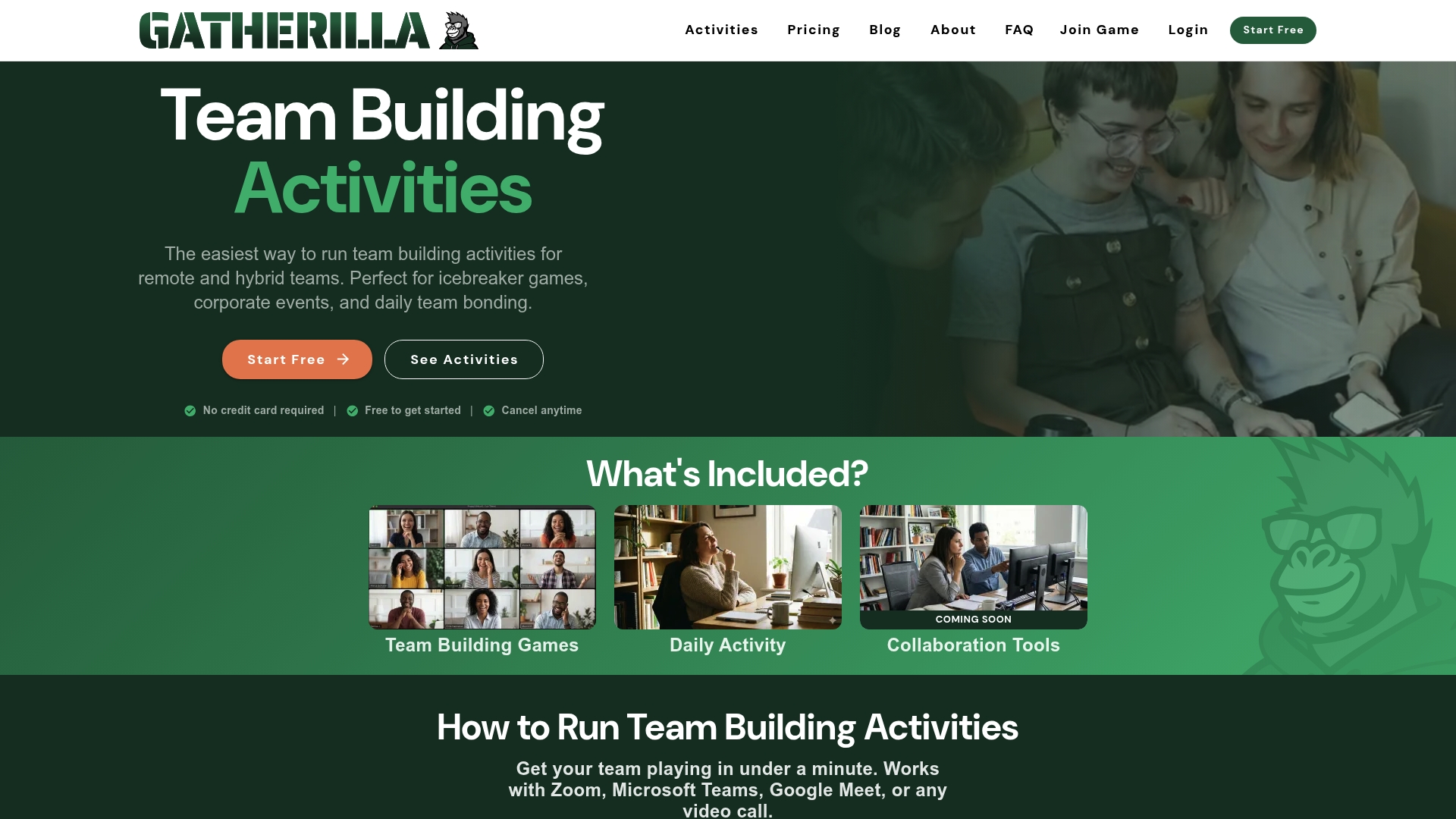
Beyond one-off events, our daily challenges and real-time leaderboards give teams a reason to check in with each other between the bigger sessions, which fits the same ritual-based approach we outlined above for sustaining engagement over time. You can browse the full library of team-building games and activities to see what fits your next meeting, or review our pricing for the Free tier and the Premium plans if you want access to more games, leaderboards, and reporting. If attendance tracking or digital check-in is part of your larger event plan, a partner solution like Tapn.vip’s digital check-in tools covers that side for hybrid and in-person components.
Start with the Free tier on our pricing page to try a game in your next team meeting.
FAQ
How long should a virtual company event last?
Typical durations depend on the format and setting. Group size usually dictates structure more than content, with breakout rooms helping manage larger groups. Quarterly or company-wide celebrations can be longer when mixing live programs with social breaks.
What are good virtual team building activities for large groups?
For larger groups, breakout-room formats like trivia, minute-to-win-it challenges, or scavenger hunts can work better than open-floor discussion because they split people into smaller, more manageable conversations. Our Virtual Team Trivia and Virtual Minute to Win It playbooks are both built around this kind of team-based structure.
How do I make virtual events accessible for everyone?
Collect accommodation needs during registration, including a field for invisible disabilities, and default to offering live captions and a transcript rather than waiting for someone to ask. Prioritizing verified audio and captioning over relying on room volume reduces cognitive load for all attendees, according to an accessible event checklist.
How do I measure whether a virtual event was successful?
A single post-event poll asking whether attendees found the session valuable or would want to repeat it is usually more reliable than a long survey that few people complete. Tracking simple metrics like camera-on percentage, chat activity, and poll response rate across multiple events lets you compare what actually worked over time.
What low-prep ideas work for a short daily or weekly check-in?
A one-word check-in, a rotating question of the day, or a brief lightning trivia round can fit a short slot and need little advance setup. These small, routinized rituals help offset the loss of casual small talk that comes with remote work and support a stronger sense of belonging, according to research on remote workdays and social connection.
Sources
- How and when remote workdays impact employee daily social need fulfilment
- [Enhancing Attendee Engagement in Virtual and Hybrid Events: The Roles of Technology and Data Analytics | Journal of Event, Tourism and Hospitality Studies](https://e-journal.uum.edu.my/index.php/jeth/article/view/29394)
- Every attendee matters: An accessible event checklist - Chris Ruden