

Leadership Meeting Icebreakers That Work for Senior Teams

The best leadership meeting icebreakers are short (two to five minutes), tied to the meeting’s real work, and low-risk to answer. They also get every voice into the room before the hard topics start. Senior teams usually know each other well, so skip “two truths and a lie”. Use prompts about decisions, energy, and what people need from each other. Below you’ll find 15 you can run this week, a simple format, and the mistakes that make executives dread the first five minutes.
TL;DR
- Keep it to two to five minutes and choose a prompt that connects to the agenda. Leaders resent icebreakers that feel like filler.
- Pick prompts with a low personal cost. Work-adjacent questions beat confessional ones for teams that have to make hard calls together.
- Everyone speaks once, early. Going around the room sets the habit of contributing, which pays off when the real discussion starts.
- The leader goes first, answers briefly, and acknowledges each person. Visible attention from the leader affects who speaks up.
- On video, use a browser-based format that needs no downloads so the warm-up doesn’t eat the time it was meant to save.
Table of Contents
- Why leadership teams still need an icebreaker
- What makes an icebreaker work for executives
- 15 icebreakers for leadership meetings
- A simple format you can repeat
- Running icebreakers on video or in hybrid meetings
- Perspective: why we think a ritual beats a one-off
- Common mistakes to avoid
- A sample 45-minute leadership meeting
- When to use a platform and when not to
- Facilitation habits that make any icebreaker land
- FAQ
- Sources
Why leadership teams still need an icebreaker
There’s a common assumption that icebreakers are for strangers. A leadership team of eight people who have worked together for years doesn’t need to learn names. But it often does need something else: a shift from the previous call, email thread or crisis into a shared room.
The Psych Safety site makes a useful point here. Icebreakers aren’t only for people who haven’t met. Even in a group that knows each other, they can encourage contribution from all members. The same page also warns that badly run icebreakers eat valuable time and can feel awkward, stressful or even harmful. Both halves matter. The aim is not fun for its own sake. It is to make speaking up the default.
That default matters because leadership meetings are where the costliest decisions happen. Psychological safety is the shared belief that people can voice ideas without fear of rejection. INSEAD’s write-up of Amy Edmondson’s work describes it as something leaders build deliberately: they frame the meeting as information sharing, invite input from different voices, and listen before moving to a decision. An opening round is one of the cheapest ways to do the first two.
What makes an icebreaker work for executives
After watching how teams respond to different warm-ups, a few criteria separate the ones that land from the ones that get eye-rolls.
It connects to the work
A prompt such as “What’s one decision from last quarter you’d make differently?” gets a senior group thinking in the right frame. “If you were a vegetable, which one?” does not. Silly can work, but only when the team has already opted into it.
It costs little to answer
Asking a VP to share a childhood fear in front of peers and a CEO is a big ask. Asking what they’re reading, what they’re protecting time for, or what the week looks like is not. Start light and go deeper only as trust grows.
It’s quick and predictable
Senior calendars are tight. A fixed format (same length, same structure) removes the dread. People know the first four minutes are a check-in, and they plan their answers.
It’s inclusive across locations and styles
Introverts, new team members and people dialing in from another time zone should find it as easy as the person sitting next to the CEO. Prompts that require a story from your personal life can exclude; prompts about work, preferences or one-word answers include.
15 icebreakers for leadership meetings
Grouped by what you want the opening to do. Each takes two to five minutes for a team of up to ten.
To shift the room into focus
- One-word weather report. Each person gives one word for how they’re arriving, and nothing more. It takes under two minutes and shows the leader the mood before the first agenda item.
- Rose and thorn. One good thing and one frustrating thing from the past week. Cap each at a sentence.
- Where is your attention? Ask each leader to name the one issue pulling most of their attention right now. It surfaces hidden priorities and often shapes the agenda.
- Three emojis for the quarter. Describe your function’s quarter in three emojis. It’s quick, mildly fun and still work-related.
To build trust without oversharing
- Best advice I’ve received. Name one piece of professional advice that still shapes how you lead. It reveals values without exposing anything painful.
- A mistake I’m glad I made. Works best when the leader goes first and sets a candid, brief tone. If the most senior person models it, others follow.
- What I’m reading, watching or listening to. Low-stakes, personal enough to humanize, and it often turns into book recommendations that last past the meeting.
- Something nobody on this team knows about my job. A neat way to build empathy across functions, since each leader has invisible work.
To prepare for decisions
- Assume we fail. Before a strategy session, ask: “It’s a year from now and this initiative failed. What’s the most likely reason?” It invites dissent in a structured way.
- Defining moment. Share a moment that shaped how you lead. Keep it to 60 seconds each. Use only with teams that already have some trust.
- One thing to stop. What is one meeting, report or process we should stop doing? You’ll leave with a list and a team that feels heard.
- Disagree and commit, in advance. Ask: “What’s one topic today where you expect to disagree, and how would you like us to handle it?” This names tension before it surfaces.
To reconnect a distributed team
- Show your workspace. Everyone shares one object within reach that matters to them. Cameras on, thirty seconds each.
- Quick poll, then explain. Run a one-question poll (“Energy level today, one to five?”) and ask two people to say why. It’s fast on video and gives a record you can compare week to week.
- Team bingo or trivia. For offsites or a kickoff after a break, a five-minute browser game gets laughter going without anyone having to disclose anything. Our icebreaker bingo guide explains how to run it with no downloads.
A simple format you can repeat
Consistency matters more than cleverness. A format that works:
- State the purpose in one sentence. “Two minutes to land in the room, then we’ll start on the agenda.” Executives tolerate warm-ups better when the clock is visible.
- Leader goes first. Brief and honest. The first answer sets the depth for everyone else.
- Go in a rotating order. Don’t always start with the same person, and don’t let the loudest voices set the pace.
- Acknowledge each answer. A nod, a name, a short “thanks”. More on this below.
- Link back to the agenda. One sentence connecting what you heard to the work: “Several of you mentioned capacity, so let’s start there.”
- Rotate the facilitator. Having a different leader pick the prompt each week spreads ownership and keeps prompts fresh.
Why acknowledgment matters
Research from Harvard Business School on leader eye gaze found that receiving direct gaze from a leader boosted feelings of psychological safety and participation. The effect was especially notable for introverts and minority members. On video the equivalent is visible attention: look at the camera when someone speaks, say their name, and avoid reading messages while they talk. An icebreaker run on autopilot wastes the chance. One run with real attention does the opposite.
Running icebreakers on video or in hybrid meetings
Most leadership teams now meet in a mix of settings. Some practical points:
- Remote participants first. In a hybrid room, ask the people on screen to speak before those in the room. Otherwise they stay spectators.
- No setup tax. Anything requiring a download, a login or a shared document will burn the first five minutes. Prefer tools that open in a browser from a link.
- Use the chat for quiet voices. Let people type one-word answers in chat while others speak. It lowers the barrier.
- Cap video-game style activities at five minutes. They should be a spark, not a session.
For tool-specific walkthroughs, we’ve written guides to Zoom icebreakers with scripts, Microsoft Teams icebreakers and hybrid meeting icebreakers. If your leaders are spread across offices and time zones, the global team icebreakers guide covers prompts that work across cultures.
Perspective: why we think a ritual beats a one-off
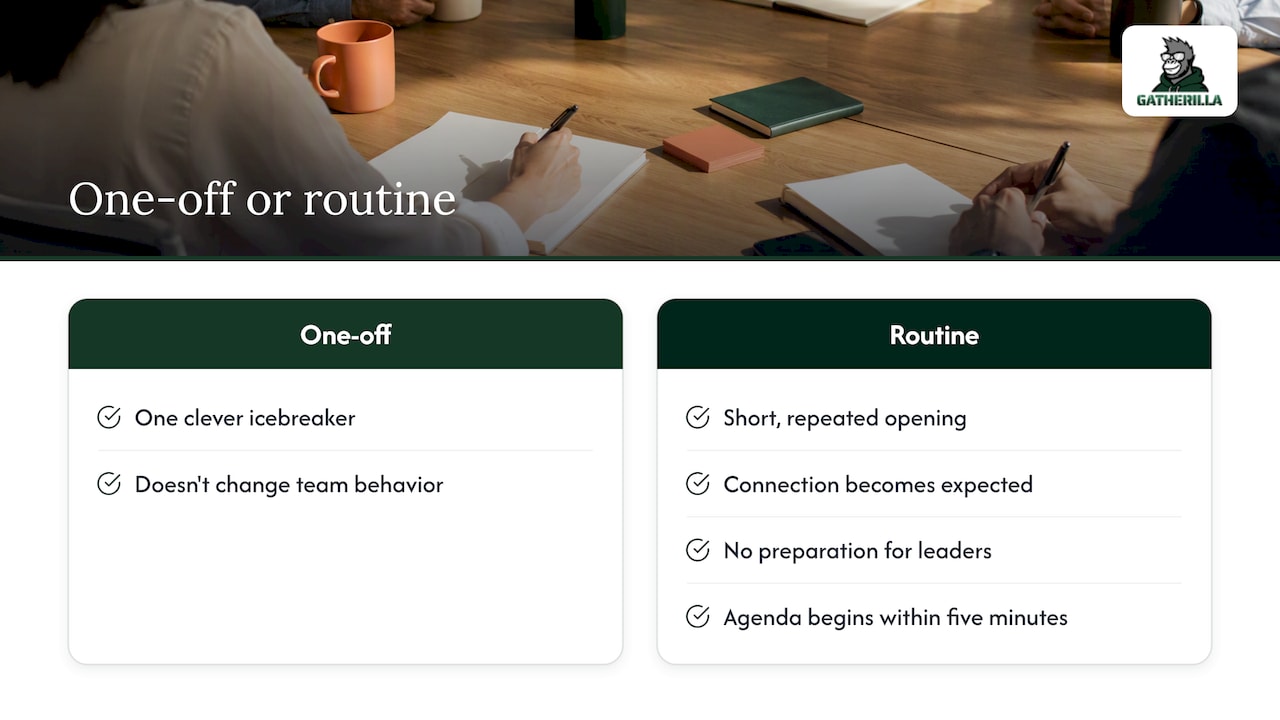
We build team games for remote and hybrid teams, and the pattern we see most often is this: leadership groups try one clever icebreaker, it goes fine, and they never run another. A single event doesn’t change how a team behaves. A routine does.
That’s why we design for habit rather than occasion. A short, repeated opening (a daily word or trivia challenge, a weekly check-in prompt) turns connection into something people expect, not something HR schedules. For leaders, the benefit is that it takes no preparation. You open a link, everyone plays in the browser, and you’re in the agenda within five minutes.
There is also evidence that structure helps. A 2025 paper on a hybrid-first engagement framework reports that organizations using structured hybrid-first engagement frameworks had 32% higher engagement scores and 41% lower voluntary turnover intention than peers on legacy, office-centric models. Another study found that hybrid organizations with deliberate connection protocols showed 61% greater cultural cohesion than those with informal systems. Both are academic papers about organizations broadly, not about our product, and they don’t prove that an icebreaker alone produces those numbers. But they point the same way: deliberate beats accidental.
Our advice to any leader: pick one format, run it for six weeks, and watch who starts speaking earlier in the meeting.
— Thomas
Common mistakes to avoid
- Forcing vulnerability. Deep personal questions before trust exists feel like a test. Psych Safety notes that poorly run icebreakers can turn stressful or harmful, so give people the option to pass.
- Skipping the leader’s turn. If the most senior person asks questions but never answers, the exercise feels like surveillance.
- Letting it run long. Ten minutes of sharing in a 45-minute meeting costs more than it gives. Set a timer.
- Recycling the same prompt. Rotate through categories (focus, trust, decisions) so it doesn’t turn into a chore.
- Ignoring what you hear. If someone says they’re overloaded, and nothing happens, people learn that the warm-up is theater.
- Treating it as the whole culture plan. INSEAD research on a randomized trial with 7,000 employees found that managers trained to adapt one-on-one meetings to individual needs raised team-level psychological safety, with the biggest gains on teams that started lower. The lesson: icebreakers help, but one-on-ones, framing and follow-through carry weight too.
A sample 45-minute leadership meeting
Here’s how an opening could fit into a real agenda:
| Time | Segment | Purpose |
|---|---|---|
| 0:00 to 0:04 | Opening round (“Where is your attention?”) | Surface priorities, get every voice in |
| 0:04 to 0:15 | Metrics and updates | Shared facts, no debate |
| 0:15 to 0:35 | Main decision or discussion | Use “Assume we fail” if it’s a strategy item |
| 0:35 to 0:42 | Actions and owners | Confirm who does what |
| 0:42 to 0:45 | Closing word | One-word reflection on the meeting |
Bookending the meeting with a one-word check-in at the start and end gives you a quick read on how the discussion landed. Over several weeks, the pattern tells you more about team health than a survey.
When to use a platform and when not to
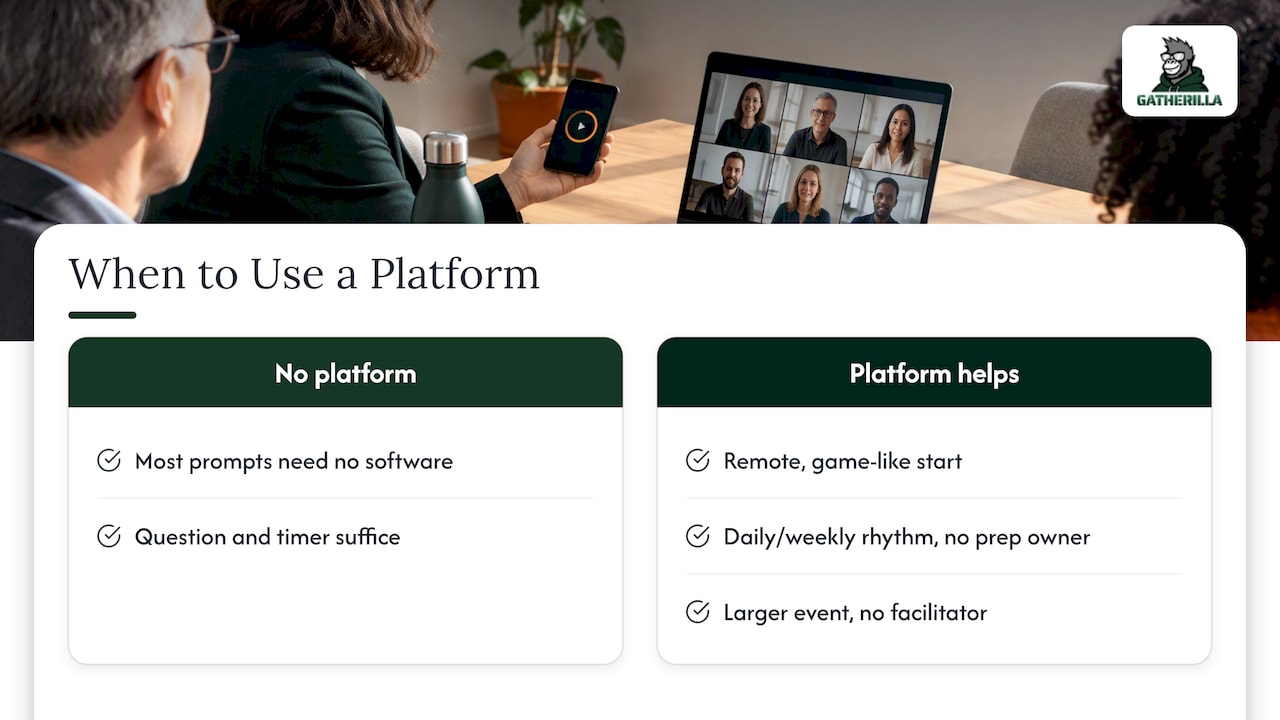
You don’t need software for most of the prompts above. A question and a timer will do. A platform helps in three situations: when your leaders are remote and a lighter, game-like start would break the stiffness; when you want a daily or weekly rhythm without someone owning the prep; or when you’re running a larger event such as a leadership offsite or all-hands where a facilitator isn’t practical.
Gatherilla is a browser-based platform with multiplayer games, daily word and trivia challenges, icebreakers for meetings and onboarding games. It works with any video conferencing tool, and players don’t need to download anything. The Free plan lets you try it with your team. Premium adds more games, analytics and priority support, at $0.50 to $1.00 per seat per month or $5 to $10 per seat per year, as listed on our pricing page. You can also explore the Gatherilla homepage to see the games before you decide.
If you’re planning more than leadership meetings, our guides to remote icebreaker games for team leaders, building psychological safety in your team and icebreakers for training sessions go further.
Facilitation habits that make any icebreaker land
The prompt matters less than how you run it. Commons Library’s facilitation guide separates the topic (what the conversation focuses on), the framing (how it’s described and bounded) and the format (how people interact). Apply that to an opening round and you get three decisions to make before you start:
- Topic: what do you want the group thinking about? Capacity, risk, a decision, or simply arriving?
- Framing: how will you describe it? “Two minutes, one sentence each” sets a boundary that makes people comfortable.
- Format: round robin, chat, poll, or pairs? Pairs work well for ten or more people, because each person gets airtime without a long wait.
Two more habits help. First, name the opt-out: “Pass is always fine.” Counterintuitively, this tends to increase participation because the pressure drops. Second, close the loop: if a prompt produced an action, mention it at the next meeting. People watch whether the warm-up leads anywhere.
FAQ
What is a good icebreaker for a leadership meeting?
A good one is short, tied to the agenda and low-risk to answer. “Where is your attention right now?” works well because it takes under a minute per person and reveals priorities. Have the leader answer first and keep each response to a sentence or two.
How long should a leadership icebreaker take?
Aim for two to five minutes in a standard 45 to 60 minute meeting. Longer is fine for an offsite or kickoff, where building relationships is part of the purpose. Use a visible timer so no one worries it will run over.
What if my leadership team hates icebreakers?
Often they hate bad ones: forced, childish or unrelated to work. Switch to work-adjacent prompts like “One thing to stop” or “Assume we fail”, explain the purpose in a sentence, and run it consistently for a few weeks. If it still doesn’t land, ask the team what they’d prefer.
Can I run icebreakers in a hybrid or fully remote leadership meeting?
Yes. Call on remote participants first, use the chat for quieter voices and choose formats that open in a browser without downloads. Polls, one-word check-ins and short browser games all work on any video platform.
Are icebreakers useful for teams that already know each other well?
Yes. They aren’t only for introductions. A brief opening round helps everyone contribute early, which makes it easier to speak up later, according to Psych Safety’s guidance on icebreakers. Shift the prompts from getting acquainted to focus, decisions and needs.
Sources
- Icebreakers, Psych Safety
- Psychological safety unlocks potential in diverse teams, INSEAD Knowledge
- Effective Strategies for Building and Boosting Psychological Safety, INSEAD Knowledge
- Feeling Seen: Leader Eye Gaze Promotes Psychological Safety, Participation, and Voice, Harvard Business School
- Re-Engaging the Dispersed Workforce: A Hybrid-First Framework for Employee Engagement and Retention
- Hybrid work and cultural cohesion study, Sukkur IBA Journal of Management Sciences
- Facilitation 101, Commons Library