

Run 6 Work Trivia Themes in 20 Minutes, 4 Copy Paste Rounds for HR

The strongest work trivia themes fall into six categories: company culture, people-focused rounds, decade-based pop culture, industry knowledge, seasonal specials, and light-hearted superlatives. Pick one, borrow the sample questions below, and you can run a full session in under 20 minutes on any video platform, in a conference room, or across a hybrid mix of both.
TL;DR:
- People-focused trivia rounds are the most engaging because they encourage discussion about coworkers and often produce the funniest guesses.
- Browser-based platforms that require no app downloads ensure quick, hassle-free participation across diverse devices and IT environments.
- Rotating between themes based on team feedback and reactions improves engagement and prevents boredom over repeated sessions.
- Short, 15 to 20-minute rounds with six to eight questions optimize participation without interfering with workflow.
- Using ready-made platforms like Gatherilla enables quick setup, easy customization, and consistent delivery of themed trivia without extensive prep.
Table of Contents
- Which Work Trivia Themes Actually Land With Employees?
- Formats and Setups for Remote, Hybrid, and In-Person Trivia
- How to Pick the Right Theme and Structure for Your Team
- Ready-to-Run Rounds You Can Copy Into Your Next Session
- Timing, Team Size, Scoring, and Facilitation That Actually Works
- Gatherilla Playbooks for Fast, Low-Friction Themed Trivia
- Why Rotating Themes Matters More Than Picking the “Perfect” One
- Run Your Next Themed Trivia Session Without the Setup Headache
- Sources
Which Work Trivia Themes Actually Land With Employees?
Some trivia themes fall flat because they’re either too obscure or too easy. The ones that work share a common trait: they let almost everyone in the room contribute something, whether that’s a guess, a laugh, or a “wait, I didn’t know that” moment. Here’s the shortlist that consistently performs well in office and remote settings, based on how workplace trivia guides and team-building research frame engagement.
- Company culture and history. Questions about founding stories, product milestones, or company values work because they double as onboarding reinforcement. “What year did we launch our second office?” or “Which of these three values did our founder add last?” These rounds are gold for new hires and a nice ego boost for veterans who remember the early days.
- People-focused rounds. “Guess the Pet,” “Who Said This?”, or “Whose Desk Is This?” formats turn coworkers into trivia subjects. These rounds tend to generate the most laughter because the “answer” is a real person sitting in the room or on the call, and random mixed teams of three to four tend to guess wrong in the funniest ways.
- Pop culture (office-safe). Movies, TV theme songs, or chart-topping music from the past two decades. Keep it broad enough that a 24-year-old and a 58-year-old both have a shot. Skip anything niche to a subculture most of the room won’t recognize.
- Decade or era rounds. A dedicated 2000s or 2010s round taps nostalgia hard. Flip phones, dial-up sounds, and early social media platforts are easy wins for a “remember when” round that gets people talking between questions.
- Industry or product knowledge. Light quiz items about your own sector, delivered without the pressure of a performance review. A software company might ask “What does API stand for?” while a healthcare team might quiz on a common acronym from their own workflows. Framed right, these rounds double as low-stakes learning.
- Seasonal, holiday, or superlative specials. Winter-themed rounds in December, “office superlatives” (who’s most likely to reply to email at midnight), or snack trivia (guess the chip brand from the crunch sound) work well as a change of pace between more structured themes.
Trivia works as a low-cost team-building tool precisely because it scales across all of these categories without requiring new equipment or budget for each one. A HR manager can rotate through six themes over six months and never repeat the same feel twice.
One theme that quietly outperforms the others for engagement is the people-focused round. It’s not because people love trivia. It’s because they love talking about their coworkers, and a well-run round gives them permission to do it in a structured, low-pressure way. Practitioner guides on trivia design recommend mixing general knowledge with company-specific and people-focused questions in the same session, rather than running a single theme all the way through, since variety keeps attention from dipping around question five or six.
If you’re deciding between a culture round and an industry-knowledge round for a first session, go with culture. It has a lower failure rate. Industry knowledge can accidentally embarrass someone who’s newer to the role or the field, while culture questions tend to reward curiosity rather than tenure.
Formats and Setups for Remote, Hybrid, and In-Person Trivia
The format you choose determines whether trivia feels like a game or a chore. Get the setup wrong, and half your team spends the first five minutes troubleshooting instead of playing.
- Pick browser-based joining over app downloads. Anyone who’s tried to get twelve people across three device types to install the same app in under two minutes knows how badly that can derail momentum. Browser-based platforms that require no download let people click a link from a calendar invite or chat message and join instantly, which matters most when your group spans company laptops, personal phones, and locked-down IT environments.
- Assign a host and a support role before the session starts. The host reads questions, keeps time, and calls out fun facts after each answer. A second person handles tech troubleshooting and scoring so the host never has to break momentum to fix a frozen screen. For groups over 15 people, these two roles should not be the same person.
- Decide between breakout rooms and full-room play based on group size. Under 12 people, keep everyone in one call or room so banter and side comments land for the whole group. Above that, breakout huddles of 3 to 4 per team keep individual voices from getting lost, then bring everyone back to a shared screen for scoring and reveal.
- Build in accessibility from the start, not as an afterthought. Turn on live captions for video calls, read each question aloud even when it’s also displayed on screen, and give a few extra seconds before revealing answers so people using screen readers or translating in their head aren’t left behind. Avoid questions that assume everyone grew up in the same country or watched the same regional TV.
For a mixed in-office and remote crowd, the biggest failure point isn’t the questions. It’s the audio. Remote participants often can’t hear in-room laughter or side conversations, which makes them feel like they’re watching through a window rather than playing the game. A dedicated host who narrates the room’s reactions (“okay, half the office just groaned”) closes that gap fast.
How to Pick the Right Theme and Structure for Your Team
Choosing a theme isn’t guesswork if you ask the right questions first. Run through this short checklist before locking in a topic:
- Audience familiarity: will most of the group actually recognize the references, or does this theme only work for people who’ve been here five-plus years?
- Psychological safety: does any question risk singling someone out or forcing a personal disclosure they didn’t sign up for?
- Time and calendar fit: does the theme’s depth match the slot you have? A deep industry-knowledge round doesn’t fit into a 10-minute standup.
- Tech constraints: does everyone on the call have working audio and video, and will the platform run on whatever device policy your company enforces?
- Event objective: are you trying to build cross-department relationships, celebrate a milestone, or just add fun to a Friday meeting? The answer changes which theme fits.
A quick pre-event pulse check goes a long way. Drop a one-question poll in your team chat a few days ahead: “Would you rather guess coworker facts or 2000s pop culture this week?” It takes thirty seconds and tells you exactly which room temperature you’re walking into.
Watch for a few red flags that turn a fun round into an awkward one. Skip anything tied to religion, politics, physical appearance, or personal finances. Be careful with “guess someone’s age” or “guess someone’s salary history” style questions, even as jokes; they age badly fast. And if your team spans multiple countries, double check that pop culture references and holiday themes aren’t assuming a single cultural default.
Pro Tip: Run your very first trivia session on the safest possible theme, company culture and history, before trying anything more personal. It builds trust in the format itself, so when you introduce a people-focused round later, the team already knows the tone is playful, not exposing.
Ready-to-Run Rounds You Can Copy Into Your Next Session
Each round below runs six to eight questions, which fits the 15 to 20 minute window most practitioner guides recommend for keeping engagement high without eating into meeting time. Every answer comes with a one-line fun fact, since pairing a fact with the answer is what turns a quiz into an actual conversation starter rather than a quiz-and-move-on exercise.
- Company Culture Round (7 questions). Q: What year was our company founded? Q: Who was our first hire outside the founding team? Q: What was our original company name or product idea before it pivoted? Q: Which department has grown the most in the past two years? Q: What’s the story behind our company’s logo or colors? Q: What was our very first office location? Q: What’s one value we’ve never actually written down but everyone follows anyway? Fun fact to pair with the founding-year question: most companies pivot their core product at least once before finding what actually sells, so the “original idea” question almost always gets a laugh.
- People-Focused Round: Guess the Pet (6 questions). Show six pet photos submitted anonymously and have teams guess which coworker owns each one. Follow every reveal with a one-line fact the pet owner submits ahead of time, like “this dog once ate an entire birthday cake meant for the office party.” This format needs zero written trivia questions, just photo submissions collected a few days ahead.
- Pop Culture Round: Decade Edition (8 questions). Q: What was the best-selling album of 2005? Q: Name the movie this theme song is from (play a 5-second clip). Q: What phone brand dominated the market in 2007, right before a certain company changed everything? Q: What was the most-searched term online in 2010? Q: Name the show this catchphrase is from. Q: What was the top-grossing film of 2015? Q: What social platform launched the “story” format first? Q: What was the most-streamed song two years ago? Fun fact for the 2007 phone question: the top-selling phone brand of that year lost more than half its market share within five years once smartphones took over.
- Industry Knowledge Round (6 questions, adjust for your sector). Q: What does the main acronym our team uses daily actually stand for? Q: What year did our biggest industry regulation or standard take effect? Q: Name one common tool used across our field that most people outside it have never heard of. Q: What’s a term from our industry that means something completely different in everyday language? Q: What percentage of our workflow (roughly) touches this one specific process? Q: What’s the most misunderstood part of what our department actually does? These questions work best when the host adds a short explanation after each answer rather than just moving on, since that’s where the actual learning happens.
For remote-only sessions, run all four rounds through screen share with a chat-based answer submission so no one’s voice gets drowned out. For hybrid sessions, split scoring by physical table and remote breakout group, then read totals aloud at the end so the in-room and remote sides feel like they competed on equal footing.
Timing, Team Size, Scoring, and Facilitation That Actually Works
Run the math before you build the session: eight questions at roughly two minutes each, including the reveal and fun fact, lands you at 16 minutes, right inside the 15 to 20 minute window that fits most meeting slots without running long.
- Team size: groups of 3 to 4 people work best. Random, mixed-department teams create cross-functional conversations that a standard meeting agenda never generates, since people who never work together suddenly have to agree on an answer in ten seconds.
- Scoring: keep it simple. One point per correct answer, with a bonus point for the fastest correct team on any given question. Skip complex weighted scoring; it slows the host down and confuses half the room.
- Tiebreakers: have one estimation question in your back pocket (“how many staplers are in this building?”) to break a tie without needing a whole extra round.
- Facilitation: always read the answer, then the fun fact, before moving to the next question. That pause is where the actual bonding happens.
Pro Tip: If a question sparks a longer tangent than expected, let it run for 30 to 60 extra seconds before pulling the group back. That tangent is usually the most memorable part of the session, and it’s a strong hint for what theme to run next time.
Gatherilla Playbooks for Fast, Low-Friction Themed Trivia
Setting up a themed trivia session from scratch takes real prep time: writing questions, building slides, and hoping everyone’s device cooperates. Gatherilla was built to cut that setup time down to a single link, which matters most for HR teams running these sessions monthly rather than once a year.
- Gatherilla’s customizable multiplayer games run entirely in the browser, so remote and hybrid teams can join a themed trivia session directly from a video call without installing anything or getting IT approval first.
- Sessions launch fast enough to slot into a standing team meeting, which helps HR managers keep momentum going without asking employees to block off extra calendar time.
- The daily challenge format gives distributed teams a low-effort way to stay connected between bigger scheduled events, which helps counter the isolation that remote employees often report.
- Because setup takes minutes rather than hours, a manager can pivot from a company culture round one week to a people-focused round the next without redoing the technical groundwork each time.
For teams that already have a rotation planned, pairing a Gatherilla session with a structured trivia playbook removes most of the guesswork around question pacing and host scripting. That combination, a ready format plus a no-download join process, is what tends to separate a trivia session people actually look forward to from one they quietly dread.
Why Rotating Themes Matters More Than Picking the “Perfect” One
The mistake most HR teams make is treating theme selection like a one-time decision instead of an ongoing experiment. There’s no single best theme that works for every team forever, and the sooner you accept that, the better your trivia program gets.
What actually works is rotation paired with attention. Run a theme, watch which questions generate the longest tangents or the loudest reactions, and use that as your signal for what comes next. If the “Guess the Pet” round runs long because everyone wants to hear more pet stories, that’s your team telling you people-focused content is what they’re hungry for right now. Ignore that signal and keep running industry-knowledge rounds because they feel more “professional,” and attendance will quietly drop.
A quick, informal pulse check after each session, even just a single chat message asking “what should next month’s theme be?”, beats any elaborate survey. Small experiments cost you nothing but a session slot. Try a theme once, read the room’s actual reaction instead of guessing at it, and let that decide whether it earns a spot in the rotation or gets retired after round one.
— Thomas
Run Your Next Themed Trivia Session Without the Setup Headache
Everything in this guide works whether you’re building slides by hand or using a dedicated platform, but the setup gap between those two approaches is real. Writing questions, building a scoring system, and testing device compatibility across a distributed team eats hours that most HR managers don’t have to spare every month.
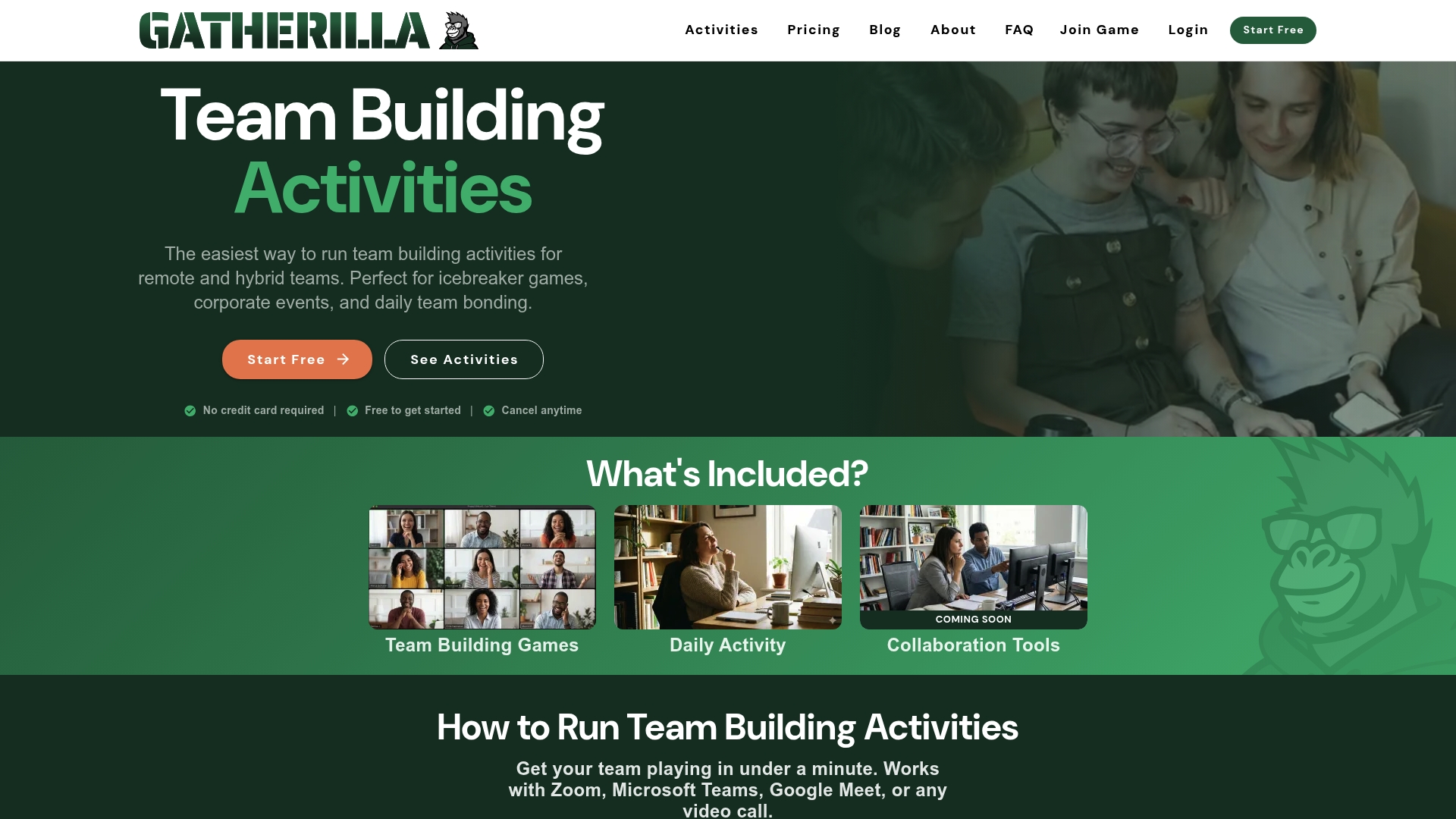
Gatherilla closes that gap by handing you browser-based games and playbooks that work the moment someone clicks a link, no downloads, no IT tickets, no compatibility checks across laptops, tablets, and phones. Teams get a customizable multiplayer format built specifically for remote and hybrid groups, plus a daily challenge option for keeping connection alive between bigger sessions. If you’re ready to swap the setup grind for a session that just works, visit Gatherilla’s team-building platform and try a playbook with your team this week.
Sources
- 11 trivia games for work — Indeed Career Advice
- Trivia questions for work — AhaSlides
- 75 Trivia Questions for Work + Team Building Tips — Uplup