

Virtual Show and Tell for HR & Team Leaders: A Playbook

A virtual show and tell is a short, browser-based session where team members demo work, share lessons, or present something meaningful — run as a 10–30 minute, timeboxed meeting with a designated host and simple prompts. The recommended approach: keep each presenter to three to five minutes, assign a facilitator who owns the clock, and use a browser-based platform that requires no downloads. Your immediate next step is to pick an upcoming team meeting and block a 15-minute show-and-tell slot before the week is out.
Table of Contents
- Why virtual show and tell actually builds connection
- Setup checklist for a smooth browser-first session
- Activity formats you can run in 10–30 minutes
- Facilitation techniques that keep sessions honest and on time
- How often should you run sessions, and with what group size?
- How to measure whether your sessions are working
- How to choose the right platform for your team
- Key Takeaways
- The thing most teams get wrong about show and tell
- Run your first virtual show and tell with Gatherilla
- Useful sources
Why virtual show and tell actually builds connection
The case for this format goes beyond “it’s a nice icebreaker.” When teams run regular sessions, they close the gap between siloed functions, surface learnings that would otherwise die in Slack threads, and give leadership a human face beyond all-hands announcements.
Chime turned this into a bi-weekly 30-minute event with an executive emcee and a dedicated Slack channel to extend the conversation after each session. Drift built structured guidelines requiring a DRI to own quality and timing. Both companies found the format became a primary channel for socializing work as they scaled. That pattern holds across organizations: the sessions humanize leadership and accelerate cross-team literacy in ways that a monthly newsletter simply cannot.
The business outcomes HR cares about follow naturally. Faster onboarding happens when new hires see real work in context. Cross-team blockers shrink when people understand what adjacent teams are actually building. And sharing failures and lessons — not just wins — builds the psychological safety that drives honest feedback and repeat participation.
- Bridge silos: presenters from different functions expose their work to people who would never otherwise see it.
- Humanize leadership: an exec who demos a rough prototype signals that polish is not a prerequisite for sharing.
- Surface learnings: prompts that ask “what failed?” generate more useful cross-team knowledge than highlight reels.
- Accelerate onboarding: new employees absorb team norms and priorities faster through live demos than through documentation.
For remote team engagement strategies, show and tell is one of the highest-leverage activities available because it combines structured sharing with genuine human connection.
Setup checklist for a smooth browser-first session
Technical friction is one of the most common causes of late starts and drop-off. A browser-based platform that requires no downloads removes the single biggest participation barrier for distributed teams.
Platform requirements:
- No-download browser access with a single join link
- Easy screen sharing for slides, images, and live demos
- Mobile and tablet compatibility
- Caption support and recording capability for accessibility
Before the meeting:
- Assign a DRI/facilitator who owns the agenda, timing, and follow-up
- Send a one-paragraph context note plus three presenter prompts in the invite
- Ask presenters to test screen sharing and audio at least 30 minutes before
- Verify media is readable on a small laptop screen
Pro Tip: Set up a persistent Slack or Teams channel for each show-and-tell series. Chime uses exactly this approach so the conversation outlives the live session and creates a searchable archive for people who missed it.
Allow people to volunteer for presenter slots via a simple form or Slack thread, as voluntary presenters tend to be more prepared and engaged. Voluntary presenters show up more prepared and more energized than drafted ones.

For hybrid meetings, confirm that remote participants can see and hear in-room presenters clearly before the session starts, not during it.
Activity formats you can run in 10–30 minutes
These templates are ready to copy into a meeting invite. Each includes a timebox, a presenter prompt, and an audience-engagement cue.
- Quick demo (10 min): Present using the structure: What? So what? Now what? Audience prompt: “What would you do differently?” Works for teams of 4–15.
- Bug-fix of the week (15 min): One presenter walks through a problem they solved. Prompt: “What was the hardest part to diagnose?” Audience votes on the most surprising fix via chat.
- Before-and-after (10 min): Show a process, design, or document in its old and new state. Prompt: “What drove the change?” Great for design and ops teams.
- Failure + learnings (15 min): Presenter shares what went wrong and the one thing they’d do differently. Prompt: “Has anyone hit the same wall?” This format consistently produces the most useful cross-team discussion.
- Visual walkthrough (20 min): A five-slide max tour of a project in progress. Audience submits questions in chat; facilitator reads the top two aloud.
- Image guessing (15 min): Presenters share a zoomed-in or cropped image of something from their work. Audience guesses what it is before the reveal. Gatherilla’s What the Zoom activity is a ready-built version of this format.
- Three-minute update (10 min, multiple presenters): Each person gets exactly three minutes, timed visibly. No slides required. Works well for weekly team standups that need a human layer.
- Lessons from a book or article (15 min): One person shares three takeaways from something they read. Prompt: “Which one applies to our team right now?”
- Tool demo (15 min): Live walkthrough of a tool the presenter uses daily. Audience prompt: “What’s the one thing you wish you’d known sooner?”
- Customer story (20 min): A team member shares a real interaction or feedback thread (anonymized). Prompt: “What does this tell us about what customers actually need?”
dxw’s playbook is worth bookmarking for facilitation scripts, especially for work-in-progress demos where the presenter needs guidance on what “done enough to share” actually means.
Facilitation techniques that keep sessions honest and on time
Authenticity beats polish. dxw’s guidance is explicit: show-and-tells are for work in progress, not finished marketing pieces. A scrappy demo with a real problem attached generates better feedback than a polished deck with no rough edges.
What works:
- Open with the problem, not the solution. Drift’s presentation structure prescribes problem → approach → impact for exactly this reason.
- Use a visible countdown timer. When presenters can see the clock, they self-edit.
- Designate a note-taker for follow-up items so the facilitator can focus on timing.
- Route questions through chat first; the facilitator selects two or three to read aloud.
What to avoid:
- Long itemized lists of updates with no narrative thread
- Slides that the presenter reads verbatim
- Open Q&A with no time limit (set a hard two-minute window)
- Skipping the “what failed” prompt in favor of highlights only
Pro Tip: Give presenters a one-sentence brief: “Tell us the problem, show us what you tried, and tell us what you’d do next.” That single constraint eliminates 80% of unfocused presentations.
For team building activities that avoid the cringe factor, the key is giving people a clear, low-stakes prompt rather than open-ended “share anything” instructions.
How often should you run sessions, and with what group size?
| Format | Session length | Per-presenter timebox | Ideal group size | Recommended cadence |
|---|---|---|---|---|
| Weekly standup add-on | 10–15 min | 2–3 min | 4–10 | Weekly |
| Team show and tell | 30 min | 5 min | 8–20 | Biweekly |
| Cross-team showcase | 10–30 min | 5–7 min | 15 | Monthly |
| Company-wide event | — | 5 min | — | Quarterly |
Groups larger than 20 benefit from breakout rooms after the main presentation so people can ask questions in smaller clusters. For company-wide sessions, record the meeting and post it to a shared channel so people in different time zones can watch asynchronously. Async team building practices extend the value of a live session well beyond the people who attended live.
Keeping presenter timeboxes short helps maintain concise meetings that scale effectively as the company grows.
How to measure whether your sessions are working
Attendance rate and repeat participation are the two numbers that matter most. If the same five people show up every time and no one new volunteers to present, the format needs a prompt redesign, not a longer session.
Primary metrics to track:
- Attendance rate per session
- Repeat participation rate
- Voluntary sign-up rate for presenter slots
- Number of follow-up conversations or cross-team connections logged after each session
Sample pulse survey (send within 24 hours of each session):
- Did today’s session give you something useful you can apply to your work? (Yes / Somewhat / No)
- How would you rate the session’s relevance to your role? (1–5)
- Did you learn something about another team’s work that you didn’t know before? (Yes / No)
- Would you present at a future session? (Yes / Maybe / No)
- What one change would make the next session more valuable? (open text)
Collect responses in a shared doc and review them with the DRI before the next session. A team retrospectives framework works well here: what worked, what didn’t, what to try next time. A dedicated Slack channel also creates a passive engagement signal: if people are posting reactions and follow-up questions after the session ends, the format is working.
How to choose the right platform for your team
| Capability | Why it matters | Gatherilla |
|---|---|---|
| Browser-based, no download | Removes the biggest adoption barrier for distributed teams | Yes |
| Single join link | Reduces friction for first-time participants | Yes |
| Built-in activity templates | Cuts prep time for facilitators | Yes |
| Analytics and reporting | Lets HR demonstrate ROI to stakeholders | Yes (premium) |
| Video conferencing compatibility | Works alongside Zoom, Teams, Meet without replacing them | Yes |
| Per-seat pricing | Scales with headcount without surprise costs | Yes |
| Security and access controls | Required for HR buyers managing sensitive team data | Yes |
What to prioritize when evaluating vendors:
- No-download access is non-negotiable. Browser-based team building tools remove IT approval delays and work on any device.
- Analytics matter more than most teams expect. Without participation data, you cannot show leadership that the program is working.
- Compatibility with your existing video platform means you don’t have to replace your infrastructure.
A practical example: a 15-person team runs a monthly show-and-tell inside their regular Zoom call. The facilitator opens Gatherilla in a browser tab, shares the link in chat, and runs a quick image-guessing round before the presentations start. The whole setup takes under two minutes, and the leaderboard at the end gives the session a natural close. For virtual event platform capabilities, browser-first tools consistently outperform download-required alternatives on first-session adoption.
Key Takeaways
A virtual show and tell works best when it is short, browser-based, and led by a DRI who owns the clock, the prompts, and the follow-up.
| Point | Details |
|---|---|
| Keep sessions short | Timebox each presenter to 3–5 minutes; total session length of 10–30 minutes drives higher repeat attendance. |
| Assign a DRI | A designated facilitator who manages time and iterates the format each cycle is a key predictor of session quality. |
| Use browser-first tools | No-download platforms remove the adoption barrier that kills participation before the first session even starts. |
| Measure what matters | Track attendance rate, repeat participation, and voluntary sign-up rate — not just headcount. |
| Start with Gatherilla | Gatherilla’s browser-based platform, built-in activity templates, and per-seat analytics give HR teams a ready-to-run setup with no IT overhead. |
The thing most teams get wrong about show and tell
The conventional wisdom says the format fails because people don’t prepare well enough. After looking at how teams like Chime and Drift have made it work at scale, I’d argue the real failure mode is the opposite: teams over-engineer the format before they’ve run a single session.
They spend weeks designing a submission process, a slide template, and a scoring rubric. By the time the first session runs, the friction they’ve built into the presenter experience guarantees low volunteer rates. The DRI role gets treated as an event coordinator job rather than a learning-loop job, and the format stagnates.
What actually improves adoption fastest is a single, low-stakes prompt sent to one willing presenter 48 hours before the meeting. Run it once. Collect two pieces of feedback. Change one thing. Repeat. The teams that run show and tell well are not the ones with the best process documentation. They’re the ones with a DRI who treats each session as a prototype, not a production.
One caution: overproducing the visual experience kills the authenticity that makes the format worth attending. And on iteration cadence, the DRI should review feedback and make one format change per cycle, not ten.
Run your first virtual show and tell with Gatherilla
If you’ve been putting off the first session because the setup feels like a project, Gatherilla removes that excuse. The platform is entirely browser-based, so your team joins from a single link with no downloads, no IT tickets, and no waiting for someone to install something.
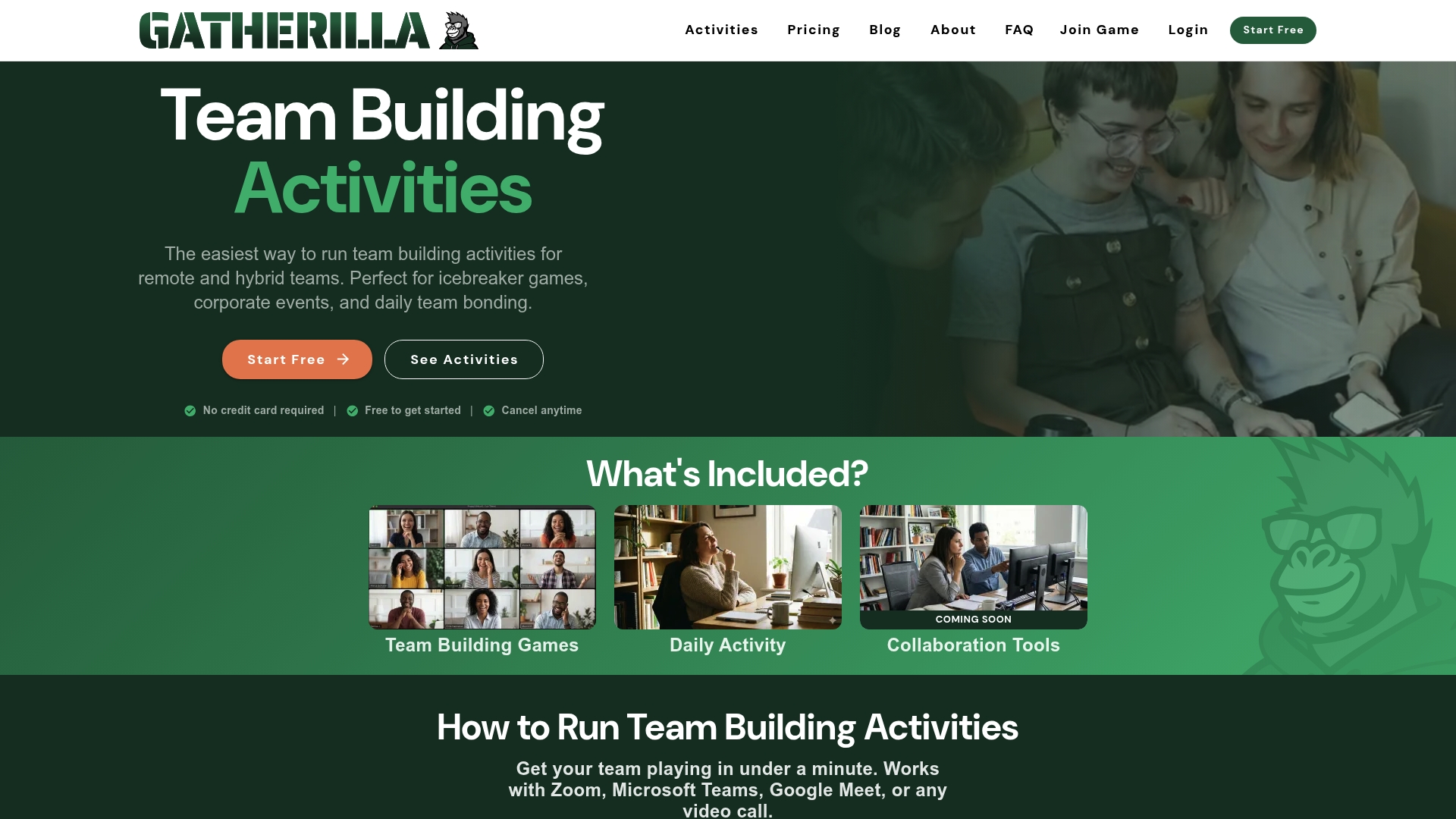
Gatherilla’s built-in activity templates, including image-guessing rounds, trivia battles, and icebreaker formats, give your facilitator a ready-to-run structure from the first session. Premium plans add analytics so you can show leadership exactly who participated and how engagement trended over time. Security and access controls meet the requirements HR buyers need for managing team data responsibly. Pricing is per-seat, so costs scale with your headcount rather than jumping to an enterprise tier you don’t need yet.
Start with a free account at Gatherilla, pick one activity template, and run a 15-minute pilot with your next team meeting. That’s the whole plan.
Useful sources
- Behind the Scenes: Show & Tell at Chime — how Chime runs bi-weekly sessions with an exec emcee and Slack archiving at company scale.
- Show and Tell Meeting Guidelines at Drift — Drift’s DRI model and problem → approach → impact presentation structure.
- Show and tells — Playbook — dxw — facilitation script and the case for showing work in progress over polished decks.
- Why we show and tell — Ilya Tulvio — evidence for short per-presenter timeboxes and scalability as organizations grow.
- Tips on doing show & tell well — Boring Magic — the argument for prioritizing failures and lessons over highlight-only formats.
- Show and tell — managing-virtual-teams.com — technical checklist for screen sharing, audio, and the case for browser-based platforms.