

Redeemable in 30 Seconds: Virtual Prize Ideas for Teams, Teachers, HR

The three prize types worth your time are flexible digital rewards (gift cards, subscription credits), experience-based virtual events (trivia, escape rooms, leadership lunches), and soft or no-cost perks (leave-early passes, shout-outs, digital badges). Match the type to your audience and the occasion: digital rewards for one-off wins, experiences for milestones, soft perks for ongoing weekly recognition. The categorized list below breaks down exactly which prize fits which group and budget.
TL;DR:
- Digital gift cards are the most versatile and immediately deliverable prizes, suitable for all audiences and easily scaled, but may be taxable if above nominal value in the US.
- Experience-based rewards like virtual escape rooms and leadership lunches can foster team cohesion and long-term engagement but require moderation in frequency and budget.
- Soft, no-cost perks such as early leave or public shout-outs often outperform expensive prizes because they deliver recognition with minimal friction and cost.
- Prizes should be chosen based on audience preferences, ease of digital delivery, and compliance with tax or privacy policies, avoiding complex or hard-to-redeem options.
- Consistent, quick-delivering rewards prioritized over larger, infrequent prizes better sustain motivation and participation over the long term.
Table of Contents
- Virtual Prize Ideas by Audience: Teams, Students, and Everyone Else
- Digital Gift Cards, Subscriptions, and Course Credits
- Experience-Based Virtual Prizes That Build Real Connection
- Low-Cost and No-Cost Prizes That Still Work
- Delivery, Timing, and Budgeting for Virtual Prizes
- A Quick Framework: Fit, Frequency, Friction
- How Gatherilla Runs Experience-Based Prizes Without the Setup Headache
- Legal and Ethical Considerations for Virtual Prizes
- What Actually Moves the Needle on Prize Programs
- Sources
Virtual Prize Ideas by Audience: Teams, Students, and Everyone Else
Different groups respond to different incentives, and a prize that lands with a sales team can flop in a fourth-grade classroom. Sorting ideas by audience saves you from guessing.
For remote teams and employees:
- Digital gift cards — universal appeal, works for any budget tier, delivered by email in minutes.
- Coffee or snack delivery — small daily-life touch that lands well for quick wins or Friday shout-outs.
- Subscription box (one month) — good for quarterly recognition; pick a curated box tied to hobbies.
- Online course credit — fits professional development pushes and shows the company invests in growth.
- Virtual escape room session — strong for team milestones since it requires group participation.
- Lunch with a senior leader — costs little, delivers outsized perceived value for career-minded employees.
- Extra PTO hour — nearly free to the company, consistently rated as high-value by staff.
For students and classrooms:
- Class playlist pick — the winning student chooses the background music for a session.
- Virtual field trip — a short guided video tour tied to the week’s lesson.
- Homework pass — a classic that still performs because it’s immediately usable.
- Show-and-tell slot — gives quieter students a reason to want the win.
- Digital sticker or badge — low cost, high frequency, works well with gamified trivia formats.
- Read-aloud privilege — a role-based reward that reinforces good classroom behavior, a tactic LiveSchool has documented across PBIS programs.
All-purpose (teams or classrooms):
- Trivia night win — pairs naturally with a small digital prize for the top scorer.
- Virtual scavenger hunt reward — works for onboarding cohorts or student groups alike; see scavenger hunt templates for structure.
- “No meeting” or “no homework” pass — a universal favorite because it removes friction, not adds it.
Each idea above earns its spot by solving a specific problem: budget limits, delivery speed, or the need for repeatable, ongoing recognition rather than a single splashy reward.
Digital Gift Cards, Subscriptions, and Course Credits
Digital gift cards top most incentive lists for a simple reason: they let the winner choose exactly what they want, and delivery takes seconds regardless of where the recipient lives. PaymentsJournal points to this flexibility as the core reason digital gift cards remain a top-tier incentive category, especially for distributed teams where shipping a physical prize adds delay and cost.
Subscription credits and course access solve a different problem: retention of the behavior you’re rewarding, not just a one-time dopamine hit. A platform like Coursera works well here because the prize keeps paying off for weeks after you award it, which matters if the goal is sustained engagement rather than a single spike.
Quick comparison of the main digital options:
- Retailer-specific gift cards — cheaper to source in bulk, but limited if your team is dispersed across regions with different retail access.
- Branded prepaid debit cards — maximum flexibility for the recipient, slightly higher processing fees for you.
- Subscription credits — best for recurring engagement goals, weaker for instant gratification.
- Course or training credit — strongest long-term value, weakest as a “fun” reward for casual wins.
One reminder before you build a program around these: gift cards and cash-equivalent rewards are generally taxable income in the US once they exceed nominal value, so loop in payroll or HR before scaling a digital gift card program company-wide.
Experience-Based Virtual Prizes That Build Real Connection
Cash and gift cards are easy, but they’re not always what moves people. SHRM research on reward preferences found that soft, experience-based rewards often outperform cash bonuses because they improve someone’s actual day-to-day experience and sense of belonging on the team. A cash bonus gets spent and forgotten. A team escape room win gets talked about for weeks.
Here are five experiences worth running:
- Virtual escape room — book a facilitated session, keep groups to 6-8 people for pacing.
- Hosted trivia night — a browser-based format removes setup friction entirely; see how a ready-to-run trivia playbook structures rounds and scoring.
- VIP meeting invite — winner joins a leadership call or strategy session they wouldn’t normally attend.
- Lunch with leadership — send a meal delivery code, then block 30 minutes on the calendar.
- Class or team-day pick — the winner chooses the next team activity or classroom theme.
Facilitator needs vary by format: trivia and escape rooms usually need one host and 30 to 45 minutes; a leadership lunch needs nothing but a calendar invite. Budget $15 to $40 per person for hosted formats and reserve them for monthly or quarterly milestones rather than weekly cadence.
Pro Tip: Announce small instant-win prizes live during the session and save the bigger experiential reward for the finale. That one-two structure keeps energy up the whole time instead of peaking early.
Low-Cost and No-Cost Prizes That Still Work
Not every reward needs a budget line. Soft perks often outperform expensive gifts precisely because they’re scarce and tied to status, not spending.
- Leave 30 minutes early — one of the most requested perks in employee surveys, costs nothing.
- No-meeting pass — winner can skip one non-essential meeting that week.
- Zoom co-host privileges — small but genuinely desired, especially by newer team members.
- Public shout-out — a Slack post or opening-of-meeting mention, more effective when it’s specific rather than generic.
- Digital sticker or badge collection — works especially well with students; kids and adults both like visible progress.
Make these feel ceremonial, not routine. Announce the winner by name, state exactly what they did to earn it, and issue the “pass” as an actual document or digital card rather than a verbal mention. That extra ten seconds of formality is what separates a real reward from a passing comment.
Delivery, Timing, and Budgeting for Virtual Prizes
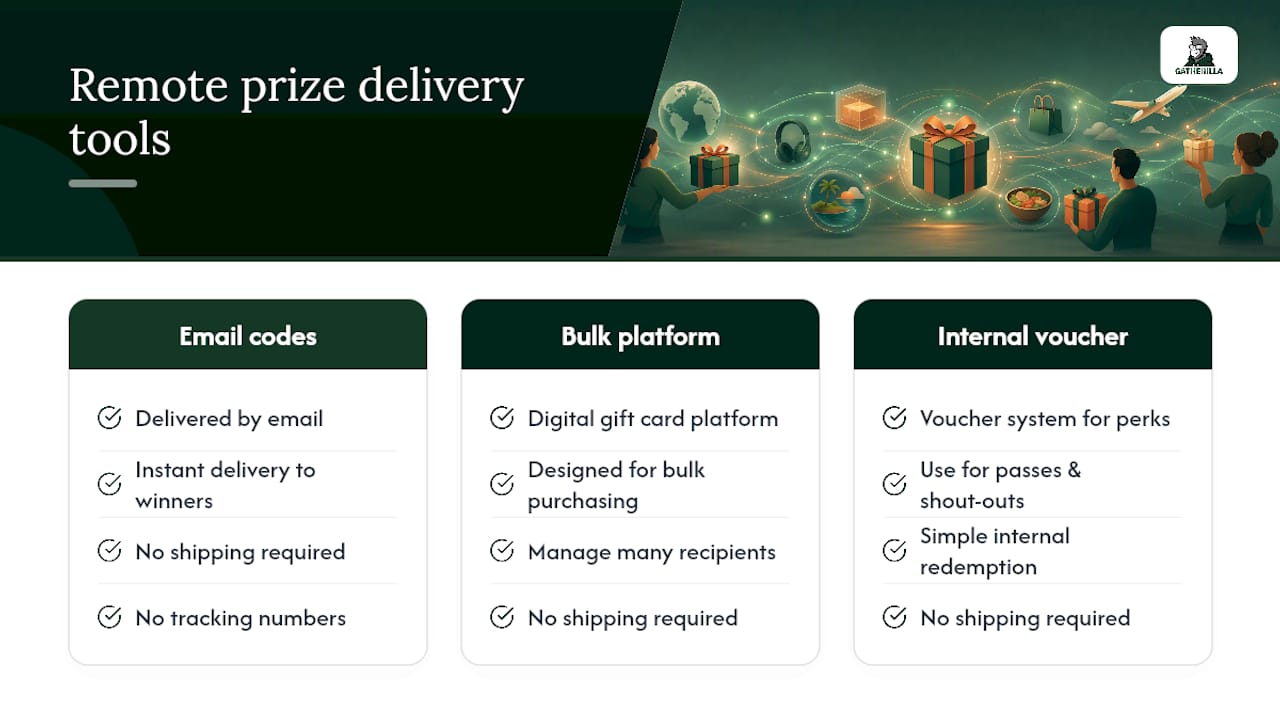
Getting a prize into someone’s hands remotely comes down to three tools: email-delivered gift card codes, a digital gift card platform for bulk purchasing, or a simple voucher system for internal perks like passes and shout-outs. All three work without shipping, tracking numbers, or physical inventory.
Cadence matters as much as the prize itself. Prizestash recommends mixing instant-win moments during live sessions with scheduled, higher-value experiences reserved for milestones, a combination that keeps both short-term energy and long-term motivation alive.
A rough budgeting framework:
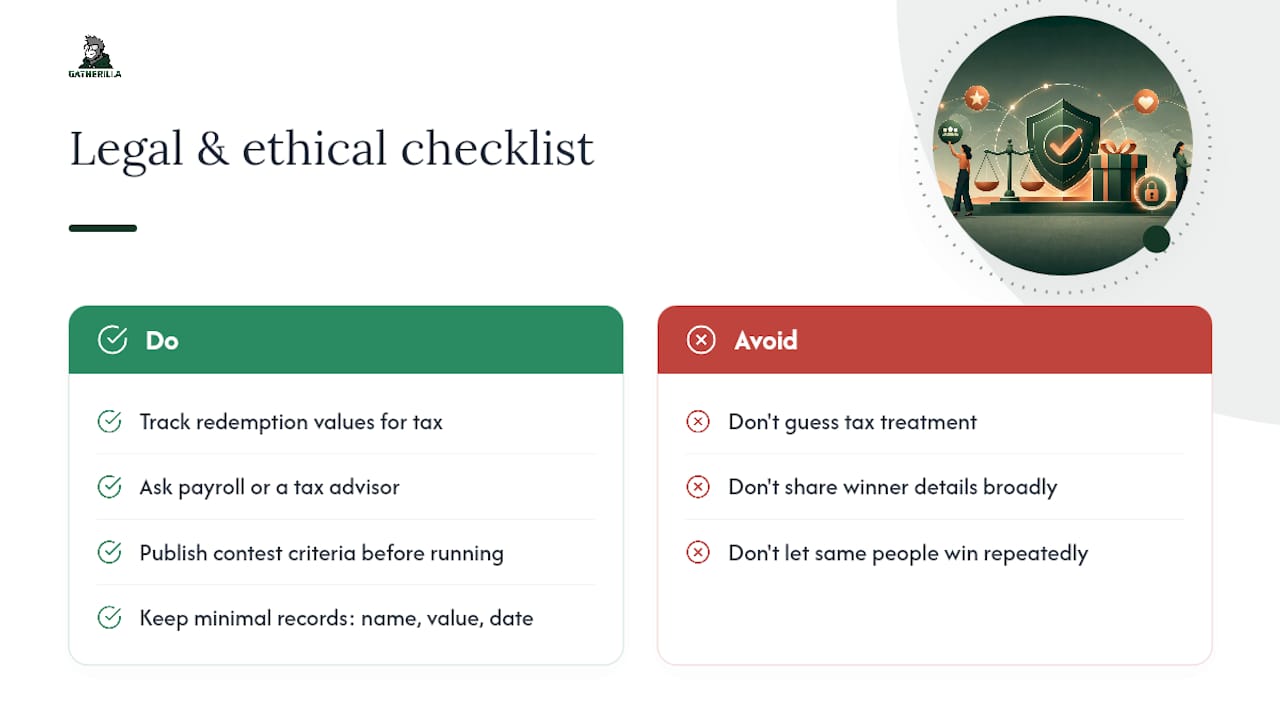
Fairness matters more than most programs admit. Publish your criteria before the contest starts, rotate who’s eligible to win big-ticket prizes, and keep a simple log of who received what and when. And a compliance note worth repeating: most cash-equivalent prizes, gift cards included, count as taxable income above small thresholds, so check with payroll before a program scales past a handful of people.
A Quick Framework: Fit, Frequency, Friction
Score any prize idea against three factors before you commit to it.
- Fit — does this reward match what your specific audience actually values? A gift card menu that skews toward coffee chains flops with a team that doesn’t drink coffee.
- Frequency — is this a one-off reward or part of an ongoing recognition rhythm? High-friction prizes (escape rooms, leadership lunches) belong at lower frequency; low-friction ones (badges, shout-outs) can run weekly.
- Friction — how many steps does the winner need to take to actually redeem it? A prize that requires downloading software or filling out a claim form loses momentum fast.
Three questions to ask before finalizing any prize list:
- Does the audience actually want this, or does it just look good on a slide?
- Can this be delivered digitally in under five minutes?
- Does this trigger a tax or policy question that needs sign-off first?
Pro Tip: If a prize idea fails two of the three Fit, Frequency, Friction tests, replace it rather than trying to fix it. A mediocre prize that’s easy to deliver almost always beats a great prize nobody redeems.
Red flags worth dropping entirely: physical prizes with unclear shipping timelines, prizes requiring new software installs, and rewards with vague or shifting eligibility rules. Replace each with a digital equivalent, a no-download activity, or a clearly stated criteria list.
How Gatherilla Runs Experience-Based Prizes Without the Setup Headache
Gatherilla runs entirely in the browser, so a trivia night, a daily challenge, or a milestone celebration can start without anyone downloading anything or fumbling with a new app mid-meeting.
- Team trivia as a prize moment — pair a live round with a small digital reward for the winner.
- Milestone celebrations — use a themed game session in place of (or alongside) a physical gift.
- Onboarding rewards — new hires join a low-pressure game as their first team interaction.
Reducing that setup friction is exactly why no-download formats tend to see higher participation than tools requiring installs or logins.
Legal and Ethical Considerations for Virtual Prizes
Prize programs run into trouble in three predictable places: tax treatment, fairness in eligibility, and data privacy around who gets contacted with prize notifications.
On taxes, cash and cash-equivalent prizes, including most gift cards, generally count as taxable income once they exceed nominal value under US tax rules. That means HR and payroll teams should track redemption values, not just announce winners and move on. This gets more complicated with international remote teams, where tax treatment of a prize can vary by the recipient’s home country. When in doubt, route the question to payroll or a tax advisor rather than guessing.
On fairness, publish your contest criteria before you run it, not after someone questions the outcome. Rotating who’s eligible for top prizes and avoiding repeat winners in small groups keeps morale intact. Students and employees both notice when the same three people win everything.
On privacy, sending prize notifications or gift card codes over email or chat means you’re handling personal data. Keep prize records only as long as you need them for tax or audit purposes, and don’t share winner details more broadly than necessary. A simple internal log with names, prize values, and dates covers most compliance needs without turning your recognition program into a data liability.
None of this requires a legal department for a standard team recognition budget. It does require someone checking a box before scaling past casual, occasional prizes.
What Actually Moves the Needle on Prize Programs
Most advice on virtual prizes treats teams, classrooms, and companies as separate problems needing separate playbooks. They don’t. The same three questions apply everywhere: does the reward fit the recipient, does it arrive without friction, and does it happen often enough to matter. A $10 gift card delivered instantly beats a $50 gift that takes two weeks to ship, every time.
The overrated idea is the single “big” annual prize. It gets remembered for a day and forgotten by the next quarter. What actually sustains engagement is the boring stuff done consistently: weekly shout-outs, monthly small rewards, quarterly experiences. Gatherilla’s daily challenge model fits that boring-but-effective pattern better than most one-off gift ideas, because it gives you a built-in, low-effort reward moment that doesn’t require reinventing your prize list every week.
If you take one thing from this, prioritize delivery speed over prize size. A smaller reward that shows up in someone’s inbox in thirty seconds will outperform a bigger one stuck in a shipping queue.
— Thomas
Sources
- Present and accounted for: digital gift cards in incentive programs — PaymentsJournal
- The Ultimate List of Virtual Prizes for Students — LiveSchool