

Virtual Family Feud for Work: Run It in 30 Minutes

The fastest way to run a virtual Family Feud for work is to use a browser-based, host-controlled game where players join from their phones via QR code or room code. No installs, no IT tickets, no one sitting out because they can’t figure out the app.
Here’s why this format works for remote teams:
- No-download browser play means anyone on the call can join in under 60 seconds, whether they’re on a laptop or a phone.
- QR or room-code joining removes the friction that kills momentum at the start of a session.
- Live scoring and a buzzer system create the competitive energy that makes the game feel like the real show, not a PowerPoint quiz.
These are the trust signals HR teams should look for when choosing a platform: browser play, QR join, host controls, and a live scoreboard that everyone can see on the shared screen.
Key Takeaways
Running a virtual Family Feud for work requires a browser-based platform with QR joining, host controls, and live scoring, and the whole session can run in under 30 minutes with minimal prep.
| Point | Details |
|---|---|
| Platform requirements | Choose browser-based play with QR/room-code joining and host controls; no downloads needed. |
| Session length and structure | Run three survey rounds plus Fast Money in 25–30 minutes; 4–8 players per team works best. |
| Question design | Use open-ended survey prompts with 5–8 natural answers; avoid sensitive or exclusionary topics. |
| Measure and repeat | Send a 5-question follow-up survey within two hours and schedule the next session before this one ends. |
| Gatherilla | Gatherilla’s browser-based platform covers the full setup checklist with templates, leaderboards, and admin controls. |
Table of Contents
- What do you need to run a virtual Family Feud at work?
- How do you design Family Feud questions for a work audience?
- What does a solid game structure look like for remote play?
- Which technology works best for virtual Family Feud at work?
- How do you host a virtual Family Feud session smoothly?
- How do you keep everyone engaged and included?
- How do you measure whether the session worked?
- Why does Family Feud actually work for remote teams?
- What running a 30-minute Family Feud taught me about remote energy
- Gatherilla makes it easy to run your first session today
- Sources
What do you need to run a virtual Family Feud at work?
Before the meeting starts, run through this checklist. Five minutes of prep prevents 20 minutes of chaos.
Tech you need:
- Host laptop with screen-share enabled in Zoom, Microsoft Teams, or Google Meet
- Stable WiFi (wired connection preferred for the host)
- Optional: a second device (phone or tablet) to monitor the player view while hosting
- Meeting link sent to all participants in advance
Participant requirements:
- Any smartphone or laptop with a browser; no app download needed
- The room code or QR code (share it in the meeting chat the moment the game opens)
Roles to assign:
- Host: runs the board, reads questions, controls pacing
- Scorekeeper/producer (optional): manages the scoreboard on a second screen if the platform doesn’t auto-score
Timing and group size:
- 15–30 minutes for a quick mid-meeting energizer; up to less than an hour for a dedicated team event
- Ideal team sizes: 4–8 players per team, 2–4 teams total
- Works well for small to medium-sized groups; browser-based formats scale easily because each player uses their own device
Pro Tip: Run a 5-minute tech test with one colleague before the session. Confirm screen-share shows the game board clearly and that the buzzer registers on a phone. If buzzer latency is an issue, have players type answers in the meeting chat as a fallback.
How do you design Family Feud questions for a work audience?
The game lives or dies on the questions. Survey-style prompts work best: open-ended, with multiple expected answers ranked by popularity. Think “Name something people do to avoid a Monday morning meeting” rather than “What is the capital of France?”
Design rules:
- Write prompts that have 5–8 natural answers so teams can score on multiple guesses.
- Avoid anything touching salary, performance, personal relationships, or health.
- Test each question by asking yourself: could every person on the team answer this comfortably? If not, cut it.
10 ready-to-copy sample questions for corporate teams:
- Name something people do in the first five minutes of a work-from-home day.
- Name a reason someone mutes themselves on a video call.
- Name something always in a conference room.
- Name a snack people keep at their desk.
- Name something a coworker says that means the meeting could have been an email.
- Name a popular workplace communication tool.
- Name something people do to look busy on a slow Friday.
- Name a movie everyone has seen at least once.
- Name something you’d find in a break room.
- Name a reason someone is late to a meeting.
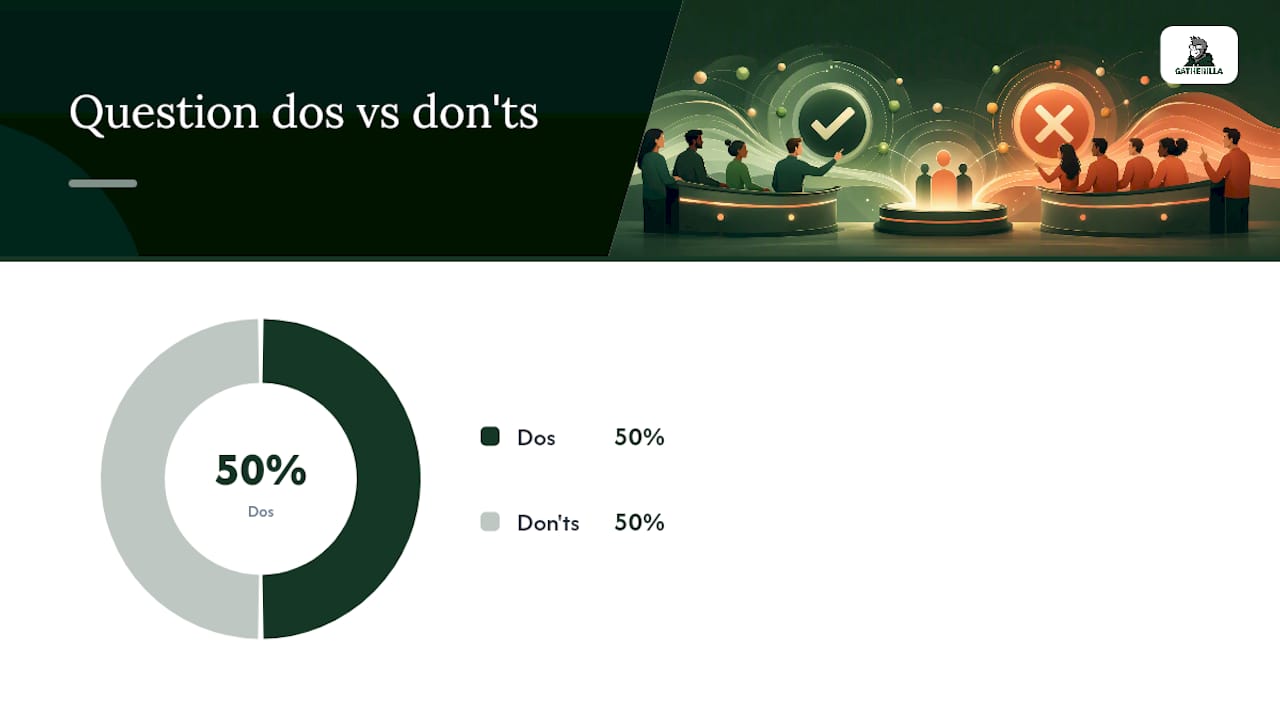
Dos and don’ts for inclusive questions:
- Do mix work-themed prompts with light pop culture and universal everyday topics.
- Do add one or two company-specific questions (“Name a value from our company handbook”) if the group knows each other well.
- Don’t use inside jokes that exclude newer team members.
- Don’t ask anything that could embarrass a specific person or department.
For more on question types that don’t make people cringe, the principle is simple: if the answer could be awkward for anyone in the room, swap it out.
What does a solid game structure look like for remote play?
A well-paced session follows the TV format closely, adapted for a 25–30 minute window. Official Family Feud rules put two teams competing across rounds with point values tied to survey popularity, and Fast Money as the high-stakes bonus closer.
Sample agenda:
- 0–3 min: Welcome, explain rules, teams join via QR/room code
- 3–6 min: Warm-up round (one easy question, no points, just to test buzzers)
- 6–18 min: Three survey rounds (4 minutes each); each team sends one rep to buzz in
- 18–22 min: Steal round (losing team gets one steal attempt per question)
- 22–28 min: Fast Money round (two players answer 5 questions solo, 20 seconds each)
- 28–30 min: Score reveal, winner announcement, wrap-up
Scoring rules:
| Element | Rule |
|---|---|
| Survey answer (top answer) | 40–50 points |
| Survey answer (lower ranked) | 5–25 points |
| Strike | 3 strikes = board passes to opposing team |
| Steal | Opposing team gets one guess to claim all points |
| Fast Money target | A combined point target triggers the Fast Money bonus |
| Tie-breaker | Sudden-death buzzer round on a single question |
A typical Family Feud flow runs three timed rounds followed by Fast Money, which awards bonus points when players collectively hit the target score. For remote play, give each Fast Money player 20 seconds and mute the other team during their turn to prevent coaching.
Which technology works best for virtual Family Feud at work?
The platform decision comes down to one question: can every player join in under a minute without downloading anything? If the answer is no, you’ll lose the first five minutes of every session to tech support.
Feature checklist to prioritize:
- Browser play with no app or plugin required
- QR code or short room code for phone joining
- Host controls (reveal answers, award points, manage buzzers)
- Live scoreboard visible on screen-share
- Buzzer input from phones
- Privacy controls or SSO for corporate use
Platform categories and tradeoffs:
Free browser builders (like Family Feud Maker) let you create custom games with QR code joining and host-controlled buzzers at no cost. They’re great for one-off sessions but typically lack admin reporting or saved question banks.
Fully hosted pro events add a live host, concierge setup, and production polish. They’re worth considering for large company-wide events, but the cost and scheduling friction make them impractical for recurring weekly rituals.
Enterprise-integrated platforms combine browser play with admin dashboards, analytics, and SSO. They cost more but pay off when you’re running activities at scale across departments.
Pro Tip: Look for a platform with single-click session templates. Loading a pre-built question set cuts your prep time from 30 minutes to under 5.
For HR teams who want fast setup, browser-based play, and admin controls without the overhead of a fully hosted event, Gatherilla is the recommended option. It covers the full checklist: no downloads, QR/room-code joins, host templates, and real-time leaderboards.
How do you host a virtual Family Feud session smoothly?
Minute-by-minute host agenda:
- 0–5 min: Welcome everyone, share the room code in chat, explain the two-team format and buzzer rules in two sentences.
- 5–8 min: Split into teams (use breakout rooms or just call out names); confirm everyone can see the game board on screen-share.
- 8–25 min: Run three survey rounds. After each question, read the top answers aloud as you reveal them.
- 25–28 min: Fast Money. Isolate one player per team, run the clock, read scores aloud.
- 28–30 min: Announce the winner, give a quick shout-out to standout moments, close the game.
Script snippets:
- Opening: “Welcome to [Company] Family Feud! We surveyed 100 people and asked them… your job is to guess the top answers. First team to buzz in gets to answer.”
- Strike: “Ohhh, that’s a strike! One more and the other team gets a steal.”
- Steal: “Team B, you have 10 seconds to steal. Put your heads together.”
- Fast Money: “No coaching allowed. [Name], you’re up. Ready? Go.”
Troubleshooting:
- Players can’t join: Paste the room code in the meeting chat and ask them to open a browser tab. Avoid asking them to “find the link” verbally.
- Buzzer lag: Switch to chat-based buzzing. First name typed wins the buzz.
- Screen-share fails: Browser-based formats work smoothly on Zoom, Teams, and Google Meet when the host shares a specific browser tab rather than the full desktop. Try that first.
For Microsoft Teams-specific screen-share tips, the team building games for Microsoft Teams guide covers the exact settings to check.
How do you keep everyone engaged and included?
Family Feud-style games are fast, inclusive, and require almost no learning curve, which helps teams engage quickly. Still, a few deliberate choices separate a great session from a forgettable one.
Engagement dos and don’ts:
- Do rotate who hosts each month. Fresh hosts bring fresh energy and question sets.
- Do use breakout rooms for 60-second team huddles before buzzing in. It creates collaboration, not just competition.
- Do encourage emoji reactions in the meeting chat during reveals.
- Don’t let the same two or three people dominate buzzing. Assign a “designated buzzer” per round.
- Don’t run the game longer than less than an hour. Energy drops sharply after that.
Accessibility considerations:
- Enable live captions in Zoom or Teams for participants with hearing differences.
- Allow typed answers in chat for anyone who finds the buzzer mechanic a barrier.
- Schedule sessions at a time that works across time zones; a 10 AM Pacific / 1 PM Eastern window covers most U.S. teams.
Prize ideas that work remotely:
- $10–$25 digital gift cards (Amazon, Starbucks, DoorDash)
- A company shout-out in the next all-hands or Slack channel
- A small team perk: the winning team picks the next game or gets to leave the next Friday meeting a short period of time early
Pro Tip: For remote icebreaker games that warm up a cold group before Family Feud, run one quick two-truths-and-a-lie round before the game starts. It takes three minutes and gets people talking.
How do you measure whether the session worked?
One game won’t tell you much. A pattern across three or four sessions will.
Simple metrics to track:
- Participation rate (attendees who joined the game vs. total invited)
- Post-session NPS or engagement score (a single 1–10 question works)
- Qualitative comments from a two-question follow-up survey
- Repeat-attendance intent (“Would you join again?”)
Sample follow-up survey questions:
- How much did you enjoy today’s session? (1–10)
- Did the game help you connect with teammates you don’t usually talk to?
- What was your favorite question?
- What would make the next session better?
- Would you recommend this to another team?
Send the survey within two hours of the session while the experience is fresh. Share highlights and the winner’s name in your team Slack channel or email the same day.
Turning a one-off into a ritual:
- Schedule the next session before the current one ends.
- Rotate hosts every month and ask each host to contribute five new questions.
- Keep a shared question bank (a simple Google Sheet works) so questions don’t repeat.
For a full recurring-event planning framework, the virtual office Olympics guide covers scheduling cadence and how to build momentum across multiple sessions.
Why does Family Feud actually work for remote teams?
Short synchronous games manufacture the social interaction that remote teams miss. There’s no equivalent of the watercooler moment in a distributed setup, and browser-based trivia formats that scale from 5 to 500 players fill that gap because everyone participates on their own device at the same time.
A few specific mechanics make Family Feud particularly effective:
- Shared wins flatten hierarchy. When a junior analyst and a VP are on the same team guessing answers together, titles disappear for 25 minutes.
- Live reaction moments create emotional connection. The collective groan when a team gets a strike, the cheer when someone nails the top answer — those micro-moments build rapport faster than a structured icebreaker.
- The buzzer creates urgency. Unlike a passive quiz, buzzing in requires a decision under pressure. That small adrenaline spike makes the game memorable.
Live virtual game platforms with buzzers, leaderboards, and host controls recreate the in-person energy that makes these moments land. The technology isn’t incidental; it’s what makes the format work at scale.
What running a 30-minute Family Feud taught me about remote energy
The first time I ran a Family Feud session for a cross-functional team of 18 people, the group included engineers, marketers, and two new hires who had never met most of the team. The game was 28 minutes. By the Fast Money round, people were typing in all caps and someone unmuted to yell at their screen.
What surprised me wasn’t that people had fun. It was what happened in the meeting after the game. The conversation was looser, the new hires spoke up, and the usual dynamic of a few voices dominating had shifted. One game did more for that team’s cohesion than three months of weekly standups.

The practical takeaway: rotate the host every month. When the same person runs every session, the game becomes their personality. When someone new hosts, they bring different questions, a different energy, and the format stays fresh. That rotation alone is what turns a one-off into a ritual people actually look forward to.
Gatherilla makes it easy to run your first session today
Running a virtual Family Feud for work doesn’t have to mean building a game from scratch or hiring an event company. Gatherilla gives HR teams and team leads a browser-based platform where players join via QR code or room code, no downloads required, and the host gets full controls from the first screen.
What you get out of the box: customizable multiplayer games, real-time leaderboards, session templates that cut prep to under five minutes, and admin controls built for corporate use. It works with Zoom, Teams, and Google Meet without any integration setup. The free tier lets you run your first session today; the paid plan unlocks additional games, analytics, and priority support as your program grows.
Start your first session on Gatherilla and run a 15-minute pilot with your next team meeting.
Sources
Next steps: