

Remote Onboarding Gamification: A Practical Guide for HR

Gamified remote onboarding works when the game does real onboarding work: it gives a new hire clear next steps, a visible sense of progress and a reason to talk to colleagues they have never met. Points and badges alone do not do that. Short multiplayer games, scavenger hunts and daily challenges that run inside the video calls your team already uses do. Gatherilla’s browser-based games need no downloads, so a new hire can join a session in seconds on day one.
This guide is for HR managers and team leaders who onboard people they will never meet in an office. It covers what gamification means here, what the research supports, which mechanics to use, a first-month plan and how to tell whether it is working.
TL;DR
- Remote onboarding gamification means using game elements (progress, challenges, light competition, recognition) to make a new hire’s first weeks structured and social, not to turn work into a contest.
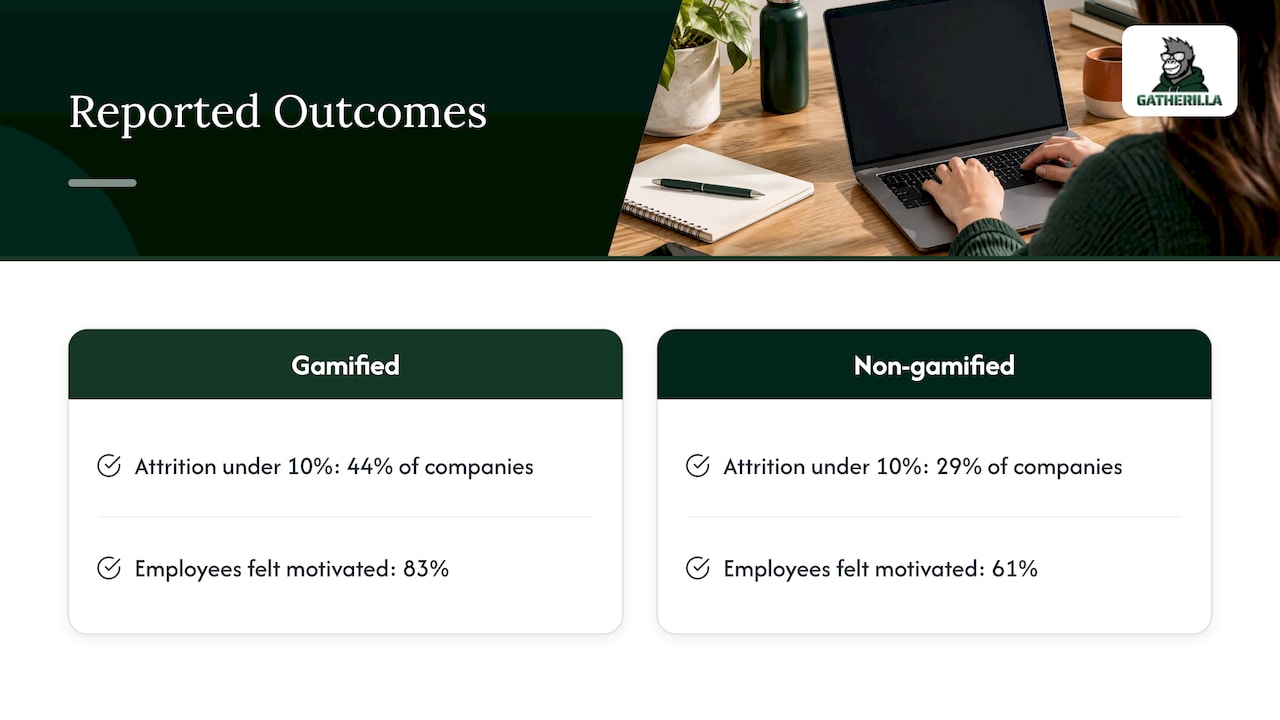
- Companies that use games in onboarding were more likely to report low new-hire attrition in one industry study: 44% reported under 10%, against 29% of companies without games.
- The mechanics that hold up are visible progress, clear rules, graduated challenges and cross-team contact. Leaderboards need to be optional and team-based.
- Start with a 15-minute icebreaker on day one, add a daily challenge and a scavenger hunt in week one, and review participation at 30 days.
- You can start free and add seats on a paid plan later, so the pilot costs little.
Table of Contents
- What gamification means in remote onboarding
- What the evidence says
- Game mechanics that suit remote onboarding
- A first-month plan
- Make it work for every new hire
- Measure what matters
- Our perspective
- Where Gatherilla fits
- FAQ
- Sources
What gamification means in remote onboarding
Gamification is the use of game design features, such as points, levels, challenges and rewards, in something that is not a game. In onboarding, the “something” is the stretch between signing the offer and feeling at home in the job: paperwork, tools, training, meeting the team, learning how decisions get made.
Remote onboarding has a particular problem. In an office, a new hire absorbs a lot by sitting near people. Remotely, they get a calendar full of calls and a pile of documents, and nobody tells them what “good progress” looks like. Games fix a specific part of that: they supply structure (a next step), feedback (you did it) and a low-stakes reason to interact with strangers.
There are two kinds of gamified onboarding, and most programs need both:
- Learning games teach content: product knowledge, security basics, company history, tool tours. These are often quizzes, missions or levels.
- Connection games build relationships: icebreakers, trivia, word challenges, team scavenger hunts. These are played together, live or in a daily rhythm.
Many onboarding programs invest heavily in the first kind and leave the second to chance. For remote hires, the second kind is often what decides whether they feel part of a team after week two.
What the evidence says
The evidence is encouraging but not unconditional, and it helps to know where the conditions are.
Attrition. Brandon Hall Group’s strategic onboarding research found that 44% of companies using games in onboarding reported new-hire attrition under 10%, compared with 29% of companies that did not use games. That is a correlation across companies, not a guarantee for yours, but it points in a consistent direction.
Motivation. A TalentLMS survey reported by SHRM found that 83% of employees who received gamified training felt motivated, versus 61% after non-gamified training. The same report says 89% of employees feel more productive when gamification is part of their work.
Leadership matters. A Harvard Business School study of gamified training found that the benefits were greater when employees started out more engaged and when more leaders took part as role models. The practical lesson: a manager who plays the day-one icebreaker alongside the new hire does more for the program than any badge system.
Real examples. Ware2Go built a 10-level virtual game in which new employees train in every department and book meetings with director-level colleagues outside their own team. The game gives remote hires a path and forces cross-team contact. Riot Games gives each onboarding cohort its own Slack channel for daily team-building activities and virtual game nights, and has senior executives attend orientation sessions.
The pattern across these: the game points at something the company already wants new hires to do (learn the business, meet people across teams), and people in authority show up.
Game mechanics that suit remote onboarding
You do not need every mechanic. Pick the few that match what a new hire needs in each week.
| Mechanic | What it does for a remote new hire | How to use it well |
|---|---|---|
| Progress tracking | Shows what is done and what is next, replacing the “am I on track?” worry | Tie each step to a real task: set up tools, meet a buddy, finish a module |
| Clear rules | Removes guesswork, which matters when nobody is nearby to ask | Say in one sentence how each game or challenge works and what counts as finished |
| Graduated challenges | Builds confidence by starting easy | Begin with a two-minute icebreaker, move to a team trivia round, then a cross-team hunt |
| Recognition | Makes small wins visible to the team | Celebrate completed steps in the team channel, not only top scores |
| Light competition | Adds energy to live sessions | Use team-based scoring, make participation optional and keep stakes low |
| Daily challenges | Creates a habit of showing up | Keep it to a few minutes and run it at a predictable time |
Brandon Hall’s write-up of the EI Design approach recommends progress tracking, clearly defined rules, a graduated scale of challenges, meaningful rewards and recognition of accomplishments, and starting engagement before day one. That fits the table above.
One caution on leaderboards: new hires will always rank below people who know the content and the colleagues. Team-based boards, or boards that reward participation and streaks rather than raw knowledge, avoid that. Our guide to team leaderboard ideas that motivate without embarrassing anyone covers several formats.
A first-month plan
This plan assumes a new hire joins a team of five to fifteen people and a video conferencing tool is already in use. Adjust the timing to your own program.
Before day one: set the tone
Send the welcome message with one small, fun action: a short question about a favorite work-from-home snack, or a link to a quick trivia game. Starting engagement in preboarding is something the Brandon Hall piece recommends, and it gives the new hire something to do other than wait.
Day one: a 15-minute icebreaker
Open the first team call with a short game that everyone plays, including the manager. Pick something where nobody can answer wrong: a word challenge, a “two truths” round or quick trivia about the team. The goal is for the new hire to hear colleagues laugh, not to test them. Our post on virtual onboarding games lists six formats that fit this slot, and the 25 new employee orientation games give you a bigger menu.
Gatherilla runs in the browser with no downloads and works with all video conferencing tools, so there is nothing to install before the call starts.
Week one: a daily challenge and a scavenger hunt
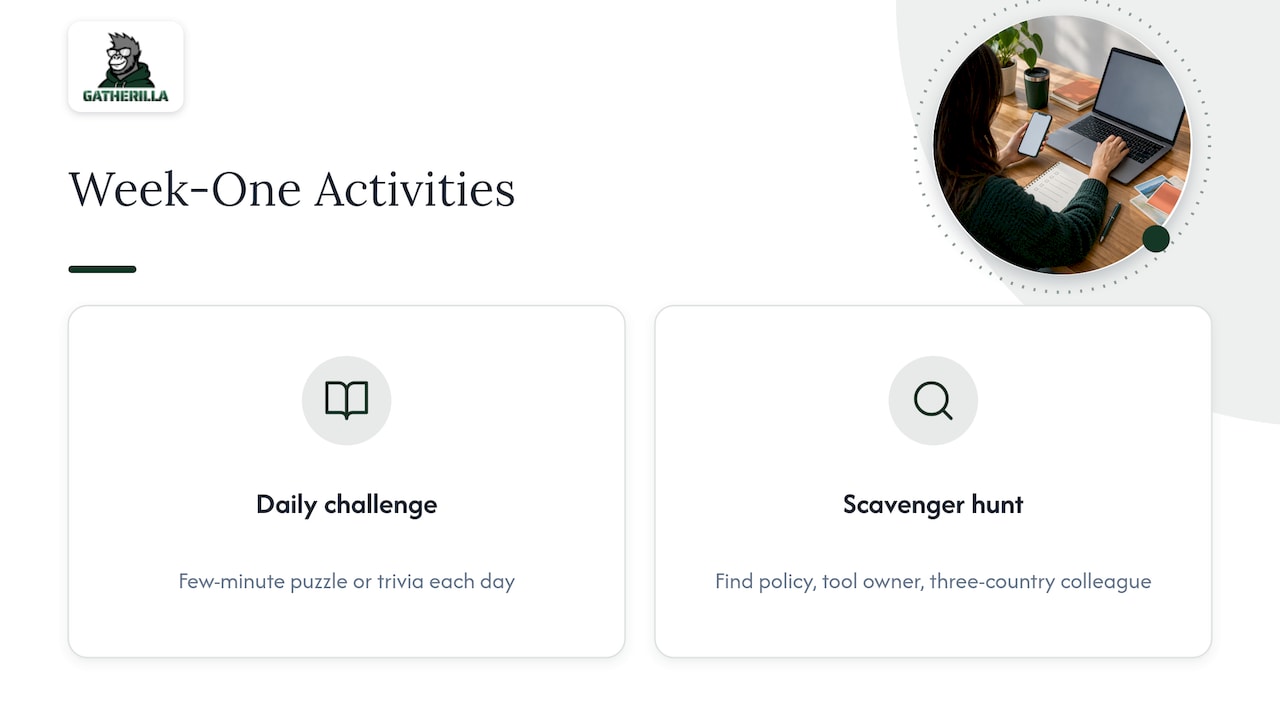
Add a daily challenge, such as a word puzzle or trivia question, that takes a few minutes. The point is rhythm: the new hire sees the same people showing up at the same time each day. See daily team challenge ideas for remote and hybrid teams for variations.
Later in the week, run an onboarding scavenger hunt. The best ones send the new hire to find real things: where the expense policy lives, who owns a given tool, which colleague has worked in three countries. Ware2Go’s approach of requiring meetings with people outside the new hire’s team shows why this works. See onboarding scavenger hunt ideas for remote teams for examples.
Weeks two to four: cross-team contact and recognition
Pair the new hire with people from other teams for a short game or challenge. Recognize completed steps publicly: finishing a training module, completing the first project, helping a colleague. If you run hybrid teams, the same principles apply with small changes, as in hybrid onboarding games.
Day 30: review and adjust
Look at who joined sessions, who skipped them and what the new hire says helped. Then change the plan for the next cohort.
Make it work for every new hire
Gamification fails when it makes people uncomfortable. A few design choices prevent most problems.
- Make competition optional. Let people join the game without appearing on a ranking. Some new hires are shy, and some are in time zones where live sessions are awkward.
- Keep rules short. A game that needs a long explanation is not an icebreaker.
- Offer asynchronous options. A daily challenge people can complete when it suits them works across time zones. Riot Games’ program, in the Fortune report, also condenses training and uses asynchronous formats for shorter remote attention spans.
- Fit the role. A support agent and an engineer need different learning content. Keep connection games general and learning games role-specific.
- Avoid rewards that feel like pressure. Recognition works better than prizes for most teams.
- Have managers play. The HBS study’s finding on leaders as role models is the strongest argument for this.
Measure what matters
A gamified program is only worth keeping if it changes something you care about. Choose a small set of measures before the first cohort starts.
- Participation. What share of new hires and team members joined the day-one icebreaker and the daily challenge in the first two weeks?
- Connection. Ask the new hire at day 30 how many colleagues they feel comfortable messaging. A simple survey question works.
- Learning. Did completion of required modules improve compared with the previous cohort?
- Retention. Compare 90-day and 180-day attrition across cohorts, remembering that the sample may be small.
- Manager observation. Training Industry notes that live polling, virtual whiteboards and chat give instant feedback on engagement during sessions, and that managers can also use surveys and verbal feedback.
Onboarding generates a lot of feedback in calls and chats. If you want to keep it organized, tools for capturing meeting feedback and decisions can turn conversations into records you can review at the 30-day check-in.
Gatherilla’s paid plan adds analytics and reporting, so participation data can sit alongside your other onboarding notes. For a deeper look at what to track and why, see our post on onboarding games grounded in self-determination theory, which covers results to expect over 6 to 12 weeks.
Our perspective
We built Gatherilla on a simple belief: remote new hires do not need more content, they need more people. Most onboarding programs are good at telling someone what to do and weak at helping them know who to ask, who to laugh with and who is on their side.
That is why we focus on games that take no preparation and no downloads. If a game needs a long setup, a manager skips it, and the new hire is back on a calendar of calls with strangers. When a game opens in the browser and works with whatever video tool you already use, it actually happens.
We also think engagement should be a habit, not an event. One welcome party does not make a team. A daily word or trivia challenge, played in a few minutes, gives people a reason to show up for each other every day, and new hires join an existing rhythm instead of watching from outside it. Add peer-to-peer recognition tied to company values, and the new hire sees what the culture rewards.
Our advice to HR teams: start small, play with your new hires, and let the rhythm do the rest.
Thomas
Where Gatherilla fits
Gatherilla is a browser-based team-building platform for remote and hybrid teams. It offers customizable multiplayer games, daily word and trivia challenges, icebreakers for meetings, onboarding games for new employees and real-time leaderboards, and it works with all video conferencing tools.
The Free plan lets you try the games with your next cohort. Premium adds more activities, reporting and priority support, and is published at $0.50 to $1.00 per seat per month, or $5 to $10 per seat per year. See the pricing page for the current plans.
If you want to see the games before you plan your first cohort, start at Gatherilla.
FAQ
What is gamification in remote onboarding?
It is the use of game elements, such as challenges, progress tracking, recognition and light competition, to structure a new hire’s first weeks. In remote settings it often means live icebreakers, trivia, scavenger hunts and daily challenges that help people meet colleagues they have never seen in person.
Does gamified onboarding actually improve retention?
One industry study found that 44% of companies using games in onboarding reported new-hire attrition under 10%, versus 29% of those that did not. The result is a correlation, so track attrition for your own cohorts before and after you introduce games.
How long should an onboarding game take?
Keep day-one icebreakers to about 15 minutes and daily challenges to a few minutes. Longer sessions, such as a scavenger hunt, can run across several days so new hires complete them between other tasks.
Should onboarding games have leaderboards?
They can, if they are designed carefully. Use team-based boards or recognition for participation, and let people take part without being ranked. That keeps the energy of competition without discouraging someone who joined last week.
Can we run onboarding games on any video platform?
Yes, with Gatherilla. It runs in the browser, needs no downloads and works with all video conferencing tools, so the same game can be used across the tools your teams already have.
Sources
- Brandon Hall Group: How to Reimagine Induction and Onboarding Training for a Hybrid Workplace
- SHRM: Gamification Advances Post-Pandemic
- Harvard Business School: When Does Gamified Training Improve Performance?
- Quartz: How to use gamification to recruit and retain top talent
- Fortune: Why Riot Games is still committed to denewbing its new hires
- Training Industry: How to Measure Engagement in Your Training Program
- The Intent Ledger: Client Feedback Tracking