

Town Hall Engagement Ideas That Get People Talking
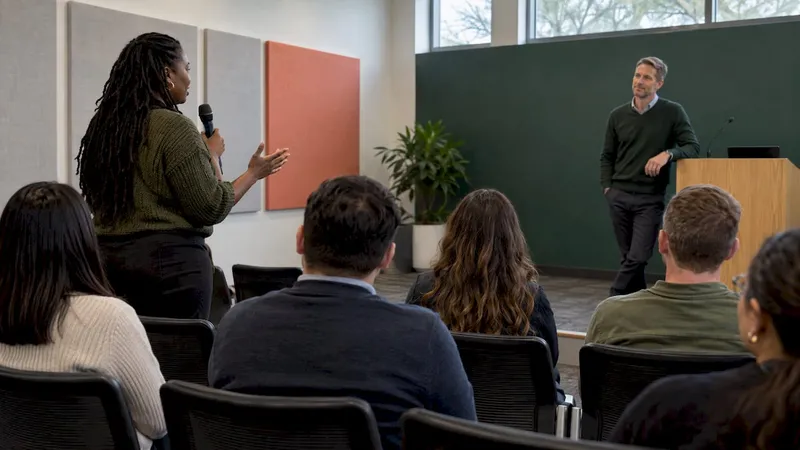
A town hall is engaging when employees do something in it besides listen. The ideas that work share one pattern: a short, low-pressure activity that gets everyone participating in the first five minutes, questions collected before and during the meeting, recognition that comes from peers as well as executives, and a follow-up that proves the input was heard. For remote and hybrid teams, a browser-based icebreaker game is the fastest way to start. Gatherilla’s multiplayer games run in the browser with no downloads and work with any video conferencing tool, so the opener takes no preparation.
Below you will find the formats, the timing, and the mistakes that turn a company-wide meeting into a muted screen with 200 tiles.
TL;DR
- Give every town hall one clear goal and say it up front, so people do not multitask through the hour.
- Open with a short, nonwork icebreaker or game so the first thing attendees do is take part.
- Collect questions ahead of time and let people vote on them, then hand the microphone to employees, not only executives.
- Use the meeting to recognize people and welcome new hires, and keep it to 30 to 60 minutes.
- Follow up with a recap, the recording and a visible answer to what employees asked.
Table of Contents
- What makes a town hall engaging
- Before the meeting: build interest early
- Start with an icebreaker that takes two minutes
- Live interaction: polls, word clouds and Q&A
- Put employees at the microphone
- Recognition and new-hire moments
- Make it work across time zones and hybrid rooms
- Our perspective
- Try it at your next town hall
- After the meeting: show that people were heard
- FAQ
- Sources
What makes a town hall engaging
A town hall is a company-wide meeting where leadership shares updates and employees can ask questions. Engagement is the difference between a broadcast and a conversation.
SHRM’s coverage of post-pandemic town halls quotes an expert who argues that leaders should be open to questions because it makes employees feel seen and heard, which builds a positive workplace culture. The same article advises giving each session a clear, meaningful goal, such as gathering feedback, brainstorming or simply creating space, and announcing that goal at the start. The reasoning is practical: people who take time out of their workday will multitask if the hour is not filled with real discussion.
So every idea below does one of three jobs: it gets people participating, it lets them shape the agenda, or it shows them their input led somewhere.
Before the meeting: build interest early
Engagement starts in the invitation, not in the first slide.
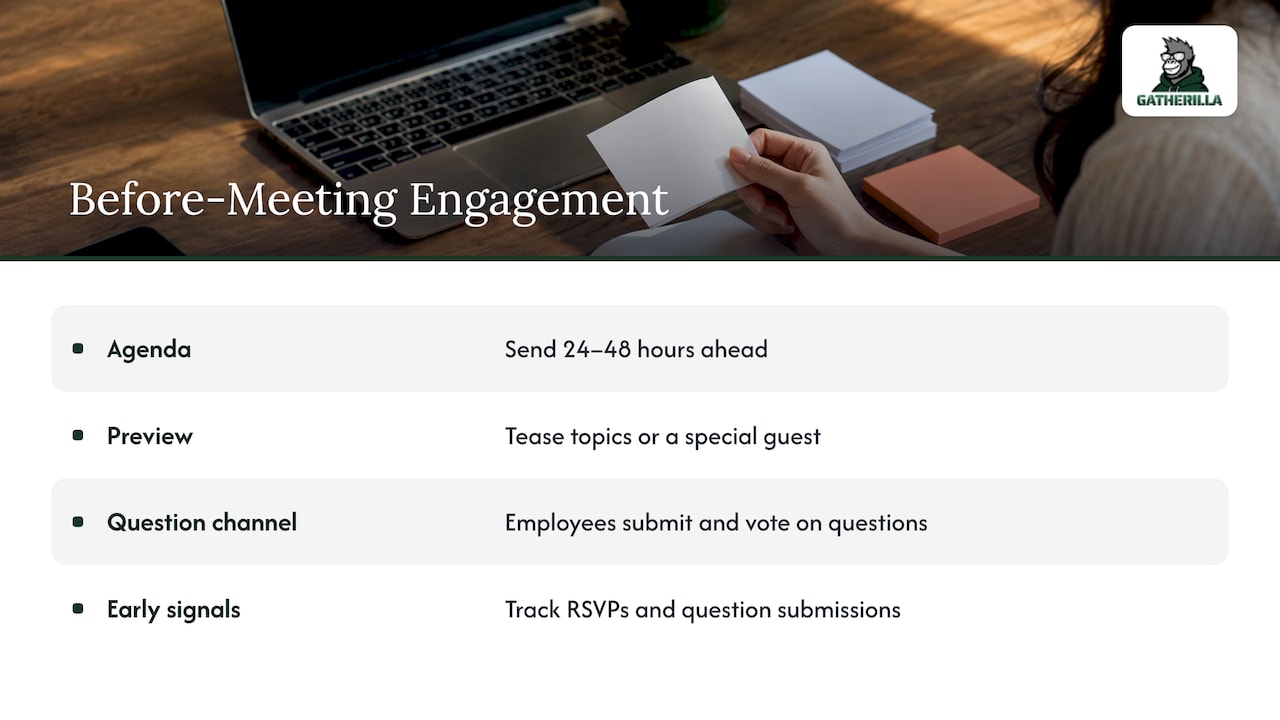
Send the agenda 24 to 48 hours ahead. Slack’s guide to all-hands meetings recommends distributing the agenda at least 24 to 48 hours in advance so people can prepare questions. An agenda that arrives five minutes before the call produces silence in the Q&A.
Preview topics and tease a guest. Ragan quotes a corporate affairs VP who suggests planning engagement before, during and after the town hall: previewing topics, teasing a special guest, or even sending a 30-second movie-trailer-style video as the invitation. It costs little and makes the meeting feel like an event.
Open a question channel. A Forbes Communications Council contributor describes setting up a channel where employees submit and vote on questions, so the most interesting questions rise to the top. Voting also protects quieter people: they can back a question without having to ask it aloud.
Watch the early signals. The same Ragan piece suggests tracking how quickly people RSVP or submit questions to gauge interest in a topic and adjust the presentation. If questions about one subject flood in, give it more time.
Start with an icebreaker that takes two minutes
The first five minutes set the tone. SHRM’s source recommends opening with a nonwork icebreaker to put attendees at ease and to use the time to foster community. In a large virtual meeting, this matters more than in a conference room, because nobody is chatting by the coffee machine beforehand.
What makes an icebreaker work in a big group:
- Everyone can answer at the same time. A question typed into the chat, or a quick game played in parallel, beats going around the room.
- It is low stakes. Favorite lunch, a morning-routine confession, a trivia round. Nothing that requires vulnerability or expertise.
- It is short. Two to five minutes, then straight into the agenda.
- It needs no setup from attendees. If people must install software or create accounts, half of them will still be signing in when you start.
This is where Gatherilla fits. Its platform is browser-based, needs no downloads, and works alongside any video conferencing tool. It offers customizable multiplayer games, icebreaker activities for meetings and real-time leaderboards, so a quick trivia or word round can run on screen while people join the call. If you want a list to pick from, our guides to all-hands meeting games and all-hands activities for remote and hybrid teams cover formats for large groups.
A simple daily-style prompt also works as a warm-up: post a light work question of the day in the chat while people arrive and read a few answers aloud.
Live interaction: polls, word clouds and Q&A
Once the agenda starts, give people something to do every ten minutes or so.
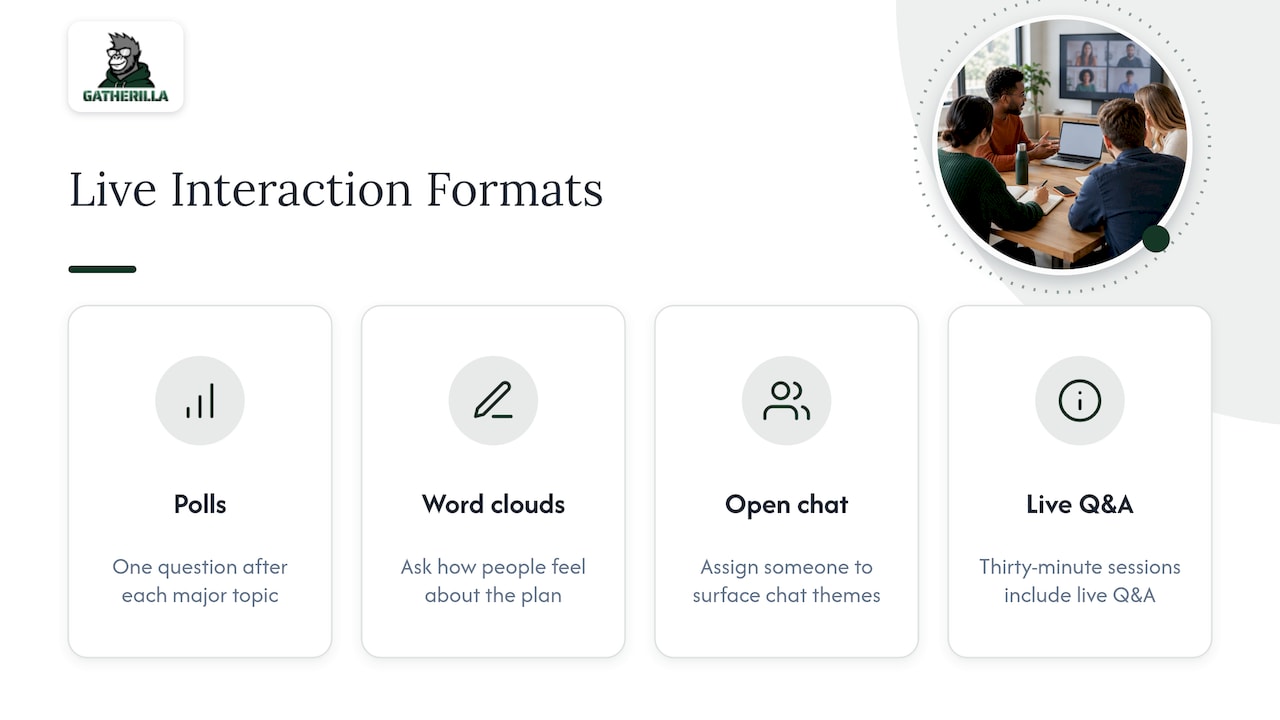
Polls and ratings. A single-question poll after each major topic tells you whether people followed the message and how they feel about it. Keep to one question per poll so the meeting does not become a survey.
Word clouds. The Forbes contributor describes using open tools for Q&A, word clouds, ratings and crowdsourcing. A word cloud asking “one word for how you feel about this plan” is quick and honest. The same author tells a cautionary story: when the timing of a session was misaligned, the resulting word cloud was dominated by the word “disappointed.” That is useful information, and it is why you should ask while you can still respond to it.
Keep the chat open. Sun Life’s communications lead told Ragan that streaming without sign-in barriers makes the experience a bit more democratic, since everyone views it the same way, and that an always-on chat shows how people are feeling, not only what they ask. Someone on the team should be assigned to read the chat and surface themes to the presenter.
Run Q&A every time. Sun Life holds 30-minute sessions with live Q&A at every one, puts headlines and recent wins in the first five minutes, and keeps the rest for dialogue. A fixed rhythm like that tells employees the questions are not an afterthought.
Mind the length. The Forbes contributor warns that a town hall longer than an hour sets expectations of significant announcements. If you have no big news, a tighter meeting is the better signal.
A quick structure for a 45-minute session
| Minutes | Segment | Purpose |
|---|---|---|
| 0 to 5 | Icebreaker or short game | Everyone participates right away |
| 5 to 10 | Headlines and recent wins | Set context and recognize people |
| 10 to 25 | Main topic with one poll | Share the message, check understanding |
| 25 to 40 | Voted questions, live Q&A | Answer what people actually asked |
| 40 to 45 | Next steps and what happens after | Promise a visible follow-up |
Put employees at the microphone
Engagement jumps when the speaker is someone who looks like the audience. The Forbes contributor argues that employees relate better to peers than to leaders, and that handing the microphone to people living a change makes them authentic communicators. She cites a Bayer town hall where employees working in a new operating model spoke instead of senior leaders.
Slack’s guide makes a related point: rotate speakers so different team members present updates rather than the same executives dominating every session. Qumu has each business function, such as finance, HR, sales and engineering, give an update, so employees see the whole organization, according to SHRM.
Leaders have a job here too: listening without rushing to answer. This lesson on leaving one ear open as a leader is a good habit to carry into the Q&A portion.
Recognition and new-hire moments
The first search result for this topic puts it simply: town halls are a natural place to celebrate. Done well, it takes five minutes and does more for morale than another slide.
- Open with shout-outs. Qumu’s human capital VP told SHRM the company kicks off town halls with shout-outs for key accomplishments, milestones and completed projects.
- Welcome new hires by name. Duke University’s HR office lists welcoming new hires with a banner, ready desk supplies, a small gift and lunches with co-workers among its examples of recognition. In a remote company, the equivalent is a short intro slide, a fun fact each, and a trivia question about them that the whole company can guess.
- Tie recognition to values. Ragan reports that CVS Health profiled four employees who embody its four new values. The videos premiered during a town hall, the employees were brought onstage, and the videos were reused in later sessions dedicated to one value at a time.
- Celebrate teams, not only individuals. Service anniversaries and letters of commendation are on Duke’s list too, and both translate easily to a shared screen.
For more formats, see our 50 employee recognition ideas. New hires also benefit from the lighter side: an onboarding game before or after the meeting gives them a way to meet colleagues without being put on the spot.
Make it work across time zones and hybrid rooms
In hybrid meetings, remote attendees often feel like spectators. A few fixes:
- Give remote voices the first turn on polls and questions, so the room does not dominate.
- Record and re-cut. SHRM reports that SmileDirectClub records large meetings and sometimes edits them into shorter versions for people in other time zones, and that Qumu offers town halls on demand and schedules them at times convenient for all global regions.
- Use tools everyone can reach the same way. Browser-based activities avoid the problem where one office has the software and another does not. More on this in our guide to keeping remote participants engaged in hybrid meetings.
Our perspective
We think of a town hall as the biggest meeting of the quarter, which is exactly why it should not be the only moment of connection. Teams that only come together for a leadership broadcast tend to treat it as something to sit through.
Our approach at Gatherilla is built on the opposite idea: engagement should be a daily habit, not an occasional event. A daily word or trivia challenge, a quick icebreaker before a meeting and peer-to-peer recognition tied to company values mean that when the town hall arrives, people already know each other’s names and are used to speaking up.
That is also why we built the platform to need no downloads and no preparation. If a leader can start a game in the browser in a minute, they will actually do it at the start of every meeting. The town hall then opens with energy instead of an awkward pause.
Our advice: pick one small, repeatable ritual, run it every time, and let the town hall grow from there.
Thomas
Try it at your next town hall
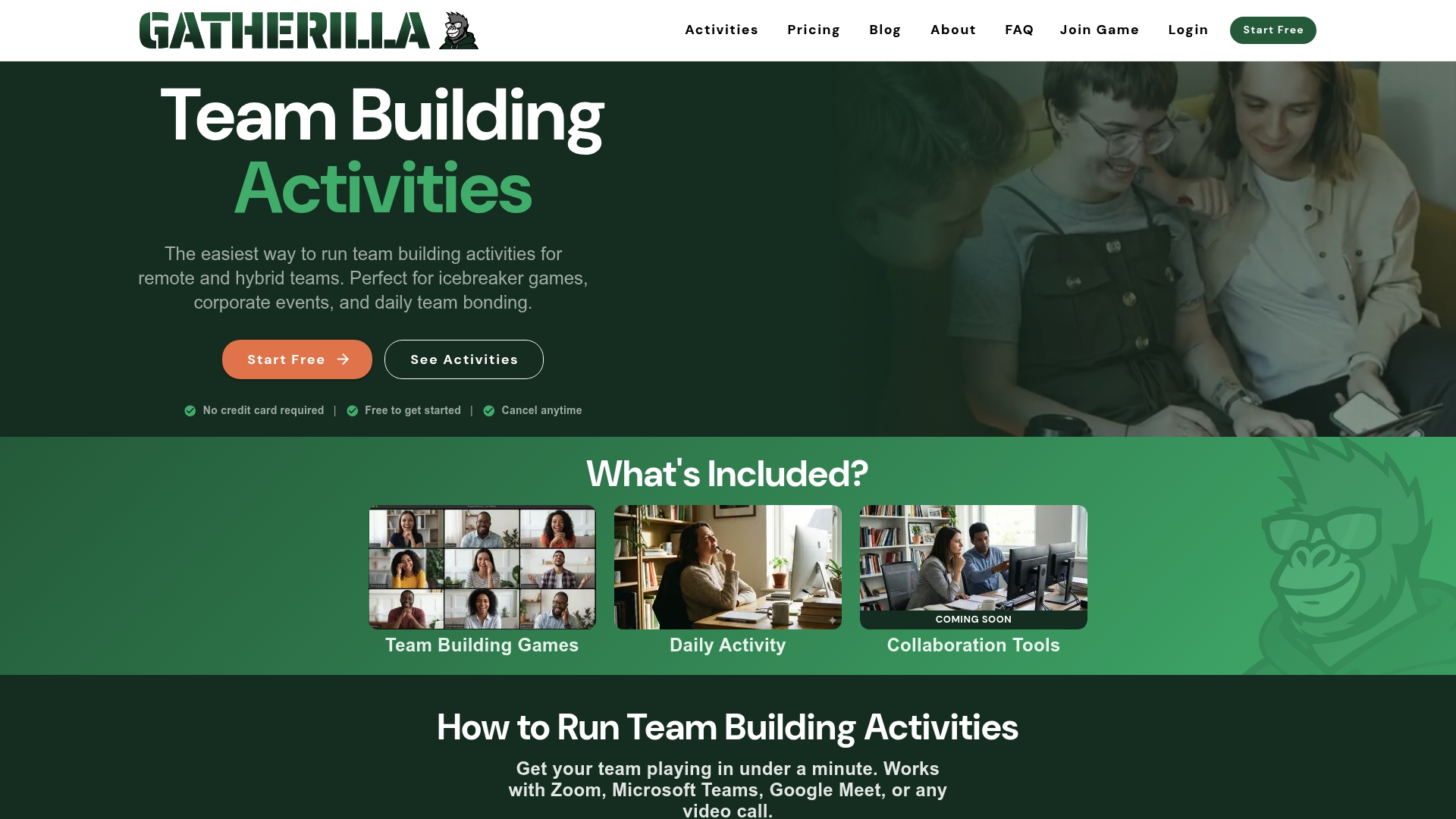
Gatherilla is a browser-based team-building platform for remote and hybrid teams. It includes customizable multiplayer games, icebreakers for meetings, onboarding games for new employees, daily word and trivia challenges and real-time leaderboards. It requires no downloads and works with all video conferencing tools.
There is a free plan, and the Premium plan is priced per seat: $0.50 to $1.00 per seat per month, or $5 to $10 per seat per year, with access to additional games, reporting and priority support. See Gatherilla’s pricing for the details, or start from the Gatherilla home page.
After the meeting: show that people were heard
The meeting itself is the firework; the follow-up is what keeps the glow. CVS Health’s Pearson, as quoted by Ragan, frames town halls as tentpole moments and asks how to extend what is used at them into other channels.
A follow-up routine that works:
- Post a recap within a day. Sun Life publishes a follow-up post after every session linking to the slides, the recording and related resources.
- Answer the unanswered questions. List the questions you did not get to and answer them in writing, with a name next to each answer.
- Report on actions. The U.S. Merit Systems Protection Board’s survey results guide advises sharing results with all employees within one month, starting visible action planning the following week, and using a town hall or all-hands meeting as the most powerful channel. It warns that when time passes with no word, enthusiasm wanes and frustration builds.
- Keep the thread alive. Continue the conversation with a daily question or a team challenge, so the town hall is one moment in a steady rhythm.
- Measure the shift. Compare question volume, poll participation and chat activity from one session to the next.
FAQ
What is a town hall meeting at work?
It is a company-wide or large-group meeting where leaders share news and employees can ask questions. The best ones are two-way: leaders listen as much as they present, and employees leave knowing what happens next.
What are some fun ideas for meetings like a town hall?
Start with a two-minute trivia round or a one-word chat prompt, add a poll or word cloud halfway through, and close with a shout-out round. Games that run in the browser and need no sign-up keep the energy up without slowing the agenda.
How long should a town hall be?
Thirty to forty-five minutes is enough for most updates. Sun Life runs 30-minute sessions, and one Forbes contributor cautions that anything past an hour makes people expect major announcements.
What questions should employees ask at a town hall?
The most useful are specific and tied to the work: how a priority affects their team, what changes in the next quarter, and how feedback from the last session was used. Leaders can make asking easier by collecting and upvoting questions ahead of time.
Sources
- How to Run Employee Town Hall Meetings Post-Pandemic, SHRM
- How To Shift From Monologues To Inclusive Town Halls, Forbes Communications Council
- How Sun Life shifted its town hall approach, Ragan
- How to make your town hall more than a standing meeting, Ragan
- Inside CVS Health’s strategy for engaging town halls, Ragan
- Examples of Recognition, Duke University Human Resources
- All-Hands Meetings: What They Are and How to Run Them, Slack
- Survey Results Action Guide, U.S. Merit Systems Protection Board