

Recognition Games for Teams: 9 Ideas That Feel Sincere

A recognition game is a short, repeatable activity where teammates name what someone did well and why it mattered, wrapped in a format light enough that people actually take part. The games that work share three traits: they are specific about the contribution, they are open to everyone, and they happen often. For remote and hybrid teams, the easiest way to get all three is a browser-based game that takes no setup and fits into a meeting you already hold. That is how we built Gatherilla’s games: no downloads, and a daily challenge that keeps the habit going between big moments.
Below you will find what separates a recognition game from an icebreaker, nine formats you can run this week, how to keep them fair, and how to adapt them for onboarding, daily check-ins and different team sizes.
TL;DR
- A recognition game names a specific contribution and why it mattered. A plain icebreaker does not, and that is the difference.
- Frequency beats size: Gallup links recognition received in the last week to better productivity and lower absenteeism.
- Keep it fair: transparent criteria, rewards that stay small, and no mechanics where the same few people always win.
- Five minutes in a regular meeting, plus a daily challenge, builds the habit better than one big event a quarter.
- New hires benefit most from early, public, specific recognition in their first weeks.
Table of Contents
- What makes a game a recognition game
- Why it is worth ten minutes a week
- Nine recognition games to run with your team
- How to keep recognition games fair and sincere
- Running recognition games in remote meetings and daily check-ins
- Adapting for group size and work style
- Recognition games for new hires
- Our perspective
- Start with a free plan
- FAQ
- Sources
What makes a game a recognition game
Most “team games” are built to help people relax or get to know each other. That is useful, but it is not recognition. Recognition tells a colleague, in front of others, that what they did was seen and valued.
One leadership writeup on recognition rituals breaks a good one into three parts: the “why” (the specific contribution), the “how” (a short moment of anticipation) and the “what” (the reward). The same source warns that chance should never decide who deserves recognition. If winners are picked at random, playfulness starts to look like favoritism.
So the working definition is simple. A game earns the label “recognition” when:
- The praise is specific. “Great job” is a greeting. “You rewrote the handoff doc and saved the night shift an hour” is recognition.
- The criteria are visible. People know what is being celebrated before the game starts.
- Anyone can be recognized. The game does not favor the loudest, the most senior or the people on camera most often.
- It repeats. One surprise party is a gesture. A weekly ritual is a culture.
Why it is worth ten minutes a week
The business case is stronger than most leaders expect. Gallup’s research on recognition found that if the median business doubled the number of employees who strongly agree they were recognized for good work in the last week, it could see a 9% improvement in productivity and a 22% decrease in absenteeism. The same study found employees are nearly twice as likely to rate their team’s performance as excellent when recognition is part of the culture.
Retention follows the same pattern. In a Gallup and Workhuman brief, 68% of employees who strongly agree their recognition needs are fulfilled plan to be at their organization in five years, versus 51% of employees overall. Note the word “last week” in the first finding. Recognition is perishable, which is why a recurring game outperforms an annual award.
Nine recognition games to run with your team
Each format below runs in a video call or a chat thread, and each can be done in 5 to 20 minutes.
1. Kudos cards
Each person writes a short note to a teammate: what they did, and the effect it had. Read a few aloud or post them on a shared board. The leader goes first to set the tone, and keeps the notes about contribution, not ranking. This works well for teams of roughly 3 to 15 people, and it is the simplest format on the list.
2. Guess the colleague
Someone submits an anonymous description of a teammate’s recent win (“this person caught the pricing error before launch”). Everyone guesses who it is. The guess is the playful part; the description is the recognition. Because the facts are specific, the game cannot turn into a popularity contest.
3. Values bingo
Build a bingo card from your company values, with each square a concrete behavior: “documented something for the team,” “helped someone outside their department.” Over a week, people mark squares when they see a colleague do it and name the person in the chat. A completed row earns a shout-out in the next meeting.
4. The trivia with a twist
Run a short trivia round about the team itself: the project that shipped, the customer problem solved, the person who did the work. The questions double as a recap of accomplishments, so recognition arrives as a side effect of the fun.
5. The daily challenge
A short word or trivia puzzle that everyone can finish in a couple of minutes gives the team a shared daily touchpoint. It is not recognition by itself, but it creates the habit of showing up together, and a leaderboard lets you celebrate participation and streaks, not only top scores. Our own daily challenge is built for exactly this role.
6. Spotlight rotation
Each week, one person is the spotlight. Teammates add one specific strength or contribution each, and the spotlight person reads them out. Rotate in a fixed order, so nobody is skipped and nobody has to wonder when their turn is.
7. Peer awards with real categories
Instead of “employee of the month,” create small, named categories: the Unblocker, the Documenter, the Customer Whisperer. Peers nominate with a one-line reason. Categories keep the criteria transparent and give more people a path to winning.
8. Two truths and a win
A twist on a familiar icebreaker. Each person shares two true facts and one recent win of a colleague, and the team guesses which statement is the win. It keeps the light tone while moving the spotlight onto others.
9. Minute-to-win-it team rounds
Short, silly challenges in small groups, followed by a one-minute “credit round” where each group thanks someone for how they helped. If you want ideas for the challenge part, our guide to virtual minute to win it games lists formats that work on camera.
For more ways to celebrate beyond games, our list of employee recognition ideas covers the rest of the toolkit.
How to keep recognition games fair and sincere
A badly designed game can do harm. Gamification at work can backfire when it ignores people’s growth. One expert quoted by SHRM put it plainly: if you ignore personal growth, you create stress and backlash. In the same piece, a manager resets her team’s game weekly so everyone has a chance to excel. The design principle is that the average worker must be able to win.
A few rules follow from that.
Pick observable behaviors first. Choose three to five behaviors before you choose game mechanics. “Share a solution that saves colleagues time” can be seen and counted. “Show leadership” cannot.
Keep rewards modest. The same source notes that once the prize becomes the main attraction, people start to optimize for the prize and not for the behavior you wanted. A shout-out, a choice of the next game or a small gift card is plenty.
Prioritize sincerity over size. The Incentive Research Foundation’s 2025 study found that sincerity matters more than monetary value: employees who rated recognition as sincere were more likely to say even a thank-you without a reward felt meaningful. The study recommends recognition that is consistent, specific and sincere, with guidelines so managers and peers stay fair and credible.
Make it work for everyone. The same research says recognition programs must work regardless of role, level or location. In practice that means:
- Offer a written option (chat or cards) as well as spoken, for people who dislike being on the spot.
- Let people opt for private thanks if public praise is uncomfortable.
- Schedule across time zones, or run an asynchronous version, so remote colleagues are not always the audience.
- Track who has been recognized over a quarter and quietly close the gaps.
Running recognition games in remote meetings and daily check-ins
The most common mistake is making recognition a separate event. It gets postponed, and then it never happens. Attach it to meetings you already hold.
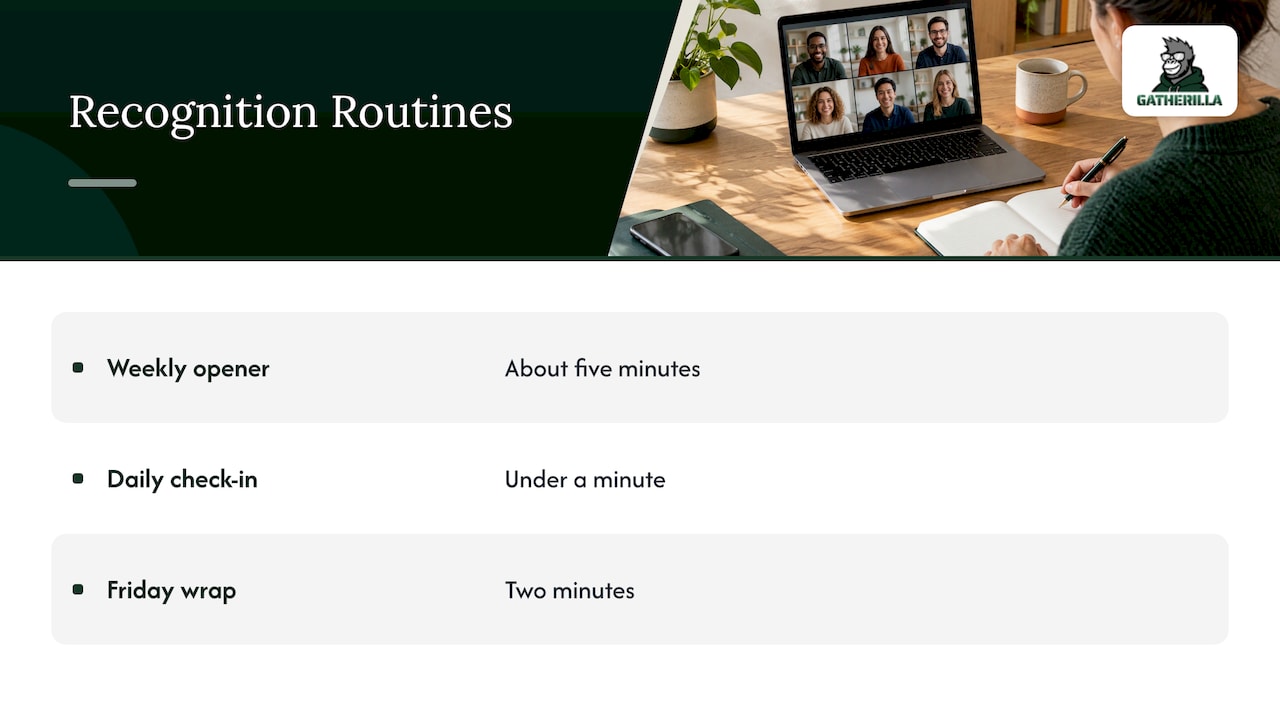
The five-minute opener. Start your weekly meeting with one kudos round. Ask each person to name one teammate and one specific thing. With a team of eight, that is about five minutes. Larger teams can use breakout rooms of four or five people and then share one highlight with the full group.
The daily check-in. For teams that touch base each morning, a short shared puzzle replaces the awkward silence while people join. Add a standing line to the chat: “Anyone you want to thank from yesterday?” It takes under a minute.
The Friday wrap. End the week with a two-minute look back: one win per person, one thank-you per person. Written in chat, it leaves a record people can scroll back through on a rough day.
A quick rule on timing: recognition loses value the longer it waits. The Gallup finding above is framed around the last week, so a weekly rhythm is a sensible minimum.
Adapting for group size and work style
| Team size | Best format | Time |
|---|---|---|
| 3 to 8 | Kudos cards, spotlight rotation | 5 to 10 minutes |
| 9 to 20 | Values bingo, guess the colleague, small-group rounds | 10 to 15 minutes |
| 20 to 100+ | Peer awards with categories, shared daily challenge, department leaderboards | Ongoing, asynchronous |
Remote teams do best with chat-based and browser-based games, since everyone has the same view and nobody is disadvantaged by a poor camera.
Hybrid teams have a specific risk: people in the room get noticed more. Run recognition rounds through a shared screen or chat even when some people are together, so the remote participants take part on equal terms. Our guide to a virtual game day at work shows a simple plan for mixed groups.
In-person teams can use the same formats on paper cards or a whiteboard. The principles do not change.
Recognition games for new hires
The first weeks are when recognition counts most, because new employees do not yet know whether their work is seen. A university well-being center’s 2025 toolkit on social connection and belonging suggests ideas such as new-employee coffees or lunches with managers, a morning game added to team breakfasts, virtual or in-person bingo, and monthly appreciation days.
Here is how to turn that into a first-month plan:
- Day one: a light icebreaker so the new hire learns names and one fun fact about each person.
- Week one: a values bingo card that includes a square for “helped the new person.” Existing teammates earn recognition for welcoming, which sets the norm.
- Week two to four: a kudos round where the new hire is both giver and receiver. Receiving a specific thank-you for an early contribution tells them they belong. Giving one gets them noticing the team’s strengths.
- Day 30: a short team round celebrating what the new hire has already changed or improved.
If you are building a fuller program, our guides to virtual onboarding games, hybrid onboarding games and remote onboarding gamification go deeper. For teams that also track onboarding tasks and check-ins alongside the social side, employee engagement software built around frontline workflows is one more piece of the puzzle.
Our perspective
Recognition fails when it is treated as an event. A big award night feels good for a day, but the people who do steady work in the background are rarely the ones on stage. We think the better answer is a small daily habit that everyone shares.
That is why we focus on games that need no preparation, no downloads and no accounts. If a game takes twenty minutes to set up, a busy manager will skip it. If it opens in a browser and works with whatever video tool your team already uses, it happens.
We also think recognition should be tied to what your company values, and it should come from peers, not only from managers. A daily challenge, a leaderboard that celebrates participation and peer-to-peer recognition lined up with your values give a team a rhythm that carries through the quiet weeks, when nobody is planning a party.
Start small. Five minutes a week, with specific praise and a fair format, will do more than an elaborate program that nobody keeps up.
Thomas
Start with a free plan
Gatherilla is a browser-based platform with customizable multiplayer games, daily word and trivia challenges, icebreakers for meetings, onboarding games and real-time leaderboards, and it works with all video conferencing tools. There is a free plan to try the games with your team.
The Premium plan adds more games, reporting and priority support, and is published at $0.50-$1.00 per seat per month, or $5-$10 per seat per year. See the details on the pricing page, or explore team building games for remote and hybrid teams to pick your first round.
FAQ
Are recognition games the same as team-building games?
No. Team-building games help people relax and learn about each other. Recognition games add a specific purpose: naming a colleague’s contribution and why it mattered. Many teams combine them, running a fun game and finishing with a short thank-you round.
How often should we run them?
Weekly is a good starting rhythm. Gallup’s findings are framed around recognition received in the last week, so frequent, short moments work better than occasional big ones. A daily challenge can fill the days in between.
What if some people hate being praised in public?
Offer choices. Let people take part through written cards or chat, and let them opt for private thanks. The Incentive Research Foundation’s work shows sincerity matters more than spectacle, so a well-worded note is enough.
Do we need prizes?
Not really. Keep any reward modest, because large prizes can shift attention from the behavior you want to the prize itself. A shout-out, a choice of the next team game or a small token is plenty.
Sources
- Global Gurus: custom scratch-off tickets and recognition rituals for team engagement
- Gallup: From Praise to Profits, the business case for recognition at work
- Gallup and Workhuman: Recognition as a Business Imperative
- Incentive Research Foundation: Building a Culture of Recognition
- SHRM: Be Careful, Gamification at Work Can Go Very Wrong
- USC WorkWell Center: Social Connection and Belonging Toolkit 2025