

3–5 Second This or That Sessions for HR That Spark Real Connection

Yes. This-or-that questions reliably spark quick engagement and warm up a team in a few minutes. The trick is rapid-fire timing with a short few-second limit per pick paired with a quick “why?” follow-up, which turns a throwaway choice into a real conversation. A tool with a browser-based platform can help teams run this on repeat without anyone building question lists from scratch.
TL;DR:
- This-or-that questions effectively increase participation and engagement, especially when timed strictly at three to five seconds per pair.
- Using different formats such as verbal rounds, chat polls, or reaction emojis is necessary to scale for team sizes from five to over fifty.
- Follow-up questions that explore “why” solidify the connection and turn simple preferences into memorable conversations.
- An automated browser-based platform like Gatherilla helps maintain question rotation and participation tracking across multiple teams and meets.
- Repeated, consistent sessions are key to building habits, with a focus on asking “why” and rotating categories to avoid stagnation.
Table of Contents
- Personal Preference Questions for Quick Team Warm-Ups
- Work and Office Questions That Reveal Working Styles
- Food and Drink Pairs Everyone Can Answer
- Entertainment and Hobby Questions for Themed Meetings
- Pop Culture and Nostalgia Questions for a Laugh
- Funny and Silly This-or-That Questions
- Lifestyle and Routine Questions That Inform Scheduling
- Travel and Adventure Questions for Distributed Teams
- Rapid-Fire This-or-That Questions for Lightning Rounds
- How to Run a This-or-That Session That Actually Builds Connection
- Why Facilitators and HR Teams Keep Coming Back to This Format
- Adapting This-or-That Questions for Different Team Sizes
- Measuring Whether This-or-That Questions Are Actually Working
- A Facilitator’s Honest Take on Making This Stick
- Run Consistent This-or-That Sessions Without the Prep Work
- Where to Find More Question Sets and Play Tools
- Sources
Personal Preference Questions for Quick Team Warm-Ups
Personal preference pairs work because they ask nothing risky and reveal something real. Keep the two options close in appeal, or the pick becomes obvious and the round dies fast.
- Coffee or tea?
- Cats or dogs?
- Beach vacation or mountain cabin?
- Morning person or night owl?
- Sweet or salty snacks?
- Books or podcasts?
- Window seat or aisle seat?
- Text or call?
- Homebody or always out?
- Summer or winter?
- Early bird breakfast or skip it?
- City living or small town?
Use these for brand-new teams or the first thirty seconds of any meeting.
Work and Office Questions That Reveal Working Styles
Work-themed pairs surface real preferences about collaboration and meeting habits, not performance. Skip anything that sounds like you’re grading someone’s productivity.
- Camera on or camera off?
- Async updates or live standup?
- Open floor plan or private office?
- Detailed agenda or loose discussion?
- Slack message or email?
- Morning meetings or afternoon meetings?
- Written feedback or verbal feedback?
- Deep focus blocks or frequent check-ins?
- Sticky notes or digital docs?
- One long meeting or several short ones?
Answers here are a quick, low-pressure way to gauge whether your team leans toward async work or synchronous check-ins, which can shape how you schedule the next sprint.
Food and Drink Pairs Everyone Can Answer
Food questions almost never fail. Everyone has an opinion, nobody feels exposed, and a good pair invites a quick follow-up story.
- Pizza or tacos?
- Sweet breakfast or savory breakfast?
- Cooking at home or ordering out?
- Chocolate or vanilla?
- Spicy food or mild food?
- Soda or sparkling water?
- Sushi or burgers?
- Ice cream or cake?
- Grilling or baking?
- Fast food or fine dining?
After the pick, ask for one favorite restaurant or a go-to recipe. That single follow-up does more bonding work than the question itself.
Entertainment and Hobby Questions for Themed Meetings
Entertainment pairs give facilitators an easy on-ramp to longer stories, especially in a themed social hour or a Friday wrap-up.
- Movies or TV series?
- Concerts or festivals?
- Reading fiction or reading nonfiction?
- Hiking or biking?
- Board games or video games?
- Solo travel or group travel?
- Live music or recorded playlists?
- Painting or photography?
- True crime or comedy?
- Running or lifting weights?
Follow up with “what’s the last one you actually did?” It turns a preference into a real, recent memory instead of a vague category.
Pop Culture and Nostalgia Questions for a Laugh
Nostalgia pairs are built for laughter, not depth. They work best when everyone in the room grew up with roughly the same references.
- 90s music or 2000s music?
- Flip phones or smartphones?
- Saturday morning cartoons or streaming binges?
- Arcade games or console games?
- Dial-up internet stories or none?
- Mixtapes or playlists?
- Skater style or preppy style?
- Rollerblading or skateboarding?
Save these for celebrations and social mixers. Avoid anything tied to current events or a specific fandom that half the room won’t recognize.
Funny and Silly This-or-That Questions
Silly pairs exist to lower tension, not to test anyone’s sense of humor against a standard they didn’t sign up for.
- Fight one horse-sized duck or a hundred duck-sized horses?
- Talk in rhymes for a day or whisper everything?
- Have a pet dragon or a pet unicorn?
- Always be ten minutes late or always be an hour early?
- Read minds or predict the future?
- Never use emojis again or only communicate in emojis?
- Superpower: fly or invisibility?
- Live in a treehouse or a houseboat?
Run silly humor by someone outside the room first if you’re new to a group’s culture. A safe fallback: “Fight a bear or fight a swarm of bees?” always gets a reaction.
Lifestyle and Routine Questions That Inform Scheduling
Routine pairs quietly tell you a lot about how a team actually operates day to day, without asking anyone to disclose anything personal.
- Early riser or night owl?
- Planner or spontaneous?
- Weekend chores first or relaxing first?
- Gym in the morning or evening?
- To-do lists or mental notes?
- Napper or push through tired?
- Structured weekends or unstructured?
- Alarm clock or natural wake-up?
These answers can shape flexible scheduling and deadline conversations, but keep the wording about habits, never about health or sleep quality.
Travel and Adventure Questions for Distributed Teams
Travel pairs are strong for informal socials because remote teammates rarely get to swap real travel stories otherwise.
- Road trip or flight?
- Backpacking or all-inclusive resort?
- Camping or hotel?
- Beach town or big city?
- Passport full of stamps or one favorite destination visited many times?
- Adventure sports or slow sightseeing?
- Solo exploring or guided tour?
- Local food stalls or well-known restaurants?
Ask “what’s one place you’d go back to right now?” as a follow-up. It reliably surfaces a story worth two extra minutes.
Rapid-Fire This-or-That Questions for Lightning Rounds
- Salty or sweet?
- Dogs or cats?
- Text or call?
- Morning or night?
- Beach or mountains?
- Coffee or tea?
- Books or movies?
- Summer or winter?
- Pizza or burgers?
- Window or aisle?
- Cash or card?
- Early or late?
- Indoors or outdoors?
- Plan or wing it?
- Quiet night in or night out?
Run these with a strict three to five second timer per pair, tracked with a chat poll, four corners in a physical room, or a reaction emoji on a shared screen. Short timing forces gut answers instead of overthought ones, which is exactly why these rounds get more real participation than slower question formats.
How to Run a This-or-That Session That Actually Builds Connection
The format only works if the pace and the follow-up are both right. Too slow, and people overthink. No follow-up, and it stays a novelty instead of a bonding exercise.
- Read the pair out loud or drop it in chat.
- Give the group three to five seconds. Not more.
- Collect answers fast: a show of hands, a chat poll, a four-corners split in a room, or reaction emojis on a shared slide.
- Pick one volunteer and ask “why did you choose that?”
- Move to the next pair before energy drops.
Formats scale differently depending on the room. A verbal round works for five to ten people. A chat poll or emoji reaction handles fifty or more without anyone waiting their turn.
Inclusivity matters here. Stick to clean, work-safe pairs, skip anything tied to money, religion, politics, or physical ability, and always allow a simple “pass” for anyone who’d rather sit out a round.
Pro Tip: Open with rapid-fire for the first two minutes to raise energy, then slow down for one or two deeper “why” questions once the group is warmed up. Reversing that order kills momentum before it starts.
Why Facilitators and HR Teams Keep Coming Back to This Format
The appeal isn’t the question itself. It’s the “why” that follows it, and treating each pick as an opening line rather than the whole conversation is what separates a flat icebreaker from one people actually remember.
That balance is also why a browser-based format has an edge over printed lists or one-off Slack polls. Gatherilla runs entirely in the browser, needs no downloads, and layers in a daily challenge so the habit doesn’t rely on one person remembering to plan it every week. For a single team meeting, a facilitator with a good question list is plenty. For a company trying to keep the habit alive across dozens of teams and time zones, a platform earns its place by removing the “who’s writing today’s questions” problem entirely.
Adapting This-or-That Questions for Different Team Sizes
A five-person team and a fifty-person all-hands need different mechanics, even though the underlying questions barely change.
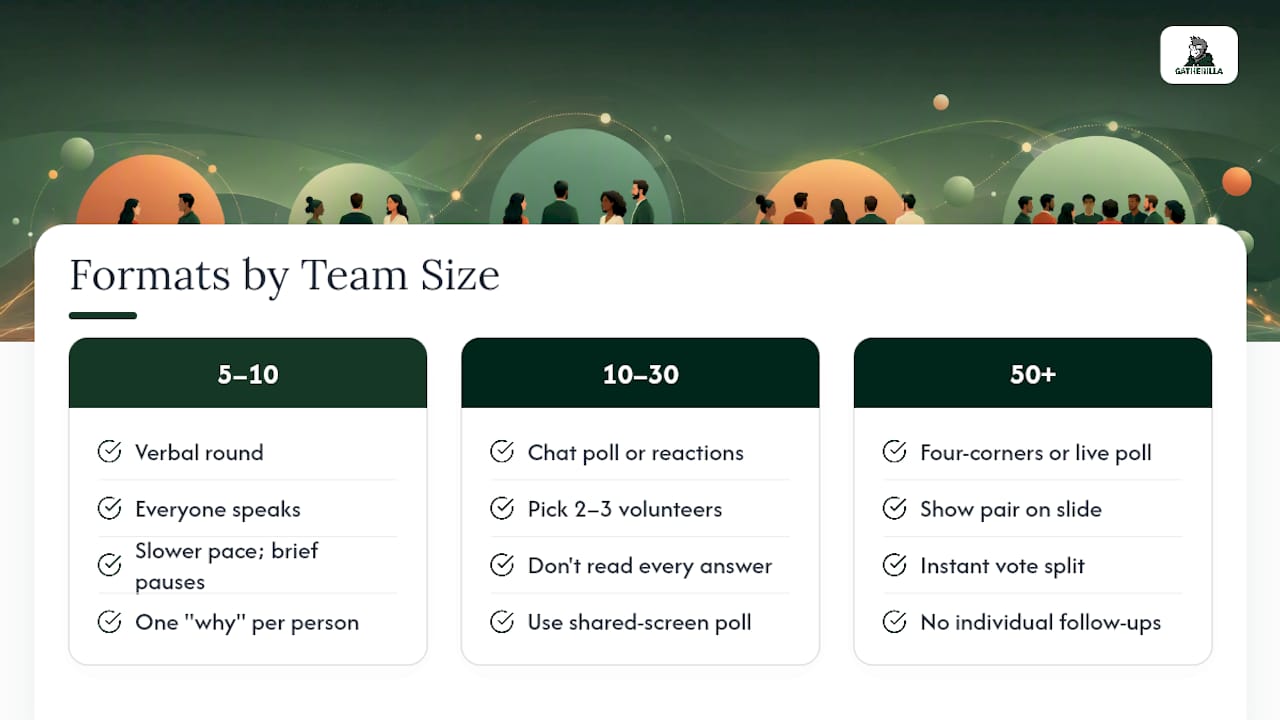
For teams of five to ten, a verbal round works well. Go person by person, ask one “why,” and let the answer breathe for a few seconds before moving on. This size tolerates a slower pace because everyone gets a turn within a minute or two.
For teams of ten to thirty, switch to a chat poll or reaction-emoji format on a shared screen. Reading every answer out loud stalls the energy, so pick two or three volunteers per round instead of going around the room.
For fifty or more in a company all-hands or cross-department meeting, four corners or a live poll tool is the only format that scales without turning the session into a fifteen-minute detour. Show the pair on a slide, let people vote, then display the split instantly. Skip individual follow-ups entirely and instead invite one or two people to unmute and share.
Team dynamics matter as much as headcount. A newly formed team benefits from safer, lighter categories (food, entertainment) for the first few sessions before introducing anything more personal like routines or travel. A long-tenured team can jump straight into funnier or more specific pairs since the trust is already there.
Measuring Whether This-or-That Questions Are Actually Working
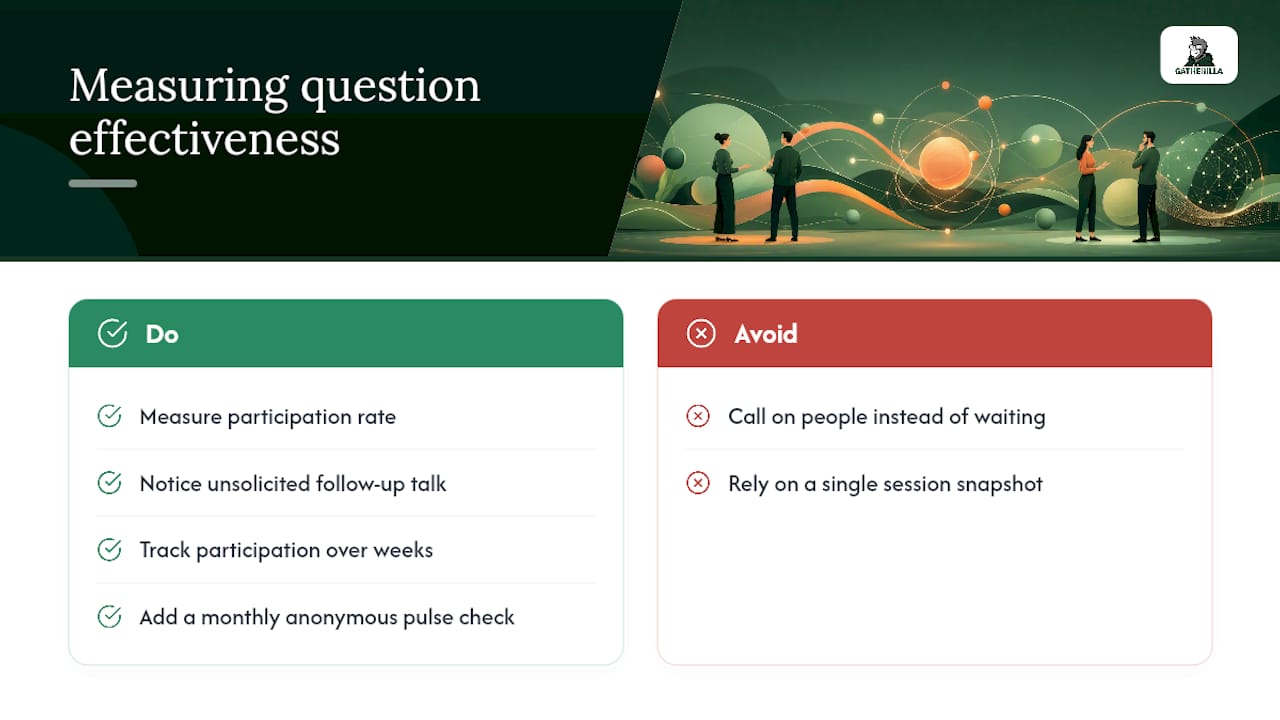
The simplest signal is participation rate: are people answering voluntarily, or does the facilitator have to call on names? A round that gets unprompted responses from most of the group in the first few seconds is doing its job.
Watch for unsolicited follow-up talk. If someone answers a pair and then keeps talking without being asked “why,” that’s a stronger signal than any survey could give you. It means the prompt hit something real.
Track it over time, not just in the moment. If you’re running a daily or weekly question, notice whether the same people always answer first and whether quieter teammates start participating more after a few weeks. That shift is often the clearest proof the ritual is working.
A quick anonymous pulse check, one question on a monthly engagement survey asking whether meeting warm-ups feel worthwhile, gives you something concrete to point to when deciding whether to keep the habit, adjust the cadence, or retire a question set that’s gone stale.
A Facilitator’s Honest Take on Making This Stick
The teams that get the most out of this format aren’t the ones with the funniest questions. They’re the ones who ask “why” consistently and don’t skip it when time gets tight. I’ve seen a five-minute daily question turn a silent standup into one where people actually laugh before the work talk starts.
Twice a week is enough to build the habit without it feeling forced. Rotate categories so nobody predicts what’s coming.
A quick script for a meeting invite: “First up: rapid-fire this-or-that, three seconds, no wrong answers.” That’s it. Nobody needs more setup than that.
— Thomas
Run Consistent This-or-That Sessions Without the Prep Work
Every list above works fine typed into a chat or read off a slide, especially when supported by an AI chief of staff tool that automates facilitation. The gap shows up in week three, when nobody remembers whose turn it is to write the next set of questions. There are browser-based alternatives to manually maintaining question banks and rotation schedules that need no downloads and ship a daily challenge so the ritual runs itself instead of depending on one person’s memory.
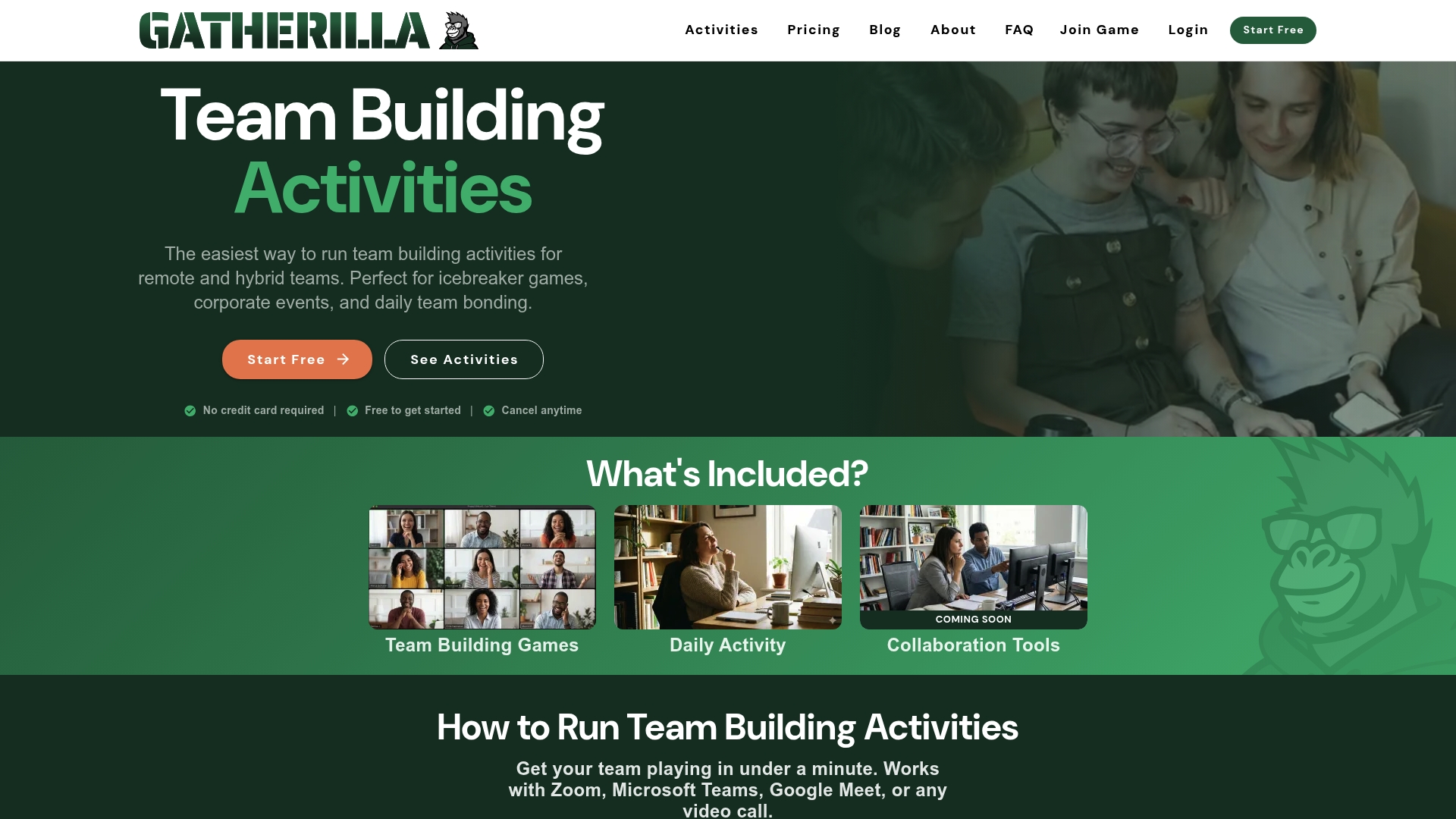
Beyond this-or-that rounds, the same low-friction setup covers onboarding games for new hires and company-wide events, with engagement analytics so HR can see participation trends instead of guessing. If your team’s meeting warm-ups have gone stale, or you’re trying to keep a hybrid team from feeling scattered, check the Gatherilla team-building platform and try a session with the free tier before deciding whether to roll it out company-wide.
Where to Find More Question Sets and Play Tools
Need more pairs beyond this list? The This or That Generator offers category filters for work-safe or funnier sets. Spin Your Pick runs a free browser-based rapid-fire mode with built-in timers. RandomlyFun’s generator offers over 150 questions sorted by tone.
For more structured formats, Gatherilla’s blog covers remote icebreaker games, Microsoft Teams icebreakers, and a daily Work Question of the Day format worth stealing for standups.
Sources
- This or That Generator — Question Ideas Online
- This or That Questions – Free Online Game
- This or That Questions Generator (150+ Questions) | RandomlyFun™