

Team Check-In Questions That Get People Talking Fast

A team check-in question is a short prompt, usually one sentence, that gets every person on the call to say something before the real agenda starts. The best practice is simple: pick one question, the leader answers it first, then everyone else answers in 30 seconds or less, with the whole round wrapping up in 30 seconds to 5 minutes depending on the meeting.
You don’t need a new question every day. You need the right question for the room you’re in.
Two you can use in your next meeting, starting today:
- Light: “One word for your energy right now?”
- Work-focused: “What’s one thing you need from this group today?”
That’s the whole system. Everything else in this guide is about choosing the right prompt, running it well, and knowing when to skip it.
Key Takeaways
Short, well-matched check-in questions build psychological safety and surface blockers that would otherwise stay hidden until they become expensive problems.
| Point | Details |
|---|---|
| Keep it brief | Cap check-ins at 30 seconds to 5 minutes depending on meeting type, never longer. |
| Model the answer first | The leader answers first and under 30 seconds to set length and tone for everyone else. |
| Match depth to trust | Use light prompts for new teams and save reflective questions for high-trust groups or one-on-ones. |
| Turn answers into action | Capture every blocker or win mentioned and assign an owner before the meeting ends. |
| Rotate categories weekly | Mix quick, mood, fun, deep, and team-focused prompts to prevent check-in fatigue. |
| Pair prompts with easy games | Gatherilla’s no-download games and daily challenges give leaders a fast way to add connection to recurring check-ins. |
Table of Contents
- Why Team Check-In Questions Actually Work
- Facilitation Best Practices: Running a Check-In Without Killing the Momentum
- Quick & Light Check-In Prompts for Fast Rounds
- Mood and Energy Check-Ins to Read the Room
- Fun and Creative Prompts to Warm People Up
- Deep and Reflective Prompts for High-Trust Teams
- Team-Focused Check-Ins That Surface Blockers and Wins
- Virtual and Hybrid Check-Ins That Keep Everyone Included
- Closing and One-Word Check-Out Prompts
- A Practical Playbook for Running Better Check-Ins
- Check-In Questions Across Roles and Industries
- Making Check-Ins Work Across Cultures and Communication Styles
- Common Check-In Problems and How to Fix Them
- How to Tell If Your Check-Ins Are Actually Working
- How Often Should Teams Run Check-Ins?
- Make Check-Ins Effortless With Gatherilla
- Sources
Why Team Check-In Questions Actually Work
Check-ins aren’t a warm-up ritual. They’re a data-gathering tool disguised as small talk, and skipping them costs you information you’d otherwise never get.
Teams that run consistent check-ins report higher psychological safety and more willingness to speak up later in the same meeting. That second part matters more than most leaders realize. The person who answers a check-in question, even a throwaway one, has already broken the ice with their own voice. They’re statistically more likely to raise a concern, ask a clarifying question, or push back on a decision twenty minutes later, because they’ve already spoken once and the room didn’t feel dangerous.
The timing math is not flexible. A check-in that eats ten minutes of a thirty-minute standup isn’t a check-in, it’s a second meeting. Match the format to the room:
- Daily standups: 30 to 60 seconds total, one word or one short phrase per person
- Weekly team meetings: 1 to 3 minutes, enough for a real sentence from each person
- Workshops or planning sessions: up to 5 minutes, since the group is already settling in for longer, deeper work
Not every meeting needs one. A five-minute status sync with three people who talked an hour ago doesn’t need a check-in. But certain meeting types get outsized value from them:
- Retrospectives, where an opening prompt about the week primes people to be more honest about what went wrong
- Remote and hybrid standups, where a check-in question for meetings is often the only moment people see each other’s faces before diving into work
- Onboarding sessions, where a new hire’s first spoken words in a group shouldn’t be a status report
- Any meeting after a stressful week, where skipping the check-in signals that nobody cares how the team is actually doing
The pattern across all of it: check-ins work when they’re short and skipped when they’re not.
Facilitation Best Practices: Running a Check-In Without Killing the Momentum
Good questions fail in bad hands. The facilitation matters as much as the prompt itself, and most of what goes wrong in a team meeting question round comes down to five fixable habits.
- Answer first, and keep it under 30 seconds. The leader sets the length and the tone. If you ramble for two minutes, everyone else will too. If you’re crisp and a little vulnerable, they’ll match that instead.
- Give people 10 seconds of think time before calling on anyone. Silence feels awkward to a facilitator and useful to everyone else. Introverts in particular need that beat to form an answer instead of freezing.
- Match the depth of the question to how much the team trusts each other. A three-level model works well here: light questions for new or low-trust groups, moderate questions once people know each other, and deep questions only for teams with an established track record of psychological safety.
- Rotate who picks the question. If you’re always the one choosing, the check-in becomes another top-down ritual instead of a shared habit. Handing the pen to a different team member each week also surfaces questions you’d never think to ask.
- Always allow a pass, and never make anyone justify it. A team member who says “I’ll pass today” is giving you information too. Forcing an answer defeats the entire purpose of building safety.
Depth-mismatching is the single most common facilitation error. Asking a brand-new team “What’s a personal struggle you’re working through?” in week two doesn’t build trust, it destroys it. The three-level framework exists precisely because vulnerability has to be earned by the room, not assigned by the calendar.
Dominant speakers are the other recurring headache. If one person turns every check-in into a five-minute monologue, don’t cut them off mid-sentence. Set the expectation before the round starts: “One sentence each, we’ll go deeper after the meeting if needed.” Then hold everyone, including yourself, to it.
The most underused move is turning a check-in answer into an actual follow-up. If someone says their energy is a “3 out of 10,” that’s not just color commentary, it’s a signal. A quick private message after the meeting (“Saw your check-in, want to talk?”) does more for retention than any survey.
Pro Tip: Keep a running note of who passed on the last three check-ins. A pattern of passing, more than any single answer, tells you something is off.
Quick & Light Check-In Prompts for Fast Rounds
These are built for standups, large groups, and meetings where you have 60 seconds and not a second more. The format matters as much as the content: one word, a quick scale, or a forced choice moves fast because nobody has to think of a sentence.
- One word for your energy today
- Coffee, tea, or neither
- Rate your week so far, 1 to 10
- Beach or mountains
- What’s one word for your Monday
- Morning person or night owl
- One emoji for how you feel right now
- Cats or dogs
- Indoors or outdoors this weekend
- One word: focused, scattered, or somewhere in between
- Pizza or tacos
- What’s your current caffeine level, low, medium, or maxed
- One word to describe your to-do list
- Sun or rain today
- Quick weather report on your mood
- Text or call, your preference this week
- One word for how the last meeting felt
- Sweet or savory breakfast today
- Early bird or last-minute type this week
- One word for your focus level right now
- Window seat or aisle seat
- Book or podcast on your commute
- One word: charged, drained, or steady
- Summer or winter person
- Quick thumbs up, sideways, or down for the week
- One word for what you need today
- Planned day or chaos day so far
- Sneakers or dress shoes today
- One word for your team’s mood this week
- Green light, yellow light, or red light on your workload
Running a lightning round with 30 prompts like these takes almost no setup. Announce the question, give everyone a five-second beat, and go around by speaking order or by name in the participant list. For teams larger than eight, skip the verbal round entirely and use chat: everyone drops their one-word answer at once, and you scan for patterns in ten seconds. Reactions (thumbs up, a color emoji) work the same way on video platforms that support them.
Keep the turn order loose. Calling on people in the same sequence every week gets predictable, and the last person always feels like an afterthought. Randomize it, or start from wherever the previous meeting ended.
Mood and Energy Check-Ins to Read the Room
A mood check-in question does one job: it tells you, in five seconds, whether the room is ready for hard conversations or needs a minute first. Skip this step and you’ll spend the first ten minutes of a meeting talking past a tension nobody named out loud.
Scales work better than open-ended questions here because they’re fast to answer and fast to compare. A few reliable formats:
- “Energy level, 1 to 10, no explanation needed”
- “What’s the weather like in your head today? Sunny, cloudy, storming”
- “Pick a color for how you’re feeling: green, yellow, or red”
- “Battery check: full charge, half, or running on fumes”
- “One word for your focus today”
The interpretation matters more than the prompt. A string of 3s and 4s on an energy scale isn’t a coincidence, it’s a signal that the meeting agenda might need to shrink or that something happened before the call that nobody’s mentioning. The immediate move isn’t to fix it live in front of the group. It’s to acknowledge it (“Sounds like a rough morning for a few of us, let’s keep this tight”) and follow up privately afterward with anyone who flagged low.
These questions belong in daily standups and weekly status meetings more than in workshops, where you have time for a fuller check-in anyway. In a standup, a one-word energy read takes five seconds and tells you whether to adjust your tone for the next fifteen minutes.
Pro Tip: If three or more people report low energy in the same week, that’s not a fluke, it’s a workload conversation waiting to happen. Don’t wait for the retro to raise it.
Fun and Creative Prompts to Warm People Up
Fun check-in questions exist to lower the temperature, not to force intimacy. The goal is a genuine laugh or a small surprise, something that makes people feel like individuals for thirty seconds before the spreadsheet talk starts.
- What’s your walk-up song, the one that plays when you enter a room
- What was the first piece of technology you owned
- If you had a superpower for exactly one hour, what would it be
- What’s a food combination you love that other people find weird
- What’s the most useless talent you have
- If your job were a movie genre, what would it be this week
- What’s a snack you’d defend to the death
- What fictional character would survive one day at your job
- What’s the last show you binged that you’re slightly embarrassed about
- If you could instantly master one skill, what would it be
- What’s your go-to karaoke song, real or hypothetical
- What’s the weirdest thing on your desk right now
Timing matters more than the content. Save these for the start of a weekly meeting or a workshop, never for a two-minute standup where there’s no room to enjoy the answer. And read the audience: a leadership sync with three departments meeting for the first time needs a lighter touch than a team that’s worked together for two years.
For remote teams, these work even better with a visual twist. Ask people to grab the weird desk item and hold it up on camera, or screen-share the walk-up song for ten seconds. Gatherilla’s daily question prompts are built around exactly this kind of low-stakes, high-connection format for distributed teams.

Deep and Reflective Prompts for High-Trust Teams
Deep check-in questions ask for something real: a struggle, a goal, a moment of doubt. They belong in teams that have already proven, over weeks or months, that vulnerability doesn’t get punished. Skip the trust-building and jump straight to these, and you’ll get silence, forced answers, or a slow erosion of who actually shows up to your meetings.
A few that work once trust exists:
- “What’s a lesson from this quarter you don’t want to repeat learning the hard way?”
- “What’s one thing blocking you that you haven’t said out loud yet?”
- “Where do you want to be in your role a year from now?”
- “What’s something you’re proud of that nobody’s acknowledged?”
- “What’s a moment recently where you felt genuinely stuck?”
Three rules make these safe to run. First, timebox it, two minutes per person maximum, or the round eats the whole meeting. Second, get informal consent before you start (“Today’s check-in is a bit deeper, that okay with everyone?”) rather than dropping a heavy question with no warning. Third, model the answer yourself, and make it real, not a rehearsed version of vulnerability.
The three-level question model draws the line clearly: light prompts for new or low-trust groups, moderate ones once familiarity builds, and deep ones only after the team has demonstrated it can hold difficult answers without judgment. Depth-mismatching, asking a level-three question to a level-one team, is the fastest way to make people stop answering honestly altogether.
These prompts are most useful in one-on-ones and small, established teams rather than large group meetings. When someone shares something real, don’t let it evaporate. A “where do you want to be in a year” answer should turn into an actual line item in their next development conversation, not a nice moment that gets forgotten by Thursday.
Team-Focused Check-Ins That Surface Blockers and Wins
These questions have one job: get information the leader actually needs, not filler that sounds like a check-in but reveals nothing. A question that doesn’t surface sentiment, a blocker, or a piece of missing context isn’t worth the airtime, so pick prompts that force something real to the surface.
- “What’s blocking you right now that I might not know about?”
- “What’s one handoff you’re waiting on from someone else?”
- “What context are you missing to move forward this week?”
- “What’s a win from the last few days that hasn’t been mentioned yet?”
- “What’s one thing you need from this group before Friday?”
Turning answers into action is a three-step process:
- Collect every response during the round, don’t interrupt to problem-solve mid-answer.
- Capture the blockers and wins in a shared doc or channel right after the meeting.
- Assign an owner to each blocker before the meeting ends, even if the owner is just “I’ll follow up with you after this.”
These questions earn their place in retrospectives, sprint planning, and daily standups alike, because a blocker named on Monday is cheaper to fix than one discovered on Friday.
Virtual and Hybrid Check-Ins That Keep Everyone Included
Remote and hybrid teams lose the hallway conversations that used to surface half of this information for free. A virtual team check-in has to work harder to replace that, and the fix is usually a visual or async adjustment rather than a different question entirely.
- Ask people to hold up something from their desk or home office on camera, it turns a text answer into a thirty-second show-and-tell
- Use chat for one-word answers when the group is large, it’s faster than an unmuting relay race
- Let people react with an emoji instead of speaking if they’re camera-shy that day
- Collect answers async in a shared doc or Slack thread before the meeting starts, then read a few highlights out loud instead of running the full round live
Camera-friendly, low-effort prompts (show-and-tell, physical objects, quick reactions) reduce friction and build shared memory for teams that rarely share a physical room. Mute and unmute friction is real, and it’s the number one reason live rounds drag in large virtual meetings, so default to chat or reactions once the group passes eight or nine people.
Async check-ins work well when the team spans time zones or when the meeting agenda is already packed. Post the question an hour before the call, let people answer in a thread, then spend fifteen seconds acknowledging a couple of answers live instead of running the full round. Gatherilla’s guide to hybrid meeting engagement covers more of these adjustments in detail.
Pro Tip: If you’re asking people to show something from their home on camera, remind the team to keep it work-appropriate and to be mindful of what’s visible in the background, especially for anyone dialing in from a shared or public space. Following remote work security best practices helps keep your virtual meetings safe and professional.
Closing and One-Word Check-Out Prompts
A check-out question closes the loop the check-in opened. It’s the last thirty seconds of the meeting, and it’s the moment most leaders skip, which is exactly why action items disappear into the void by Thursday.
- “What’s one action you’re leaving with?”
- “One word for how you feel right now?”
- “Any blockers still standing after this conversation?”
- “What’s the one thing you’re taking away from today?”
Action-oriented check-outs increase follow-through because they force people to name a next step out loud, in front of the group, instead of quietly forgetting it the moment the call ends. Someone who says “I’m leaving with: send the draft to Sam by Wednesday” is far more likely to actually do it than someone who just closes their laptop.
Log whatever comes up. A blocker named at check-out and never written down is worse than not asking at all, because now everyone thinks it’s handled.
Use a one-word wrap for short or low-stakes meetings, when you just need a temperature read before people log off. Use a short action-oriented closing for anything where decisions got made and someone needs to actually do something with them.
A Practical Playbook for Running Better Check-Ins
Most of this comes down to habit, not talent. Run the same five-item checklist before every meeting and the awkward parts mostly disappear.
- Pick one question, matched to the meeting’s trust level and time budget
- Decide who answers first (usually you) and time your own answer to under 30 seconds
- Give the group a 10-second beat before calling on anyone
- Allow a pass with zero follow-up questions
- Capture any blocker or action item mentioned before moving to the agenda
Pair the checklist with something playful to keep the habit from going stale. Three options that take two minutes or less and need no downloads:
- A rapid-fire trivia round using whatever theme fits the week
- A one-word word association game where each person builds on the last answer
- A quick “guess who said it” using an anonymous answer from that day’s check-in
No-download micro-games and daily challenges increase participation in virtual settings, largely because there’s no setup friction standing between “let’s do this” and actually doing it.
Gatherilla builds exactly this kind of low-friction, browser-based format into its daily challenges, which is worth knowing if you’re already running check-ins manually and want the games part to require less of your own planning.
Check-In Questions Across Roles and Industries
The right prompt shifts depending on who’s in the room. A sales team check-in and an engineering standup are solving different problems, and the questions should reflect that.
Sales teams benefit from prompts tied to momentum and rejection resilience: “What’s one deal that moved forward this week?” or “What’s the most useful objection you heard, and how did you handle it?” These normalize the ups and downs of a pipeline-driven job.
Engineering and product teams do better with prompts about blockers and context: “What’s one thing you’re stuck on that a teammate could unblock in five minutes?” This turns the check-in into a mini triage session instead of a status recitation.
Customer support and success teams benefit from prompts about emotional load: “What’s the toughest conversation you had this week, and how are you feeling about it now?” Support roles absorb a lot of frustration that never surfaces otherwise.
Creative and design teams respond well to prompts about inspiration and stuck points: “What’s something you saw this week that sparked an idea?” It keeps the creative muscle warm even in a status-heavy meeting.
People managers and HR leaders get more value from prompts about team pulse than personal status: “What’s one thing your team needs from leadership right now?” That question surfaces organizational blockers a status update never would.
The pattern holds across all of them: match the question to what that role’s actual daily friction looks like, not a generic template borrowed from a different function.
Making Check-Ins Work Across Cultures and Communication Styles
Not every team member experiences a check-in question the same way, and assuming they do is the fastest way to make your most reserved people dread meetings.
Some cultures place a high value on group harmony and may find personal, opinion-based prompts uncomfortable in front of colleagues, especially more senior ones. Others come from workplace norms where volunteering personal information at work feels inappropriate regardless of seniority. Neither reaction means someone isn’t engaged. It means the prompt didn’t match their comfort zone.
A few adjustments make check-ins genuinely inclusive rather than just present:
- Default to lighter, more universal prompts (energy scales, work-related questions) rather than personal ones when the team is culturally mixed or newly formed
- Offer an async or written option for anyone who processes better in text than out loud on the spot
- Avoid idioms, pop culture references, or humor that depends on a specific cultural context (“What’s your walk-up song?” may not translate cleanly everywhere)
- Never call on someone by surprise to answer first; let volunteers go, or rotate predictably so people can prepare
The pass option matters even more here. A team member from a culture where deferring to the group is the norm may pass on every prompt that feels self-promotional, and that’s not disengagement, it’s a mismatch between the question style and their communication norms. Build in enough variety, including team-focused and work-based prompts, so quieter cultural styles still have something to say.
Common Check-In Problems and How to Fix Them
Most check-in failures fall into a handful of repeatable patterns, and each one has a specific fix.
The round drags past its time budget. This usually means the question was too open-ended for the format. A “how was your weekend” question in a daily standup invites a three-minute story. Swap it for a scale or one-word prompt when time is tight.
The same three people always talk, and everyone else passes. Rotate who picks the question, and call on people in a different order each time instead of always starting with the most vocal person.
Answers feel forced or fake. This is a trust problem, not a question problem. Drop back a level on the depth scale and rebuild before pushing deeper again.
Blockers get mentioned and then forgotten. Nobody captured them. Assign someone, even yourself, to jot down every blocker mentioned and follow up before the next meeting.
The check-in feels like a chore. Rotate categories. Running the same “rate your week 1 to 10” prompt for six months straight is where check-in fatigue comes from. Mix quick, mood, fun, and team-focused prompts across the month.
New or hybrid teams feel awkward doing it on video. Lower the stakes with a visual prompt (show an object, use an emoji reaction) rather than requiring a spoken answer from everyone every time.
How to Tell If Your Check-Ins Are Actually Working
You don’t need a dashboard to measure this, but you do need to watch for specific signals over several weeks, not just judge it off one good or bad meeting.
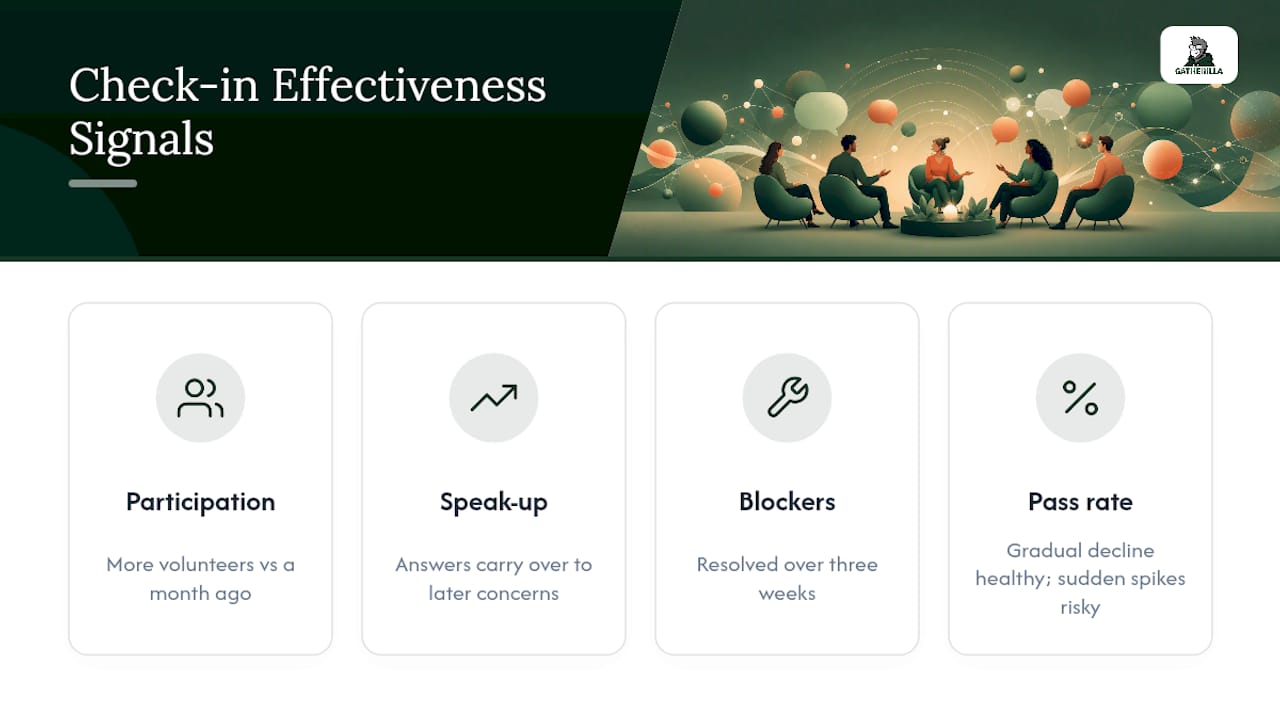
Participation rate is the clearest signal. Are more people volunteering answers without being called on directly than they were a month ago? That shift, from reluctant to voluntary, is the most reliable sign that psychological safety is building.
Speak-up rate later in the meeting matters more than the check-in itself. Track whether people who answer the check-in question are also the ones raising concerns, asking questions, or disagreeing with a decision later in the same call. Teams with [strong psychological safety](https://www.forbes.com/sites/cynthiapong/2025/05/18/6-ways-to-know-if-your team-feels-psychologically-safe/) show more of this carryover effect.
Blocker follow-through is measurable. Look back at three weeks of check-ins. Were the blockers people named actually resolved, or did the same person mention the same blocker four meetings in a row? Repeated, unresolved blockers mean the check-in is surfacing information nobody’s acting on.
Pass rates trending down (not to zero) is healthy. A team that never passes might be performing engagement rather than feeling it. A team where passing drops gradually as trust builds is a good sign. A team where passing spikes suddenly is worth a private conversation.
None of this requires a formal survey. A simple habit, jotting a one-line note after each meeting about who spoke up, who passed, and what got resolved, gives you a real trend line within a month.
How Often Should Teams Run Check-Ins?
Daily standups warrant a check-in every single time, but it has to stay under a minute. The frequency compensates for the brevity: a daily 20-second energy read adds up to more real signal over a month than one long monthly conversation.
Weekly team meetings should open with a check-in every week, using slightly more depth than the daily version since you have 1 to 3 minutes to work with.
Retrospectives and planning sessions benefit from a check-in every time they occur, typically every one to two weeks, since the reflective nature of a retro pairs naturally with an opening prompt about the week.
One-on-ones can go deeper less often. A reflective, level-three question doesn’t need to appear in every single one-on-one, maybe every third or fourth conversation, so it doesn’t become routine and lose its weight.
The justification for daily-plus frequency at the light end and occasional frequency at the deep end comes back to the same principle covered earlier: light questions can run constantly without fatigue, but deep questions lose their power if they show up too often. Overuse a level-three prompt and it turns into a script nobody takes seriously anymore.
Make Check-Ins Effortless With Gatherilla
Running a great check-in every single meeting takes discipline most leaders don’t have time to maintain alone, especially across a distributed team juggling different time zones and video fatigue. Gatherilla gives you a browser-based way to pair your check-in questions with a two-minute game, a daily challenge, or a quick multiplayer round, all without asking anyone to download anything or fumble with a new app mid-meeting.
The free tier lets you try the daily challenges and a set of core games before deciding whether the paid plan’s extra activities and reporting are worth it for your team. Setup takes minutes, it works inside whatever video tool you already use, and there’s nothing to install on anyone’s laptop, which matters when half your team is joining from a phone during a commute. If you’re already running check-ins manually and want the connection part to take less of your own planning, try Gatherilla’s team games and see what a two-minute round adds to your next standup.
Sources
The facilitation guidance and prompt categories in this article draw on a mix of workplace research and practitioner tools:
- Team check-ins and check-outs | University of Wisconsin HR
- 6 ways to know if your team feels psychologically safe | Forbes
- Three levels of questions | C3 Leaders
- 90+ check-in questions for meetings & teams | TeamRetro
Pair these with your own team’s facilitation notes for the most reliable results over time.