

Remote Watercooler Ideas That Teams Actually Use

A remote watercooler works when it is short, regular and effortless to join. The ideas below, from a five-minute check-in to a daily team challenge, share one trait: nobody has to prepare anything, and nobody feels forced. If you lead a distributed team, that is the standard to hold every idea against. Our own answer is a browser-based daily challenge and a set of multiplayer games your team can start in seconds, with no downloads. First, though, the evidence on what a virtual watercooler is and what makes it stick.
TL;DR
- A virtual watercooler is a recurring, low-pressure space for the casual talk that offices produce by accident.
- Regularity matters more than novelty: a short ritual that happens every day or week beats an elaborate event that happens once.
- Quick icebreakers, random pairings, shared games and recognition channels cover most needs, and each takes 5 to 20 minutes.
- Keep it voluntary, let people skip, and give quieter colleagues a structured way in.
- For new hires, regular informal contact with colleagues beyond their own desk is worth building into the first weeks.
Table of Contents
- What a virtual watercooler is, and why teams miss it
- Quick icebreakers: the five-minute watercooler
- Go deeper: structured questions beat small talk
- Recurring rituals that need no meeting
- Games: the watercooler with a reason to show up
- How often should you do it?
- Welcoming new hires
- Make it inclusive and optional
- A starter plan for the first month
- Perspective
- Try it with your team
- FAQ
- Sources
What a virtual watercooler is, and why teams miss it
SHRM describes a virtual watercooler as a digital gathering point where remote colleagues share stories and light conversation, filling the gap left by coffee chats and hallway talks. In an office, nobody schedules those moments. Remotely, they vanish unless someone creates them.
The cost is real. The USC WorkWell Social Connection and Belonging Toolkit cites studies showing that limited face-to-face contact can hurt remote workers’ performance through loneliness and weaker support from colleagues, while social interaction during work hours helps replenish those resources and supports task performance.
So the goal is not a party. It is a dependable, small, human moment inside the workday.
Quick icebreakers: the five-minute watercooler
The easiest place to start is the beginning of a meeting you already hold. Atlassian suggests a five-minute weekly icebreaker at the start of team meetings, with prompts such as who the last artist was that you searched for on your music app, or putting your morning routine in order: breakfast, coffee or tea, opening the laptop.
Dropbox’s virtual-first team recommends check-in rituals of five to ten minutes. Examples include “What’s your internal weather right now?” and “If your mood were an animal, what would it be?” It also suggests:
- Quick questions, such as what small, unexpected thing brought someone joy this week.
- Show-and-tell of a personal object, 10 to 20 minutes.
- Last photo: each person shares the most recent photo on their phone, uncurated.
- Rapid-fire connections: random pairs spend 15 minutes inventing a secret handshake or a life motto.
The same source gives a useful group-size rule. Groups of six or fewer can share one by one. Larger groups work better split into subgroups of three or four.
Where it goes wrong: the leader improvises a question on the spot, it lands flat, and the silence is awkward. Having a ready prompt each time removes that risk. Our Zoom icebreakers with scripts and Microsoft Teams icebreakers guides give you lines to use as written. Gatherilla also runs in the browser alongside any video conferencing tool, so the prompt and the game are one click away.
Go deeper: structured questions beat small talk
Small talk can feel thin on a screen. Wharton’s Neuroscience Initiative adapted the “Fast Friends” method for distributed teams: pairs or trios answer 36 progressively deeper questions in three 15-minute sets, using breakout rooms. A full 45-minute session has the most impact, but even a three-to-five-minute version before a meeting is beneficial.
The guidance on running it is worth following closely:
- Stress that taking part is voluntary.
- Agree on confidentiality beforehand.
- Let people pause or skip any question.
- Pair peers at the same level where possible. If a manager is paired with a direct report, the manager answers first.
The principle of escalating prompts also works in games. This case study on gamified engagement in five minutes shows how a short, guided activity can hold attention without a long setup.
Recurring rituals that need no meeting
Meetings are the thing remote teams already have too many of. These ideas live in the gaps.
A standing chat channel
USC’s toolkit recommends a dedicated “watercooler” or “just for fun” channel, interest-based channels and “random acts of kindness” threads. They cost nothing and run asynchronously, so time zones do not matter.
A recognition thread
Custom Ink’s 2026 guide describes a wins channel where people post peer recognition, about two minutes a day. A weekly ritual from an HBR podcast pairs well with it: each person shares one professional accomplishment and one personal thing they are excited about.
Random pairings
Custom Ink also describes random one-to-one chats of around 20 minutes, which recreate the serendipity of bumping into someone. Pairing across teams has a bonus: a new hire might end up talking with a senior leader they would otherwise never meet.
A short, optional coffee break
Smartsheet’s guide suggests a 10 or 15 minute virtual coffee break on video that can become daily or weekly. It also advises managers to skip it if their presence might chill the conversation. That is good, practical advice for any leader.
A monthly lunch
Atlassian describes a monthly online lunch where members can expense up to $25 to eat from a favorite cafe, a delivery order or their own kitchen. Shorter 15 to 30 minute coffee chats and happy hours are listed as lighter options.

Games: the watercooler with a reason to show up
Some people will happily chat for ten minutes. Others need something to do with their hands. A shared game gives conversation a structure and takes the pressure off. USC’s toolkit lists themed scavenger hunts and trivia nights, and the Deel glossary points to group watercoolers such as virtual breakrooms and interest clubs as natural places for trivia and quick icebreaker questions.
This is where we think the habit is won or lost. Gatherilla is a browser-based platform with customizable multiplayer games, daily word and trivia challenges and real-time leaderboards. It needs no downloads and works with every video conferencing tool. A team can play the daily challenge in a few minutes, then trade results in chat, which is exactly the kind of low-effort, repeatable moment this article is about. For more formats, see our remote icebreaker games guide.
How often should you do it?
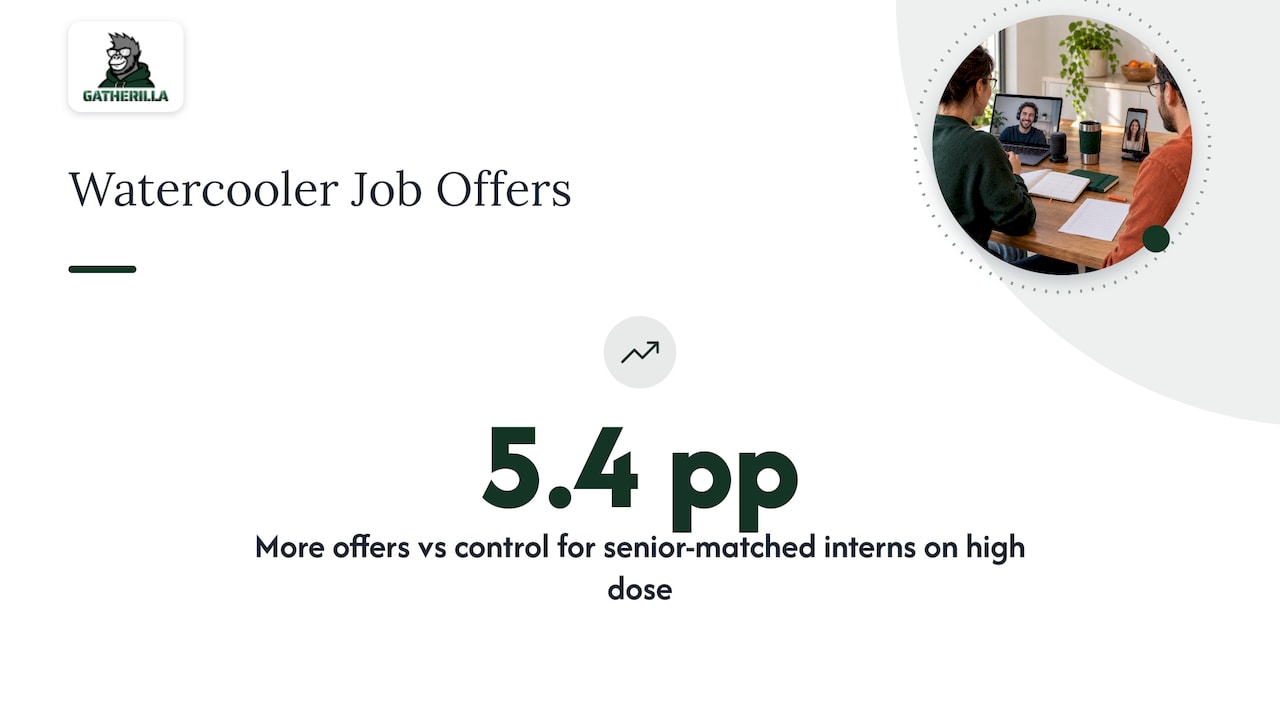
The research that most directly tests virtual watercoolers is a Harvard Business School field experiment with remote summer interns. It found that virtual watercoolers may improve performance and career outcomes when they occurred at regular intervals or paired interns with senior managers of a matching background. Interns matched with a senior manager and given a high dose of sessions were 5.4 percentage points more likely to receive a job offer than the control group.
The takeaway for team leaders is simple: set a rhythm and keep it. Pick a cadence your team can sustain, whether a daily five-minute challenge or a weekly check-in, and protect it. A habit that is easy to join survives a busy week. A big quarterly event is easy to cancel.
Welcoming new hires
New remote employees have no hallway to wander. The experiment above used a scheduled 30-minute weekly video slot with three or four other interns as its watercooler format, which gives you a concrete template for a first-month cohort.
For HR managers, a practical first-month plan:
- Week one: a short icebreaker in every team meeting, so the newcomer learns names and personalities fast.
- Weeks one to four: two or three random one-to-one chats with colleagues from other teams, ideally including someone senior.
- Ongoing: the daily team challenge, which lets a new person join in without having to speak first.
Our new hire icebreakers list gives HR teams ready-to-use prompts, and Gatherilla’s onboarding games are built for this moment.
Make it inclusive and optional
SHRM flags three issues to plan for: uneven participation, cultural and language differences that call for sensitivity, and the need for clear norms that balance casual chat with work. Practical answers:
- Offer more than one format. Happy hours alone can leave out colleagues who do not drink, so mix in games, interest channels and written threads.
- Give structure to the quiet. A prompt or a game lets someone contribute without having to invent a topic.
- Keep it voluntary. Chats should feel fun, not like another task, as Deel’s glossary puts it. Never track attendance as if it were a deliverable.
- Mind the manager effect. If your presence stiffens the room, step out sometimes.
- Rotate times if your team spans several time zones.
The value of this informal contact is well covered in this piece on the importance of community building, which applies to online teams as much as to customers.
A starter plan for the first month
| Week | Ritual | Time | Who runs it |
|---|---|---|---|
| 1 | One icebreaker at the start of the weekly team meeting | 5 min | Rotating team member |
| 1 | Open a fun channel and a recognition thread | 10 min setup | Team lead |
| 2 | Start the daily team challenge | 3 to 5 min a day | Everyone, optional |
| 3 | Random cross-team pairings | 20 min each | Self-scheduled |
| 4 | Short retro: what did people use, what did they skip? | 10 min | Team lead |
By week four, keep what people used and drop the rest. Rituals that feel like chores will not last.
Perspective
Most watercooler advice fails for a boring reason: it asks someone to organize something. A leader has to write the questions, find the game, remind everyone, and then chase them. After three weeks, the ritual dies.
We built Gatherilla around the opposite idea. Engagement should be a daily habit, not an occasional event, so the activity has to be zero-preparation. There is nothing to download and no account needed to join a game, and it works with whatever video tool your team already uses. Our daily word and trivia challenges give people a reason to check in, and the leaderboard gives them something to joke about.
We also care about recognition, because a team that notices each other’s good work talks more freely. Peer-to-peer recognition tied to your company values sits alongside the games, so the light moments and the meaningful ones live in the same place.
If you do one thing this month, make it small and make it repeat.
Thomas
Try it with your team
Gatherilla has a free plan, so a team can start playing straight away. Premium is $0.50 to $1.00 per seat per month, or $5 to $10 per seat per year, and adds more games, reporting and priority support. Details are on the pricing page, and you can see the games on the Gatherilla homepage.
FAQ
What is a water cooler question?
It is a light, low-stakes prompt that invites casual conversation, such as the last artist you listened to or what your mood would be as an animal. Good ones are easy to answer in a sentence and safe for everyone. They work best when you have them ready before the meeting starts.
How do I make virtual team meetings more engaging?
Open with a five-minute icebreaker or check-in, and split larger groups into subgroups of three or four so everyone speaks. Rotate who leads it. A short shared game at the start also gets people participating before the agenda begins.
How often should a remote team hold a virtual watercooler?
Choose a rhythm you can keep. A daily five-minute challenge or a weekly 10 to 15 minute break both work. Research on virtual watercoolers points to regular intervals as a factor in better outcomes, so consistency matters most.
Do virtual watercoolers work for hybrid teams too?
Yes. Keep the activity online and browser-based so remote and in-office colleagues join on equal terms. That avoids a split between people in the room and people on the screen.
Sources
- Virtual Watercooler: How Remote Teams Stay Connected (SHRM)
- Social Connection and Belonging Toolkit 2025 (USC WorkWell)
- Recreate watercooler moments (Dropbox Careers)
- 18 high-impact virtual team building activities and games (Atlassian)
- Create Authentic Connections with Virtual Team Members (Wharton)
- Virtual Team Building That Works (Custom Ink)
- Take Control of Your Onboarding (HBR)
- Team-Building Games for Remote Workers (Smartsheet)
- What is a virtual water cooler (Deel)
- Virtual Water Coolers: A Field Experiment (Harvard Business School)
- Onboarding summer interns in a virtual work environment (World Bank)
- Gamified engagement in five minutes (case study)
- Importance of community building