

Remote Hackathon Ideas for Teams That Want to Connect

The best remote hackathon ideas give mixed groups of colleagues a small, real problem, a short clock and a stage to show what they made. A one-to-three-day event does that well. But the connection it creates fades unless you keep it going between events. That is why many teams pair a big hackathon once or twice a year with a short daily or weekly game that keeps people talking. Below you will find themes, formats, a planning timeline and a lightweight version for meetings.
TL;DR
- Pick a theme that solves a team problem: onboarding, meeting overload, remote belonging, or an internal tool people actually want.
- Mix tenures and roles in teams of four to six, and give every team a non-technical member.
- Spread the event over working hours instead of an overnight sprint, and plan for time zones.
- Announce early, run one shared chat channel, and finish with short demos and a vote.
- Between big events, a 10-to-20-minute game keeps the connection alive. Our free tier is an easy place to start.
Table of Contents
- Why a hackathon works for distributed teams
- Remote hackathon ideas by goal
- How to structure the event
- Make it inclusive and sustainable
- Shrink it: hackathon ideas for a meeting or a daily habit
- A sample plan: two big hackathons, daily play in between
- Where Gatherilla fits
- FAQ
- Sources
Why a hackathon works for distributed teams
A hackathon is a time-boxed event where people leave their usual workstreams and build something together. Remote teams rarely get that kind of shared push, and the results show it.
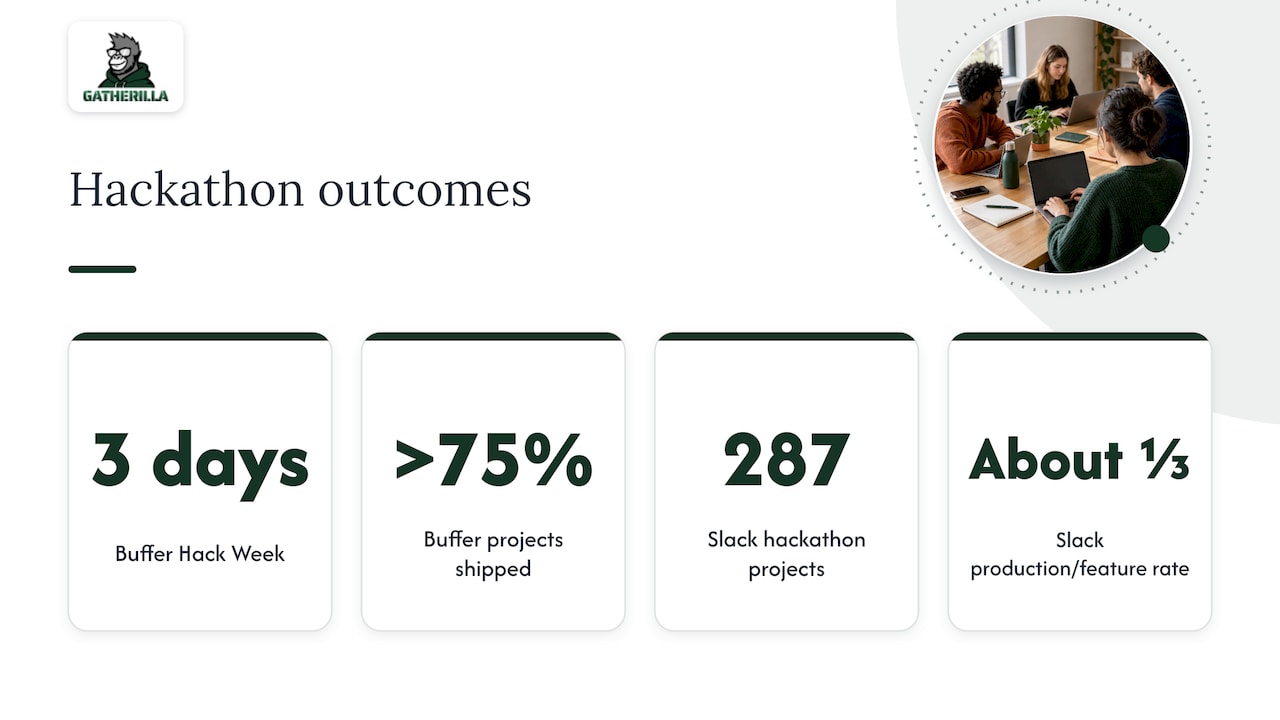
Buffer gave its fully distributed engineering team a three-day Hack Week, collected ideas on a Trello board weeks ahead, and shipped more than 75% of the projects to users. Slack reports that teams built 287 projects across its hackathons, and about a third reached production in some form or influenced features that did.
The bonding side matters as much as the output. Moov designed its event to connect an engineering org that doubled to more than 50 people in six months, mixing veterans and newcomers into teams of five or six. Haystack’s guide makes the same point: relationships formed across departments are often worth more than any single prototype.
You do not need to be an engineering team to use the format. Slack advises opening entries to non-technical staff, who can submit mockups, and including non-technical judges.
Remote hackathon ideas by goal
Choose the theme before anything else. It decides who signs up and what “success” means.
Ideas to bond a distributed team
- Culture rituals sprint. Teams design a ritual that makes remote work feel less lonely: a weekly show-and-tell, a virtual coffee format, a recognition habit. Haystack lists culture rituals among its ten suggested themes.
- Build something for the team itself. Bluecore’s first remote hackathon had a theme about improving the remote experience, engagement and communication. The winning team built a Slack bot with a question of the day, jokes, icebreakers and memes. It is a good model: the product of the hackathon becomes a bonding tool.
- Best Meme award. Fingerprint’s fully remote hackathon gave a Best Meme award decided by emoji reactions in Slack. Joke categories lower the stakes for people who feel shy about pitching.
- Cross-team knowledge hub. Mixed teams build a shared place for the answers new and old employees keep asking for.
Ideas to welcome new hires
- Onboarding overhaul. This is another theme on Haystack’s list. Include people hired in the last six months, because they remember what was confusing.
- One-day onboarding build. Leveragai describes a 24-hour structure: define outcomes such as new hires being productive within 30 days, map the journey from pre-boarding to day 90, design manager check-ins and social moments, assign owners, and pressure-test the plan for a fully remote hire. You can stretch the same sequence across three half-days.
- Buddy-matched teams. Put a new hire on a team with veterans. Smartsheet noted that an engineer who had started two weeks earlier contributed meaningfully to its virtual event.
Ideas to solve workplace problems
- Meeting-free workflow. Haystack’s example target is cutting meeting load by 30%.
- Eliminate toil. Moov’s judges proposed themes such as automating manual work, reducing customer communication delays and improving an existing system.
- Customer friction hunt, accessibility sprint, AI quick wins, manager toolkit. All appear in the same Haystack list and suit non-engineering teams as well.
If you want more ideas in a lighter format, our remote team challenge ideas and virtual offsite ideas cover the non-build side.
How to structure the event
The companies above converge on a similar shape. Here is a version you can copy.
| Phase | When | What happens |
|---|---|---|
| Announce | 4 to 6 weeks out | Calendar holds, theme, rules, a single chat channel |
| Collect ideas | 2 to 4 weeks out | A form or board where anyone adds or upvotes ideas |
| Pitch and sign up | 1 to 2 weeks out | 3 to 5 minute live pitches, then team sign-up |
| Build | 1 to 3 working days | Team channels, check-ins, leader office hours |
| Demo and vote | Final day or the week after | 3 to 5 minute demos, company-wide vote |
This follows what HackerOne describes for its remote Hack Week: a small committee sets the dates, pitches come one to two weeks before, team leaders open Slack channels, and employees vote on demos the following week. Quartet Health added a Google Form for problem ideas four weeks out, mailed swag the week of the event and a kickoff happy hour in breakout rooms the day before.
Set up the teams
Cap teams at four to six people and put a non-technical role on every team, as Haystack recommends. Mix tenures on purpose, as Moov did. Left alone, people sign up with the colleagues they already know, and the bonding value disappears.
Recreate the room
Monday.com ran its remote hackathon with always-open Zoom rooms per team, a company-wide Slack channel and its familiar in-person schedule moved to Zoom: an opening talk, a happy hour and a closing talk. Its team called the shared channel a crucial element in keeping people engaged. Twenty teams built apps and more than 350 employees attended the final outcomes meeting.
Judge fairly
Moov scored entries from 1 to 10 on value, innovation, execution, scalability and complexity. Slack suggests judging groups of about 10 entries each, with non-technical judges included. If you want a cheaper option, use a people’s choice vote, like Tripadvisor, whose final round included a people’s choice category.
Make it inclusive and sustainable
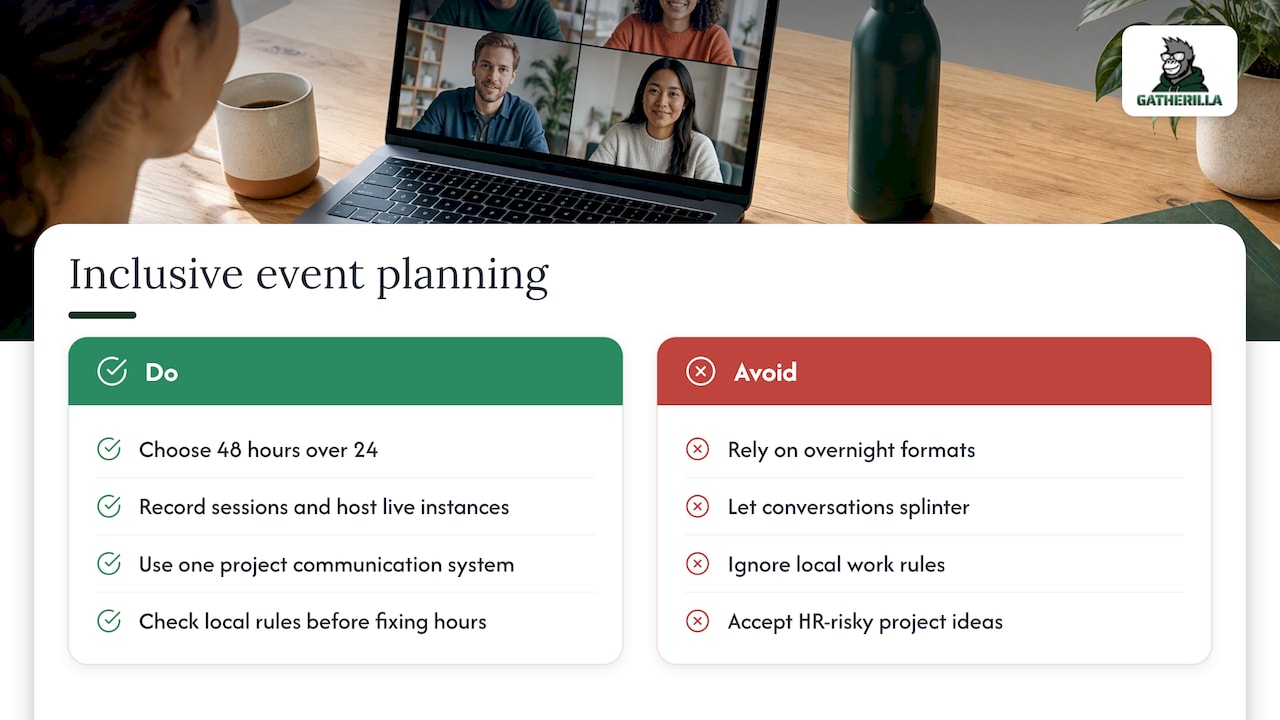
The first decision is length. Slack recommends 48 hours instead of 24, because overnight formats skew toward younger participants. Chime spread its event across three full working days and added a Design Idea Week beforehand so non-engineers could prepare designs without rushing. Moov went further and banned all-nighters.
The second is time zones. Tripadvisor held idea-matching sessions for US East, US West and Europe, and ran parallel judging groups to shorten judging. GitLab’s handbook recommends recording sessions and hosting multiple instances of live ones, plus one system for project communication so conversations do not splinter. Smartsheet let teams choose their own rhythm: a joint kickoff, asynchronous work, then synchronous check-ins, with a Zoom Demo Day giving every presenter equal stage time. For more on that style of working, see our guide to async team building across time zones.
If some of your people work from another country, check local working-time and remote-work rules before fixing event hours. For Portugal, Portugal’s remote work law is a good starting point for HR.
Finally, screen project ideas. Slack filters out entries that could create HR problems, such as projects requiring too much personal data or excluding employees.
Shrink it: hackathon ideas for a meeting or a daily habit
Most teams cannot stop work for three days, and new hires should not wait months for the next event. The core of a hackathon is a small group, a clear prompt, a short clock and a share-out. That scales down well.
- 20-minute micro-hack. Break into groups of three or four. The prompt: “Redesign our Monday standup so it takes five minutes.” Ten minutes to build, one-minute pitches, a quick vote.
- 30-minute onboarding hack. A new hire and two veterans draft one page: the first-week question we wish had an answer. Post it in your team wiki.
- Lightning demo hour. Everyone shows something small they built or improved that month, three minutes each.
- Game-based warm-up. Start the session with a quick multiplayer game so people are already talking before the pitch round. Our post on remote team tournament ideas shows how to run these for meetings and daily play, and daily team challenge ideas covers the everyday version.
- Hybrid-friendly versions. If part of the team is in an office, our guide to hybrid team building ideas for HR covers 10-minute prep and no spectators.
Then measure. Haystack suggests tracking participation across departments, ideas submitted, post-event satisfaction, and how many ideas reach pilot or production within 90 days. Even a short version benefits from one number: how many people from outside the usual circle took part.
A sample plan: two big hackathons, daily play in between
Here is a pattern for a team of 40 to 200 people:
- Twice a year: a three-day, working-hours hackathon with a bonding theme and a build theme.
- Monthly: a 60-minute lightning demo hour.
- Weekly: a 20-minute micro-hack in a team meeting.
- Daily: a short shared challenge that takes a few minutes and requires no setup.
- At every start date: a new hire joins a mixed team or game session in their first week.
The daily layer is where most teams drop off, because it needs someone to remember it every day. That is the gap we built Gatherilla to fill.
Where Gatherilla fits
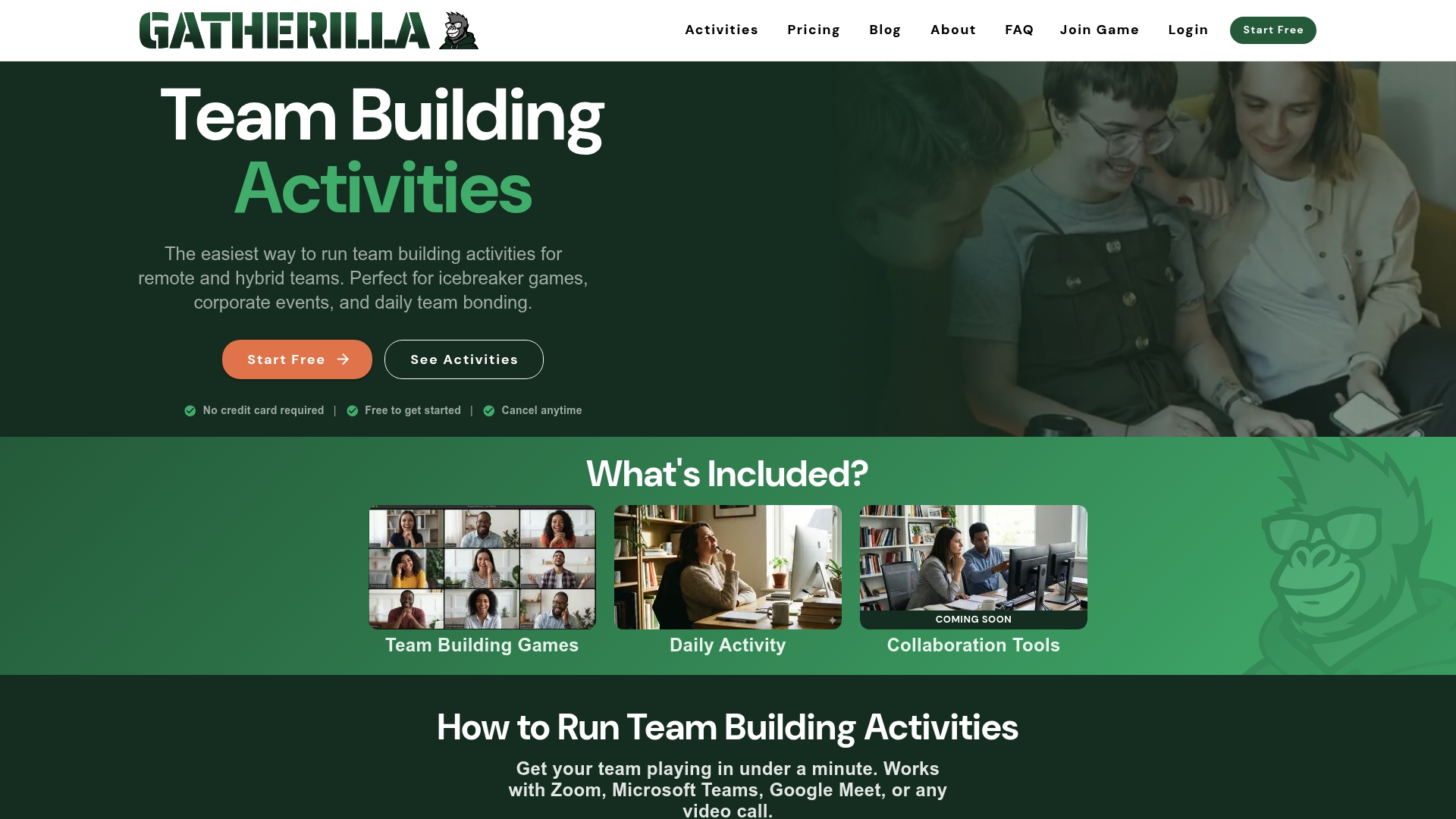
Gatherilla is a browser-based platform for remote and hybrid teams, with customizable multiplayer games, daily word and trivia challenges, icebreakers for meetings, onboarding games for new employees and real-time leaderboards. It needs no downloads and works with all video conferencing tools, so you can open a game at the start of a hackathon kickoff or a Monday meeting without a technical briefing.
The Free plan lets you try the games with your team. Premium adds more games, analytics, reporting and priority support, at $0.50-$1.00 per seat per month or $5-$10 per seat per year, as published on our pricing page. To see the full set of activities, start from Gatherilla’s team building games.
Our view
Hackathons are one of the best ideas in remote culture, and we love them. But a hackathon is an event, and teams do not become close through events alone. They become close through small, repeated moments: a shared puzzle, a joke, a quick win at the start of a call.
That is why we think the strongest setup combines both. Use the hackathon for the big, shared push. Use a daily habit to keep people connected in the weeks between. We built Gatherilla around zero-preparation games with no downloads or accounts, so the daily layer takes no effort from the person organizing it, and recognition between colleagues can follow the company values.
If you run just one thing this quarter, run a 20-minute micro-hack with a game warm-up and see who speaks up who usually does not.
Thomas
FAQ
How long should a remote hackathon be?
One to three working days suits most teams. Slack recommends 48 hours over 24, and Chime used three daytime days because overnight formats are less inclusive. If that is too much, a 60-minute or 20-minute version still delivers the mixing and the share-out.
Can non-technical teams run a hackathon?
Yes. Slack advises opening entries to non-technical staff, who can submit mockups. Haystack suggests themes such as onboarding overhaul, culture rituals and manager toolkit, and recommends a non-technical member on every team.
How do I get people to take part across time zones?
Announce early, record live sessions, and run more than one idea-matching session, as Tripadvisor did for three regions. Let teams choose between synchronous and asynchronous work, as Smartsheet did, and keep all communication in one channel.
What is a good hackathon idea for new hires?
An onboarding overhaul, with recent hires on the team. They know what felt confusing, and the team ends up with a concrete first-90-days plan. A shorter version works as a 30-minute session in the first week.
Sources
- How to Hold a Hackathon When Your Team Is Fully Remote (Buffer)
- Lessons from five years of hackathons at Slack
- How to engage engineers in a fully remote company (Moov)
- How to Run a Company Hackathon That Changes How Teams Work (Haystack)
- Remoticon2020: Bluecore’s First Remote Hackathon
- How We Ran Fingerprint’s Third Hackathon
- The One-Day Onboarding Hackathon (Leveragai)
- Innovating and collaborating, one hack at a time (Smartsheet)
- How HackerOne Organizes a Remote Hack Week
- Having a Hackathon in 2020 (Quartet Health)
- Remote Hackathon (monday.com)
- Hack Tripadvisor
- Chime Engineers: 2023 Hackathon Recap
- GitLab all-remote handbook: asynchronous work
- Portugal’s remote work law