

2, 5, 10 Minute Never Have I Ever for Work for Leaders, EEOC Aligned

This page gives team leaders a curated, work-safe set of Never Have I Ever prompts plus facilitator scripts and opt-out rules for virtual or in-person meetings. You will find categorized questions, step-by-step play instructions, and safety guidance grounded in psychological safety in the workplace research and Gatherilla’s work with remote teams.
TL;DR:
- Structured, low-stakes games like Never Have I Ever build trust faster than open-ended icebreakers by providing a shared task that lowers emotional barriers.
- Use clear ground rules, including a visible pass option and no follow-up questions, to maintain psychological safety and prevent discomfort or exclusion.
- Tailor prompts to the team’s cultural context, avoiding personal or sensitive topics that may pressure or exclude participants in diverse or remote groups.
- Conduct short sessions of 2 to 10 minutes, with carefully selected prompts, to maximize engagement and rapport without risking low trust or safety.
- Utilize browser-based platforms with pre-built formats for easy, no-download hosting of weekly or daily team icebreakers across common video conferencing tools.
Table of Contents
- Clean, categorized Never Have I Ever prompts for every team
- How to play in virtual and in-person meetings
- Setting ground rules that protect inclusion
- Copy-ready scripts for 2, 5, and 10 minutes
- Tailoring prompts to different teams and cultures
- Pitfalls beyond harassment: privacy and personal boundaries
- Why quick games beat conversation-only icebreakers
- A low-prep way to run games like this every week
- Where these guidelines come from
- Sources
- FAQ
Clean, categorized Never Have I Ever prompts for every team
Pick the category that matches your meeting’s tone and how well the group knows each other. A new hybrid team should start with office or onboarding prompts. A team that already jokes around on Slack can handle the light funny set.
Office and desk life (good for mixed seniority, low risk):
- Never have I ever pretended to be on mute during a meeting.
- Never have I ever sent an email to the wrong person.
- Never have I ever forgotten to unmute right as I started talking.
- Never have I ever fallen asleep during a webinar.
- Never have I ever eaten lunch at my desk five days in a row.
- Never have I ever used a fake background to hide a messy room.
- Never have I ever joined a call from my car.
Remote and work-from-home (good for distributed teams, low risk):
- Never have I ever worked in pajamas during a client call.
- Never have I ever had a pet interrupt an important meeting.
- Never have I ever forgotten what day of the week it was.
- Never have I ever taken a work call while walking outside.
- Never have I ever had a video call freeze on an unflattering face.
- Never have I ever missed a meeting because of a time zone mix-up.
- Never have I ever used a coffee shop as a backup office.
Professional quirks (use only with small teams who know each other, medium comfort needed):
- Never have I ever Googled how to spell a word mid-email.
- Never have I ever rehearsed a difficult conversation out loud before having it.
- Never have I ever taken credit for an idea that was not entirely mine.
- Never have I ever submitted a project a minute before the deadline.
- Never have I ever pretended to understand a tool I had never used.
- Never have I ever laughed at a joke in a meeting that I did not get.
Onboarding-friendly (good for new hires, low risk, no personal history required):
- Never have I ever worked at a company with more than five people.
- Never have I ever had a job interview that lasted under 15 minutes.
- Never have I ever learned a coworker’s name wrong for weeks.
- Never have I ever used the wrong software for a task out of habit.
- Never have I ever asked a question in a meeting I thought everyone else already knew the answer to.
- Never have I ever had a first day where nothing went as planned.
Light funny (safe for most teams, read the room first):
- Never have I ever cried at a commercial.
- Never have I ever tripped in front of a group of people.
- Never have I ever forgotten someone’s name seconds after they told me.
- Never have I ever sung in the shower loud enough for someone to hear.
- Never have I ever accidentally liked a years-old social media post while stalking a profile.
- Never have I ever walked into a glass door.
For groups larger than 10, run chat-only rounds: everyone types “I have” or stays silent, no stories. For teams of 4 to 8, allow a quick story after each round.
How to play in virtual and in-person meetings
The standard rule: read a prompt, and anyone who has done the thing responds (a raised finger, a thumbs-up reaction, or a chat emoji). No shaming, no follow-up unless the person offers more.
- Pick 5 to 10 prompts ahead of time, ordered from safest to slightly riskier.
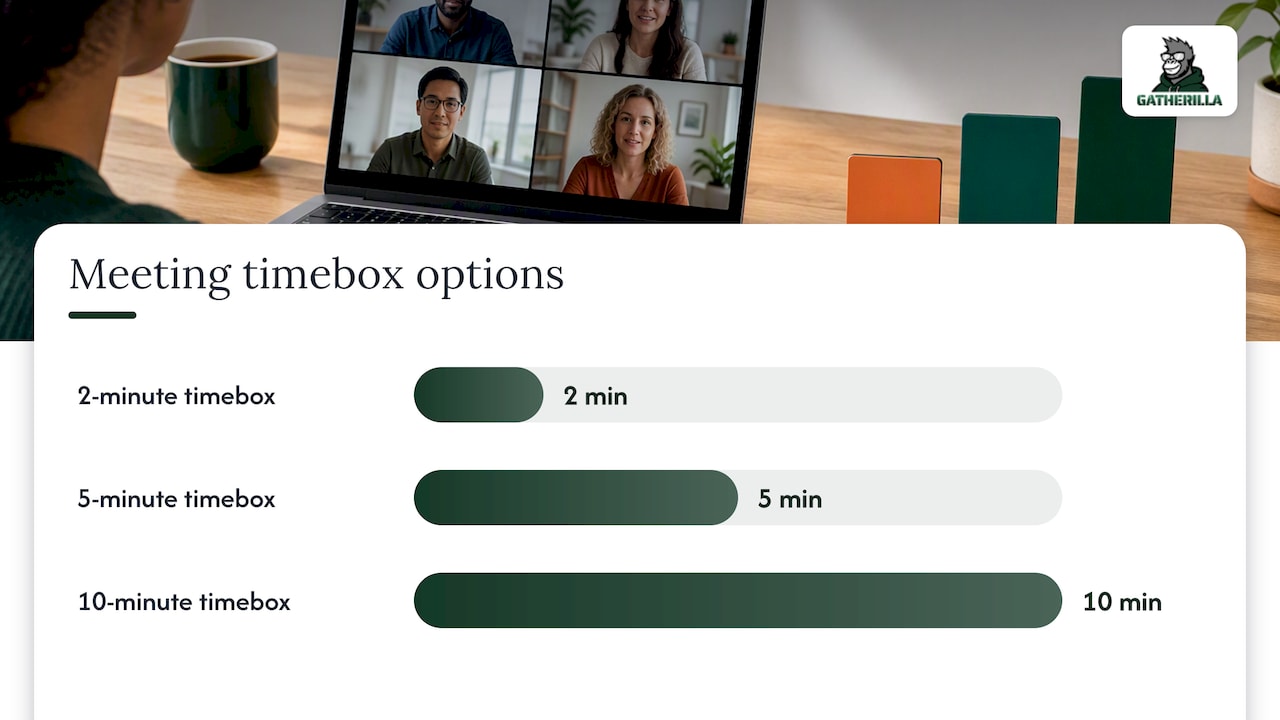
- Set a timebox before you start (2, 5, or 10 minutes).
- Read each prompt once, pause 10 to 15 seconds for responses, then move on.
- Decide upfront whether you’re playing for fun only or tracking points for a lighthearted winner.
Virtual tips: use emoji reactions or a quick poll instead of unmuting everyone at once. For groups over 12, split into breakout rooms of 4 to 6 so more people get airtime.
In-person tips: go round-robin so turns are predictable, and let people pass by saying “pass” out loud or raising a hand instead. Offer a silent sticky-note version for mixed comfort levels.
Skip this game if: the team has had recent conflict, trust is already low, or the group includes people who do not know each other well enough to gauge what feels comfortable to share.
Pro Tip: Draft your prompt list the night before and read it once from the reader’s perspective. If any question made you hesitate to answer out loud, cut it.
Setting ground rules that protect inclusion
Start every session the same way: “You can pass at any time, no explanation needed,” and “please don’t ask follow-up questions unless the person offers more.” Say this out loud before the first prompt, not buried in a chat message.
This matters because EEOC promising practices emphasize clear, written norms and training as core harassment-prevention tools, and a one-line rule in the meeting invite applies that same logic to a low-stakes game. The American Psychological Association’s psychological safety guidance frames icebreakers as learning moments, not performance tests, and recommends avoiding sensitive personal territory.
**Statistic callout: ** APA’s Work in America 2024 report links higher psychological safety with better job satisfaction and team outcomes. A short game only helps if it is run in a way that protects that safety.
Ground rules to post in the meeting invite:
- “You may pass at any time, no pressure, no explanation.”
- “No follow-up questions unless the person volunteers more.”
- “Keep it light: work and pop culture, not personal history.”
- “Session runs a few minutes, facilitator will keep time.”
If a disclosure gets heavier than expected, the facilitator should acknowledge it briefly (“thanks for sharing that”) and move to the next prompt rather than probing. Follow up privately afterward if something seemed to affect someone. More on building psychological safety covers leader behaviors that reinforce this between sessions.
Copy-ready scripts for 2, 5, and 10 minutes
2-minute script: “Quick one: Never have I ever [prompt]. Thumbs up if you have, no pressure to share more. Pass is always fine.” Wait 15 to 30 seconds, move on.
5-minute script: Open the same way, run 3 prompts, and after the last one say “anyone want to give the 30-second story behind theirs?” Cap volunteer stories at 45 seconds.
- Opener and ground rule reminder (15 seconds).
- Three prompts, reactions only, 20 seconds each.
- One optional volunteer story, 30 to 45 seconds.
10-minute script: run up to 6 prompts, rotate who answers first each round, and let the facilitator call time on any story past 45 seconds. For teams over 15, keep this version chat-only or split into breakout rooms. For teams under 6, encourage a short story after every prompt. See zero-setup Zoom icebreaker scripts for more timed formats.
Tailoring prompts to different teams and cultures
A prompt that reads as harmless to one group can land differently in a team spanning multiple countries, religions, or generations. Avoid prompts tied to alcohol, dating, politics, physical appearance, or family structure since these touch on cultural or personal norms that vary widely.
Test prompts against a simple filter: would this question make sense and feel comfortable to someone outside your own cultural context? “Never have I ever missed a flight” works almost everywhere. “Never have I ever skipped a work happy hour” assumes a drinking culture that not every team shares.
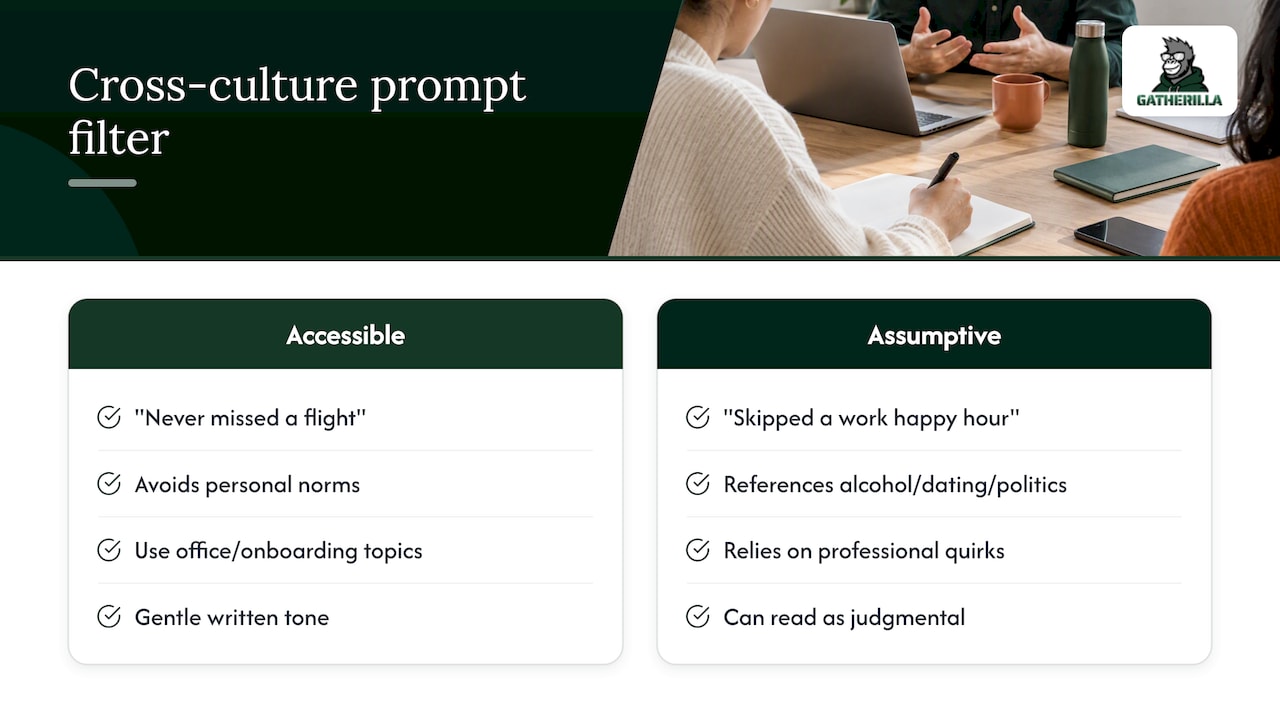
For global or newly merged teams, lean harder on the office and onboarding categories, since they reference shared work experiences rather than personal history. Skip the professional quirks and light funny categories until the team has played a few rounds together and you have a feel for what lands well.
Leaders running distributed teams across time zones should also watch tone in text. A joke that reads as playful out loud can read as judgmental in a chat message, so written-only play needs slightly gentler prompts than spoken play.
Pitfalls beyond harassment: privacy and personal boundaries
Harassment risk is not the only thing to watch. Prompts that fish for financial details, health history, immigration status, relationship status, or family planning can put people in an awkward spot even when no one intends harm. “Never have I ever been late on rent” or “never have I ever been to therapy” might sound like harmless icebreakers but quietly pressure someone to disclose something private in front of coworkers and a manager.
Watch for prompts that assume a shared baseline, like homeownership, parenthood, or travel abroad, since they can unintentionally exclude people and make the game feel like a tally of who has the “better” life. Keep the list rooted in shared work experiences and low-stakes everyday life rather than life milestones.
Finally, remember that a manager’s presence changes what feels safe to answer. A junior employee may feel pressure to participate just because a director is in the room. Giving everyone, including leadership, a visible and equally used pass option is the simplest fix.
Why quick games beat conversation-only icebreakers
Structured games create a shared task, which tends to build trust faster than open-ended conversation starters. Research comparing social games to conversation-only icebreakers found games more effective at building interpersonal trust, likely because the structure gives people a lower-stakes way to connect.
That is the logic behind Gatherilla’s daily challenge format: short, recurring, structured games fit into existing meeting routines instead of asking teams to carve out time for open conversation. A few minutes, a few times a week, tends to build more consistent rapport than one long session a quarter.
— Thomas
A low-prep way to run games like this every week
Running a good Never Have I Ever round takes a few minutes of prep. Running one every week, with fresh prompts and no repeated setup, is where most teams drop off. Gatherilla gives leaders a browser-based way to run icebreakers, trivia, and daily challenges without downloads or accounts.
- No downloads or accounts, works directly in your browser.
- Pre-built game formats so you are not writing prompts from scratch each time.
- Fits into Zoom, Microsoft Teams, and other video tools your team already uses.
- A daily challenge format keeps engagement going between larger team events.
Check Gatherilla’s pricing to see the Free tier and Premium options starting at $0.50 per seat per month.
Where these guidelines come from
- EEOC promising practices: policies and training that reduce harassment risk in group activities.
- APA psychological safety: why icebreakers should stay low-stakes and inclusive.
- Psychological Safety Reflection and Action Framework: practical leader behaviors to assess and build team safety.
Sources
- Psychological safety topic page (American Psychological Association)
- Promising Practices for Preventing Harassment | U.S. Equal Employment Opportunity Commission
- Trust Me: Social Games are Better than Social Icebreakers at Building Trust
FAQ
Is Never Have I Ever appropriate for work meetings?
Yes, when the prompts stay focused on everyday work life and light, non-personal topics, and when the facilitator sets clear opt-out rules first. Avoid prompts about alcohol, dating, politics, health, or finances, and keep a visible pass option throughout.
How many questions do I need for a work session?
A 2-minute session needs just one prompt, a 5-minute session works well with three, and a 10-minute session can cover up to six. Prepare a slightly longer list than you need so you can skip any prompt that feels off once you read the room.
What do I do if someone refuses to answer?
Say “pass is always fine, no explanation needed” before you start, and move on immediately if someone passes. Normalizing the pass option early, and modeling it yourself first, removes the pressure that makes people feel singled out.
When should I skip this game entirely?
Skip it if the team has had recent conflict, if psychological safety is already low, or if the group is too unfamiliar with each other’s comfort levels to gauge what feels safe. A quiet trivia round or a structured check-in works better in those moments.
What are some good clean questions to start with?
Start with office and onboarding prompts like missed flights, email mishaps, or mute mishaps during calls, since they rely on shared work experience rather than personal history. These tend to get an easy laugh without putting anyone on the spot.