

Marketing Team Icebreakers: 30+ Ideas That Work

The best icebreakers for a marketing team borrow from the work itself: brand quirks, campaign jargon, creative constraints and quick visual prompts. Keep them under five minutes, make them optional to answer in depth, and run them at the start of the meeting, not the end. Below you will find questions, virtual games, onboarding openers and a simple way to make them a habit.
TL;DR
- Marketing-flavored prompts (overused buzzwords, brands to borrow from, A/B test confessions) land better than generic “favorite pizza topping” questions.
- Five minutes is enough. Short, rapid-fire formats beat long go-around rounds.
- For remote teams, pick chat-friendly or visual formats: emoji check-ins, desk tours, bingo, quick drawing exercises.
- Let people pass, set simple rules, and answer first yourself so nobody feels put on the spot.
- Turn a one-off opener into a routine: a weekly question or a daily browser game keeps the connection going.
Table of Contents
- Why marketing teams need their own icebreakers
- Icebreaker questions made for marketers
- Five-minute icebreakers for virtual meetings
- Sales-adjacent ideas for performance and demand gen teams
- Welcoming new marketing team members
- Make it inclusive so everyone can join
- The “4 C’s” icebreaker, explained
- Make icebreakers a habit, not an event
- Perspective
- Run it with Gatherilla
- A sample 5-minute opener you can use tomorrow
- FAQ
- Sources
Why marketing teams need their own icebreakers
Marketers spend their days making things for strangers. Meanwhile the people sitting two desks away (or two time zones away) may know little about each other beyond a Slack avatar. Creative, deadline-driven teams also tend to jump straight into reviews and feedback, which is hard to do well when people don’t feel at ease.
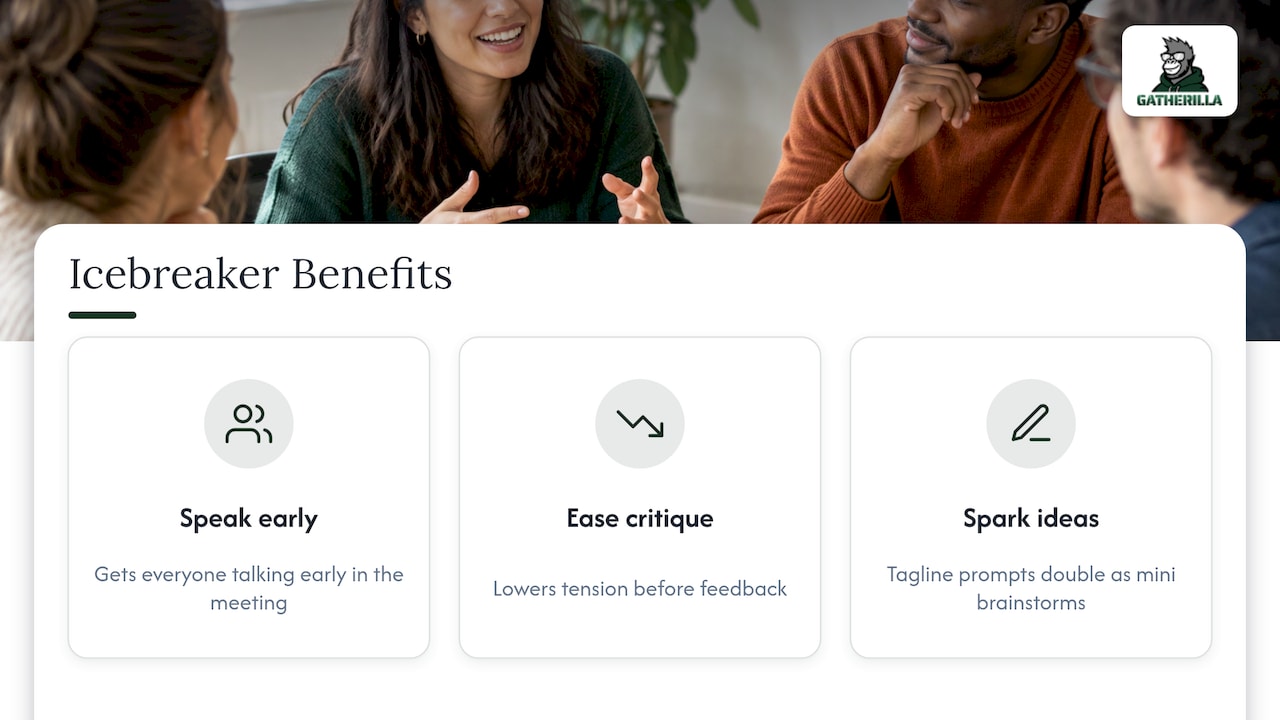
A good opener fixes that in a few minutes. It does three jobs: it gets everyone to speak early in the meeting, it lowers the temperature before critique, and it warms up the creative muscle. That last part is the marketing advantage. A prompt that asks people to think about taglines, mascots or theme songs doubles as a mini brainstorm.
Harvard Business Review points out that in an era of remote work and scattered teams, fostering connection among employees wherever they are is a key managerial challenge, and team-building activities can help. Icebreakers are the smallest, cheapest version of that.
Icebreaker questions made for marketers
Questions are the lowest-effort format: no setup, no tools, and they work on a call, in chat or in a room. A list of icebreaker questions from G2’s learning resource includes several written specifically for marketing teams. Some favorites:
- What’s a brand you’d love to steal creative ideas from (ethically)?
- What’s your most overused marketing buzzword?
- If your marketing style had a theme song, what would it be?
- What’s the weirdest A/B test idea you’ve actually run?
- What’s one marketing trend you think is totally overhyped?
- What’s your most overused emoji in campaign copy or Slack?
- If your marketing style had a mascot, what would it be?
- What marketing jargon secretly drives you nuts?
The same list works well as a rotating menu: pick one prompt per meeting and you won’t repeat for two months.
General work questions that still suit creative teams
When you want something a little less shop-talk, these work-adjacent prompts from a large team icebreaker collection and another widely shared question bank travel well:
- What’s one piece of advice you’d give to someone starting in your field?
- If you could pick any fictional character to be your mentor at work, who would it be?
- What was your dream job when you were a kid, and how has it changed?
- How did you end up in your current job?
- If you could have another career, what would it be?
- What’s the best career advice you’ve ever received?
- What’s the most fun project you’ve ever worked on?
The career-story questions are especially good for teams that mix designers, writers, analysts and paid media specialists, because everyone took a different road into marketing and people enjoy hearing it.
Funny questions for a looser start
For a Friday stand-up or a post-launch debrief, humor lowers stakes. Prompts from a collection of funny team meeting questions include:
- If our team had a mascot, what should it be?
- What is the most ridiculous job title you could give yourself that would still be technically accurate?
- If our meetings had a soundtrack, what song should play at the start?
- What is the strangest item currently on your desk or in your bag?
The “ridiculous job title” question is a natural for marketers, who already live in a world of “Chief Storyteller” and “Growth Ninja.”
Five-minute icebreakers for virtual meetings
Virtual calls need formats that are simple, visual or chat-friendly. Skift Meetings recommends matching the format to the setting: virtual sessions should be simple, visual or chat-friendly, while hybrid ones work best with polls, shared visuals or timed prompts. Here are options that fit the five-minute window.
| Activity | Time | Best for | How it works |
|---|---|---|---|
| Emoji check-in | 1 to 2 min | Any size, weekly meetings | Everyone posts one emoji in chat that shows how the week is going |
| Where are you logging in from? | 2 min | Distributed teams | Describe your location with an emoji, a photo or five words in chat |
| Virtual background bingo | 5 min | Small to mid-size groups | Share a card in advance (bookcase, pet, coffee mug); first to five in a row wins |
| Reflect and predict | 5 min | Quarter starts, retros | Answer “What are you most proud of this year?” and “What are you most looking forward to?” |
| Desk tours | 5 min | Teams that know each other a bit | A quick look at each person’s work setup, with an opt-out |
| Virtual scavenger hunt | 3 to 5 min | Energizing a flat call | Find something blue, a favorite book or a childhood photo |
| Draw it upside down | 5 min | Creative kickoffs | Flip an image, then draw it |
The emoji check-in and the location prompt come from Skift Meetings and Paperless Post’s icebreaker ideas, which also describes virtual show and tell and desk tours with an opt-out for people who prefer not to share. The scavenger hunt appears in FigJam’s icebreaker library.
The upside-down drawing exercise
This one is a gift for creative teams. Morgan Andersen, a marketing solutions manager at Intel, told Ragan Communications to have people pick an image, flip it upside down and try to draw it on a new sheet of paper. She called it “super surprising how well it works,” and it shows that a different way of looking at a problem can change the result. Use it before a campaign brainstorm, then ask: where else could we flip our perspective this week?

Quick opening activities with almost no setup
SessionLab notes that icebreaker questions need almost no setup and work for in-person and remote teams: split people into pairs or small groups and have them answer one question. Its method library also lists openers such as team story, draw a symbol and a one-minute Lego tower. Team story is a quiet winner for copywriters: each person adds one sentence to a shared story, which turns into a very silly product launch narrative within two minutes.
Sales-adjacent ideas for performance and demand gen teams
Marketing teams that sit close to sales sometimes borrow from sales meeting icebreakers, such as brainstorming objections, speed pitches or “sell me this pen” challenges. Adapt the same idea to your team:
- Speed pitch. Each person has 30 seconds to pitch a boring object on their desk as if it were a launch campaign.
- Headline remix. Show a competitor-neutral, anonymous headline and have everyone rewrite it in 20 seconds.
- Objection roulette. Name one objection customers raise most often; the group offers one-line answers.
- One-word brief. Describe your current project in a single word, then explain it in one sentence.
These double as practice for messaging work, so nobody feels the time was wasted.
Welcoming new marketing team members
Onboarding is where an icebreaker earns its keep. A new hire usually meets a dozen people in a week and remembers few of them. Keep the opener fast and low-pressure.
Megan Scott, a growth specialist at HubSpot, used a two-minute show and tell scavenger hunt at the start of an orientation call: each cohort member had two minutes to talk about something they grabbed. As she put it to Ragan, it was “open-ended and quick, no time to overthink what you show”.
A simple onboarding sequence for a marketing hire:
- Day one: a show and tell with the immediate team, two minutes per person.
- Week one: a “how did you end up in marketing?” pairing with someone from a different discipline.
- Week two: a bingo or trivia round with a wider group, so the new person meets people outside their pod.
- Month one: a team-wide prompt where the new hire gets to ask the question.
If you also run onboarding for other roles, our guide to icebreakers for training sessions has more formats that scale to bigger cohorts.
Make it inclusive so everyone can join
The fastest way to kill an icebreaker is to make someone feel exposed. Figma’s facilitator tips are practical: match the icebreaker to your goal, consider setting and timing, answer first yourself, promote active listening, and use small groups or pairs to make the session less intimidating.
Some extra moves that help in marketing teams:
- Set a parameter. Whitney Magnuson, senior director of marketing at Northwestern Mutual, suggests rules such as “no pets or children” for show and tell, which pushes people toward more creative objects. She also mentions Team Cribs, a Zoom tour of your home, for teams that like sharing more.
- Offer an opt-out. Desk tours and home tours should always be optional. Not everyone wants to show their space.
- Keep it snappy. Ragan notes that anticipation can be half the reason for the nerves and impatience that come with icebreakers. Rapid-fire formats stop the dread from building while people wait their turn.
- Mind hybrid setups. If some people are in a room and others are on screen, use chat, polls or shared visuals so remote participants aren’t an afterthought. Our piece on keeping remote participants engaged in hybrid meetings goes deeper.
The same thinking applies when your team gets together in person after months apart. Planning who arrives when, and who overlaps in a city, makes the first-day icebreaker much easier; this walkthrough on coordinating remote team offsite arrivals covers the logistics.
The “4 C’s” icebreaker, explained
People searching for icebreakers often run into the 4 C’s. One common version, described by an agile retrospective guide, splits the exercise into four themes: collaboration, creativity, challenges and connection. Each person answers a prompt for each theme, such as how they work best with others, a creative idea they’re proud of, a problem they see coming, and something that links them to the group.
For a marketing team, try this version:
| C | Prompt |
|---|---|
| Collaboration | Who on this team makes your work better, and how? |
| Creativity | What’s the best idea you’ve had this month, however small? |
| Challenges | What’s one obstacle you expect in the next campaign? |
| Connection | What’s one thing outside work that you want the team to know? |
Give each C two minutes in pairs and you have a ten-minute opener that doubles as a kickoff check-in. Because the term is used loosely, tell your team which four you mean.
Make icebreakers a habit, not an event
One-off icebreakers feel like a special occasion. Routines feel like culture. Erin O’Donnell, a social media specialist at Prime Therapeutics, runs a “nonsensical question of the week every Friday” in team chat, from favorite holiday traditions to boring facts about yourself. It’s optional, so there’s no pressure to answer every week.
A few ways to make the habit stick:
- Rotate the host each week so it doesn’t fall on the manager.
- Pair the question with a recurring meeting, such as the Monday sync.
- Save the best answers (the funniest mascot suggestions, the worst buzzwords) in a shared doc.
- Use a channel for the async version, then spotlight one answer live.
For Slack-based teams, see Slack icebreaker ideas for channels and meetings. If your calls run on Zoom or Teams, we have scripts in our short Zoom icebreakers guide and a list of Microsoft Teams icebreakers.
Perspective
Most teams treat icebreakers as an event: someone remembers, scrambles for a question, and the meeting starts three minutes late. We think that is backwards. Connection comes from small, repeated moments, not one big session a quarter.
That is why we built Gatherilla around browser-based games that need no downloads and no accounts to join, so a team leader can open a game at the start of a call with zero preparation. Daily word and trivia challenges and real-time leaderboards are designed to turn engagement into a habit, and our games work with any video conferencing tool.
For a marketing team, the bonus is that playful competition and word play feel close to the work itself. Pair a game with one of the questions above and you have an opener people look forward to.
Thomas
Run it with Gatherilla
If you want the structure without the prep, Gatherilla gives remote and hybrid teams customizable multiplayer games, daily challenges, icebreakers for meetings and onboarding games for new hires, all in the browser. The Free plan lets you try it with your team. Premium adds more games, analytics and priority support, and is listed at $0.50 to $1.00 per seat per month, or $5 to $10 per seat per year. See the pricing page for the current details.
You can also browse more remote icebreaker games for team leaders or start from the Gatherilla homepage.
A sample 5-minute opener you can use tomorrow
Need a plan right now? Here is a complete opener for a weekly marketing meeting.
- Minute 0 to 1: Post the prompt in chat: “What’s your most overused marketing buzzword?” Answer first yourself.
- Minute 1 to 3: Everyone types an answer. Read out three or four, and let people react with emojis.
- Minute 3 to 5: Vote on the worst buzzword and add it to a “banned words” list for the meeting.
The banned-word list is a nice touch. It is silly, but it quietly sharpens the copy discussions that follow.
For large all-hands or virtual events, our conference icebreaker guide covers formats for bigger rooms, and the bingo guide shows how to run the five-minute bingo from the table above without downloads.
FAQ
What are some icebreaker questions for a marketing team?
Try “What’s your most overused marketing buzzword?”, “What’s the weirdest A/B test idea you’ve actually run?” or “If your marketing style had a theme song, what would it be?” They draw on shared experience, so everyone has an answer ready. Pick one per meeting.
How long should an icebreaker take in a marketing meeting?
Aim for two to five minutes. Short formats keep energy up and stop people from dreading their turn. If the conversation takes off, let it run, but plan for the short version.
What is a good icebreaker for virtual marketing meetings?
Chat-based formats work best: an emoji check-in, a “where are you logging in from” prompt or virtual background bingo. They’re quick, visual and let quieter people take part without speaking first.
Which icebreakers suit new marketing hires?
A two-minute show and tell is easy and low-pressure. Follow it with pairings across disciplines in the first weeks, so the new person meets designers, analysts and writers outside their own pod.
What are the 4 C’s icebreakers?
One common version covers collaboration, creativity, challenges and connection. Each person answers a short prompt for each theme, often in pairs, which makes it a good kickoff opener for a new project or team.
Sources
- Harvard Business Review: 17 team-building activities for in-person, remote and hybrid teams
- G2: 164 best icebreaker questions for team-building
- 150+ team icebreaker questions for work and meetings
- 148 icebreaker questions you’ll keep coming back to
- 90+ funny icebreaker questions for work
- Skift Meetings: 48 strategic icebreakers for meetings
- Paperless Post: 40 icebreaker ideas for meetings and workshops
- FigJam: 53+ icebreaker ideas for a more connected workplace
- Ragan Communications: group icebreakers that won’t make people cringe
- SessionLab: top 21 5-minute team building activities
- SessionLab: opening questions and activities
- The 4C icebreaker activity explained