

Intern Onboarding Games: Ideas for a Connected First Week

The best intern onboarding games are short, low-pressure and tied to a purpose: learning names, learning the company, or meeting people outside the intern cohort. Start with a five-minute icebreaker on day one, add a team trivia or scavenger hunt in the first week, then keep a small recurring ritual going all summer. Interns arrive knowing almost nobody, so the games below are built to get them talking quickly without making anyone perform.
This guide covers what to run, how long it takes, how to adapt it for remote and hybrid interns, and how to schedule it so it becomes a habit instead of a one-off.
TL;DR
- Keep day-one games under 10 minutes and make them optional-feeling: Two Truths and a Lie, In Six Words and Three Questions all fit.
- Use a team scavenger hunt or trivia in week one so interns have a reason to talk to people outside their own team.
- For remote interns, use breakout groups of three or four and keep the same groups across sessions so relationships build.
- Match every game to one objective (trust, backgrounds or company knowledge) before you run it.
- Repeat something small every week. A weekly ritual beats a single big kickoff.
Table of Contents
- Why games work for interns specifically
- How to choose a game before you run it
- Quick icebreakers for the first meeting (5 to 10 minutes)
- Team games that teach the company (20 to 60 minutes)
- Running onboarding games for remote and hybrid interns
- Keep it going: recurring activities beat a single kickoff
- A sample first-week plan
- Perspective: why we think daily beats annual
- Run these games with Gatherilla
- Tips for running onboarding games well
- FAQ
- Sources
Why games work for interns specifically
A full-time hire usually has a team, a manager and a few months to settle in. An intern has a few weeks. The social side of onboarding cannot wait, and it cannot be left to chance. In SHRM’s coverage of virtual onboarding, Pearson’s advice is blunt: do not ignore the social side of onboarding, and managers should come up with creative ways to connect new hires with the team.
Games are a practical way to do that. They give people something to do with each other, which is far easier than standing in a circle and making small talk. The same SHRM-reported programs show the idea at larger scale. FORUM rebuilt its orientation around games, and its vice president of organizational development says a life-size financial board game helps new hires learn products and retain information better than brochures.
The point is not entertainment for its own sake. A good onboarding game does one of three jobs:
- It helps interns learn who people are.
- It helps interns learn how the company works.
- It gives interns a shared experience with their cohort.
Pick a game by the job you need done.
How to choose a game before you run it
The federal Virtual Team Toolkit from the Partnership for Public Service advises facilitators to identify an icebreaker’s objective, say whether advance preparation is needed, explain how the activity works, and send any material in time. It also notes that traditional team-building exercises often fail virtually because they rely on physical interaction. That gives you a simple checklist for any game:
- Objective. Is this about trust, backgrounds, or learning the business?
- Time. Five minutes, twenty minutes or an hour?
- Setting. In a room, on video, or asynchronous?
- Preparation. Does anyone need to set something up or read something first?
- Comfort. Can someone join with their camera off or pass on a question without it being noticed?
USF’s team-building guide adds that you should incorporate participants’ preferences and comfort zones, since some exercises work better in person and others suit remote teams, and that you should share the desired outcome with the group. Interns are often reluctant to look foolish in front of senior colleagues, so telling them why you are doing an activity helps.
Quick icebreakers for the first meeting (5 to 10 minutes)
These work when the intern group is small and you only have a few minutes at the start of a welcome meeting.
Two Truths and a Lie
Each person shares two true facts and one lie about themselves, and the others guess the lie. USF’s guide recommends it as a classic icebreaker that builds familiarity between colleagues. Tip for interns: ask managers and mentors to go first, so the interns see the tone is light.
In Six Words
From MDRC’s Break the Ice, Build Connections guide: each person introduces themselves using six words from a shared list. For remote groups, the list goes to video participants by chat or email. It is quick, it forces everyone to be brief, and it removes the pressure to come up with something clever from nothing.
Three Questions
Also from MDRC: the facilitator offers three light questions, such as which famous person you would like to meet. Each participant picks one, reflects for two minutes and reports back. MDRC describes it as working both as a 60 to 90 minute meeting starter and as a five-minute break in a long training. With interns, choose questions that have nothing to do with work, so nobody feels tested.
Write Me a Story
Another MDRC remote option: participants pass story lines to each other through private chat, which suits people dialing in by phone. It produces a funny shared artifact and gives quiet interns a way to contribute in writing.
For more ready-to-run options with scripts, see our guides to remote icebreaker games and Zoom icebreakers that take under two minutes.
Team games that teach the company (20 to 60 minutes)
Icebreakers help people meet. Longer games help interns understand where they work. Two formats stand out in the evidence.
Scavenger hunts that send interns to people
SHRM’s HR Magazine describes a one-hour Amazing Headquarters Race at FORUM, a scavenger hunt in which teams have to talk to employees to find answers. Another HR leader in the same article uses a culture-and-products scavenger hunt she calls “integration therapy for the shy.” Tasks include shadowing a client call, setting up a video meeting with a remote co-worker, and answering trivia.
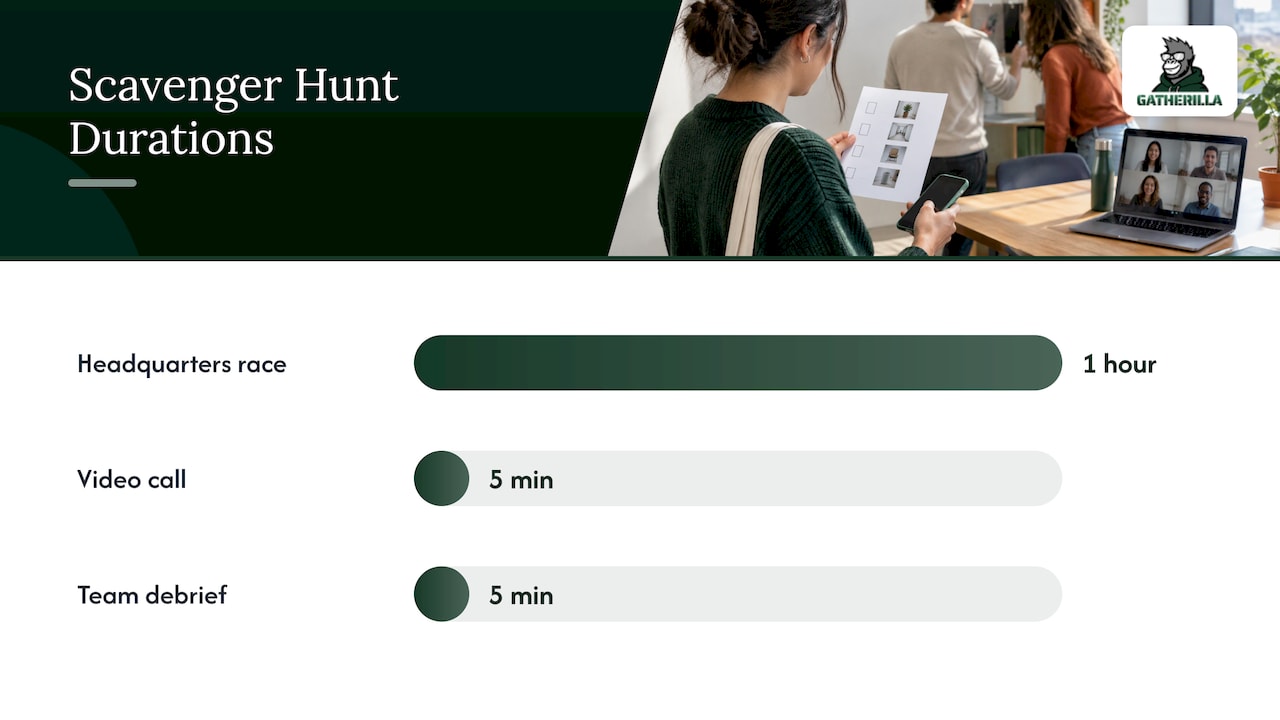
The reason this works for interns is structural. The task is the excuse to approach a stranger, so shy interns do not need to find a topic of conversation themselves.
How to build one for your company:
- Write eight to twelve clues that need a person to answer: “Who on the finance team started here as an intern?” or “Which product launched most recently, and who worked on it?”
- Mix in two or three tasks that connect interns to remote or hybrid colleagues, such as a five-minute video call.
- Put interns in teams of three or four from different departments.
- Give a clear time limit and a small prize, and end with a five-minute debrief where each team shares the most surprising thing they learned.
Company trivia
Trivia is the easiest way to teach products, history and terminology without a slide deck. Ask questions about the company, the industry and the team, and add a few about the interns themselves, collected in advance, so the game is personal. Keep it to 15 or 20 minutes and use teams so nobody is quizzed alone.
A cohort project with a social task
The same SHRM article reports that new hires at one company organize a company-wide snack break as a low-pressure networking task. For an intern class this can be a small group challenge: plan a coffee hour, a lunch trivia, or a team showcase. It gives interns ownership and a reason to invite people.
Our list of new employee orientation games sorts more options by time and setting, and our piece on intern onboarding activities covers the structure of the first days.
Running onboarding games for remote and hybrid interns
Remote interns lose the hallway. Nobody bumps into them at the coffee machine, so the games must create those encounters on purpose.
SHRM reports that ServiceNow runs a six-hour Day 1 virtual session with built-in breaks, followed by a 90-minute Day 2 session. Its CHRO named Zoom breakout sessions, polling and chat as the moments where new hires have the most fun and connect. LinkedIn, in the same article, keeps breakout groups of three or four consistent across sessions so cohort members build relationships over time.
That last detail is worth copying. A new random group every session gives interns a new set of strangers each time. Keeping the same small group gives them a first real set of friends.
Practical rules for remote and hybrid sessions:
- Use small groups. Three or four people per breakout room is enough to make everyone speak.
- Include chat. Quiet interns often contribute through chat, polls and short written prompts.
- Send material early. If a game needs a word list or a question set, send it before the call.
- Let cameras be optional. Comfort matters more than a grid of faces.
- Avoid games that need physical props. Pick formats that work in a browser or on a call.
For hybrid teams, where some interns are in the office and others are not, make sure the remote people are never the audience. Everyone plays from their own screen, or teams are mixed across locations. Our guides to hybrid onboarding games and breakout room games go through formats in more detail, and our overview of virtual onboarding games covers six ways to connect and learn.
Keep it going: recurring activities beat a single kickoff
A strong first day fades quickly if nothing follows. USF frames team building as an ongoing HR process rather than a one-off event.
The recurring formats in the research are worth borrowing. Cloudflare’s 2020 remote internship program, described on its engineering blog, included weekly Zoom lunches, bi-weekly project newsletters, hour-long executive fireside chats, and a buddy plus a mentor for every intern. A Harvard Business School field experiment assigned interns to five conditions, including a weekly intern-only video water cooler for three or four interns and a weekly water cooler with a senior manager, to measure effects on supervisor ratings and return offers.
You do not need a big program to apply the idea. A light weekly rhythm is enough:
- A Monday word or trivia challenge that takes two minutes.
- A Wednesday small-group video coffee of three or four interns.
- A Friday shout-out where interns recognize a colleague who helped them.
For buddies, our onboarding buddy activities give pairs things to do together over the first 90 days.
One extra idea: let the cohort vote on something. A “best intern project” poll, a team-name vote or a lunch-order choice gives everyone a voice and a reason to look at what others built. Online voting for employee polls makes this simple to run with live results.
A sample first-week plan
Use this as a template and swap games to fit your culture.
| Day | Game or activity | Time | Objective |
|---|---|---|---|
| Monday | Two Truths and a Lie or In Six Words in the welcome meeting | 10 min | Learn names and backgrounds |
| Tuesday | Buddy meet-up with three light questions | 20 min | Build a first one-to-one relationship |
| Wednesday | Team scavenger hunt across departments | 45 to 60 min | Learn the company and meet new people |
| Thursday | Company trivia in mixed teams | 20 min | Retain products and terminology |
| Friday | Cohort breakout of 3 to 4 interns, then a short recap with a manager | 30 min | Reflect and bond |
The total is under three hours across the week, and none of it feels like a lecture. Notice that the week mixes four things: a quick icebreaker, a one-to-one, a company-knowledge game and a cohort moment. If you only have time for two, keep the scavenger hunt and the Friday breakout.
Perspective: why we think daily beats annual
We built Gatherilla around a simple observation: most team-building is treated as an event, and interns do not need an event. They need a habit that makes it normal to talk to colleagues.
That is why our platform runs in the browser, needs no downloads, and works with whichever video tool your team already uses. An HR manager can start a game in a welcome call without preparing slides, and interns can join without creating an account. Friction is what kills a good idea in week two, so we remove it.
We also think the daily rhythm matters. A short word or trivia challenge, a real-time leaderboard and peer recognition tied to your company values turn onboarding from a single day into something interns do all summer. The research points the same way: connection comes from repeated contact in small groups.
If you are choosing between a one-time kickoff and a light, repeatable routine, build the routine and put the kickoff games inside it.
Thomas
Run these games with Gatherilla
Gatherilla is a browser-based platform for remote and hybrid teams with customizable multiplayer games, icebreakers for meetings, onboarding games for new employees, daily word and trivia challenges and real-time leaderboards. It needs no downloads and works with all video conferencing tools, so you can start an intern game in the middle of a call.
The Free plan lets you try it with no published price. Premium adds more games, reporting and priority support, at $0.50 to $1.00 per seat per month or $5 to $10 per seat per year, as published on the pricing page. You can see the full game library on Gatherilla.
Tips for running onboarding games well
Go first. When a manager shares an embarrassing fact or a silly answer, interns relax. When no one senior joins, they assume the game is for them alone to be judged on.
Cap live virtual sessions. Keep them short. SHRM’s ServiceNow example works because the long Day 1 includes built-in breaks, so even the large session is paced.
State the purpose. Tell interns what the game is for: “This is so you know three people outside your team by Friday.” That fights the skepticism that team building sometimes meets, which USF says you can reduce by sharing desired outcomes.
Include everyone. Avoid games that depend on local references, sports knowledge or physical ability. Choose prompts any 19-year-old and any 55-year-old can answer.
Follow up. After a game, ask each intern to message one person they met. A short note turns a one-time exchange into a connection.
Keep a few go-to games. Have a short list ready for a meeting that starts early, a mentor session that stalls, or a long training that needs a break.
FAQ
What are good onboarding games for interns?
Start with Two Truths and a Lie, In Six Words and Three Questions for quick introductions. Add a cross-department scavenger hunt and company trivia in week one to teach the business and introduce people outside the intern group.
How long should an intern onboarding game take?
Icebreakers take 5 to 10 minutes. Trivia usually runs 15 to 20 minutes, and a scavenger hunt fits in about an hour, as in the one-hour headquarters race SHRM describes. Keep live virtual sessions short and include breaks.
How do you run onboarding games for remote interns?
Use a browser-based game or a video call with breakout rooms of three or four people, and keep the same groups across sessions. Send any word lists or prompts ahead of time, and let people join with cameras off.
Can interns join Gatherilla games without an account?
Yes. Gatherilla games run in the browser with no downloads or accounts needed, and they work with any video conferencing tool. That makes it easy to start a game in the first minutes of a welcome call.
How often should we repeat onboarding games?
Weekly at minimum. A small recurring format, such as a weekly intern coffee or a daily two-minute challenge, keeps connections going after the first week ends.
Sources
- Original Onboarding Options from 4 HR Leaders, SHRM HR Magazine
- Virtual Onboarding of Remote Workers, SHRM
- 13 Team-Building Exercises Your Staff Will Actually Enjoy, USF
- Break the Ice, Build Connections, MDRC
- Virtual Team Toolkit, Partnership for Public Service
- How We Ran a Successful Remote Internship Program in 2020, Cloudflare
- Virtual Water Coolers: A Field Experiment, Harvard Business School