

Cultural Awareness Games for Work: 9 Activities That Work
The best cultural awareness games for work are short, voluntary and built on personal stories rather than national stereotypes. Start with a 15-minute identity or storytelling exercise, add a quick forced-choice icebreaker to meetings, and save longer simulations for workshops where people have agreed to take part. This guide covers nine games, how long each takes, how to run them on video calls, and how to debrief without anyone feeling put on the spot.
TL;DR
- Pick games that ask people to share their own experiences (food, language, work habits), not to represent a country or group.
- Quick options such as bus-stop questions fit into 5 to 10 minutes. Simulations such as “Walk a Mile in My Shoes” need about an hour and prepared cards.
- Keep every activity optional, avoid big power gaps in the room, and always allow a pass.
- For remote teams, run short rounds often instead of one big annual event.
- Debrief with open questions, and pause the game if a prompt creates discomfort.
Table of Contents
- What cultural awareness games are actually for
- Nine cultural awareness games to try
- Adapting the games for remote and hybrid teams
- Using these games in onboarding
- Keeping the games voluntary and free of stereotypes
- How to debrief and handle discomfort
- Make it a habit with Gatherilla
- FAQ
- Sources
What cultural awareness games are actually for
A cultural awareness game gives colleagues a structured, low-stakes way to learn how background, language and experience shape the way people work. It is not a quiz about holidays. The useful ones surface assumptions: why one person reads silence as respect and another as disagreement, or why a “quick call” means different things to different people.
Research backs the idea that play can shift perspective. A 2025 study in PMC followed 82 university staff who played the board game Far From Home across 10 sessions. Participants reported greater awareness of structural barriers and less stereotyping of international students. The study is small and set in a university, so treat it as encouraging rather than a guarantee for your office.
The creator of the board game Inequality-opoly had a similar motive. He told Forbes he attended diversity trainings and saw facilitators struggle to show the effects of discrimination in an engaging, personal way, so he decided an interactive game was the best way to teach it.
Nine cultural awareness games to try
The table gives the overview. Details follow below it.
| Game | Time | Group size | Preparation | Best for |
|---|---|---|---|---|
| Circles of Identity | 15-20 minutes | Any | None | Team kickoffs |
| A Ticket to Know You | 20-30 minutes | Pairs | Colored tickets or slips | Workshops, onboarding |
| Commonalities and Diversity | 5-10 minutes | 6+ | A list of forced-choice questions | Meeting icebreakers |
| Story Stitch | 30-60 minutes | Small groups | Card game | Retreats, trainings |
| Drawing in Two Hands | 20-30 minutes | Pairs in two groups | Pens and paper | Communication workshops |
| Walk a Mile in My Shoes | 60 minutes | 8+ | Scenario and character cards | Empathy training |
| Far From Home | Multiple sessions | Small groups | Board game | Staff training |
| Inequality-opoly | Long session | Small groups | Board game | Facilitated discussion |
| Photo or object share | 10-15 minutes | Any | Ask people ahead of time | Remote teams |
Times for the first six come from the sources linked in each section. Time for the last three is an estimate based on how these formats usually run, so adjust to your group.
1. Circles of Identity
People stand in a circle (or, online, use a reaction or the chat) and step to the center when a statement applies to them: “I speak more than one language at home,” “I moved cities for work.” A team-building and diversity manual lists the activity at 15 to 20 minutes and uses it to show shared and unique identities at once.
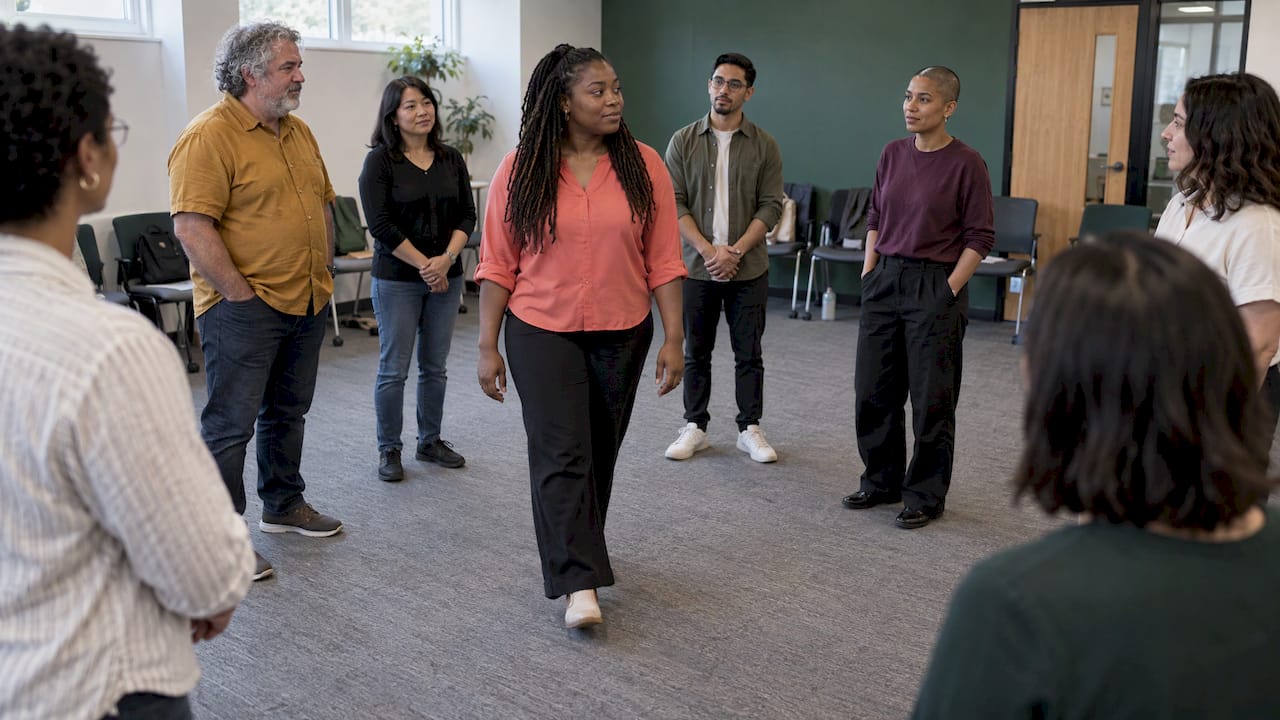
Keep statements light at first and let people sit out any they prefer not to answer. For mindful ways to open sessions like this one, these wellness icebreakers for teams pair well with a circle format.
2. A Ticket to Know You
The Cultural Competence Learning Institute at ASTC describes A Ticket to Know You as a paired exercise. Each person gets three colored tickets and uses them to answer prompts, from “What was your favorite childhood food?” to sharing a hard work situation that later turned out to stem from a cultural difference.
The prompts move from easy to reflective, which is a good model for any session: warm up, then go deeper only if the room is ready.
3. Commonalities and Diversity
This is the quick one. Cornell’s group teambuilding guide describes a bus-stop format in which forced-choice questions, such as chocolate or vanilla, sort people into groups. Everyone sees where they match and where they differ.
To make it culturally relevant, mix trivial choices with work-style ones: early call or late call, written update or live discussion, direct feedback or private feedback. Five questions take under 10 minutes.
4. Story Stitch
Green Card Voices created Story Stitch in 2018 with 70 community members. It is a conversation card game that builds connection through storytelling between immigrants and their neighbors. The organization says it suits workplaces, diversity trainings, workshops and retreats. It is a good fit when you want stories, not trivia.
5. Drawing in Two Hands
Two people hold one pen and draw together without speaking. Faculty Focus describes the activity by Kazi Haneeya Wahed and Angela Palmer-Wackerly: participants belong to two simulated cultural groups (Mars and Venus), then use communication accommodation strategies in a final round to merge their approaches. It is playful, and it makes the point that adapting to each other is a skill.
6. Walk a Mile in My Shoes
Symonds Research recommends this 60-minute exercise for eight or more people. Participants receive prepared scenario and character cards that represent differences in income, cultural background and disability, and then discuss what each situation feels like. It takes the most preparation of the nine, so schedule it as a workshop.
7. Far From Home and 8. Inequality-opoly
Both are board games that make structural barriers visible. In Inequality-opoly, as Forbes reports, each player gets an identity, and the money collected when passing Start depends on race and gender according to U.S. wage gap data. Life Event cards also use U.S. population statistics. These games land hardest with a trained facilitator and a group that has opted in.
9. Photo or object share
Ask each person to bring a photo or an object that says something about where they come from or how they learned to work. Each person gets one minute. It is simple, works on any call, and lets people choose how much to reveal. Our guide to photo icebreakers for work has formats that run in 5 to 20 minutes.
Adapting the games for remote and hybrid teams
Most of these games translate to video with small changes:
- Use breakout pairs for ticket-style prompts, with a shared prompt list in the chat.
- Replace physical movement with emoji reactions, polls or raised hands for Circles of Identity and bus-stop questions.
- Keep rounds short. A five-minute question at the start of a weekly meeting does more than a yearly workshop, because familiarity builds a little at a time.
- Let people answer in chat first. This helps non-native speakers and anyone who needs a moment to think.
- Mind time zones. Rotate meeting times so the same people are not always joining at odd hours, and avoid assuming a shared calendar of holidays.
If you want ready-made formats for specific tools, we have collected Zoom icebreakers with scripts, Microsoft Teams icebreakers and hybrid meeting icebreakers. For a broader view of how icebreakers build trust across locations, see our icebreakers for psychological safety.
Using these games in onboarding
New hires are still learning the unwritten rules, so choose games that invite them to share rather than perform. Good first-week options are a photo or object share, A Ticket to Know You in pairs with a buddy, and short bus-stop questions in the first team meeting. Keep prompts about food, languages, hobbies and favorite ways to work. Leave out questions about religion, politics or family unless the person raises them.
Our list of new hire icebreakers for HR teams gives more ideas, and new manager icebreakers help a leader’s first meetings with an inherited team.
Keeping the games voluntary and free of stereotypes
The format matters less than the facilitation. Four habits help.
- Make it optional. The Ally Skills Workshop facilitator’s guide says participation should be voluntary and in good faith, with large power differences between attendees avoided. It also argues that mandatory diversity training reduces diversity. In practice, don’t mix managers and their direct reports in the most personal exercises, and always allow a pass.
- Ask about people, not countries. “What food did you grow up with?” invites a story. “What do people in your country do?” invites a stereotype.
- Act as a resource, not a lecturer. A youth exchange facilitator’s guide recommends a “Yes and” mindset, where the leader lets learning emerge from the conversation instead of sticking to rigid goals.
- Go first. If the facilitator shares something real but modest, others calibrate their own answers.
How to debrief and handle discomfort
Spend at least a third of the time on the debrief. Three questions work for almost every game: What surprised you? What did you notice about how we communicate? What is one thing we will do differently in our meetings?
If a prompt hurts someone or a comment lands badly, stop the game. Crucial Learning advises that when safety may be at risk, you should pause and talk about the conversation itself, asking people for feedback on how they are coming across. Then offer a private follow-up and resume only if the group agrees.
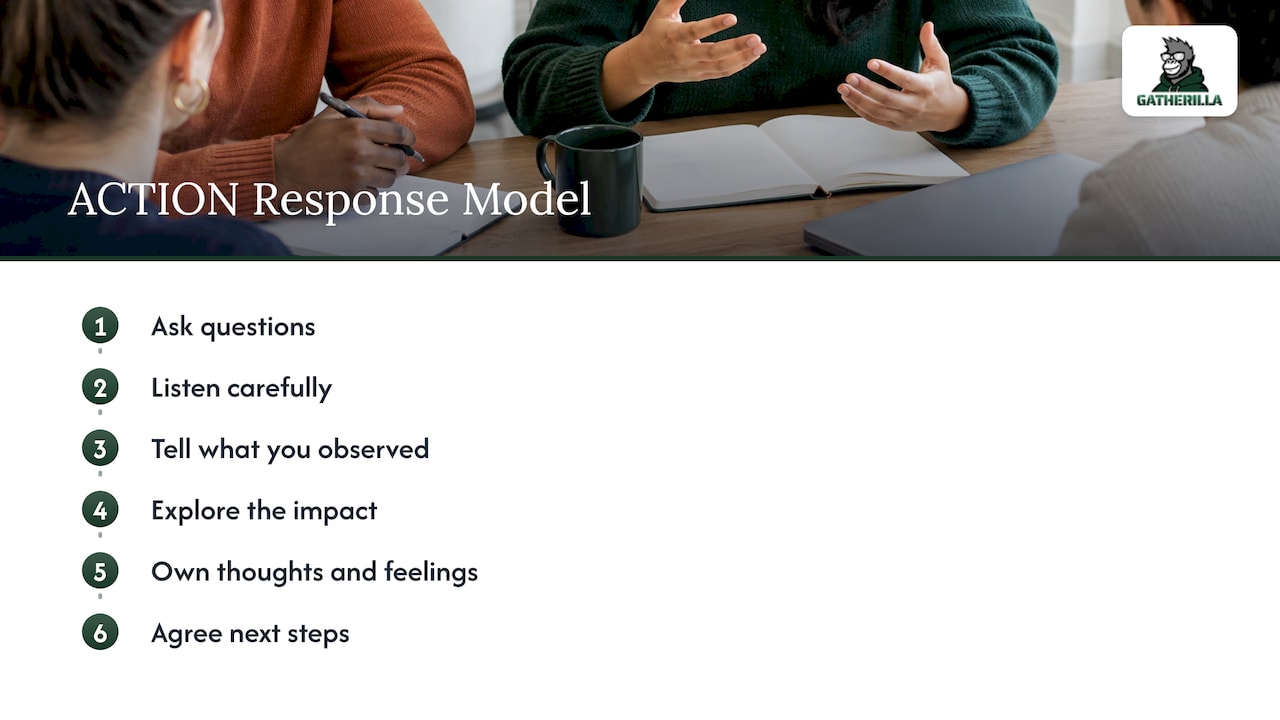
For a comment that reads as a microaggression, UCL’s ACTION model gives a sequence: Ask questions, Carefully listen, Tell others what you observed, explore the Impact, Own your thoughts and feelings, and agree Next steps. Persistent or serious concerns should go to your HR team or the person responsible for employee relations, not be settled in a game debrief.
Our perspective
We build Gatherilla for teams that rarely share a room, and the pattern we see is simple: cultural understanding grows from small, repeated moments, not one big session. A workshop once a year is easy to schedule and easy to forget. Two minutes of real conversation in a weekly meeting becomes part of how a team works.
That is why we designed our platform around quick setup, no downloads and a daily challenge, so that the effort of starting a conversation stays low for the HR lead or team leader running it. When joining takes a single link in the browser, people with different devices, time zones and comfort levels can all take part on equal terms.
Our advice to leaders is to pick one of the games above, run it as an optional ten-minute opener, and keep going. The habit matters more than the game.
Thomas
Make it a habit with Gatherilla
Gatherilla is a browser-based platform for remote and hybrid teams, with multiplayer games, daily word and trivia challenges, icebreakers for meetings and onboarding games. It needs no downloads and works with all video conferencing tools, so you can open a meeting with a quick game and then move into one of the conversation formats above.
There is a free tier, and Premium is listed at $0.50 to $1.00 per seat per month, or $5 to $10 per seat per year, with additional games, reporting and priority support. See the pricing page for the current plans, or explore Gatherilla’s team games for remote and hybrid teams.
FAQ
How long should a cultural awareness game at work take?
It depends on the format. A bus-stop icebreaker takes 5 to 10 minutes, Circles of Identity 15 to 20, and a scenario-card exercise like Walk a Mile in My Shoes about 60. For a remote team, several short rounds beat one long session.
Should participation be mandatory?
No. Facilitation guidance recommends voluntary, good-faith participation, and one guide argues that mandatory diversity training reduces diversity. Invite people, explain the purpose, and let anyone pass on a question without explanation.
What are good cultural awareness icebreakers for virtual meetings?
Forced-choice questions in a poll, a photo or object share, and paired prompts in breakout rooms work well online. Include work-style choices such as written or live updates, which reveal differences without asking anyone to speak for a culture.
What should I do if someone is uncomfortable during a game?
Pause the activity and talk about the conversation itself. Ask how people are experiencing it, thank the person for speaking up, and offer a private check-in afterward. Direct serious concerns to HR.
Sources
- Fostering Empathy Through Play: Far From Home (PMC, 2025)
- A Board Game That Brings Racial Inequities To Life (Forbes)
- Team-Building, Diversity & Resilience Manual (ECRE)
- A Ticket to Know You (CCLI at ASTC)
- Group Teambuilding Games and Initiatives (Cornell)
- Story Stitch (Green Card Voices)
- Drawing in Two Hands (Faculty Focus)
- 12 Best Diversity and Inclusion Activities for Employees (Symonds Research)
- Ally Skills Workshop Facilitator’s Guide
- Guidelines for Facilitators: Coloured Glasses (YFU)
- Managing Micro-Behaviours: ACTION model (UCL)
- A Revisit of When Cultures Clash (Crucial Learning)
- Wellness Icebreakers for Teams