

Kahoot vs Mentimeter: Which Tool Fits Your Goal?

For high-energy recall in a classroom, Kahoot wins. For structured feedback and anonymous sentiment in a professional setting, Mentimeter is the stronger pick. And when the goal is genuine team connection for remote or hybrid employees, Gatherilla is purpose-built for exactly that.
Quick picks by scenario:
- K–12 or college review sessions: Kahoot’s speed-scored leaderboards keep energy high and recall sharp.
- Corporate presentations, workshops, and faculty meetings: Mentimeter’s word clouds, open text, and anonymous polling collect honest input without the game-show feel.
- Remote or hybrid team-building and HR culture programs: Gatherilla’s multiplayer games and daily challenges build connection without requiring downloads or separate apps.
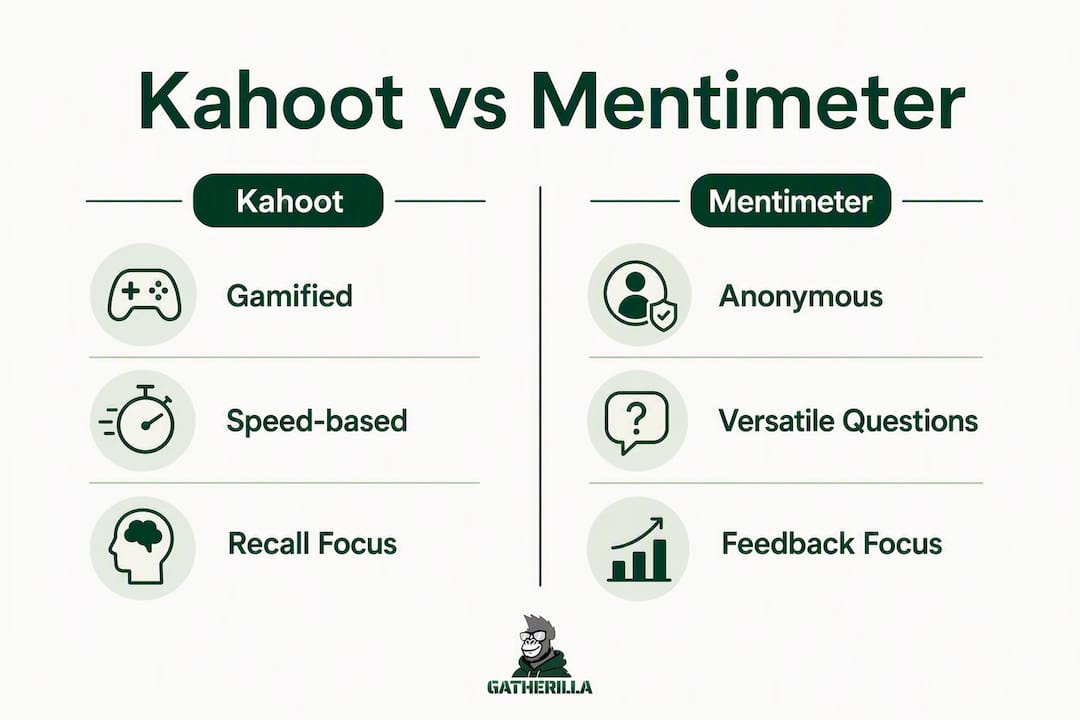
The core difference between Kahoot and Mentimeter is design philosophy, not feature count. Kahoot rewards speed and competition; Mentimeter prioritizes curated, anonymous feedback. Neither is built for sustained team engagement, which is where Gatherilla fills a gap the other tools leave open.
Table of Contents
- How do Kahoot, Mentimeter, and the alternatives compare side by side?
- What does each platform actually do?
- Which question types and features does each platform support?
- What do the pricing models actually cost you?
- How do integrations and analytics differ across these tools?
- Which tool fits which real-world scenario?
- What are the real pros, cons, and red flags for each tool?
- How do you choose the right tool before you buy?
- What does the research say about which tool actually works?
- Key Takeaways
- The case for choosing by goal, not by popularity
- Gatherilla: the team-building option for remote and hybrid teams
- Useful sources and further reading
How do Kahoot, Mentimeter, and the alternatives compare side by side?
| Tool | Best for / ideal audience | Primary engagement style | Question types & interactivity | Pricing & participant limits | Integrations & platform compatibility | Analytics / reporting focus | Ease of setup |
|---|---|---|---|---|---|---|---|
| Gatherilla | Remote and hybrid team-building; HR culture programs | Purpose-built team games and daily challenges | Multiplayer games, icebreakers, trivia, word challenges | Free tier + per-seat paid plan; no per-event caps | Works with all video conferencing tools; no downloads | HR-focused reporting and engagement analytics | No downloads; quick setup for hosts and participants |
| Kahoot | Live classroom review; formative recall; K–12 and higher ed | Gamification: leaderboards, speed scoring, podiums | Multiple choice, true/false, puzzle, polls, open text | Free tier (~40 participants on education plans); paid plans for more | Zoom, Teams, Google Classroom, LMS via LTI | Per-question performance and grading scores | Very easy; participants join by code |
| Mentimeter | Professional presentations; workshops; anonymous feedback | Presentation-first; sentiment and idea collection | Word clouds, open text, ranking, scales, polls, quizzes (13 types) | Free plan with monthly participant-count limits; paid tiers | PowerPoint, Teams, Zoom, Google Slides | Aggregate sentiment; open-text exports | Easy; slide-based presenter flow |
| Wooclap | Mixed education and business; balanced assessment and feedback | Polling and assessment hybrid | Broad question types; LMS integrations | Freemium; paid plans scale by event size | LMS (LTI-compliant), Teams, Zoom | Assessment and participation data | Moderate; more configuration options |
| Slido | Conference Q&A; live event polling; meeting moderation | Q&A and live polling | Polls, Q&A, quizzes, word clouds | Free tier with event limits; paid plans for larger events | Cisco Webex, Teams, Google Slides, Zoom | Event-level Q&A and poll summaries | Very easy for participants; moderate for hosts |
Three differences that matter most:
- Kahoot’s gamification score on G2 outpaces Mentimeter’s, but that same game-show energy can read as patronizing in executive or sensitive corporate sessions.
- Mentimeter’s free plan caps monthly participant counts across all presentations, not just per event. Kahoot’s free education tier limits concurrent players per live session.
- Neither Kahoot nor Mentimeter is designed for ongoing team engagement. Gatherilla’s subscription model is built around repeat play and daily connection, not one-off sessions.
What does each platform actually do?
Gatherilla
Gatherilla is a browser-based team-building platform built specifically for remote and hybrid teams. The design intent is sustained engagement: daily word and trivia challenges, multiplayer icebreaker games, onboarding activities for new hires, and company-wide event solutions. HR managers and team leaders subscribe; employees just show up in their browser, no download required.
- No downloads; works inside any video call
- Real-time leaderboards and team scoring
- HR-facing analytics and engagement reporting
Kahoot
Kahoot is a game-based learning platform built around the classroom quiz format. Participants join a live session with a code, answer timed multiple-choice questions, and compete on a leaderboard. The podium reveal after each question is the signature moment. Educators use it for formative review; corporate trainers use it for onboarding knowledge checks.
- Speed-scored leaderboards and podium reveals
- Host-driven live sessions with participant codes
- Integrates with Google Classroom and LMS platforms via LTI
Mentimeter
Mentimeter started as a tool for building interactive presentations, the next evolution from a static PowerPoint deck. Its 13 question types lean toward sentiment and idea collection: word clouds, open text, ranking, scales, and polls. Responses are anonymous by default, which makes it the go-to for honest feedback in faculty meetings, all-hands sessions, and professional workshops.
- Anonymous responses by default
- Slide-centric presenter flow
- Word clouds and open-text exports for qualitative analysis
Wooclap
Wooclap sits between Kahoot and Mentimeter on the engagement spectrum. It supports a broad range of question types and LMS integrations, making it a practical choice for higher-ed instructors who need both formative assessment and live polling in the same session.
- LTI-compliant LMS integrations
- Broad question-type library
- Used in both education and corporate training
Slido
Slido was originally designed for real-time Q&A at events and conferences, not for building presentations. Its moderation tools let hosts approve, pin, and respond to audience questions, which is what separates it from the polling-first tools. Cisco acquired Slido and embedded it natively into Webex.
- Audience Q&A with upvoting and moderation
- Native Webex integration; also connects with Teams and Zoom
- Best for large-audience events where question management matters
Practitioners often run both Kahoot and Mentimeter in the same institution, using Kahoot for class review days and Mentimeter for faculty meetings and conferences. That dual-use pattern reflects how different the tools’ design philosophies actually are.
Which question types and features does each platform support?
| Feature | Gatherilla | Kahoot | Mentimeter | Wooclap | Slido |
|---|---|---|---|---|---|
| Multiple choice | ✓ (games) | ✓ | ✓ | ✓ | ✓ |
| Word cloud | — | — | ✓ | ✓ | ✓ |
| Open text | — | ✓ | ✓ | ✓ | ✓ |
| Ranking | — | — | ✓ | ✓ | — |
| Slider / scale | — | — | ✓ | ✓ | — |
| Puzzle / pin answer | — | ✓ | — | ✓ | — |
| Q&A with upvoting | — | — | — | — | ✓ |
| Gamified leaderboard | ✓ | ✓ | — | Partial | — |
| Anonymous responses | — | — | ✓ | ✓ | ✓ |
| Team multiplayer games | ✓ | — | — | — | — |
Kahoot’s game-show architecture rewards speed and competition. A participant who answers correctly but slowly scores less than one who answers fast, which drives energy in a review session but produces skewed data if you are trying to measure comprehension. Mentimeter’s 13 question types are deliberately non-scored: the goal is to surface what the room thinks, not who knows it fastest.
The practical implication: if you need to measure recall under time pressure, Kahoot’s mechanics do that well. If you need to understand sentiment, surface ideas, or collect honest input from a group that might self-censor in a live discussion, Mentimeter’s anonymous open-text and word clouds are the right instrument.
Pro Tip: Match the question type to the learning objective before you pick the tool. Recall and re-engagement call for speed-scored multiple choice. Formative assessment of understanding calls for open text or ranking. Sentiment research calls for anonymous scales and word clouds. The tool should follow the objective, not the other way around.

What do the pricing models actually cost you?
Pricing shapes how useful the free tier is in practice, and the gotchas are easy to miss.
- Kahoot: The free education plan supports roughly 40 concurrent participants per live session. Paid plans (Kahoot! for Schools, Kahoot! for Work) raise that cap and unlock features like team mode, advanced reports, and custom branding. Per-host pricing is the standard model.
- Mentimeter: The free plan limits total monthly participants across all presentations, not just per session. This means a single busy week of workshops can exhaust the monthly quota before the month ends. Paid plans are per-presenter and unlock unlimited participants, more question types, and export options.
- Wooclap: Freemium model with paid plans that scale by event size and feature access. LMS integration and advanced analytics sit behind paid tiers.
- Slido: Free tier covers basic polling and Q&A with event-size limits. Paid plans unlock larger audiences, branding, and deeper analytics. Cisco Webex users get Slido bundled in some enterprise plans.
- Gatherilla: Free tier with access to a limited set of games; the per-seat paid subscription unlocks the full game library, daily challenges, onboarding activities, and HR analytics. No per-event caps on the paid plan.
Watch out for Mentimeter’s monthly participant model. A trainer running three workshops a week can hit the free-tier ceiling mid-month without realizing it. Before committing, map your typical monthly session volume against the plan limits.
Practical buying tip: Trial each tool with a real session before purchasing. Run Kahoot with a live group of 20–30 people, run a Mentimeter presentation with the same group, and compare participant feedback. Most plans offer a free trial or a generous free tier for exactly this kind of proof-of-concept. For Gatherilla, the free tier includes enough games to run a meaningful team session before upgrading.
How do integrations and analytics differ across these tools?
Integrations
- Kahoot: Connects with Zoom, Microsoft Teams, Google Classroom, and LMS platforms via LTI. Presenters can run a Kahoot session inside a Zoom call without participants leaving the meeting window.
- Mentimeter: Integrates with PowerPoint, Google Slides, Teams, and Zoom. The PowerPoint add-in is particularly useful for presenters who build decks in PowerPoint and want to embed live polls without switching apps.
- Wooclap: LTI-compliant, which means it connects with Canvas, Moodle, Blackboard, and other major LMS platforms. Strong choice for higher-ed instructors who need grade passback.
- Slido: Native integration with Cisco Webex; also connects with Teams, Zoom, and Google Slides. The Webex native embed means participants never leave the meeting interface.
- Gatherilla: Works with all major video conferencing tools (Zoom, Teams, Google Meet) without requiring a plugin. Participants join through a browser link shared in the meeting chat.
Tab-switching between a presentation and a polling tool fragments participant attention during remote sessions. Tools with native integrations reduce that friction. Slido’s Webex embed and Kahoot’s Zoom integration address this directly; Mentimeter’s PowerPoint add-in does the same for slide-based presenters.
Analytics
The analytics gap between these tools is significant for anyone who needs to report outcomes.
Kahoot’s reporting centers on per-question performance: who answered correctly, how fast, and how scores distributed across the group. This is useful for formative assessment and identifying knowledge gaps, but it tells you nothing about how participants felt.
Mentimeter exports aggregate sentiment data, word-cloud text, and open-text responses. An HR leader running an all-hands can export every anonymous comment and analyze themes. That qualitative data is often more valuable than a quiz score in a corporate context.
Gatherilla’s analytics are built for HR reporting: engagement rates, participation trends, and team-level activity data that an HR manager can use to track culture program effectiveness over time. That is a different reporting need than either Kahoot or Mentimeter addresses.
Which tool fits which real-world scenario?
K–12 classroom review: Kahoot is the default for a reason. A 10-minute end-of-class quiz with leaderboards re-engages students who have been sitting for an hour. The speed mechanic rewards preparation, and the podium moment gives the session a natural close.
Higher-ed formative assessment: Wooclap or Mentimeter. University instructors often need a mix of quick polls and open-ended questions in the same session, and they need LMS grade passback. Wooclap’s LTI compliance and broad question types handle this well.
Professional workshop or conference presentation: Mentimeter. Anonymous word clouds and open-text responses surface honest input that participants would not say aloud. The slide-centric flow keeps the presenter in control without making the audience feel like they are taking a test.

Executive offsite or sensitive corporate session: Mentimeter, with custom theming enabled. Kahoot’s playful branding can read as patronizing in executive settings. Mentimeter’s subdued, professional UI avoids that perception risk. Slido is also a strong option here for Q&A-heavy formats.
Remote or hybrid team-building: Gatherilla. Kahoot and Mentimeter are session tools; they work well for a one-off quiz or poll, but they are not built for the ongoing connection that remote teams need. Gatherilla’s daily challenges, multiplayer games, and onboarding activities are designed for repeat engagement, not one-time use. For HR leaders tracking employee engagement over time, the reporting layer matters too.
Large conference Q&A: Slido. The upvoting and moderation tools let a 500-person audience surface the three questions that actually matter, rather than a chaotic open mic.
Accessibility note: all five tools are browser-based and work on mobile. Kahoot and Mentimeter require participants to have a second device or a second browser tab open during a presentation, which can be a barrier in low-device environments.
What are the real pros, cons, and red flags for each tool?
Kahoot
Pros: Immediately engaging for groups who respond to competition; very easy for participants to join; strong LMS integrations for grade passback.
Cons: Speed-based scoring can disadvantage slower readers or non-native speakers; game-show mechanics can feel patronizing in executive or sensitive settings; limited question types for qualitative feedback.
Red flag: If your audience includes senior stakeholders or the topic is emotionally sensitive, the podium reveal and competitive scoring can undermine the room’s tone before you realize it.
Mentimeter
Pros: Anonymous responses encourage honest input; 13 question types cover most feedback scenarios; professional UI that works in corporate settings.
Cons: Monthly participant caps on the free plan can catch trainers off guard; no gamification for sessions that need energy; export options are limited on lower-paid tiers.
Red flag: Check the monthly participant limit against your session volume before relying on the free plan for a busy training calendar.
Wooclap
Pros: Broad question types; LTI-compliant for LMS grade passback; works well in both education and corporate settings.
Cons: More configuration than Kahoot or Mentimeter; less brand recognition means more participant onboarding friction; pricing can escalate for large events.
Slido
Pros: Best-in-class Q&A moderation; native Webex integration; very easy for participants to use.
Cons: Less suited to structured learning or formative assessment; limited question variety compared to Mentimeter; most powerful features sit behind paid plans.
Gatherilla
Pros: Purpose-built for ongoing team engagement, not one-off sessions; no downloads required; HR analytics track culture program effectiveness over time.
Cons: Not a presentation tool; does not replace Kahoot for classroom recall or Mentimeter for structured feedback collection. Best used alongside, not instead of, those tools when the goal shifts from learning to connection.
Mitigations for common drawbacks:
- Second-screen fatigue: choose tools with native video-conference integrations (Slido in Webex, Kahoot in Zoom) to keep participants in one window.
- Perceived immaturity in professional settings: use Mentimeter’s custom theming or Slido’s clean UI for executive audiences; reserve Kahoot for groups that respond well to competition.
- Reporting limits: map your export needs before buying. If you need raw open-text data, verify the export format on the plan you are considering.
How do you choose the right tool before you buy?
Work through this checklist before committing to a trial or a paid plan.
- Define your engagement goal. Is it recall and re-engagement, structured feedback and sentiment, or ongoing team connection? The goal determines the tool.
- Assess your audience size and device access. How many participants? Do they all have a second device or a second browser tab available during the session?
- List the question types you actually need. Multiple choice for recall, open text for ideas, ranking for prioritization, Q&A for large events. Match the list to the feature table above.
- Check branding and UI tone. Will a game-show interface undermine your credibility with this audience? If yes, rule out Kahoot for that context.
- Map your integration requirements. Which video conferencing tool does your team use? Which LMS? Verify native integration before assuming it exists.
- Define your analytics and export needs. Do you need per-question performance data, aggregate sentiment exports, or HR engagement reporting? Each tool answers a different question.
- Check security and compliance basics. For K–12 use, verify COPPA and FERPA compliance. For enterprise, check SOC 2 or GDPR documentation on the vendor’s security page.
Scoring rubric:
- Must-have: Any item on the list above that your use case cannot function without. A deal-breaker if the tool fails it.
- Nice-to-have: Features that improve the experience but are not blocking.
- Deal-breaker: A missing integration, a participant cap that is too low, or a UI tone that does not fit your audience.
Questions to bring to a vendor trial or sales call:
- What is the exact participant limit on the plan I am considering?
- What data formats does the analytics export support?
- How does the tool handle participant data under FERPA or GDPR?
- Is there a dedicated onboarding or customer success contact for my plan tier?
What does the research say about which tool actually works?
The ACM paper on Kahoot vs. Mentimeter for active learning in computer science education frames the distinction clearly: Kahoot’s game-show architecture suits re-engagement and competitive recall; Mentimeter’s presentation-first model suits structured sentiment collection and nuanced discussion. These are not interchangeable outcomes.
G2 comparative metrics show Kahoot scoring higher on gamification and automated grading, while both platforms maintain high overall user satisfaction. Software Advice data shows Kahoot scoring higher on perceived ease-of-use among classroom educators, which tracks with how straightforward the join-by-code mechanic is for students.
The perception risk in corporate settings is documented. Research on gamification in professional environments notes that colorful, play-first interfaces can undermine perceived credibility in executive-level sessions. The practical implication: the same features that make Kahoot effective in a classroom can make a trainer look unprepared in a boardroom.
Tab-switching between a presentation and a polling tool measurably reduces sustained attention in virtual sessions. This is not a minor UX complaint; it is a cognitive load issue. Tools with native video-conference integrations reduce that cost. When evaluating any of these platforms for remote use, treat integration depth as a performance metric, not a convenience feature.
Pro Tip: Run parallel micro-trials before committing. Pick a single 10-minute session objective, run it with Kahoot one week and Mentimeter the next with the same group, then compare participant feedback and your own post-session data. The difference in energy, response quality, and participant behavior will tell you more than any feature comparison chart.
For teams evaluating Kahoot alternatives for team building, the emerging category of purpose-built engagement platforms offers AI-generated content and deeper analytics that simple polling tools do not match.
Key Takeaways
Kahoot wins on gamified recall, Mentimeter wins on structured anonymous feedback, and Gatherilla is the purpose-built choice when the goal is ongoing remote team connection.
| Point | Details |
|---|---|
| Match tool to goal | Gamified recall calls for Kahoot; anonymous sentiment calls for Mentimeter; team connection calls for Gatherilla. |
| Free-tier limits matter | Mentimeter caps monthly participants across all sessions; Kahoot caps concurrent players per live event. |
| Corporate perception risk | Kahoot’s game-show UI can undermine credibility in executive settings; Mentimeter’s professional UI avoids that risk. |
| Integration depth is a UX metric | Tab-switching between a presentation and a polling tool fragments attention; prioritize native integrations for remote sessions. |
| Gatherilla fills the ongoing engagement gap | Unlike one-session polling tools, Gatherilla’s daily games and HR analytics are built for sustained team culture programs. |
The case for choosing by goal, not by popularity
The most common mistake in this decision is picking the tool with the most name recognition and then trying to make it fit every scenario. Kahoot is enormously popular, and that popularity is earned in the classroom. But popularity in one context does not transfer to another.
What the research and practitioner experience both point to is this: the engagement goal has to come first. A trainer who uses Kahoot in an executive strategy session because “everyone knows it” is optimizing for familiarity, not outcomes. A facilitator who uses Mentimeter for a high-energy student review session because it looks professional is leaving energy on the table.
The more interesting question is what happens when the goal is neither recall nor feedback, but connection. Remote teams do not need a quiz or a poll. They need something that builds relationships across a screen, repeatedly, over time. That is a different design problem, and it is one that Kahoot and Mentimeter were not built to solve. Gatherilla’s focus on team games, daily challenges, and HR-level reporting reflects a genuine understanding of what sustained engagement actually requires, as opposed to what a one-off session can deliver.
The tools in this comparison are not competitors in the way the search query implies. They are instruments for different jobs. The right question is not “which is better?” but “which one matches what I am actually trying to accomplish?”
Gatherilla: the team-building option for remote and hybrid teams
Kahoot and Mentimeter are excellent at what they do. But if your goal is building real connection among remote or hybrid employees, rather than running a quiz or collecting poll responses, neither tool was designed for that job.
Gatherilla gives HR managers and team leaders a library of multiplayer games, daily word and trivia challenges, and onboarding activities that work inside any video call, with no downloads and no separate app. The HR analytics layer tracks participation and engagement trends over time, so you can show leadership that the culture program is working. For teams dealing with the employee engagement crisis that remote work has accelerated, that reporting matters.
Start with the free tier at Gatherilla to run your first team game in under five minutes, then upgrade when you need the full game library and analytics.
Useful sources and further reading
These are the primary sources behind the comparisons and recommendations in this article.
- Kahoot vs. Mentimeter for Active Learning in Computer and Information Science — ACM peer-reviewed paper comparing both tools in active learning contexts. First read for educators who want research-backed evidence before choosing.
- Kahoot vs Mentimeter: A Definitive Comparison (Wooclap) — Practitioner-level breakdown of design philosophy, question types, and pricing. Useful for trainers and instructional designers.
- Compare Kahoot! and Mentimeter on G2 — User-review aggregates with feature scores for gamification, ease of setup, and value. Good for validating peer experience at scale.
- Kahoot! vs Mentimeter: 2026 Comparison on Software Advice — Side-by-side ratings on ease-of-use and value-for-money from verified reviews. Useful for procurement conversations.
- Mentimeter vs Slido on TrustRadius — Practitioner notes on tab-switching fatigue and integration quality. Relevant for remote and hybrid session planning.
- Compare Mentimeter and Slido on G2 — Feature scores for polls, surveys, and ease of use. Useful for the Slido vs Mentimeter decision.
- Compare Kahoot! and Quizizz on G2 — Gamification and ease-of-setup scores for the Kahoot vs Quizizz comparison. Relevant for educators evaluating quiz-first tools.
- Mentimeter vs Slido: Which technology for collaboration? (Plymouth Digital Education) — University practitioner perspective on the Mentimeter vs Slido distinction. Recommended first read for higher-ed buyers.
- Research on gamification perception in professional settings (Chalmers) — Academic source on how play-first interfaces affect credibility in corporate environments.
- Best Kahoot Alternatives 2026 (Kvistly) — Overview of emerging tools with AI question generation and advanced analytics. Useful context for teams that have outgrown basic polling.
- Gatherilla: Team Building Games for Remote and Hybrid Teams — Landing page for HR leaders and team managers evaluating purpose-built team engagement platforms. Start here for the free trial.
- Employee Engagement Strategies for Small Teams (Kloqk) — Practical engagement strategies for small teams; useful context for HR buyers evaluating tool ROI.