

8 UDL Friendly Inclusive Icebreakers Educators Can Run With Zero Prep

An inclusive icebreaker gives every participant a low-stakes, opt-in way to contribute, using more than one mode of engagement so no one has to speak, perform, or disclose personal details on the spot. A name story someone can text into chat, a 30-second show-and-tell that’s fine to skip, or a written reflection dropped anonymously into a shared doc all meet that bar. The one non-negotiable facilitation rule: always announce an opt-out and a quieter way to participate before the activity starts.
TL;DR:
- Most inclusive icebreakers should be designed to accommodate diverse personalities, cultures, and accessibility needs, prioritizing low-pressure and voluntary participation.
- Using multiple modes of contribution, such as text, speaking, or anonymous writing, helps ensure everyone can engage comfortably regardless of their physical or social comfort levels.
- Facilitators should always provide clear opt-out options and model the activity beforehand to foster psychological safety and prevent exclusion.
- Activities like name stories, short biographies, and reflection prompts work well virtually and in-person, especially when tailored to avoid shared cultural or physical assumptions.
- Easy-to-use, browser-based tools like Gatherilla remove technical barriers, making quick, accessible, and inclusive team-building activities effortless for remote and hybrid groups.
Table of Contents
- Core Principles Behind Inclusive Icebreakers
- Inclusive Icebreaker Activities That Work In-Person and Remotely
- How to Choose and Facilitate Inclusive Icebreakers
- Common Pitfalls and Safe Swaps
- Facilitator Checklist for Running Inclusive Icebreakers
- What I’ve Learned From Watching Icebreakers Fail and Succeed
- How Gatherilla Makes Inclusive Icebreakers Effortless to Run
- Key Resources for Designing Inclusive Icebreakers
- Sources
- FAQ
Core Principles Behind Inclusive Icebreakers
Every inclusive icebreaker rests on the same foundation: nobody is forced to perform. Participation has to stay voluntary, and the activity should offer at least two ways in, speaking out loud, typing in a chat, or jotting a private note. That flexibility matters because groups are never as uniform as a single format assumes. Guidance from Dalhousie University’s teaching center notes that inclusive icebreakers work best when they accommodate different personality types, anxiety levels, and cultural backgrounds rather than assuming everyone processes a prompt the same way.
Design for the margins first, not the majority. Ask who might get left out before you ask what sounds fun: someone without childhood photos to share, someone who grew up outside the pop-culture references you’re about to use, someone using a screen reader who can’t see an image-based prompt. The University of Arizona’s Disability Resource Center points out that play only works when it feels psychologically safe, and safety breaks down the moment an activity assumes shared memories or resources that not everyone has.
Setting norms out loud helps. Tell the group what’s confidential, model the activity yourself first, and remind people that “pass” is always an acceptable answer.
Before you run anything, check:
- Does the timing work across time zones, or will someone join half awake at 7 a.m.?
- Are prompts screen-reader friendly, with no meaning trapped in an image alone?
- Is the physical space, or the platform, actually accessible to someone with mobility or sensory needs?
- Are captions or transcripts available for remote or hard-of-hearing participants?
Pro Tip: Write your icebreaker prompt as a text-only sentence first. If it doesn’t make sense without a slide, an image, or a spoken tone of voice, redesign it before you add those elements back in.
Inclusive Icebreaker Activities That Work In-Person and Remotely
These eight hold up across classrooms, workshops, and video calls, and each one bends toward text, anonymity, or partner sharing when someone needs a quieter path in.
- Name story. Ask each person to share the story behind their name, its origin, a nickname, or how they’d like it pronounced, in one sentence. Works in a circle or typed into a chat thread. Two minutes per person. It’s inclusive because it centers something everyone actually has, unlike prompts that assume a shared cultural reference point.
- 30-second show-and-tell. “Grab something within arm’s reach and tell us why it matters.” Works equally well on video or in a room. Accessible variant: describe the object in a chat message instead of holding it up on camera.
- Seven-word biography. Everyone writes a self-introduction in exactly seven words, then reads or posts it. Fast, low-pressure, and it works just as well typed anonymously into a shared document as it does spoken aloud.
- Adapted two truths and a lie, values edition. Swap personal facts for values or work preferences, “two things I care about at work and one I don’t,” to sidestep oversharing pressure. Runs five to seven minutes.
- Values quick-share. One prompt: “Name a value that guides how you work.” Written or spoken, individual or in pairs. Neutral enough to travel across cultures and comfort levels.
- Pair interviews. Break into twos, each person answers one light question, then introduces their partner to the group. Breakout rooms handle this cleanly for remote teams, and it removes the pressure of speaking about yourself directly.
- Low-prep scavenger prompt. “Find something in your space that’s a certain color” works in a living room or an office, no materials needed, no budget assumed.
- Written reflection prompt. Drop a question into a shared doc or poll and let people respond anonymously before any discussion starts. This one alone solves for social anxiety better than almost anything spoken.
For distributed teams, browser-native tools that need no downloads or logins remove the single biggest barrier to quick, recurring team-building activities: the setup friction that kills a five-minute activity before it starts.
How to Choose and Facilitate Inclusive Icebreakers
Run every activity idea through four filters before you commit to it: does it match your actual goal (comfort, connection, or content review), does the group’s current readiness support it, is it accessible to everyone in the room, and does the logistics fit your time and space?
Before the session, ask three things: What does the group’s makeup look like, culturally, linguistically, in terms of disability or neurodivergence? What are the tech or space limits, is everyone on video, is the room fully accessible? And are there privacy concerns that make certain topics off-limits?
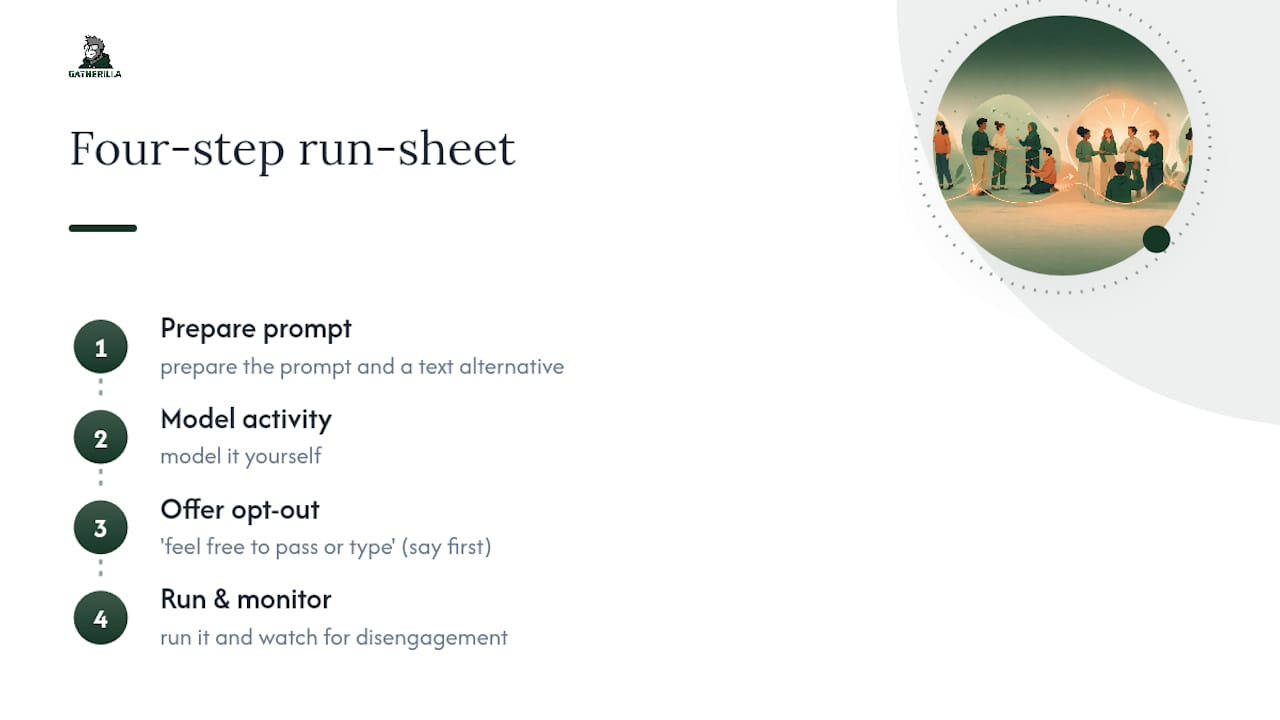
A simple run-sheet keeps facilitation honest: prepare the prompt and a text alternative, model it yourself, explicitly offer an opt-out (“feel free to pass or type your answer instead”), then run it and watch for disengagement.
Pro Tip: Say the opt-out line before you explain the activity, not after. Once people commit to listening for “the rules,” a permission to skip that comes later gets lost.
Cancel or swap the activity if you see red flags: it forces physical contact, assumes a shared cultural touchpoint nobody confirmed, or demands a disclosure someone hasn’t consented to make.
Common Pitfalls and Safe Swaps
Some icebreaker staples quietly exclude the very people they’re meant to include. Baby-photo prompts assume access to old photos and a stable childhood story, neither guaranteed. Trust falls and other physical-contact games raise real safety and consent issues, and pop-culture references (“your favorite 80s movie”) assume a shared cultural memory that plenty of participants never had.
Swap them out:
- Replace baby photos with “an object that represents home.”
- Replace trust falls with a paired verbal check-in, no physical contact required.
- Replace decade-specific pop culture with a values or interests prompt anyone can answer regardless of background.
The Red Cross’s diversity icebreaker guidance makes the same point: when a culture-specific prompt is unavoidable for some reason, always pair it with a neutral alternative so no one is stuck guessing.
Facilitator Checklist for Running Inclusive Icebreakers
A five-step run sheet keeps this simple: prepare your prompt and its text alternative, model the activity yourself first, offer explicit choices in how to respond, monitor the room for disengagement, and follow up afterward to ask what landed.
- Run a quick practice pass before the real session; it catches confusing wording fast.
- Collect responses privately when the topic could feel exposing.
- For hybrid groups, give remote participants the same anonymous-input option as the people in the room, not an afterthought.
Facilitator guidance from the Colorado School of Mines backs the value of a short practice run and a built-in reflection window before opening the floor to group sharing.
What I’ve Learned From Watching Icebreakers Fail and Succeed
The biggest lesson isn’t a technique, it’s a habit: pilot small, then actually ask what didn’t work. An icebreaker that reads perfectly on paper can flop the moment a real group with real anxieties tries it, and the only way to find that out is to run it once and listen afterward.
If your organization has an employee resource group or an accessibility contact, loop them in before you finalize an activity, not after someone flags a problem. Their read on what feels safe will catch things a facilitator alone might miss.
— Thomas
How Gatherilla Makes Inclusive Icebreakers Effortless to Run
Gatherilla removes the setup friction that kills most good intentions around inclusive facilitation. Everything runs in the browser, no downloads, no accounts required, so a remote team can drop into a five-minute check-in or a new hire can join an onboarding icebreaker without any technical barrier standing between them and the group.
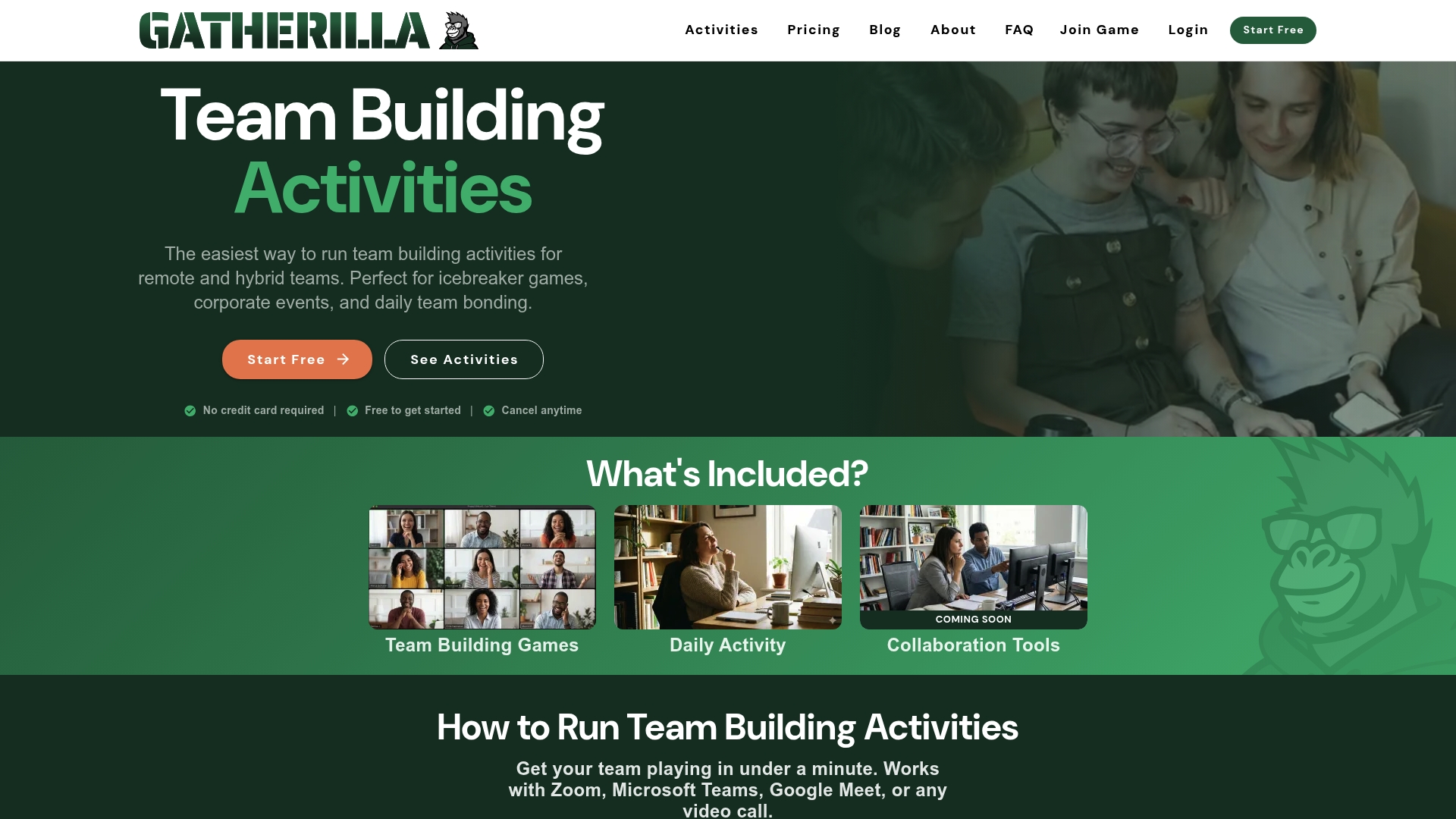
That zero-setup design fits the exact situations covered above: a weekly team check-in that needs to start on time, an onboarding session for someone who’s never used your tools before, or an employee resource group meetup where low-pressure participation matters more than polish. Multiple ways to engage are built into the daily challenges themselves, supporting shared workflows so quieter team members aren’t stuck choosing between speaking up or opting out entirely.
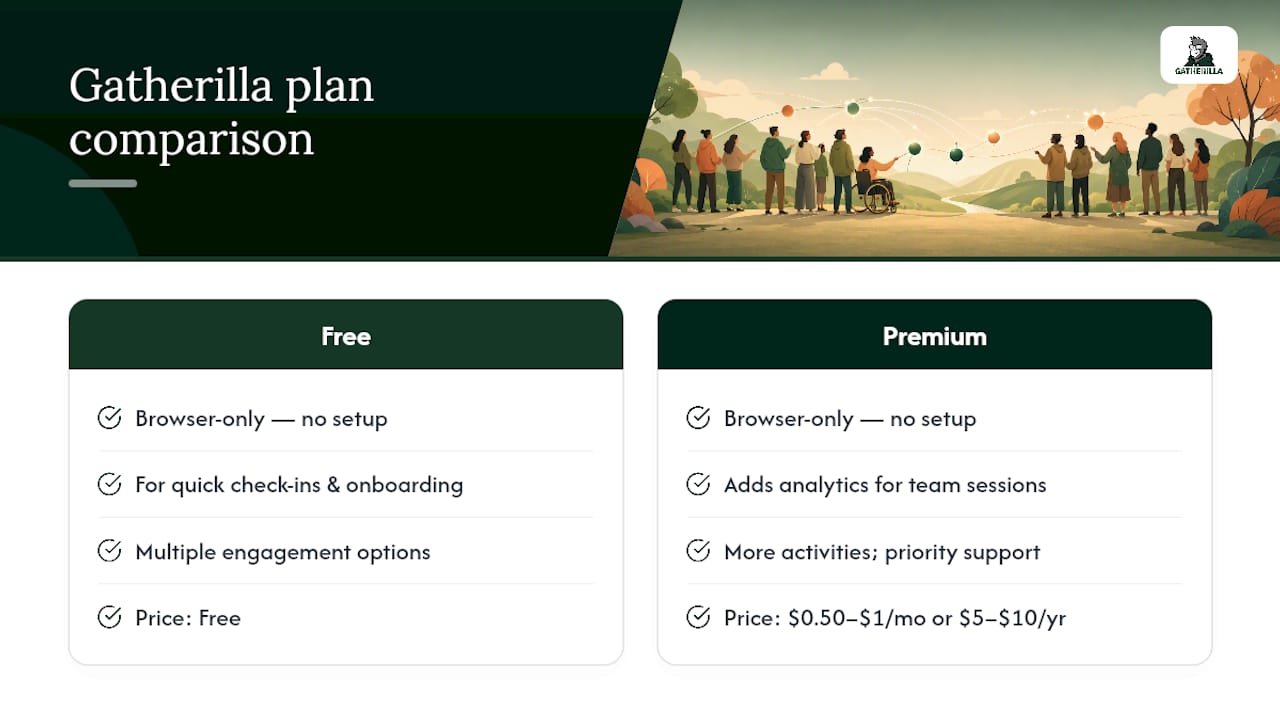
Gatherilla offers a free tier to start, with premium plans priced at $0.50 to $1.00 per seat per month (or $5 to $10 per seat annually) for teams that want more activities, analytics, and priority support. Check the pricing page or visit Gatherilla’s product page to see which plan fits your next team session.
Key Resources for Designing Inclusive Icebreakers
For deeper reading: the Dalhousie teaching center guide on inclusive facilitation, the University of Exeter’s UDL conference paper on accessible design, and the Mines facilitator guide on running structured activities.
Sources
- Using Ice Breakers in Meaningful and Inclusive Ways
- Inclusive language and icebreakers
- Breaking the ice to build inclusion
FAQ
What are some fun group icebreakers that stay inclusive?
Name story, seven-word biography, and pair interviews all work well because they’re fast, low-pressure, and don’t assume shared cultural background or physical ability.
What are five good icebreaker questions to ask a diverse group?
Try: What does your name mean to you? What’s a value that guides your work? What’s something within reach that matters to you? What’s one thing you’re looking forward to this week? What’s a small win from your week? Each avoids assuming shared resources or cultural context.
What are some inclusive welcome ideas for adult groups?
Written reflection prompts collected anonymously, a values quick-share, or a 30-second object show-and-tell all welcome adults without forcing personal disclosure or physical performance.
What are some good virtual icebreakers for remote teams?
Breakout-room pair interviews, chat-based seven-word biographies, and browser-native daily challenges through platforms like Gatherilla all work well since they need no downloads and give quieter participants a text-based way in.
How long should an inclusive icebreaker take?
Most effective icebreakers run five to twenty minutes, depending on group size, and can be shortened using breakout rooms or pair formats for larger groups.