

Culture Building Games for Managers: 30 Ready-to-Run Picks

Run this combination first: a two-minute icebreaker at the top of your next meeting, one 20 to 45 minute trust exercise this month, and a recurring five-minute ritual every week. That mix covers the three things culture building games actually need to do — lower the barrier to speaking up, build real trust, and keep the habit alive after the novelty fades. Everything else in this guide is detail on how to run each piece well, remotely or in person.
Here are three picks you can copy into a calendar invite today:
- Two Truths and a Twist (5 minutes, works in-person, virtual, or hybrid): a quick warm-up for any meeting size up to about 15 people.
- Back-to-Back Drawing (20 minutes, best virtual or hybrid with screen share): a communication exercise for pairs or small breakout groups.
- Friday Wins Ritual (5 minutes weekly, works everywhere): a recurring recognition habit that takes almost no setup.
Paste this into your next meeting invite: “First 5 minutes: quick icebreaker (facilitator: [name], no prep needed, everyone can pass).” That single line signals psychological safety before the meeting even starts.
Key Takeaways
Culture building games work best as a layered system: quick icebreakers lower the barrier to speaking up, structured trust exercises deepen it, and recurring rituals keep the habit alive.
| Point | Details |
|---|---|
| Start small this week | Run one 5-minute icebreaker like Two Truths and a Twist at your next team meeting. |
| Schedule one trust exercise | Block 20 to 45 minutes this month for an activity like Back-to-Back Drawing, with a real debrief. |
| Set a recurring ritual | Add a five-minute Friday Wins or monthly recognition round to your calendar and keep the cadence. |
| Build in inclusion by default | Always offer a pass option and a non-verbal way to participate, then collect anonymous feedback afterward. |
| Try Gatherilla for remote teams | Its browser-based daily challenges and multiplayer games handle the recurring ritual layer with no setup required. |
Table of Contents
- Why Culture Building Games Actually Help Teams
- Fast Icebreakers You Can Run in 1 to 15 Minutes
- Trust and Communication Games That Build Real Cohesion
- Problem-Solving Challenges That Mirror Real Work
- Longer Rituals and Onboarding Games That Scale
- [## A Research-Backed ‘Fictional Organization’ Exercise](#a-research-backed-fictional-organizationhttpsprosecoachblogai-writing-guidelines-for-content-teams-exercise)
- How to Pick the Right Game and Run It Well
- What Running These Games Actually Teaches You
- A Practical Way to Run These Games Without the Setup Hassle
- Sources
Why Culture Building Games Actually Help Teams
Games change behavior faster than policy documents because they force a small, low-stakes interaction that would otherwise never happen. A new hire who tells a two-minute story about a hobby is more likely to speak up in the next planning meeting. That’s not a leap of faith. It’s the mechanism behind psychological safety: people take more risks in groups where they’ve already had one low-risk success.
The strongest evidence for this comes from facilitation research rather than team-building marketing. Guidance on demonstrating vulnerability and psychological safety makes the point plainly: when managers model curiosity and admit their own uncertainty during structured reflection, teams build a level of trust that outlasts any single activity. The game is the container. The manager’s behavior inside it is what actually sticks.
Pro Tip: If you only have time to change one thing, change how you close the game. A rushed “okay, moving on” after an icebreaker teaches people the exercise was filler. A genuine “thanks, that was useful” teaches them it mattered.
Three outcomes worth tracking after a few weeks of consistent games:
- Do quieter team members speak earlier in meetings, not just during the game itself?
- Has anyone referenced a game moment in an unrelated work conversation (“like you said in the drawing exercise…”)?
- Are people opting in voluntarily to the next round, or does the manager have to chase participation?
If none of those move, the games aren’t broken. The follow-through probably is.
Fast Icebreakers You Can Run in 1 to 15 Minutes
These are meant to be copy-paste ready. Each one lists timing, ideal group size, a remote adaptation, and a one-line script you can read almost verbatim.
- Two Truths and a Twist — 5 minutes, groups up to 15, works everywhere. Script: “Share two true things about yourself and one that sounds true but isn’t. We’ll guess which is the twist.” Remote note: use chat reactions instead of a show of hands to guess.
- One Word Check-In — 2 minutes, any group size, works everywhere. Script: “In one word, how’s your week going?” Fast, low-pressure, and works even in a group of 40 if you cap it at chat responses.
- Desk or Bag Item Show-and-Tell — 5 minutes, groups up to 12, best on video. Script: “Grab something within arm’s reach with a story behind it.” Remote note: this works surprisingly well on camera because it gives people something to point at besides their own face.
- This or That Rapid Fire — 3 minutes, any group size, works everywhere. Script: “Coffee or tea? Morning person or night owl?” Great for large all-hands calls using a poll tool.
- Photo Dump Friday — 5 minutes async, any group size, remote-native. Script: “Drop one photo from your week in the channel, no caption needed.” Runs entirely in Slack or Teams, no live meeting required.
- Would You Rather, Work Edition — 5 minutes, groups up to 20, works everywhere. Script: “Would you rather have unlimited coffee or unlimited PTO?” Keep it playful, never personal.
- Guess the Desk — 5 minutes, groups up to 10, remote-native. Script: “I’ll share a photo of someone’s workspace, guess who it belongs to.” Skip this one for fully in-person teams; it loses its charm.
- Emoji Mood Board — 2 minutes, any group size, remote-native. Script: “React with the emoji that matches your energy today.” Zero verbal participation required, which makes it the most inclusive option on this list.
- Hometown Trivia — 5 minutes, groups up to 15, works everywhere. Script: “Share one fact about where you grew up that would surprise us.” Watch for oversharing on sensitive topics like immigration status; keep the prompt light.
- Song of the Week — 3 minutes async, any group size, remote-native. Script: “Drop a song that’s been stuck in your head lately.” Slack’s list of quick team activities includes similar low-lift async prompts that work well for distributed teams across time zones.
Pro Tip: Every icebreaker on this list needs an inclusion swap. If someone doesn’t want to share personal details, let them pass without comment, or offer a fallback prompt like “share a fact about your favorite hobby instead.” The rule that keeps these low-cringe: never require disclosure, only invite it.
Trust and Communication Games That Build Real Cohesion
These take longer, 15 to 45 minutes, and they’re where the actual psychological safety gets built. Each one includes a debrief, because the debrief is where the learning happens, not the activity itself.
- Back-to-Back Drawing (20 minutes, pairs or groups of 4 to 6). One person describes a simple shape or object without naming it; their partner draws it based only on verbal instructions, sitting back to back or with cameras off. Debrief questions: “What made the instructions clear or confusing? How does this map to how we hand off work?” Remote breakout script: assign pairs to separate breakout rooms, share a private image link with the describer only, and give a 5 minute warning before regrouping.
- The Empathy Interview (30 minutes, pairs). Partners take turns interviewing each other with one question: “What’s something about your work style people misunderstand?” Debrief: “What surprised you about your partner’s answer?” Accessibility note: allow written responses in chat for anyone who prefers typing over speaking.
- Values Auction (30 minutes, groups of 6 to 10). Give each person 100 fake points to “bid” on workplace values (autonomy, recognition, flexibility, mastery) displayed on a shared screen. Debrief: “What does our team’s collective spending tell us about what we prioritize?” This one works better virtual, since a shared spreadsheet makes the bidding visible to everyone at once.
- The Bridge Exercise (25 minutes, groups of 4). Split into two subgroups that each design half of an imaginary bridge without talking to the other half, then reconnect to see if the pieces align. Debrief: “Where did our assumptions about the other half go wrong, and where does that happen in real project handoffs?” Facilitator cue: pause immediately if frustration turns personal rather than task focused.
- Story Swap Circles (35 minutes, groups of 8 to 12). In small circles of three, each person shares a two-minute story about a time they overcame a challenge at work. Debrief in the full group: “What themes did you notice across stories?” Remote breakout script: rotate people through three separate breakout rooms of three, five minutes each, then reconvene for a shared reflection.
- Culture Iceberg Mapping (40 minutes, groups up to 15). Draw an iceberg; above the waterline, list visible team behaviors, below it, list the unspoken assumptions driving them. This pairs well with broader diversity and inclusion activities designed to surface perspective gaps. Debrief: “Which below-the-waterline assumption should we make explicit?”
Facilitator cue that applies across all six: if someone goes quiet or visibly withdraws, name it gently (“looks like this one might not be landing, want to switch gears?”) rather than pushing through the script. The activity is a tool, not a mandate.
Problem-Solving Challenges That Mirror Real Work
These games work because they recreate the friction of actual collaboration, misaligned information, competing priorities, unclear handoffs, in a setting where getting it wrong costs nothing.
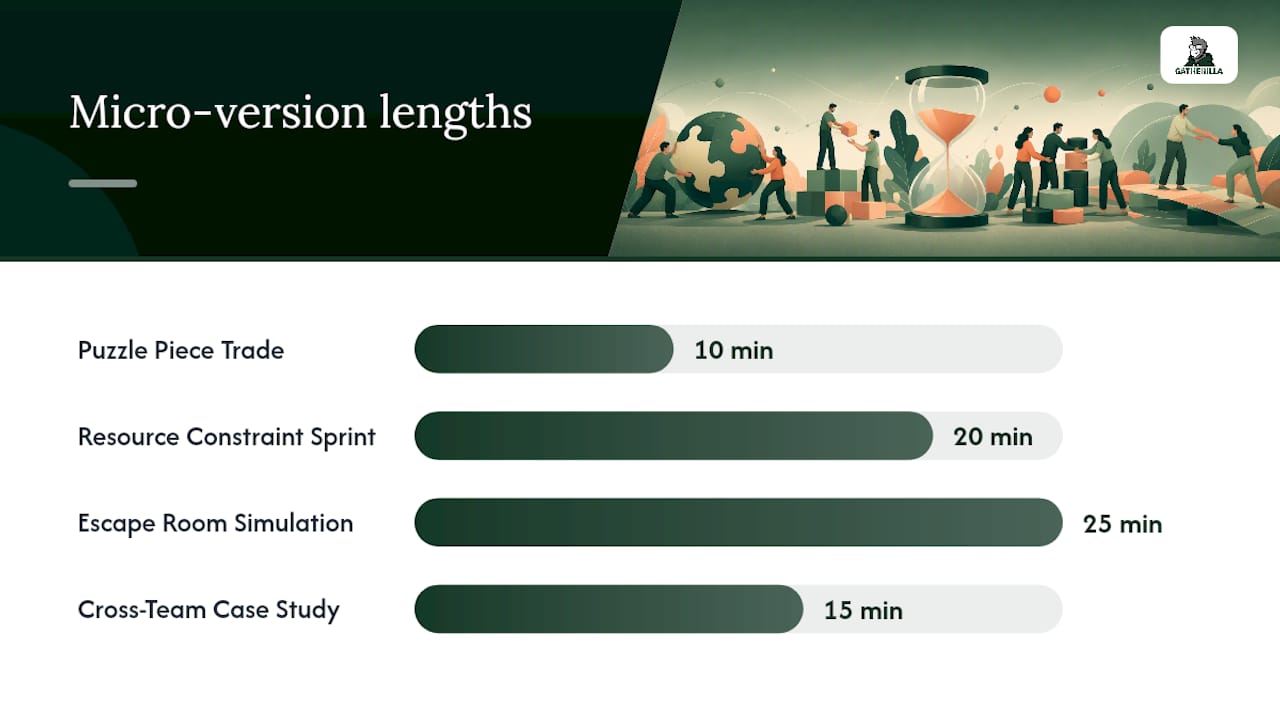
Puzzle Piece Trade (45 minutes, or a 15 minute micro-version). Objective: complete a shared puzzle or task where each subgroup holds pieces the others need but can’t see. Materials: a jigsaw puzzle split across groups, or a shared document with hidden fields per person in the virtual version. Success criteria: time to completion and number of unprompted information exchanges. Micro-version: cut the puzzle to 20 pieces and the time limit to 10 minutes for a quick team meeting.

Resource Constraint Sprint (60 minutes, or a 20 minute micro-version). Objective: design a solution to a hypothetical problem (launch a product, plan an event) using only the “budget” and “resources” assigned, which are deliberately unequal across teams. Materials: a shared slide deck template, sticky notes or a virtual whiteboard tool like Miro. Success criteria: does the group negotiate for resources, or work in isolation? Debrief: “Where did we hoard information instead of sharing it, and does that happen in our actual sprints?”
Escape Room Simulation (60 to 90 minutes, or a 25 minute micro-version). Objective: solve a series of linked clues to “unlock” a final answer, using a virtual escape room platform or a printed puzzle kit in person. Materials: a licensed digital escape room tool, or a DIY puzzle set. Success criteria: completion time and whether the team assigns roles naturally. Asana’s breakdown of team-building games categorizes escape rooms among the higher-effort options that pay off when teams need a bonding event with a clear finish line.
Cross-Team Case Study (45 minutes, or a 15 minute micro-version). Objective: analyze a short, anonymized real-world scenario (a missed deadline, a customer complaint) and propose three fixes as a group. Materials: a one-page printed or shared scenario doc. Success criteria: quality and specificity of proposed fixes, not correctness. Debrief: “Which of these fixes could we actually apply to something we’re dealing with right now?”
| Activity | Best Group Size | Materials Needed | Micro-Version Length |
|---|---|---|---|
| Puzzle Piece Trade | 6 to 20 | Puzzle or shared doc | 10 minutes |
| Resource Constraint Sprint | 4 to 12 | Whiteboard tool, budget sheet | 20 minutes |
| Escape Room Simulation | 4 to 10 | Digital platform or puzzle kit | 25 minutes |
| Cross-Team Case Study | 4 to 15 | One-page scenario doc | 15 minutes |
Every one of these connects back to real work if the debrief asks the right question. Skip the debrief and you’ve just run a fun activity with no culture payoff.
Longer Rituals and Onboarding Games That Scale
One-off games fade. Rituals don’t, because they’re baked into a recurring cadence rather than treated as a special event. The goal here is repeatable structure, not a bigger budget.
- New Hire Welcome Ritual: on a new team member’s first day, run a 10 minute “getting to know you” round where existing members share one work tip and one fun fact, cadence is per hire, not scheduled.
- Monthly Recognition Game: a rotating “shoutout board” where anyone can nominate a colleague for a specific win, read aloud in the last five minutes of a monthly all-hands.
- Quarterly Retreat Deep Dive: a half-day session combining two or three of the trust exercises above with unstructured time, best run in person if budget allows, or as a half-day virtual retreat using breakout rooms.
- Weekly Friday Wins: five minutes at the end of the week where each person names one thing that went well, works identically in-person or remote.
To measure whether any of this is working, track three things over a quarter:
- Response rate to optional recognition nominations, rising participation signals rising trust.
- A single pulse survey question added quarterly: “I feel comfortable sharing ideas in team meetings” on a five-point scale.
- Retention and time-to-productivity for new hires who went through the welcome ritual versus those who didn’t.
Retreats need the same rigor as smaller games; Gusto’s guide to indoor team-building activities notes that in-person sessions tend to deepen connection fastest when they’re structured rather than left as unstructured social time. The bigger risk with any ritual is letting outputs disappear into a meeting nobody remembers. If the shoutout board produces a genuinely good idea or a name that keeps coming up, put it on the next sprint planning agenda, not just the culture channel.
## A Research-Backed ‘Fictional Organization’ Exercise
Real culture conversations get defensive fast, because critiquing your own team feels personal even when the intent is constructive. Using a fictional organization as the subject sidesteps that. Teams analyze someone else’s problem, then apply the lesson to themselves once the defensiveness is out of the way.
- Set up the scenario (5 minutes). Introduce a fictional company, “Meridian Logistics,” a mid-size company struggling with slow decision-making and low morale. Keep it vague enough that no one maps it directly onto your actual workplace.
- Break into groups of 4 to 5 (2 minutes). Assign each group a printed or shared worksheet with three prompts.
- Round one: diagnose (10 minutes). Worksheet prompt: “What three cultural habits at Meridian are causing the slow decisions?” Groups write bullet answers, no discussion with other groups yet.
- Round two: prescribe (10 minutes). Prompt: “If you were Meridian’s new head of operations, what’s the first thing you’d change, and why?”
- Round three: reflect (10 minutes). Prompt: “Does anything about Meridian feel familiar? What’s one small thing we could try this month?” This is the pivot point where the fictional case becomes personal, voluntarily.
- Full-group share-out (10 minutes). Each group shares one idea from round three only, keep rounds one and two private unless a group wants to share.
- Convert to action (5 minutes). The facilitator writes down every round-three idea and picks one to revisit at the next team meeting.
Do list: keep the fictional company genuinely fictional, let groups skip round three if they’re not ready, write down every idea even if it seems small. Don’t list: don’t force a group to explain why an idea felt personal, don’t let the exercise run past 45 minutes total, don’t skip the follow-up meeting where you revisit the ideas, that’s where most of these exercises quietly die.
Using a neutral case study lowers defenses because nobody has to admit their own team’s dysfunction out loud before they’re ready to. That small distance is often what makes people honest.
How to Pick the Right Game and Run It Well
Start with three questions before choosing anything from this list: what’s the goal (connection, trust, or skill practice), how much time do you actually have, and what’s the group size? A 5 minute icebreaker for a goal that needs 30 minutes of trust-building will feel hollow. A 45 minute exercise dropped into a 15 minute stand-up will feel like a hijacking.
| Setting | Ideal Group Size | Typical Time Needed | Facilitator Role |
|---|---|---|---|
| In-person | Up to 20 | 15 to 90 minutes | Active, circulates the room |
| Virtual | Up to 15 per breakout | 5 to 45 minutes | Manages breakouts and tech |
| Hybrid | Up to 25 total | 10 to 45 minutes | Splits attention between rooms and screens |
SessionLab’s collection of team-building activities organizes exercises by exactly this kind of duration and materials breakdown, which is worth scanning if you need a bigger library than what’s here.
Facilitation red flags to watch for: someone who visibly disengages and isn’t invited to opt out gracefully, a debrief that turns into one person dominating the floor, and a game that reveals more personal information than the group’s trust level supports. If any of these show up, pause and reset the tone rather than pushing through the agenda.
A short inclusion and accessibility checklist before you run anything:
- Confirm the activity doesn’t require a shared religious, cultural, or family assumption that excludes anyone. Guidance on creating accessible events recommends checking scheduling against common religious and family obligations before locking a date.
- Offer a non-verbal way to participate (chat, emoji, written response) for anyone who prefers not to speak aloud.
- Check that any physical activity has a seated or remote-equivalent version.
- Collect brief anonymous feedback after the session to catch exclusion points you missed.
Remote tech checklist: confirm breakout rooms work on your video platform before the meeting starts, share any worksheet links in the chat and in the invite, and always have a no-tech backup version of the activity ready in case someone’s connection drops. If your team runs standing meetings through video conferencing, Gatherilla’s guide to team building games for Microsoft Teams covers platform-specific setup steps worth checking before your first session.
What Running These Games Actually Teaches You
The biggest surprise running these games across different teams isn’t which activity works best. It’s how much the outcome depends on what happens in the ninety seconds after the game ends, not during it. A trust exercise with a rushed debrief teaches people it was busywork. The exact same exercise with three good follow-up questions teaches people the team actually wanted to hear from them.
Shorter beats longer almost every time. Teams consistently respond better to a tight 15 minute exercise done well than a sprawling 60 minute one that loses energy halfway through. Optional sharing beats mandatory sharing, too. The moment a game requires disclosure, it stops building trust and starts testing compliance, and people can tell the difference immediately.
A few hard-won rules worth keeping on a sticky note:
- If in doubt, cut the activity time in half rather than adding more structure.
- Never make personal sharing mandatory, always offer a pass or a lighter alternative.
- The debrief question matters more than the activity itself, write it before you write the game.
- Watch body language on video calls as closely as you’d watch it in a room. It’s easier to miss disengagement on a grid of faces than most people assume.
These lessons line up with the facilitation research on psychological safety that runs through this entire guide: the manager’s behavior in the room, or on the call, does more to build lasting trust than the cleverness of the game design. Pick simple activities and facilitate them with genuine curiosity, and the culture payoff shows up faster than a more elaborate exercise run carelessly.
A Practical Way to Run These Games Without the Setup Hassle
Everything in this guide works with a shared doc, a whiteboard tool, and a facilitator willing to keep time. But scheduling breakout rooms, tracking who’s played what, and building a new icebreaker script every week adds up fast for a manager already juggling a full calendar. Gatherilla removes that setup layer entirely: it’s a browser-playable multiplayer game platform built specifically for remote and hybrid teams, no downloads, no app installs, works inside whatever video call tool you’re already using.
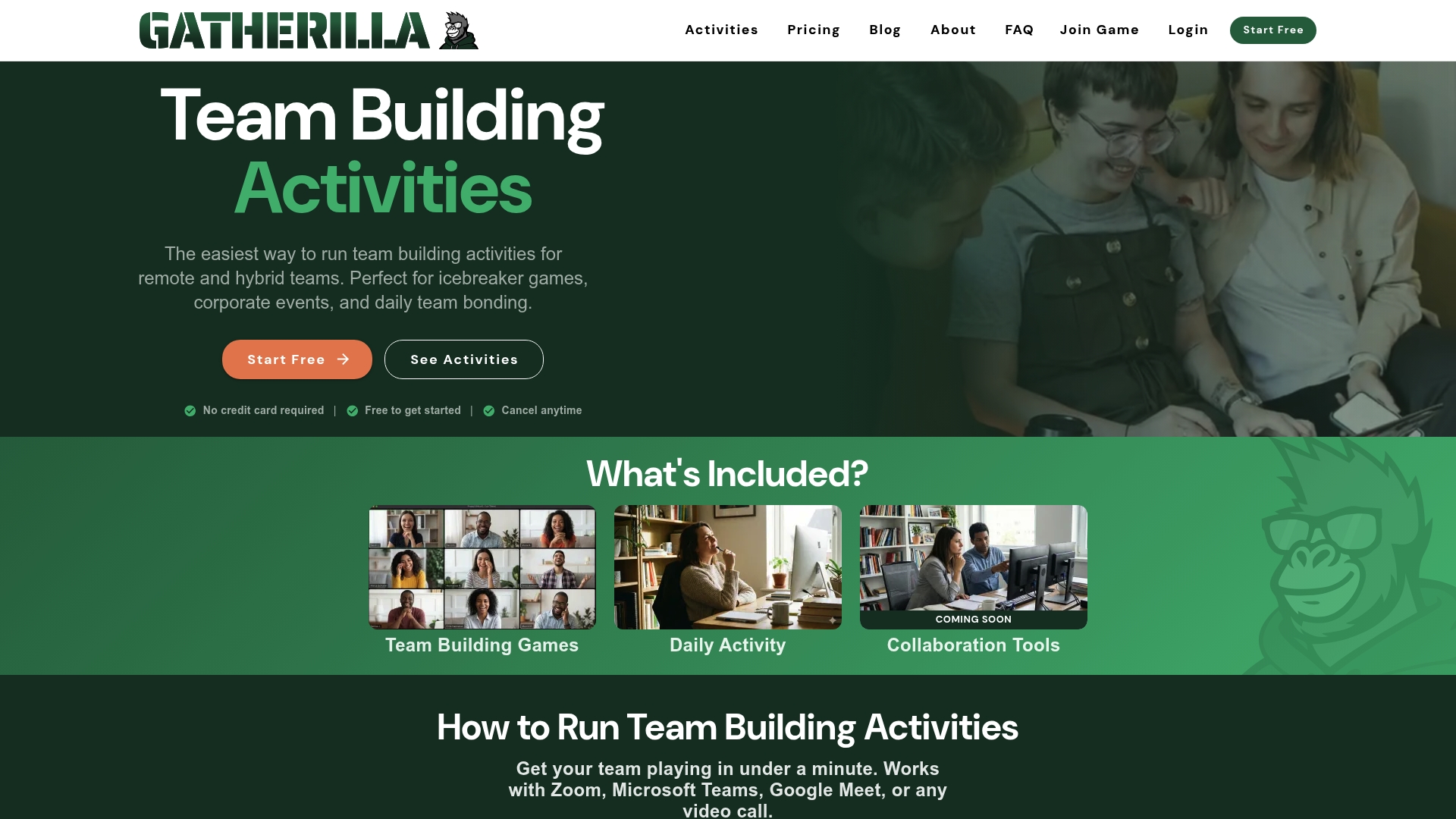
The daily challenge format fits directly into the recurring rituals covered earlier in this guide, a five-minute trivia or word game that runs automatically instead of requiring a manager to write a new prompt every week. It also works well for onboarding: new hires can join a quick multiplayer game in their first week instead of sitting through another slideshow. For managers who need to show that engagement spending is working, built-in analytics track participation over time, useful evidence for the next budget conversation. If you’re deciding between building your own icebreaker calendar from scratch or trying something that’s already built for exactly this, check out Gatherilla and start a session with your team this week.
Sources
- 29 Team-Building Activities for Work
- 45 team-building games that will bring your team together
- Creating accessible events
- Demonstrating vulnerability & psychological safety to promote team development