

In 2 Minutes: Two Truths and a Lie, Copy Ready Triples for HR

Two Truths and a Lie for Work is a two- to three-minute icebreaker where each person shares three statements about themselves and the group votes on which one is false. It requires zero prep beyond picking a theme, works over video or in person, and gets even quiet meetings talking within one round. This page gives you the rules, work-safe idea banks, remote voting tactics, and full copy-paste triples so you can run it in your next standup.
TL;DR:
- Smaller groups or breakout rooms improve the pace and engagement, especially when more than twelve participants are involved.
- Using structured voting tools like chat, polls, or emoji reactions ensures quick, anonymous, and clear turnout, particularly for remote teams.
- Crafting plausible, mundane lies with specific, balanced details enhances the challenge, reducing instant guesses and maintaining fairness.
- Sharing prompts ahead of time decreases participant anxiety and encourages more thoughtful, creative statements.
- Limit the activity to light, work-safe topics like travel, hobbies, and childhood to avoid discomfort and keep the game appropriate for professional settings.
Table of Contents
- How to Play Two Truths and a Lie at Work
- Themed Statement Ideas for Work Teams
- Running It Remotely: Voting, Polls, and Breakout Rooms
- What Makes a Lie Believable (And How to Write One)
- Complete Example Rounds You Can Use Today
- Facilitator Checklist and Red Flags to Watch For
- Copy-Ready Templates and Scripts
- How Gatherilla Supports This Activity for Remote Teams
- When This Game Actually Helps (And When It Doesn’t)
- Run It Without the Setup Hassle
- Where to Go for More Icebreaker Ideas
- Sources
How to Play Two Truths and a Lie at Work
The mechanics are simple: each person states three things about themselves, two true and one false, in any order. The group discusses briefly, votes on which statement is the lie, and the speaker reveals the answer before passing to the next person.
Standard turn flow looks like this:
- Speaker delivers all three statements without pausing for reaction.
- Group has 30 to 60 seconds to ask one clarifying question if allowed.
- Everyone votes, out loud or via chat, at the same time.
- Speaker reveals the lie and gives a quick fact behind the truths.
Group size matters more than most facilitators expect. A small to moderate size is ideal for a single round; for larger groups, split into breakout groups so no one waits excessively long for their turn. Budget a few minutes per person, including the vote and reveal, and set a visible timer if your team tends to ramble.
Scoring is optional but adds energy. A simple version awards one point to anyone who guesses correctly, plus a bonus point to the speaker if they fool the majority of the group. Skip scoring entirely for onboarding rounds where the goal is connection, not competition.
Keep topics work-safe by default. Work-focused idea banks steer players toward hobbies, travel, food, and childhood rather than health, finances, or politics, and that guidance holds regardless of team size. As facilitator, you set the tone: go first, and keep your own statements light and specific rather than vague or personal.
Themed Statement Ideas for Work Teams
Handing people a theme beats asking “tell us something about yourself,” which stalls half the room. Pick one theme per round and let people build off it.
Office life and career
- I once worked a job that had nothing to do with my current field.
- I’ve been mistaken for a coworker on a video call.
- I have a useless skill from a past job that still comes up sometimes.
- I switched careers after a class I almost failed.
- I’ve worked more than three jobs before turning 25.
- I’ve been in a meeting that ran so long I missed lunch entirely.
Travel
- I’ve been to a country most people in this room haven’t visited.
- I got lost in a city for more than two hours.
- I’ve eaten something abroad I still can’t identify.
- I’ve missed a flight because of something avoidable.
- I’ve driven on the opposite side of the road from what I’m used to.
Hobbies and skills
- I can name every state capital.
- I’ve competed in something outside of work, ever.
- I taught myself a skill from online videos.
- I’ve broken a bone doing a hobby, not a sport.
Childhood and family
- I had a nickname growing up that has nothing to do with my actual name.
- I moved schools more than twice before high school.
- I once got in trouble for something my sibling actually did.
Food
- I’ve never eaten a food most people consider basic.
- I worked in food service before this job.
- I have a strong opinion about a food most people are neutral on.
For new teams, stick to travel, food, and childhood, since those topics carry the lowest disclosure risk and the highest common ground. For close-knit teams that already know each other’s basics, office-life and career prompts work better because the lies get harder to spot.
Running It Remotely: Voting, Polls, and Breakout Rooms
Video calls change the mechanics slightly, but the game translates well to remote settings once you swap out live reactions for structured voting.
- Use chat for simultaneous voting: ask everyone to type their guess and hit enter at the same moment so no one anchors on the first answer typed.
- Zoom polls, Microsoft Teams polls, or a plain emoji reaction (thumbs for statement one, heart for two, and so on) all work as low-tech alternatives.
- For groups over eight, split into breakout rooms of four to five and have each room run its own rounds in parallel, then bring one favorite lie back to the main call.
- Private writing beforehand, where each person drafts their three statements in a shared doc or chat before the call starts, keeps the live portion fast.
A browser-based tool built for team activities removes the setup friction entirely, since nobody has to install anything or fumble with poll settings mid-meeting.
Pro Tip: Anonymous voting protects quieter team members from social pressure to vote with the loudest guesser in the room, which usually surfaces better guesses too.
What Makes a Lie Believable (And How to Write One)
The best lie sounds exactly as plausible as the truths sitting next to it. A lie that’s too wild (“I once won an Olympic medal”) gets guessed instantly, and a lie that’s suspiciously vague gives itself away just as fast.
- Make the lie mundane, not dramatic. “I’ve lived in four different states” fools people better than “I’ve met three presidents.”
- Make your truths specific enough to sound made up. “I broke my wrist trying to skateboard at 26” beats “I’ve had an injury.”
- Match the level of detail across all three statements. If two are one sentence and the lie is three sentences of backstory, people will notice the imbalance.
Idea banks that share prompts ahead of the meeting see better participation, since pre-sharing prompts reduces on-the-spot anxiety for people who freeze when asked to improvise. If someone’s stuck, give them a nudge: “What’s something on your resume that surprises people?” or “What’s a place you’ve lived that people wouldn’t guess?” usually unlocks something in under ten seconds.
Complete Example Rounds You Can Use Today
Copy any of these directly into chat or read them aloud. Difficulty refers to how hard the lie is to spot, not the content.
- Easy, new team: “I’ve never broken a bone. I’ve lived in three countries. I can’t swim.” (Ask: “Which one surprised you most?”)
- Easy, remote call: “I have a twin. I once met a celebrity in an airport. I’ve never had a cavity.” (Good for a first-week onboarding call.)
- Medium, small group: “I worked at a theme park in college. I’ve run a marathon. I’ve never left the country.” (Follow up by asking about the theme park.)
- Medium, all-hands: “I speak three languages. I’ve been on local news. I failed my driver’s test twice.” (Works well as a large-group energizer with a poll.)
- Hard, close team: “I almost became a professional musician. I’ve eaten insects on purpose. I’ve met my favorite author.” (High detail parity makes this one genuinely tricky.)
- Hard, remote call: “I’ve skydived. I’ve written a published article. I once got locked out of my own apartment for six hours.” (Great for teams that already know each other well.)
Facilitator Checklist and Red Flags to Watch For
Run through this before the meeting starts, not during it:
- Pick a theme and share it (or the idea bank) at least a few minutes ahead.
- Go first to model the tone and length you want from everyone else.
- Set a visible timer per person, roughly two to three minutes including the vote.
- Split any group larger than twelve into breakout rooms before starting.
Practitioner guides consistently point to facilitators setting tone by going first as the single biggest factor in keeping rounds appropriate, since people tend to match the disclosure level of whoever spoke before them.
If a statement veers into health, finances, or something that makes the room visibly uncomfortable, pause and redirect: “Let’s keep it to hobbies and travel for this round,” then move on without dwelling on it. Use the game as a quick energizer or onboarding warm-up, not a substitute for deeper team check-ins. A single follow-up question in your next survey, something like “did that warm-up help you feel more connected today,” gives you a fast read on whether it’s working.
Pro Tip: Keep a running list of the funniest lies from each round in a shared doc. Reusing a callback months later takes ten seconds and reminds the team the activity was worth doing.
Copy-Ready Templates and Scripts
- Calendar invite line: “Quick warm-up today: think of two true things and one lie about yourself (keep it work-safe). Takes 2 minutes to prep.”
- Opening script: “We’re playing two truths and a lie. I’ll go first, then we’ll go around. Vote in chat when I finish, and I’ll reveal the lie after.”
- Reveal script: “The lie was number two, here’s the real story behind number three instead.”
- Chat poll wording: “Type 1, 2, or 3 for the statement you think is false. Post it and hold until I say go.”
- Onboarding tweak: ask new hires to include one work-related truth so the team learns something professional, not just personal.
How Gatherilla Supports This Activity for Remote Teams
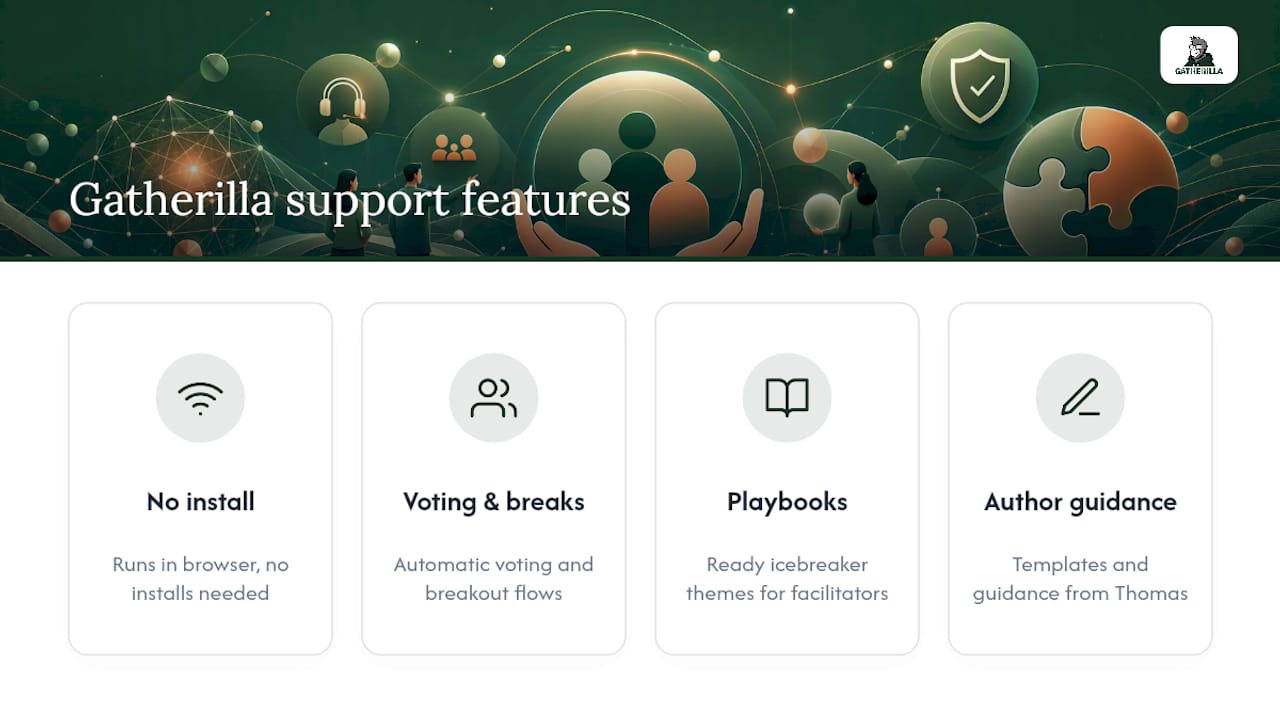
Gatherilla runs this and similar icebreakers directly in the browser, so nobody installs anything before a call starts. The platform handles voting and breakout-friendly flows automatically, and its icebreaker playbooks give facilitators ready themes instead of a blank page. Author guidance and templates throughout this piece come from Thomas, drawing on patterns seen across remote team engagement work.
When This Game Actually Helps (And When It Doesn’t)
Two truths and a lie earns its two minutes for onboarding and quick energizers. It won’t fix a team with real trust problems, and treating it as a stand-in for deeper culture work wastes everyone’s time. Use it as a warm-up, then invest in longer engagement practices for the issues that actually need them.
— Thomas
Run It Without the Setup Hassle
Gatherilla gives you the templates, polling, and breakout flow this article just walked through, minus the ten minutes you’d otherwise spend copying prompts into a doc or fumbling with Zoom poll settings mid-call. Everything runs in the browser, so remote and hybrid teams jump straight into a round without downloads or IT approval, and daily challenge features keep engagement going between meetings, not just during them.
If you run standups, onboarding calls, or all-hands meetings on a recurring basis, a repeatable setup beats rebuilding prompts from scratch every time. Check out Gatherilla’s team building platform and start your next meeting with a round that’s ready before you even open the invite.
Where to Go for More Icebreaker Ideas
For deeper idea banks, TeamRetro’s work-safe list covers dozens more themed prompts. For running large groups smoothly, see Gatherilla’s large-group icebreaker guide, and for broader onboarding practices, this remote onboarding guide offers useful context.
Sources
- 100+ Two Truths and a Lie ideas & examples (work-safe) | TeamRetro
- Two Truths and a Lie — Free Online Game (No Download)