

Daily Rituals to Boost Remote Morale Without Extra Planning

The most effective remote morale boosters aren’t the quarterly virtual party or the surprise swag box. They’re small, recurring rituals paired with consistent recognition, run weekly or even daily instead of once a quarter. A platform like Gatherilla can carry that cadence without extra setup work. The sections below cover the specific ideas, a rollout plan, quick wins, and the tools worth considering.
TL;DR:
- Small, recurring rituals such as daily check-ins, recognition threads, and informal social activities are more effective in boosting morale than infrequent large events.
- Weekly or daily activities like trivia, onboarding games, and peer mentoring are easy to implement with minimal setup and help sustain engagement over time.
- Rotating ownership of morale initiatives and limiting their duration to a few weeks increase sustainability and prevent burnout among organizers.
- Recognizing effort through frequent, low-effort formats like shout-outs and micro-awards helps maintain motivation without survey fatigue or nomination burnout.
- Tools like Gatherilla support quick, browser-based engagement activities that require no downloads, ideal for maintaining consistent rituals in distributed teams across time zones.
Table of Contents
- What Are the Best Remote Morale Boosters for Distributed Teams?
- How Do You Roll Out a Morale Program That Actually Lasts?
- Recognition Formats That Don’t Fade After a Month
- Tools and Tech That Help (and Where Gatherilla Fits)
- Same-Day Morale Boosters You Can Run With Zero Prep
- Adapting Morale Boosters Across Cultural Backgrounds
- Scheduling Morale Activities Across Multiple Time Zones
- Author Perspective: What Sustains Morale Past the First Month
- Where Gatherilla Fits Into Your Morale Routine
- Sources
- FAQ
What Are the Best Remote Morale Boosters for Distributed Teams?
Forget the idea that morale needs a big production. What moves the needle is a menu of small, repeatable actions spread across five categories: daily rituals, social connection, well-being, learning, and team challenges. Pick one or two per category rather than trying all of them at once. The research on virtual appreciation is consistent on this point: frequent small gestures build a stronger remote culture than infrequent, large-scale events.
Daily rituals cost almost nothing and take under five minutes.
- The two-minute check-in. Open every standup with one non-work question (“What’s one thing that made you smile this week?”). Works for teams of any size, costs nothing, and takes the same two minutes whether three people join or thirty.
- The Monday kickoff poll. A single async poll question in Slack or Teams (favorite coffee order, weekend plans, a caption contest for a meme). Low participation pressure since answering is optional and asynchronous.
- The Friday wins thread. One thread where anyone posts a win, big or small, before signing off for the weekend. This works especially well because it’s opt-in and text-based, so people who dislike being on camera still get to participate fully.
Social connection activities need a bit more structure but still fit inside a normal meeting.
- Virtual coffee roulette. Randomly pair two people across departments for a 15-minute unstructured chat every other week. Low-cost variant: a simple spreadsheet-based random pairing instead of a paid matching tool.
- Show-and-tell Fridays. One person shares something personal (a hobby, a pet, a recipe) for five minutes. Rotate who presents so it never falls on the same outgoing people every time.
Well-being boosters address the burnout risk that’s specific to remote work, where the boundary between “at work” and “home” blurs fast.
- No-meeting afternoons. Block one afternoon a week with zero internal meetings. Costs nothing but calendar discipline, and research on workplace culture ties clear work-life boundaries directly to lower burnout risk.
- Surprise half-day. Announce an unplanned half-day off with 24 hours’ notice, a few times a year. Low-cost variant: let each person bank one surprise half-day per quarter to use whenever they choose.
- Flexible-hours windows. Let people shift their working hours by two or three hours as long as core collaboration time overlaps. This particularly matters for teams spanning multiple time zones, covered in more detail below.
Learning and growth rituals tap into something recognition alone can’t fix: people who feel stuck tend to disengage and eventually leave. A Pew Research report on why workers quit found that low pay, lack of advancement, and feeling disrespected were the top reasons cited by people who left their jobs in 2021.
- Lunch-and-learn swaps. One person teaches a 20-minute skill session monthly, work-related or not (Excel shortcuts, sourdough starter, a language basics primer).
- Peer mentoring pairs. Match a newer employee with a tenured one for a monthly 30-minute chat, no agenda required beyond “how’s it going.”
Team challenges work best with a clear goal and a meaningful reward rather than points for the sake of points, according to HBR’s analysis of gamification.
- Multi-week step or reading challenges run through a shared leaderboard, with the “reward” being recognition rather than cash.
- Onboarding scavenger hunts for new hires that turn the first week into something closer to a game than a checklist.
Treat every idea on this list as a pilot, not a permanent commitment. Run something for two or three cycles, ask people if it landed, and drop it without ceremony if it didn’t.
How Do You Roll Out a Morale Program That Actually Lasts?
Most morale efforts die not because the ideas were bad, but because nobody owned them past week three. A sustainable program needs a pilot, a rotation plan, and a lightweight way to measure whether it’s working.
- Pick one or two rituals, not ten. Choose based on what’s easiest to run consistently, not what sounds most exciting in a planning meeting. A five-minute Friday wins thread beats an ambitious monthly event that requires three people to organize.
- Set a 4 to 6 week pilot window. Commit publicly to running it for that stretch before deciding whether to keep it, tweak it, or kill it. Announcing the timeframe up front removes the awkwardness of quietly letting something fade.
- Rotate ownership instead of assigning it permanently. The Atlassian Team Playbook’s Chief Vibes Officer play hands morale duties to a different team member on a rotating basis, which keeps ideas fresh and stops the job from becoming an unpaid extra role for whichever person volunteered first.
- Measure with a light touch. Two three-question pulse surveys, one before the pilot and one at the six-week mark, plus a simple participation rate and a short qualitative note from each manager, gives enough signal without survey fatigue.
- Decide, adjust, repeat. At the end of the window, keep what worked, cut what didn’t, and start the next pilot. This keeps remote engagement strategies evolving instead of calcifying into an ignored recurring calendar invite.
Pro Tip: Announce who’s rotating into the “vibes” role at the start of each cycle in your team channel. Public visibility keeps the person accountable and signals that morale is a shared job, not one person’s chore.
Given that about a third of U.S. workers who can work remotely do so full time, this isn’t a niche problem worth a one-time fix. It’s an ongoing operational question, closer to onboarding or payroll than to party planning.
Recognition Formats That Don’t Fade After a Month
Recognition programs tend to start strong and quietly die within a few months, usually because the format asked for too much effort per instance. The fix is picking formats light enough to survive on autopilot.
A few formats hold up well over time:
- Slack or Teams shout-outs in a dedicated channel, posted whenever, not on a schedule.
- A virtual appreciation wall, essentially a running public doc or channel where anyone can drop a thank-you note for anyone else.
- Micro-awards with silly, specific titles (“Fastest Bug Squasher,” “Best Meeting Save”) given out monthly rather than generic “Employee of the Month” plaques.
- Short recorded video thank-yous, 30 seconds, sent directly instead of posted publicly, for people who find public praise uncomfortable.
Cadence matters more than format. Daily micro-shoutouts, a weekly team kudos round in your regular meeting, and a monthly peer-nominated award cover most of what a distributed team needs. Frequent recognition correlates with higher engagement and lower turnover compared to sporadic, big-ticket praise.
Three pitfalls show up constantly. Reward mismatch happens when the prize doesn’t match the effort, like a $5 gift card for someone who saved a client relationship. Unequal visibility happens when the same three extroverted, vocal people get all the shout-outs while quieter contributors go unnoticed for months. Nomination fatigue sets in when peer-nomination programs run so frequently that people start submitting low-effort entries just to check a box. Rotating who reviews nominations and capping frequency to monthly usually solves the third problem.
Tools and Tech That Help (and Where Gatherilla Fits)
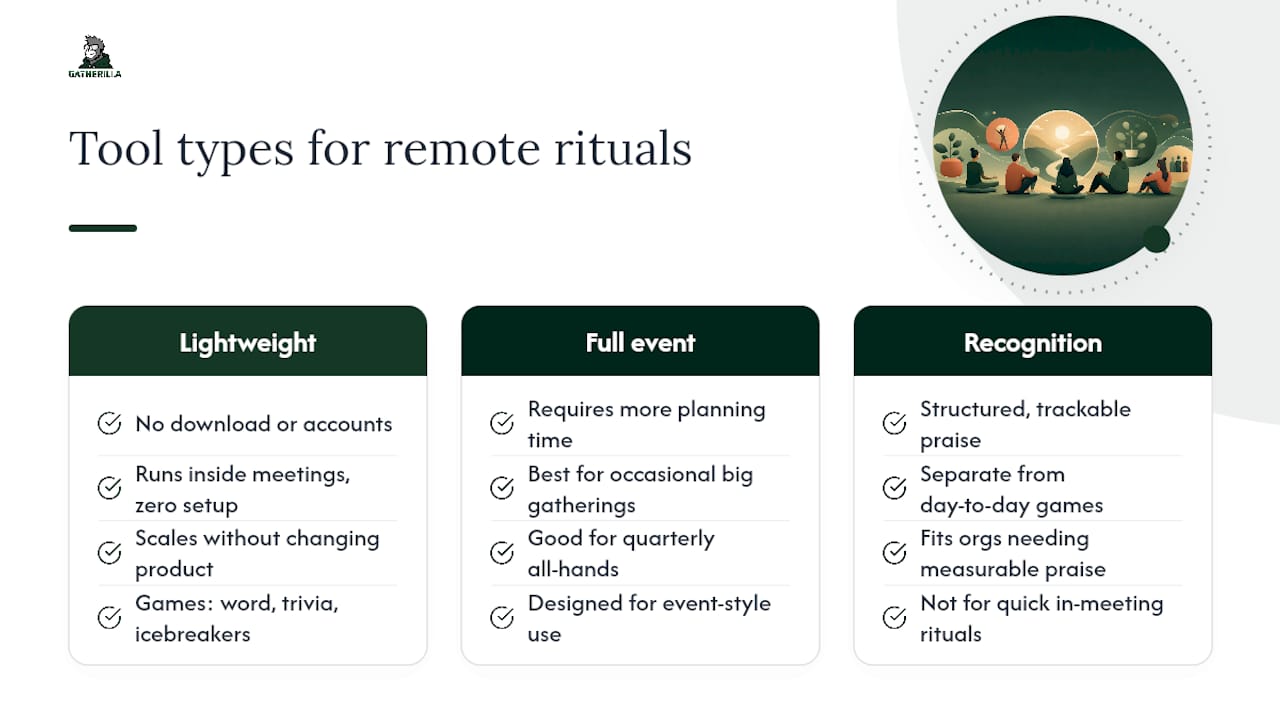
Picking a tool for remote engagement comes down to four questions: does it require a download, does it plug into the video tool your team already uses, does it give you any usable participation data, and does it scale from a five-person standup to a company-wide event without becoming a different product entirely.
Lightweight daily-ritual platforms suit teams that want something running inside an existing meeting with zero extra setup. Full event platforms make more sense for occasional bigger gatherings, like a quarterly all-hands celebration, where more planning time is already built in. Recognition-specific systems fit organizations that want structured, trackable praise separate from day-to-day games.
Gatherilla is built around the first category: browser-based multiplayer games that need no downloads or accounts, so a team lead can launch one mid-meeting without a setup delay. That includes daily word and trivia challenges, icebreaker prompts for meeting openers, onboarding games for new employees, and larger company-wide event formats when the occasion calls for something bigger than a five-minute ritual.
A realistic weekly setup: Monday opens with a two-minute icebreaker prompt, Wednesday’s team meeting starts with a five-minute trivia round, and Friday closes with an async word challenge people finish on their own time.
Pro Tip: Test any new tool for exactly two weeks before deciding whether to keep it. If participation drops off after the novelty fades, the ritual needs adjusting, not necessarily replacing.
Same-Day Morale Boosters You Can Run With Zero Prep
Some days call for something you can launch in the next ten minutes, not next week’s roadmap.
- The 5-minute gratitude round. Ask each person on the call to name one teammate who helped them that week and why. No prep, no tool needed.
- The shout-out template. Post in your team channel: “Shout-out to [name] for [specific thing they did]. It mattered because [impact].” Copy it, fill in the blanks, done.
- The surprise half-day. Message the team: “Wrap up by 1 PM today, no questions asked.” Costs nothing but goodwill and calendar flexibility.
- The one-question opener. Start your next meeting with: “What’s the best thing that happened to you this weekend?” Works cold, no setup.
- The async trivia drop. Post five quick trivia questions in Slack with a 24-hour window to answer. People jump in when they have a spare minute.
- The virtual high-five. A GIF or emoji reaction thread dedicated purely to celebrating small wins, no explanation required.
Keep inclusion in mind: build in an async or opt-in version of anything camera-based, since pairing an asynchronous prompt with an optional synchronous debrief lets quieter team members contribute without performing on camera. Cap these at one or two per week per team. Stacking three morale activities onto an already packed Tuesday just creates fatigue disguised as fun.
Adapting Morale Boosters Across Cultural Backgrounds
A recognition format that feels natural to one team can feel awkward or even uncomfortable to another. Public praise on a company-wide channel might energize someone from a culture that values individual recognition, while a colleague from a more collectivist background might feel singled out or embarrassed by the same gesture. The fix isn’t picking one universal format. It’s offering a few formats and letting people opt into the one that fits them.
Humor travels unevenly too. A joke that lands in one office can fall flat, or worse, confuse or offend, in another. Icebreaker prompts work better when they stay concrete and low-risk (“What’s a food from your hometown everyone should try?”) rather than relying on wordplay, pop culture references, or sarcasm that doesn’t translate.
Holidays and calendar rhythms also vary by region and religion. A December-heavy celebration calendar can quietly exclude teammates who don’t observe those holidays. Rotating recognition of different regional or cultural events, rather than defaulting to the majority calendar, signals that the whole team is actually seen.
Language matters at a practical level, too. If English isn’t everyone’s first language, fast-paced verbal games can put non-native speakers at a disadvantage compared to native speakers on the same call. Written or async formats, like a trivia challenge people can answer on their own time, level that playing field far better than a live, rapid-fire game does.
Scheduling Morale Activities Across Multiple Time Zones
The biggest mistake distributed teams make is scheduling every ritual around the headquarters time zone and calling it “flexible.” If half your team is logging in at 6 AM or 9 PM to catch a live trivia session, that isn’t a morale booster. It’s an extra burden dressed up as fun.
Split your rituals into synchronous and asynchronous by design, not by accident. Live games and celebrations work fine when the whole team genuinely overlaps for at least an hour, common for teams spread across two or three adjacent zones. For teams spanning six or more hours of difference, async formats should carry most of the weight: a Slack thread anyone can answer within a 24-hour window, a trivia challenge with an extended deadline, a recognition wall people update whenever they’re online.
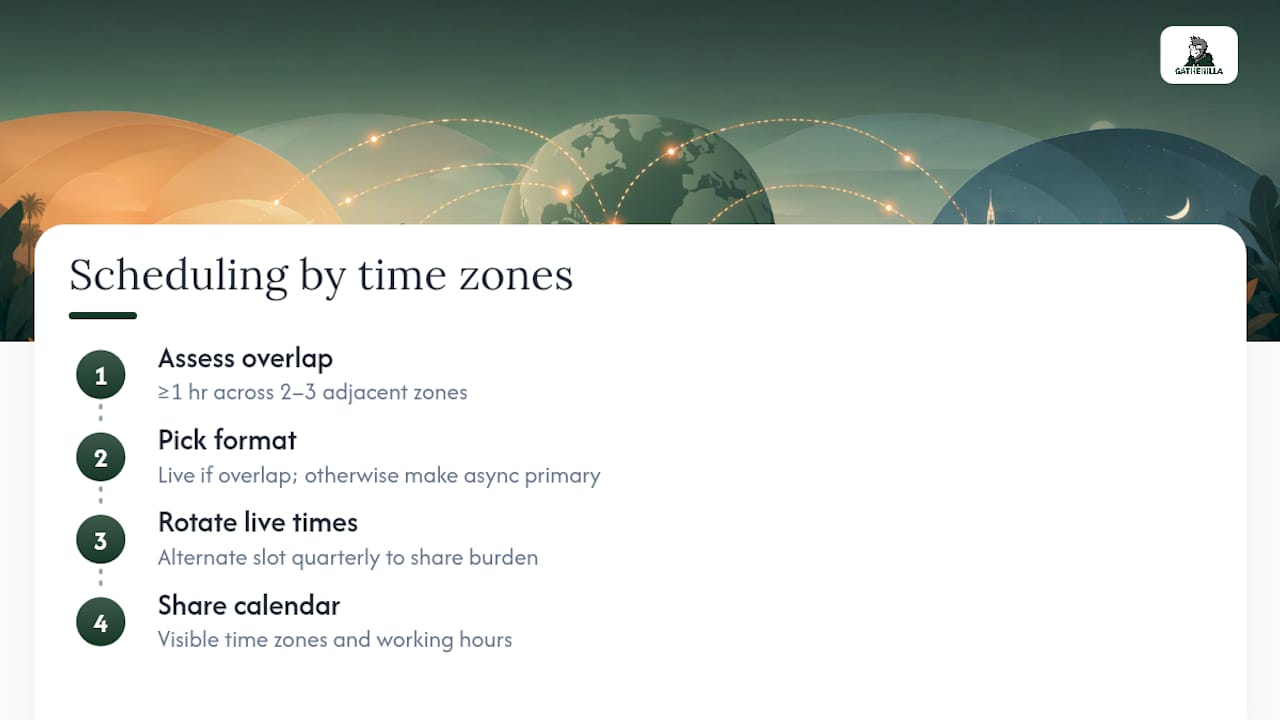
For the occasional live event that matters enough to justify asking people to adjust their schedule, rotate the meeting time. If your all-hands celebration always happens at 9 AM Eastern, your team in Singapore is permanently the one losing sleep. Alternating the time slot every quarter spreads that inconvenience fairly instead of parking it on the same group indefinitely.
Keep a shared, visible calendar of who’s in which time zone and when their actual working hours fall. It sounds basic, but a surprising number of teams schedule “spontaneous” morale moments without checking it, then wonder why participation from certain regions stays low every single time.
Author Perspective: What Sustains Morale Past the First Month
The rituals that survive are the boring ones, not the flashy ones. Teams that rotate ownership every few weeks avoid the burnout that kills programs run by one overextended volunteer. What changes over months isn’t excitement. It’s trust: people start expecting the Friday thread to be there, and that reliability becomes its own kind of morale boost, quieter than a party but longer lasting.
— Thomas
Where Gatherilla Fits Into Your Morale Routine
Gatherilla is built for the exact gap most morale plans fall into: the ritual that’s easy to plan but tedious to actually launch every single week. Its games run directly in the browser, requiring no downloads or account creation before play. That matters most for the daily and weekly rituals covered above, where friction is the thing that kills consistency, not lack of ideas.
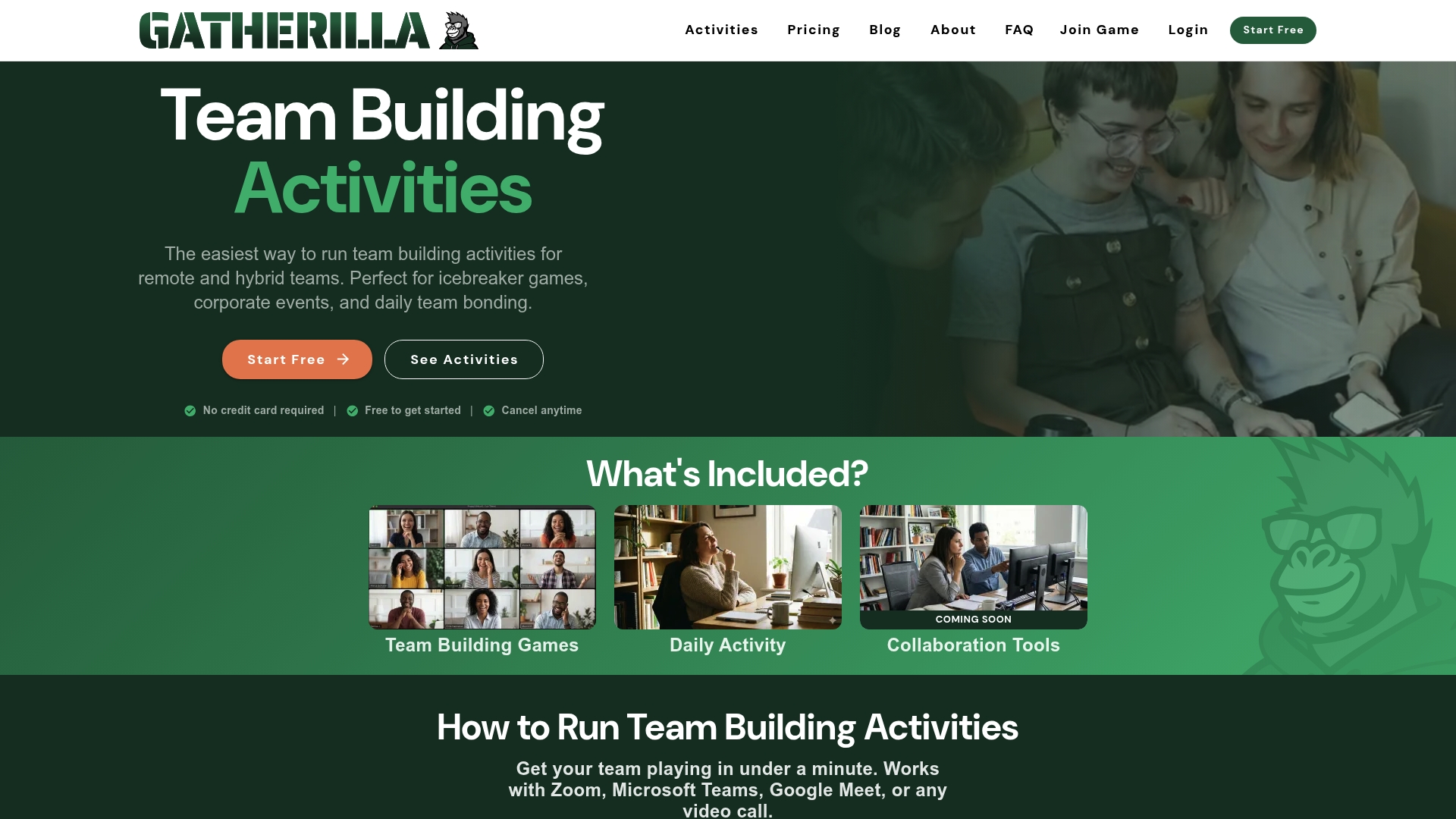
Use it for a quick trivia round before a standup, an onboarding game for a new hire’s first week, or a bigger challenge for a company-wide event night. The free tier is a reasonable place to start if you want to pilot one ritual before committing further, and the premium plan opens up more games, analytics, and priority support once you know which rituals your team actually keeps showing up for. If you’re not sure which game format fits your team’s rhythm, browse the full activity library and pick one to test this week.
Sources
The claims about recognition frequency and virtual appreciation draw on Workhuman’s guidance on virtual appreciation. Gamification design principles come from Harvard Business Review’s analysis. Rotating ownership is modeled on Atlassian’s Chief Vibes Officer play. Remote work scale data comes from Pew Research, and well-being framing draws on Harvard Professional Education.
- 28 Virtual Employee Appreciation Ideas for Remote Teams in 2026
- How gamification can boost employee engagement
- Chief Vibes Officer team icebreaker (Atlassian Team Playbook)
- About a third of U.S. workers who can work from home do so all the time
FAQ
What Are Some Quick Morale Boosters?
A five-minute gratitude round at the start of a meeting, a shout-out template posted in a team channel, or a same-day surprise half-day all work with zero prep. The research on virtual appreciation supports small, frequent gestures over rare big events as the more reliable approach.
What Are Some Fun Activities for Remote Employees?
Browser-based trivia and word games, virtual coffee roulette pairings, and themed show-and-tell sessions all work well because they need little setup and fit inside an existing meeting. A platform like Gatherilla offers ready-made game formats that run without downloads, which removes the setup step that usually kills spontaneous fun.
How Do You Motivate a Remote Team?
Consistency beats grand gestures. Frequent recognition, clear communication through regular check-ins, and respecting work-life boundaries do more for motivation than one large annual event, particularly since low respect and lack of advancement are top reasons people leave jobs.
What Are Five Ways to Improve Workplace Morale?
Run a weekly recognition ritual, block a no-meeting period for well-being, rotate ownership of morale activities so no one person burns out, use short game-based icebreakers to build connection, and measure with a brief pulse survey every six weeks. Each of these scales well for distributed teams without demanding a big planning effort.
How Often Should You Run Remote Morale Activities?
Daily or weekly rituals outperform occasional big events for building lasting morale, based on the consistency-over-scale pattern found in engagement research. A five-minute weekly ritual that never gets skipped beats a quarterly event that takes weeks to plan and fades from memory just as fast.