

The Connected Loneliness Paradox: Notes from Andrew Dowsett's HR Tech 2026 Talk
TL;DR: Andrew Dowsett’s “Timeless Team” talk at HR Tech 2026 unpacked the connected loneliness paradox — the strange reality that as workplace communication tools have multiplied, genuine connection has thinned. He highlighted four breaking points: channel overload, mismatched channel preferences, async drift, and lost tone. Here’s what he said, what struck me, and how teams can claw back the human bits without abandoning remote work.
We’ve never had more ways to stay in touch. Slack, Teams, Loom, Notion comments, voice notes, async standups, calendar invites that pop up like radio static. And yet a strange thing has happened in workplaces over the past five years: the more channels we add, the lonelier work seems to feel — particularly for the people who joined remote-first.
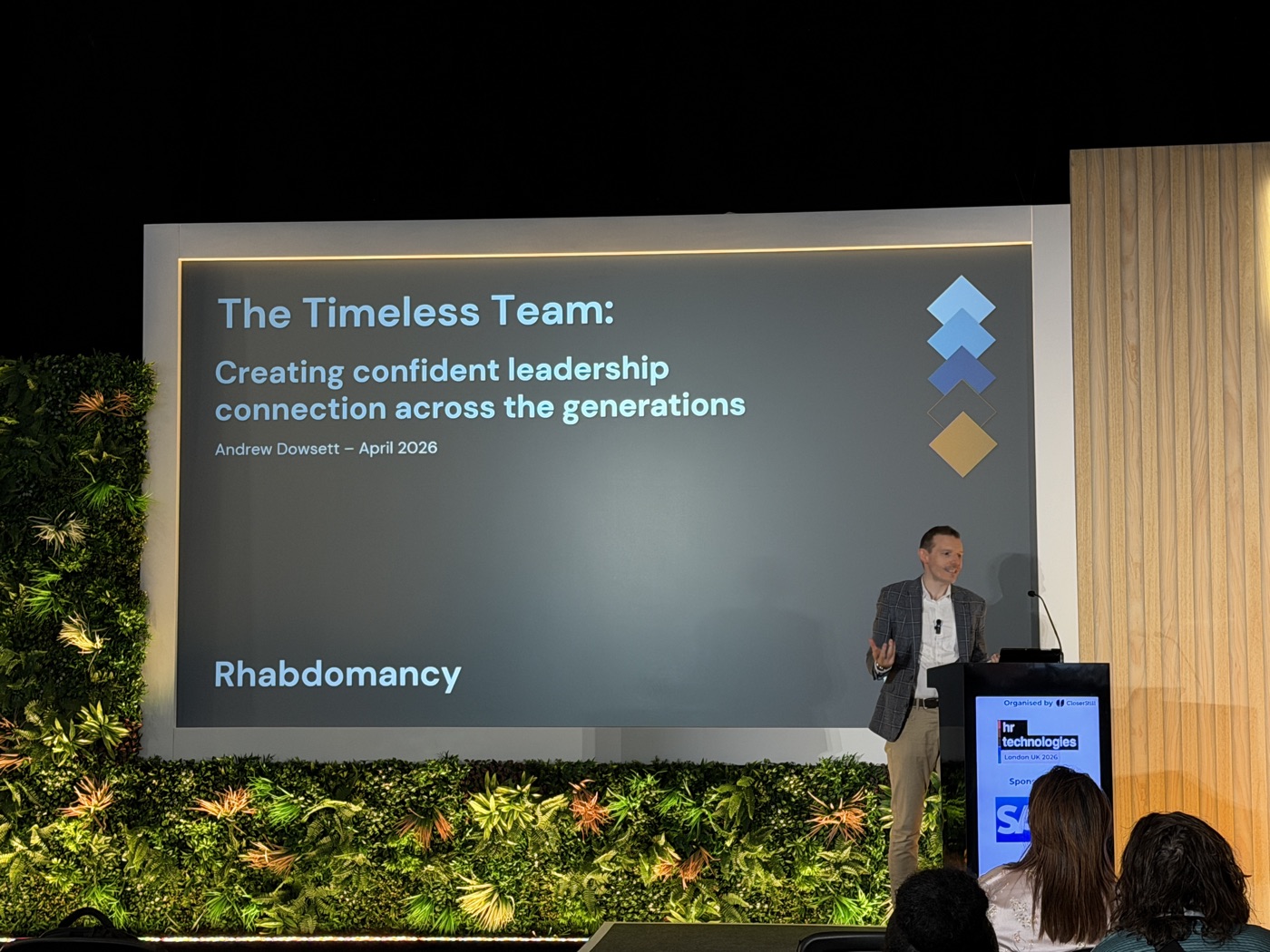
That’s the paradox at the heart of Andrew Dowsett’s “Timeless Team” talk at HR Tech 2026, which I caught at the London ExCeL last month. Dowsett, founder of leadership consultancy Rhabdomancy, spent thirty minutes pulling apart what he called the “connected loneliness paradox” — and how confident leaders can rebuild connection across generations without rolling back the clock on flexible work.
What is the connected loneliness paradox?
Dowsett’s framing is simple but uncomfortable. Tools have made connection trivial. Anyone can ping anyone, anywhere, any time. But the texture of connection — the small unscheduled moments, the corridor encounters, the half-jokes, the read-the-room conversations — has thinned. We’ve optimised for transactions and lost the ambient stuff that holds teams together.
He’s not anti-technology. He’s pointing out that our tooling is generationally lopsided: it favours the people most fluent in it, and quietly excludes those who aren’t. He laid out four problem areas where the paradox shows up most often. None will surprise anyone managing a remote team. What’s useful is having them named.
1. Channel overload
Slack, Teams, email, Loom, Asana, GitHub, Linear, calendar invites, two flavours of WhatsApp. Then the personal layer: text, LinkedIn DMs, the occasional video call DM. Dowsett pointed out that for many knowledge workers, “communication” now requires monitoring six to ten distinct channels — each with its own etiquette, latency expectation, and notification tax.
The cost isn’t the time spent on each channel. It’s the cognitive load of switching between them and the low-grade anxiety of wondering which one you’re behind on. Research on context switching consistently finds reactivation costs that compound brutally across a workday.
Worse, channel overload makes any single message feel low-stakes. If something is in five places, it’s nowhere in particular. The signal-to-noise ratio collapses, and important things get lost next to “could you grab coffee on Friday.”
2. Channel preference mismatch
Dowsett’s second point hit hardest. He talked about junior staff defaulting to cameras off in calls, preferring a one-line written message over a quick phone call, choosing async DMs where a senior colleague would expect a quick conversation.
This isn’t laziness. It’s preference shaped by the tools each generation came up on. People who entered the workforce remote-first developed defaults that match their environment: text-first, low-vulnerability, narrow-bandwidth.
Older colleagues read these choices through a different lens — as disengagement, or hiding, or refusing to participate fully. Neither side is wrong. They’re operating in different communication grammars and not noticing the friction.
The miscommunication compounds: senior staff feel disconnected from juniors who are perfectly engaged but invisibly so; juniors feel scrutinised when asked to “just hop on a quick call.”
3. Async eats the room
Async communication is genuinely brilliant for some things. Documented decisions, deep-focus work, time-zone respect, giving introverts space to think. The Buffer State of Remote Work surveys consistently show flexibility as the top remote-work benefit employees would protect.
But Dowsett’s point: async is not a substitute for synchronous time. It’s a different mode entirely. A phone call carries pauses, sighs, throat-clearing — all of which contain real information. A face-to-face conversation lets you see someone’s shoulders relax when they hear good news. These signals don’t survive the transition to text. They’re not in the message; they are the message.
When teams default to async for every interaction — including the ones where signal-rich communication would catch a problem early — they accumulate small misunderstandings. Most dissolve. Some calcify into resentment.
4. Lost tone and nuance
The fourth problem is what happens when async meets ambiguity. A short message reads as curt. A delayed reply reads as cold. A clarifying question reads as a challenge. None of those readings might be intended. But text strips out the tonal information that would have told the receiver, “I’m not annoyed, I’m in a meeting.”
Dowsett’s example: a junior staff member sending a one-line answer to a senior colleague’s question. The junior thinks: “I answered efficiently.” The senior thinks: “Why are they being short with me?”
Multiply by a year of these tiny interpretive gaps and you’ve got a team that’s technically functioning but emotionally distant. We’ve written more on practical fixes for async tone — voice notes, tone tags, escalation rules.
The generational layer
The thread running through Dowsett’s four problems is generational. Older cohorts — broadly speaking — default to richer-bandwidth communication: phone calls, in-person, longer meetings. Younger cohorts default to lower-bandwidth, more asynchronous channels.
Neither default is “right.” But when a team contains both, and nobody is naming the gap, friction builds. Senior leaders feel they’re being avoided. Junior staff feel they’re being micromanaged. Both are reading the other through their own grammar.
Dowsett was careful not to pitch this as “everyone back to the office.” His pitch was the opposite: distributed and hybrid teams are not going anywhere, but the leadership skill of consciously closing the connection gap needs to scale up.
Where this actually lands
A few of Dowsett’s practical takeaways stuck with me:
- Make channel choice intentional, not habitual. Not every message belongs in Slack. Some belong on a 10-minute call. Naming the rule reduces guessing.
- Set escalation defaults. Three back-and-forth messages on the same thread? Switch medium. Saves hours.
- Bring synchronous moments back deliberately. Not as mandatory all-hands, but as small, voluntary, high-energy touchpoints that rebuild texture.
- Read across generations, not against them. A junior’s cameras-off isn’t a refusal; a senior’s preference for calls isn’t a control move. Translate, don’t judge.
How we think about this at Gatherilla
Listening to Dowsett, I kept thinking about why we built Gatherilla the way we did. Our games are deliberately short — fifteen minutes, not an hour. They’re voluntary and structured so the awkward bit (“what do we even talk about?”) is taken care of. Cameras on or off, anyone can join in via their phone, no installs.
The reason that matters: it lowers the threshold for the synchronous moments Dowsett is calling for. You don’t need a whole calendar block, you don’t need extroverts to lead, and you don’t need the “fun manager” archetype that haunts so many remote teams. You just need a small, regular, low-stakes moment where the team is in the same room — physical or virtual — playing rather than transacting.
That’s not the answer to the connected loneliness paradox. But it’s a piece of it. The texture has to come from somewhere, and it isn’t going to come from another Slack channel. For the broader playbook, see 5 remote team culture strategies and our take on building psychological safety.
Frequently Asked Questions
What is the connected loneliness paradox?
The connected loneliness paradox is the gap between how easy technology has made it to communicate and how disconnected modern workplaces actually feel. The term, used by Andrew Dowsett at HR Tech 2026, captures the strange reality that more communication channels often mean less genuine connection.
Is the answer to remote work loneliness “go back to the office”?
Not according to Dowsett, and not according to most current research. The Buffer State of Remote Work survey consistently shows flexibility as the top benefit employees would protect. The fix is conscious leadership, not reversal — leaders who name communication gaps and invest in deliberate synchronous moments rather than mandating presence.
How do you reduce channel overload without losing useful tools?
Start by naming what each channel is for. Slack for fast questions, email for external, Loom for explanations, calendar for synchronous decisions. Most teams have an unwritten taxonomy already; making it written reduces the constant guessing.
What’s the difference between async-first and async-only?
Async-first means async is the default, but synchronous time is used deliberately for things that need it — emotional conversations, ambiguous decisions, building rapport. Async-only means everything is text. Async-only teams tend to develop the connected loneliness symptoms Dowsett describes.
How often should remote teams meet synchronously?
Short and frequent beats long and rare. Fifteen minutes a week of low-stakes synchronous time builds more texture than a quarterly two-day offsite. See our guide on remote team engagement strategies for specific cadences.
Andrew Dowsett presented “The Timeless Team: Creating confident leadership connection across the generations” at HR Tech 2026 in London. More about the conference: hrtechnologies.co.uk. More on Andrew’s work at Rhabdomancy.