

HR and Team Leaders: 11 Remote Ready Company Values Games, No Prep
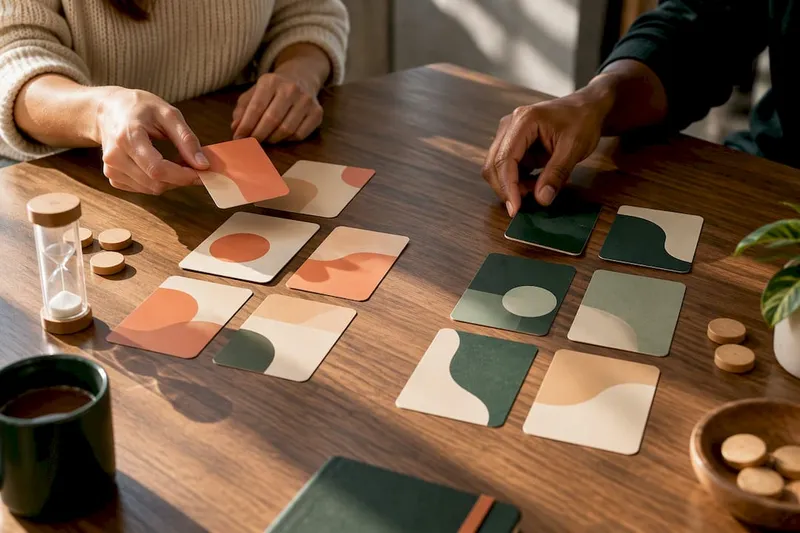
Company values games are structured activities that turn abstract statements like “integrity” or “ownership” into decisions people practice out loud, with a group, under mild pressure. Run well, they help teams make faster, more consistent calls and give managers a natural reason to recognize the right behaviors when they see them. The rest of this guide gives you the exercises, the timing, and the debrief scripts to run one this week.
TL;DR:
- Values card sorts reveal how team priorities differ from stated company values, helping identify gaps in recognition and rewards systems.
- Scenario voting effectively tests the consistency of team interpretations on value conflicts, especially for teams with established core values.
- Affinity mapping and continuous recognition tools support ongoing value integration, but should be accompanied by concrete behaviors and regular follow-ups.
- Remote sessions can be just as effective using browser-based tools like shared whiteboards and live polls, with minimal setup and no downloads required.
- Facilitators should prioritize psychological safety by asking questions, allowing passes, and focusing on observable behaviors to prevent discomfort and superficial compliance.
Table of Contents
- What Company Values Activities Actually Do (and When to Use Them)
- Ready-to-Run Values Games for Any Team Size
- Running the Session: Prework, Rules, and the Debrief
- Making Values Games Work for Remote and Hybrid Teams
- Turning the Exercise Into Actual Culture Change
- Facilitator Notes: What Trips People Up
- Run These Games Without the Setup Headache
- Where This Guidance Comes From
- Sources
- FAQ
What Company Values Activities Actually Do (and When to Use Them)
Values only mean something when they change a decision. A card-sort exercise or a scenario debate forces someone to say, out loud, why “customer first” beats “move fast” in a specific messy situation. That’s the whole mechanism: language becomes behavior because people have to defend a choice in front of peers.
The evidence backs this up. A randomized controlled trial with 250 working adults found that serious-play training produced greater team effectiveness over time than comparison conditions, and the gain tracked directly with increased group cohesion. The game itself wasn’t the point. The shared reflection was.
SHRM’s five-step model for values work follows a similar logic: individual idea generation, making ideas visible, affinity mapping into five to seven clusters, defining observable examples, then tying recognition to those examples. That structure works whether you’re building values from scratch or reinforcing ones you already have.
Use these games in three situations:
- Launching new values and needing language the team actually understands
- Reinforcing values that exist on a poster but rarely show up in meetings
- Surfacing where teams interpret the same value differently, before it becomes a conflict
Most single-exercise sessions run roughly half an hour to an hour. Reserve a longer time slot if the goal is drafting or revising the values themselves rather than practicing ones already set.
Ready-to-Run Values Games for Any Team Size
Pick two or three of these rather than running all of them back to back. Overloading a session kills the reflection quality that makes the format work in the first place.
Values card sort. Objective: rank a shuffled deck of value words by what the team actually rewards today versus what it claims to reward. Give each small group a deck, have them sort in eight minutes, then compare gaps out loud. Remote version: a shared digital board with draggable cards works fine. Runs 20 to 30 minutes.
Story circles. Objective: surface lived examples of a value in action. Ask each person for one 90 second story where they saw a teammate demonstrate (or violate) a value, no names required if that feels safer. Remote adaptation: breakout rooms of four, one story each. Runs 30 minutes.
Scenario voting. Objective: force a decision under a values conflict. Present a short dilemma, have everyone vote anonymously on the option, then discuss the split. SHRM recommends this format specifically for teams that already have stated values and need to pressure-test them. Remote version: a live poll tool. Runs 25 minutes.
Manifesto writing. Objective: co-write a one-paragraph statement of how the team will act on a single value this quarter. Small groups draft, then merge into one shared version. Remote adaptation: a shared document with simultaneous editing. Runs 40 to 60 minutes.
Peer-recognition round. Objective: name a specific behavior a teammate showed that mapped to a value, not a vague compliment. Go around the group, one recognition each, 60 seconds max per person. Works identically over video. Runs 15 to 20 minutes.
Affinity mapping for value creation. Objective: cluster individually generated ideas into five to seven groups that become candidate values. This is the core of the SHRM model and works well as a standalone session when you’re building values from zero. Remote version: a shared whiteboard with sticky-note clusters. Runs 45 to 60 minutes.
Values auction. Objective: force trade-offs by giving teams a limited “budget” to bid on which values matter most in a hypothetical crunch. Reveals priorities people won’t state directly. Remote adaptation: a shared spreadsheet tracking bids in real time. Runs 30 minutes.
Role-play scenarios. Objective: act out a customer or coworker conflict where two values seem to pull in different directions. Low-stakes since it’s fictional, which keeps it safe for people who dislike personal disclosure. Remote version: assign roles in breakout pairs. Runs 25 to 30 minutes.
Escape-room style dilemma chain. Objective: solve a sequence of linked ethical or operational puzzles where each answer must align with a stated value to “unlock” the next clue. Best for teams that already know the values and need practice applying them fast. Remote adaptation: a browser-based puzzle sequence works without downloads. Runs 45 minutes.
Recognition leaderboard variant. Objective: track who has publicly recognized a specific value-aligned behavior, not who “wins” a competition. Keep the board visible but keep scoring secondary to the story behind each entry. Runs continuously, check-ins weekly.
Lightning round check-in. Objective: a 5 minute daily or weekly opener where each person names one small action from the past 24 hours that matched a value. Good for keeping values present between bigger sessions. Runs 5 to 10 minutes.
Pro Tip: Skip anything that requires someone to reveal a personal failure or private struggle. Story circles and role-play work better as fictional or third-person scenarios when your team is new to this kind of exercise, and a “pass” option should always exist.
Running the Session: Prework, Rules, and the Debrief
The facilitation matters more than the game you pick. Before the session, translate each value into two or three observable behaviors and one clear anti-example. “Ownership” without a behavioral definition just becomes a word people nod at.
Prework checklist:
- Write two to three observable behaviors and one anti-example per value
- Set up an anonymous input channel if the group is new or trust is low
- Choose a scenario or prompt that doesn’t require personal disclosure
In-session rules that protect the exercise:
- Ask more questions than you answer
- Invite dissent explicitly. Ask “who sees this differently?” before moving on
- Manage anyone dominating the conversation by rotating who speaks first
- Allow a pass, always, with no follow-up pressure
- Timebox every segment and announce the time out loud
- Default to small-group sharing before full-group discussion
SHRM’s guidance on psychological safety centers on this exact pattern: ask more questions than answers, invite assumptions, and explain why a viewpoint was or wasn’t incorporated into the final output. Skipping that last step is the fastest way to make people stop volunteering ideas.
Close every session with three debrief questions: What did we see? Which behaviors match which values? Who owns the follow-up? That third question is the one most facilitators skip, and it’s the reason most values sessions produce good energy and zero lasting change.
Making Values Games Work for Remote and Hybrid Teams
Remote sessions need the same structure with less friction. Browser-based cards, shared whiteboards, live polls, and breakout rooms replicate every in-person mechanic without asking anyone to install anything.
A few setup habits make the difference between a smooth session and a clunky one:
- Use a template you’ve tested beforehand, not one you’re building live
- State instructions in writing in the chat, not just out loud
- Keep one facilitator in the main room and a group lead in each breakout
- Timebox visibly, with a shared countdown if your tool supports it
Keep any scoring or leaderboard secondary to the reflection. A 2025 study of a digital strengths-based team activity covering 58 teams and 395 participants found that changes in need satisfaction, not competitive standing, predicted improvements in motivation, well-being, and perceived team effectiveness over three weeks. Trivia-style points get attention. Cohesion is what actually moves the needle, which is the same finding the serious-play trial produced with a completely different format.
Turning the Exercise Into Actual Culture Change
The game is worthless if the outputs die in the meeting room. Write down the specific behaviors and anti-examples people named, not general impressions, and turn each into a single-sentence statement anyone could recognize on sight.
- Record concrete behaviors and anti-examples from the session, verbatim where possible
- Draft a one-sentence behavior statement for each value discussed
- Assign an owner and schedule a 30-day check-in
- Add a lightweight ritual, a Slack channel or a meeting shout-out, and tie recognition to the exact behavior named, not a vague compliment
Recognition that names the specific action and its impact predicts real motivation gains; recognition that just says “great teamwork” mostly doesn’t. Treat the debrief notes, not the leaderboard, as the real output of the session.
Facilitator Notes: What Trips People Up
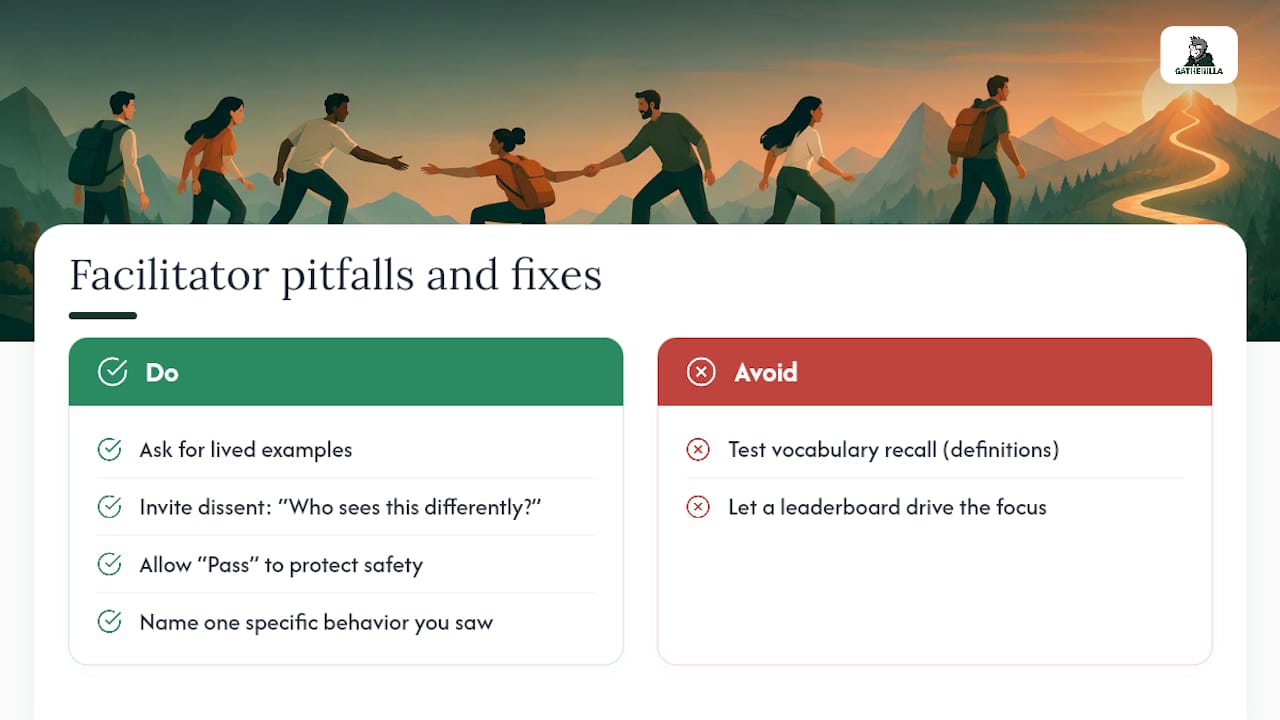
Two mistakes repeat constantly. Treating values as vocabulary recall, testing whether people can define the word instead of asking for a lived example, and letting a leaderboard steal focus from the evidence behind it.
Keep a few lines ready: “Who sees this differently?” to invite dissent, “Pass is completely fine” to protect safety, and end on naming one specific behavior you saw, not a generic thank you.
— Thomas
Run These Games Without the Setup Headache
Most of the friction in values work isn’t the exercise itself, it’s the logistics: finding a tool, building a template, chasing people to open one more app. There are platforms that run games directly in the browser with no downloads and no accounts required for participants, serving as alternatives to cobbling together whiteboards and poll links for remote and hybrid teams.
That matters most for HR professionals and team leaders running these sessions repeatedly rather than once a year. Some multiplayer games include peer-to-peer recognition features aligned to how teams name their values, plus a daily challenge format that maintains engagement between bigger workshops instead of letting it fade after a single meeting. Setup can be quick and straightforward, not requiring a lengthy planning session.
Start with the free tier to run your first card sort or scenario-voting session this week, or check the Premium plan if you want ongoing analytics and priority support for recurring values work across the team.
Where This Guidance Comes From
- SHRM’s five-step values workshop model, the basis for the affinity-mapping and scenario-voting formats above
- The serious-play randomized controlled trial showing cohesion drives team-effectiveness gains
- SHRM’s psychological safety guidance for debrief and dissent rules
- Continuous training as a complement to one-off exercises, for teams pairing values games with ongoing skill development
Sources
- 5 steps to discover your organization’s core values
- Gamification-based intervention for enhancing team effectiveness and coping flexibility: Randomized controlled trial
- Finding your Totem: effects of a positive technology intervention on employees
- Create a psychologically safe workplace to foster inclusiveness
FAQ
How Many Core Values Should a Company Have?
There’s no fixed number. Atlassian runs on five, IKEA lists eight, and PayPal uses four, so the right count is whatever your team can actually recall and apply in a decision. Fewer, behaviorally specific values beat a long list nobody remembers.
What Are Some Fun Corporate Game Ideas for Teaching Values?
Card sorts, scenario voting, values auctions, and story circles all work well because they force a decision rather than a definition. Escape-room style dilemma chains and peer-recognition rounds add variety for teams that have already done the basics.
What Are Good Values-Based Activities for a Remote Team?
Browser-based card sorts, shared whiteboards for affinity mapping, and live polls for scenario voting all translate directly to remote settings. A platform like Gatherilla runs these formats with no downloads, which removes the setup friction that usually kills remote engagement sessions.
How Do I Keep a Values Game From Feeling Forced or Awkward?
Never require personal disclosure. Offer fictional scenarios, allow a pass, and give people the option to contribute anonymously if the group is new to this kind of exercise. SHRM’s inclusion guidance centers on asking questions rather than demanding answers, which lowers the pressure considerably.
How Long Should a Values Game Session Run?
Most single-exercise sessions run 30 to 60 minutes. Reserve 90 minutes only when the group is drafting or revising the values themselves, since that process needs more discussion time than reinforcing values that already exist.