

Sprint Retrospective Icebreakers for Agile Teams, 2–10 Minute Picks

This article gives you a copyable bank of sprint retrospective icebreakers organized by time and mood, plus two facilitator scripts you can run today. The rule of thumb: spend 2 to 10 minutes on the icebreaker, no more than 5 to 10% of the total retro, and pick based on how the sprint actually went, respecting adaptable timing.
TL;DR:
- Teams should choose icebreakers based on current energy levels and sprint outcomes, favoring simple, low-effort prompts when the team is exhausted.
- Timeboxing icebreakers to no more than 10% of the retro duration ensures they support, not hinder, the main discussion.
- Facilitators modeling participation and answering their own prompts encourage honesty and trust, especially during remote or hybrid retrospectives.
- Rotating question types every few sprints prevents boredom and maintains engagement, rather than relying on repetitive warmup questions.
- Using visual, chat-based, or no-download tools enhances participation and reduces setup friction for distributed teams.
Table of Contents
- Sprint Retrospective Icebreakers Organized by Time and Energy
- How to Choose the Right Icebreaker for Your Team
- Two Ready-to-Run Facilitator Scripts
- Remote and Hybrid Retrospective Icebreaker Options
- Keeping Icebreakers Fresh Without Turning Them Into a Ritual
- Why Consistency Beats Cleverness in Retro Facilitation
- Try a No-Download Icebreaker Before Your Next Retro
- Where This Icebreaker Bank Comes From
- Sources
Sprint Retrospective Icebreakers Organized by Time and Energy
Every prompt below fits a specific window. Grab one, read it out loud, and go. The 50+ Retrospective Icebreaker Questions & Games for Team Warmup guide backs the same principle: cap icebreakers at 5 to 10% of retro time, and sort them by time and energy so you’re never scrambling mid meeting.
Under 2 minutes (quick check-ins)
- One-word check-in. Ask everyone to type one word describing the sprint. 2 min, low energy, good after a rough sprint. Use it when the team looks tired or the sprint ran long.
- 1 to 10 scale. “On a scale of 1 to 10, how did this sprint feel?” Drop numbers in chat, no explanation required. 90 seconds, low energy, best for time crunches.
- Highlight of the week. One quick sentence, no follow up questions allowed. 2 min, medium energy, works any time.
- Mood emoji. Everyone reacts with one emoji in the chat or video call reaction bar. 60 seconds, low energy, ideal for tired or distracted teams.
2 to 5 minutes (reflective prompts)
- “If this sprint were a movie…” Ask for a genre and a one-line pitch. Comedy, horror, slow-burn drama, whatever fits. 3 min, medium energy, great for sprints with mixed results. Segue directly: “Let’s see what scenes we want to cut from the next one.”
- “One thing I wish I’d said sooner.” A gentle nudge toward honesty without putting anyone on the spot. 4 min, medium energy, use when communication gaps caused friction.
- Share a quick win. Everyone names one thing that went right, personal or team-related. 3 min, medium energy, strong opener after a stressful release.
5 to 10 minutes (playful and connection-building)
- Sprint as a metaphor. “This sprint was like a ______ because ______.” Weather, a road trip, a kitchen disaster. It surfaces real feelings through a low-stakes frame. 6 min, high energy, best when morale is already decent.
- Two Truths and a Lie. Classic format, sprint-themed version works too (“two things that shipped, one that didn’t”). 8 min, high energy, good for team-building outside crunch weeks.
- Superpower round. “If you had a superpower for next sprint, what would it be and why?” 5 min, medium-high energy, useful for onboarding new teammates.
- Five-word sprint summary. Everyone writes exactly five words describing the sprint, then reads them aloud. 5 min, medium energy, works well when you want brevity and a laugh.
These map to the categories TeamRetro recommends for retro-specific ceremonies: short, psychologically safe, and matched to the room’s actual state, not a generic warmup pulled from a workshop deck.
How to Choose the Right Icebreaker for Your Team
Picking the wrong prompt for the moment is the fastest way to kill momentum before the retro even starts. The fix is a simple two-part check.
- Read team energy first. A drained team after a death-march sprint needs a low-effort, low-judgment prompt (one-word check-in, mood emoji). A confident team coming off a clean release can handle something playful like Two Truths and a Lie.
- Match the sprint outcome. If the sprint hit every goal, lean into celebration prompts (quick win, superpower round). If it missed the mark, choose reflective but non-blaming prompts (“one thing I wish I’d said sooner”) rather than anything that sounds like an evaluation.
- Timebox it, strictly. A 10-minute icebreaker in a 60-minute retro eats a sixth of your working time. Set a visible timer and stick to it, even mid-sentence.
- Answer first, every time. Facilitator modeling matters more than the question itself. ICAgile points out that facilitators who answer their own prompt before asking the team unlock noticeably more honest responses.
- Never force a response. Let quiet teammates pass, answer in chat, or submit anonymously through a shared board. Forced participation defeats the entire point of building safety.
Two Ready-to-Run Facilitator Scripts
Copy these directly. No prep required.
- The 2-minute check-in script. Open with: “Before we dig into the sprint, quick check-in: on a scale of 1 to 10, how did this sprint feel for you? I’ll go first. I’m at a 6, mostly because of the deploy delay Thursday.” Let two or three answers land, then close with: “Good, that gives us a read on the room. Let’s move into what worked and what didn’t.”
- The 5-minute activity script. Setup: “We’re doing ‘sprint as a metaphor.’ Take 90 seconds to think of one. I’ll start: this sprint was like a canoe with one paddle, because we kept moving but only in circles.” Give the team 3 minutes to share, one at a time. Jot down one or two recurring themes on a shared board, then transition: “I noticed a few of you mentioned pacing. Let’s put that on the board as a discussion topic.”
Remote and Hybrid Retrospective Icebreaker Options
Distributed teams need icebreakers that survive spotty video, muted mics, and time zone fatigue. Atlassian’s guidance on revitalizing retrospectives points to chat-first and visual-signal options as the most reliable fallback when full video participation isn’t realistic.
- Use chat-based scales or emoji reactions instead of asking everyone to unmute, especially in larger or bandwidth-constrained groups.
- Drop prompts on a shared board or sticky-note tool before the retro starts, so quieter or asynchronous teammates can respond on their own schedule.
- Offer written prompts alongside spoken ones, and always allow captions for anyone who needs them.
- Let anyone pass without explanation. A quiet “skip” option keeps remote retros just as safe as in-person ones.
For teams running fully remote ceremonies, Gatherilla’s guide to remote icebreaker games covers no-download formats that avoid the setup friction that kills momentum before a call even starts.
Keeping Icebreakers Fresh Without Turning Them Into a Ritual
Rotate your question type every 3 to 4 sprints. Reusing the same prompt for six months in a row turns a useful warmup into background noise the team tunes out.
- Do: model your own answer first, timebox strictly, and always leave responses optional.
- Don’t: ask anything that sounds like a performance judgment, and don’t let one enthusiastic answer eat five minutes of storytelling.
- Don’t: skip icebreakers entirely just because the team seems busy. A rushed retro produces shallower feedback.
For retros where past prompts have surfaced tension, a resource like MMDC Alchemy’s coaching guide for difficult workplace conversations offers a useful framework for handling responses that get more candid than expected.
Pro Tip: Track one simple signal, who answers first without being called on, or how many concrete action items came out of the retro. If that number climbs after a few sprints, your icebreaker rotation is working.
Why Consistency Beats Cleverness in Retro Facilitation
The best icebreaker question in this article won’t fix a retro where the facilitator never answers first or lets silence turn into judgment. Teams open up because a pattern gets established sprint after sprint, not because one prompt was clever. A one-word check-in run the same honest way every two weeks builds more trust than a rotating carousel of elaborate games that make people feel watched.
Quick, no-download formats matter here too. Anything that adds setup friction, a login, a plugin, a five-minute tutorial, quietly tells the team the warmup isn’t worth their time. Tools built for remote teams, Gatherilla among them, work because they strip that friction out entirely.
— Thomas
Try a No-Download Icebreaker Before Your Next Retro
If your team is scattered across time zones or half the room is on video and half is dialing in, the setup itself becomes the barrier, not the question. Some team building games run entirely in the browser, so there’s no download, no plugin, and no five-minute tech check eating into your actual retro time.
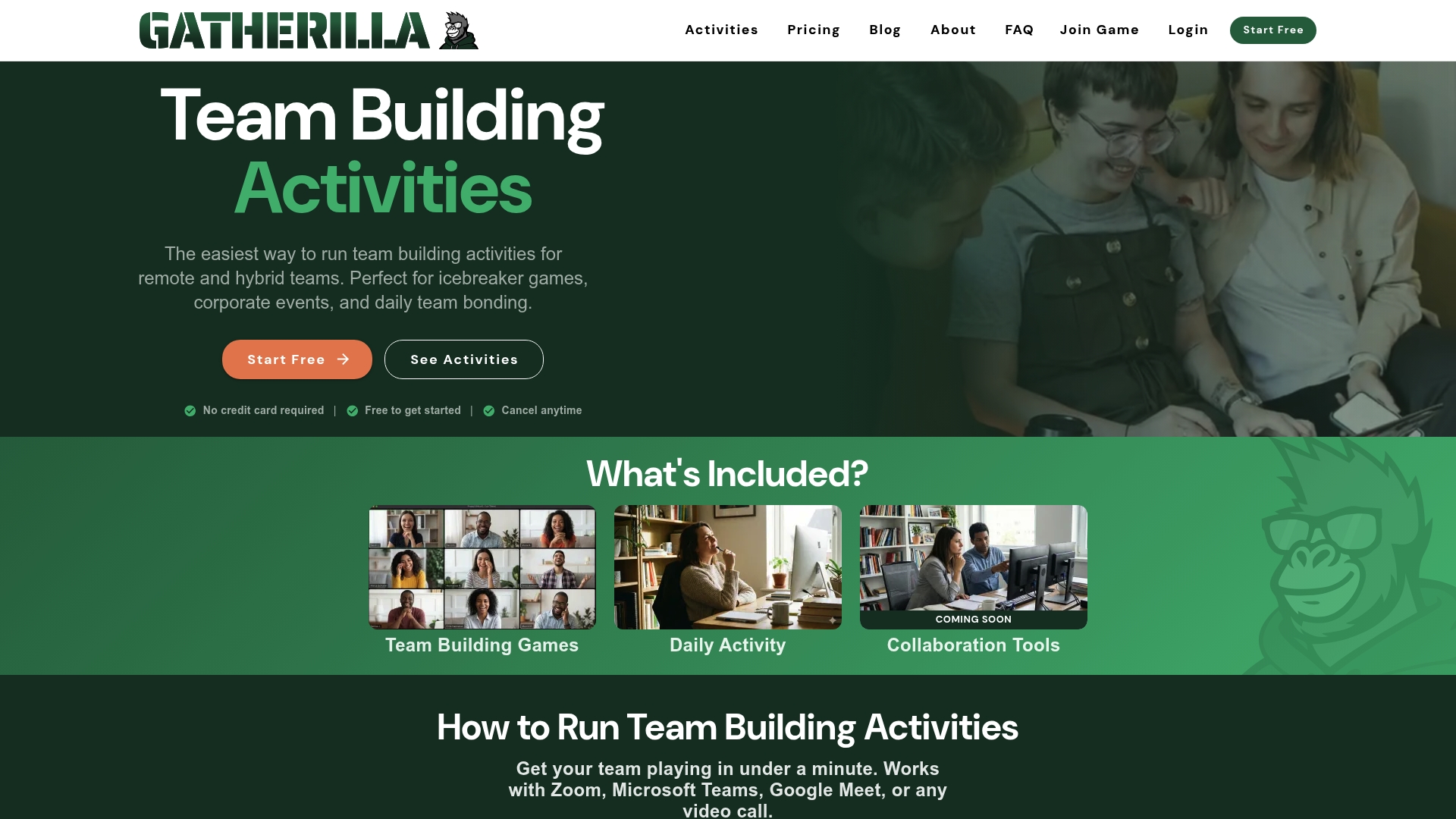
Try one of the quick check-ins from the bank above, or run a short bingo-style warmup before your next sprint retrospective to see how it changes the energy in the room. Gatherilla’s team building games platform is built for exactly this: quick setup, works with whatever video tool your team already uses, and daily challenges that keep momentum going between retros, not just during them.
Where This Icebreaker Bank Comes From
- RetroFlow’s 50+ retrospective icebreaker questions
- TeamRetro’s ceremony-specific icebreaker guidance
- ICAgile’s expert-recommended retro questions
- Atlassian’s techniques for revitalizing retrospectives
- Wrike’s guide to sprint retrospective games
Sources
- 50+ Retrospective Icebreaker Questions & Games for Team Warmup
- Icebreaker questions for agile and scrum teams | TeamRetro
- 5 Sprint Retrospective Ice Breaker Questions
- Sprint retrospective games: Ideas, benefits, and tips
- Revitalize retrospectives with fresh techniques (Atlassian)