

12 Week Quarterly Team Competition Blueprint for HR Leaders

Run short, mixed-format quarterly team competitions built on weekly micro-challenges, a midquarter checkpoint, and a final event, scored on a simple leaderboard with rewards for improvement, not just wins. Plan on roughly 3 to 5 hours of setup time per quarter and a modest budget split between small weekly prizes and one bigger finale reward. A platform designed for remote team building can handle the logistics so the program runs itself.
TL;DR:
- Micro-challenges require minimal prep and are ideal for remote and hybrid teams, with just 3 to 5 hours of setup per quarter.
- Team formation should be carefully randomized or skill-balanced to prevent dominance, with fairness mechanisms like handicaps and participation points.
- Using a simple scoring system that normalizes points across different challenge types maintains trust and clarity in leaderboard standings.
- Remote participation can be optimized by asynchronous activities, accessible formats, and scheduling varied session times to include all time zones.
- Platforms like Gatherilla can automate micro-challenges and scoring, reducing manual effort and supporting consistent quarterly competitions.
Table of Contents
- What Quarterly Team Competitions Should Actually Look Like
- How Do You Structure a Quarter-Long Competition?
- Copy This 12-Week Calendar and Adapt It
- Scoring Systems and KPIs That Actually Prove Impact
- Prize Structures That Motivate Without Playing Favorites
- Making Remote and Hybrid Teams Full Participants
- Warning Signs a Competition Has Gone Wrong
- How Gatherilla Fits Into the Quarter Blueprint
- Why Recurring Beats One-Off Every Time
- Ready to Run Your First Quarter?
- Sources
What Quarterly Team Competitions Should Actually Look Like
Not every quarter needs the same format, and forcing one style on every team is how engagement dies by week 6. The right structure depends on team size, how distributed the group is, and whether you’re optimizing for fun, performance, or skill-building. Here are the six formats that consistently work for team building challenges, along with when to reach for each one.
Micro-challenge series. Daily or weekly 5 to 15 minute activities like trivia, word puzzles, or quick polls. Best for distributed or hybrid teams where getting everyone in one room is hard. Prep is minimal, almost none if you’re using a ready-made tool, and this format is specifically effective for remote and hybrid teams because it requires little setup while keeping engagement steady week over week. Example: a five-question trivia round every Monday morning, scored and added to a running leaderboard.
Office Olympics. A single multi-event day (or a string of them) mixing physical, mental, and creative challenges. Best for co-located or hybrid teams with a day to dedicate to it. Prep is moderate, since you need at least four distinct events and a scoring system ready. Playbooks for this format recommend a simple per-event point scale like 3/2/1/0, which keeps the math easy enough that nobody needs a calculator to know where they stand.
Goal-driven metrics contests. Teams compete on a real business number, like fewer support tickets escalated or faster onboarding completion. Best for performance-minded teams (sales, support, ops) that already track weekly metrics. Prep is low if the metric already exists in your dashboards. Example: whichever support pod resolves tickets fastest for four straight weeks gets the trophy.
Innovation sprints. Short bursts (a week or two) where teams pitch and build a small improvement, then present to leadership. Best for product, engineering, or marketing teams. Prep is higher, since you need judges and a pitch format ready. This format leans on the same instinct behind curiosity-driven performance gains, turning competitive energy into actual process improvements.
Wellness challenges. Step counts, hydration streaks, sleep tracking, or mindfulness minutes, usually run over 2 to 4 weeks. Best for any team, especially ones coming off a stressful stretch. Prep is low with a shared tracking sheet or app.
Hybrid tournament. A bracket-style knockout spread across the quarter, blending trivia rounds with skill challenges. Best for larger organizations (50+ employees) that want a season-long narrative. Prep is high, closer to running a small league than a single event, similar to the staged qualification and knockout structure used in organized competitive leagues.
Pick based on your calendar constraints first, your team’s personality second. A finance team that hates public failure will resent an Office Olympics day but will happily grind a quiet metrics contest.
How Do You Structure a Quarter-Long Competition?
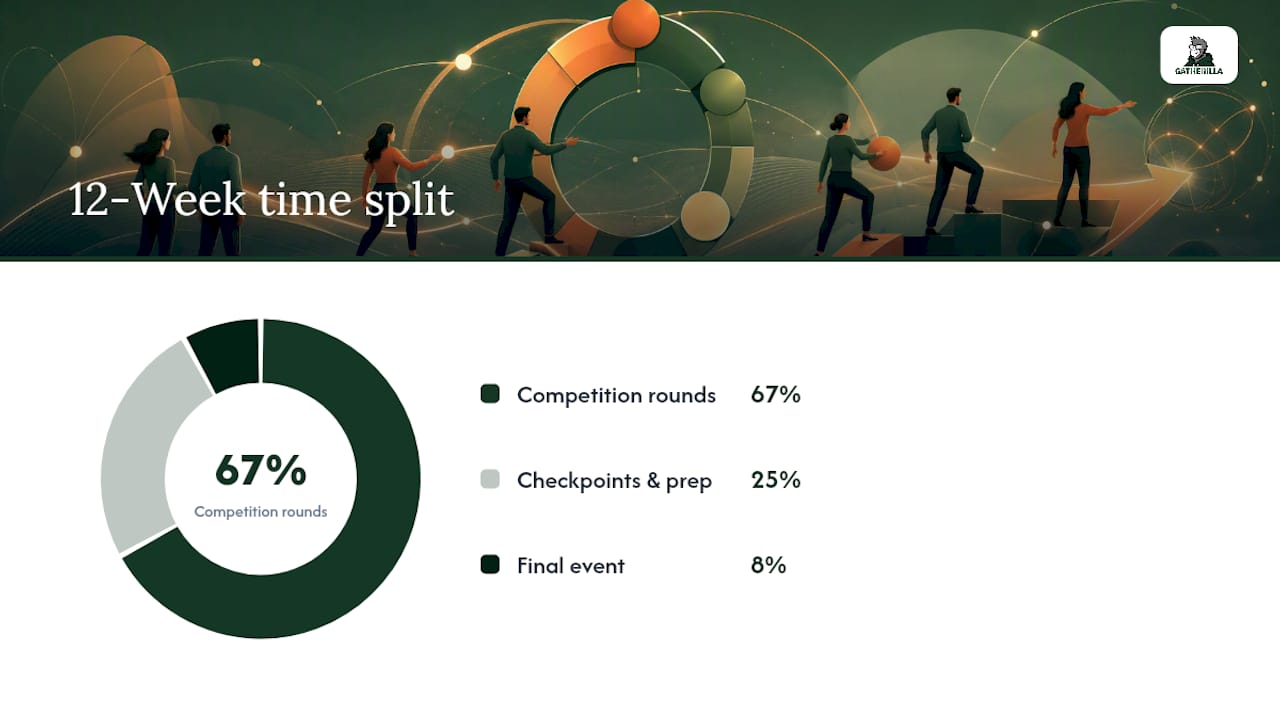
A 12-week window gives you enough runway to build momentum without the fatigue that kills longer contests. Here’s the blueprint:
- Week 1: Kickoff. Announce the format, form teams, publish the rulebook, and open the leaderboard at zero.
- Weeks 2 to 5: Round one of weekly micro-challenges, light and low-stakes to build the habit.
- Week 6: Midquarter checkpoint. Publish standings, award a small “most improved” prize, and adjust anything that’s not working.
- Weeks 7 to 10: Round two, slightly higher stakes, possibly a mini-tournament bracket.
- Week 11: Finals prep, announce the final event and rules.
- Week 12: Final event and awards.
Team formation matters more than most HR leaders expect. Random draws feel fair but often stack one team with all the naturally competitive people. A better approach: rank employees informally by tenure or role seniority, then snake-draft teams so skill and energy are distributed evenly.
Build in fairness mechanisms from day one, not as a patch after someone complains. Handicaps (bonus points for smaller teams), improvement prizes (separate from the overall win), and participation points (showing up earns something even without winning) all keep morale intact. This mirrors the guidance that combining team targets with individual improvement measures reduces toxic rivalry and keeps people showing up in week 10 instead of quietly opting out in week 3.
Your rulebook needs four things: how points are earned, how ties are broken, who resolves disputes, and what happens if someone misses a week. Assign one neutral person, not a team captain, to handle disputes.
Pro Tip: Publish the entire rulebook, including the dispute process, before week 1 starts. Teams that see the rules coming forgive close calls far more easily than teams who feel a rule got invented mid-contest.
Copy This 12-Week Calendar and Adapt It
You don’t need to design this from scratch. Here’s a runnable skeleton.
- Week 1: Kickoff email plus a 10-minute all-hands intro, teams announced, leaderboard live.
- Weeks 2 to 5: One micro-challenge brief per week, sent Monday, due Friday, 15 minutes max time commitment.
- Week 6: Standings email, midquarter mini-tournament (single elimination, one afternoon).
- Weeks 7 to 10: Round two micro-challenges, slightly harder, bonus points introduced.
- Week 11: Finals announcement, rules reminder, logistics email.
- Week 12: Final event, live scoring, awards ceremony (even a 20-minute virtual one works).
Resource estimate for HR: expect 3 to 5 hours of setup across the quarter if you’re building briefs manually, closer to 1 to 2 hours if you’re using a template-based tool that already has activities loaded.
Scoring Systems and KPIs That Actually Prove Impact
Keep the scoring model simple enough to explain in one sentence, or teams will stop trusting the leaderboard by week 3. A workable structure: points per activity completed, bonus improvement points for week-over-week gains, and flat participation points just for showing up. Normalize each event’s point scale so that a single dominant event type, say, a physical challenge that only fit employees can win, doesn’t quietly decide the whole quarter. That’s the same principle behind normalizing point scales across mixed event types in multi-event competitions.
Update the leaderboard weekly if you’re running micro-challenges, or after every event if you’re running a tournament format. Visible standings raise the energy, but pairing a public leaderboard with private improvement tracking prevents the bottom of the board from feeling publicly shamed.
The KPIs that actually matter to leadership:
- Participation rate: percentage of eligible employees who took part in at least one activity.
- Improvement rate: percentage of participants whose scores rose between the midquarter checkpoint and finals.
- Engagement or eNPS lift: pulse survey scores before and after the quarter.
- Business-linked metrics: if you ran a goal-driven contest, tie it to the actual metric moved (tickets closed, onboarding time, etc.).
Build a one-page report with four numbers, participation, improvement rate, eNPS delta, and total cost per participant. That’s the whole pitch to leadership for next quarter’s budget.
Prize Structures That Motivate Without Playing Favorites
Cash and gift cards work, but they’re not the only lever, and they’re often not even the most effective one. Consider a mix:
- Monetary: gift cards, bonus PTO days, small cash prizes for the top team.
- Experiential: team lunch, an offsite afternoon, a charitable donation made in the winning team’s name.
- Recognition-only: a traveling trophy that moves desks each quarter, digital badges, a shoutout in the company newsletter.
Tier your rewards so winning isn’t the only path to something good. A separate “most improved” prize and a “most consistent participation” prize both matter, and they’re specifically what design guidance on healthy competition recommends to keep engagement broad rather than concentrated on three competitive people. Wellness-themed prizes (a fitness tracker, a spa gift card) also tie neatly into broader workplace health promotion goals if your quarter includes a wellness challenge.
Making Remote and Hybrid Teams Full Participants
Distributed teams get left out of quarterly competitions more often than HR realizes, usually because the format assumes everyone’s in the same building. Fix that by defaulting to browser-based, no-download activities that anyone can join from a laptop in any time zone, following proven remote collaboration best practices to keep everyone engaged.
- Offer asynchronous task windows (a 24 to 48 hour deadline) instead of forcing a single live session.
- Schedule any live events with rotating start times, or record them, so no region is permanently stuck attending at 7 AM.
- Check every activity for accessibility: captions on video challenges, alt text on visual puzzles, and tasks that don’t require a specific physical ability.
- Try short remote-friendly formats like a five-minute trivia round or a photo-based scavenger hunt, both of which work well because combining scheduled live events with asynchronous tasks lets remote employees participate without forcing inconvenient synchronous windows.
Moderate remote challenges the same way you’d moderate an in-person one: one point of contact who confirms submissions and resolves timing disputes fast.
Warning Signs a Competition Has Gone Wrong
Watch for three signals: participation dropping week over week, complaints about “the same people always winning,” or side comments that sound more resentful than playful. Workplace stress already carries a real financial and productivity cost, and a poorly designed contest can quietly add to that instead of relieving it.
Quick fixes: rebalance scoring toward improvement rather than raw totals, anonymize any metric that could embarrass someone publicly, and add a participation prize immediately if engagement is sliding.
Pro Tip: Run a 15-minute retro with team captains right after the finals, three questions: what felt fun, what felt unfair, what should change. That’s usually enough to fix next quarter’s design.
- If morale keeps dropping despite fixes, pause the contest and tell the team directly why, framing it as a redesign, not a cancellation.
How Gatherilla Fits Into the Quarter Blueprint
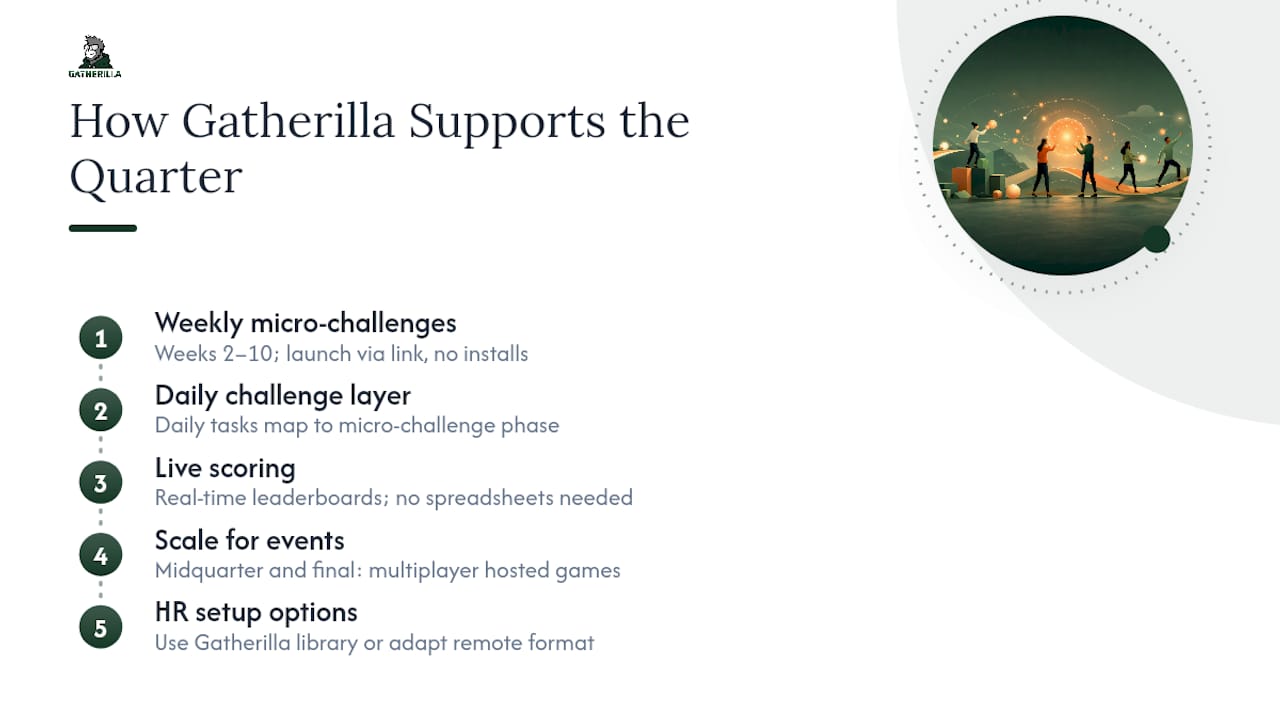
A browser-based team building platform can enable weekly micro-challenges to launch with a link, no downloads, app installs, or IT tickets. That matters most in weeks 2 through 10 of the calendar above, when you need a new activity ready every week without burning HR hours building it from scratch.
Such platforms often include daily challenges that map directly onto the micro-challenge phase of the quarter, with real-time leaderboards handling visible scoring without spreadsheets. For the midquarter checkpoint and final event, similar multiplayer games can scale up as live, hosted sessions. HR teams building their first calendar can start with Gatherilla’s engagement game library or adapt a remote-specific challenge format for distributed teams.
Why Recurring Beats One-Off Every Time
One-off events spike energy for a week and fade. A recurring quarterly rhythm builds a habit people plan around, and the improvement data compounds instead of resetting to zero each time. Do: reward improvement, publish rules early, keep formats short, rotate captains, and measure participation honestly. Don’t: let one clique dominate every leaderboard, skip the retro, over-schedule live events for remote teams, or let prizes outweigh recognition.
— Thomas
Ready to Run Your First Quarter?
There are plenty of ways to build a quarterly competition by hand: spreadsheets for scoring, a shared doc for rules, someone on the team designing trivia questions at 9 PM before the deadline. That works, but some platforms aim to remove hours of setup entirely. Browser-based games can launch instantly for remote and hybrid teams, requiring no downloads or complex scheduling, with leaderboards and daily challenges supporting a 12-week rhythm.
If you’re ready to stop building activities from scratch every week, visit Gatherilla to see the game library and start a trial. You’ll get ready-made micro-challenges, live leaderboards, and a setup that takes minutes instead of hours, so your next quarter starts running itself from week 1.