

25 New Employee Orientation Games for HR Teams

The fastest way to integrate a new hire socially is to pair a quick short name game with one collaborative activity lasting a moderate length of time. That combination covers both immediate comfort and deeper team connection before the first day ends.
Top picks by setting:
- In-person: Office Scavenger Hunt (20–30 min, any group size) gets new hires moving through the space while meeting colleagues naturally. Company Bingo (10 min, 8–30 people) works as a low-pressure opener with zero prep beyond a printed card.
- Virtual: A virtual scavenger hunt (20–30 min, 5–50 people) structures discovery through short missions. Quick trivia (5–10 min, unlimited) works as a warm-up before any video call.
- Hybrid: Pair a buddy intro (5 min, 1:1) with a group problem challenge (30 min, 8–20 people) so in-room and remote participants both have a role.
The 4 C’s of orientation (compliance, clarification, culture, connection) give you a framework for choosing which game to run when. Practitioners consistently find that 20–40 minutes is the sweet spot for collaborative activities, while quick icebreakers under 10 minutes work better as daily micro-touchpoints during the first week.
Pro Tip: Run the name game before any content-heavy segment. Social comfort lowers cognitive load, so new hires absorb policy information better after they’ve laughed with a colleague.
Gatherilla’s browser-based platform requires no downloads and plugs into any video conferencing tool, making it a practical starting point for remote and hybrid onboarding sessions.
Table of Contents
- Why onboarding games actually move the needle on retention
- 25 ready-to-run onboarding games, organized by time and setting
- How to run these games without awkwardness
- Sample 30/60/90-minute onboarding game plans
- How to handle resistance and common facilitation challenges
- How to customize games for your industry and culture
- Key Takeaways
- What actually makes onboarding games succeed or fail
- Gatherilla makes remote onboarding games effortless
Why onboarding games actually move the needle on retention
Games reduce information overload and build emotional connection when paired with social integration activities. That matters because the biggest failure mode in orientation is not a bad game. It’s a slide deck that runs 90 minutes with no human interaction.
The 4 C’s give each activity a job:
- Compliance: Scavenger hunts that route new hires through HR stations or safety checkpoints turn required stops into a mission.
- Clarification: Trivia and role-specific Q&A games surface process questions in a low-stakes format.
- Culture: Company Bingo and “Two Truths and a Lie” reveal personality and shared values without a formal presentation.
- Connection: Buddy programs and paired intros create sustained support that outlasts the orientation day itself.
Two common pitfalls to avoid: information dumping (back-to-back slides with no interaction) and game fatigue (too many activities crammed into one session). One or two well-chosen games land better than five rushed ones.
25 ready-to-run onboarding games, organized by time and setting
The table below gives you a quick scan by time investment, social payoff, and prep level before you read the full descriptions.
| Activity | Setting | Time | Group Size | Prep Level | Social Payoff |
|---|---|---|---|---|---|
| Two Truths and a Lie | Any | 5–10 min | 4–12 | Low | High |
| Emoji Check-In | Virtual | 5 min | Any | None | Medium |
| Company Bingo | Any | 10–15 min | 8–30 | Low | High |
| Name Aerobics | In-person | 10 min | 8–25 | None | Medium |
| Mingle Mingle Mingle | In-person | 10–15 min | 15+ | None | High |
| Office Scavenger Hunt | In-person | 20–30 min | Any | Medium | High |
| Virtual Scavenger Hunt | Virtual/Hybrid | 20–30 min | 5–50 | Medium | High |
| Team Trivia | Any | 15–20 min | 6–40 | Low | Medium |
| Shared Playlist | Virtual | Async | Any | None | Medium |
| Photo Sharing | Virtual | Async | Any | None | Medium |
| Buddy Intro | Any | 5 min | 1:1 | None | High |
| Problem Challenge | Any | 30–40 min | 8–20 | Medium | High |
| Word Link | In-person | 5–10 min | 4–15 | None | Medium |
| Superlatives | Any | 10–15 min | 10–30 | None | High |
| Role-Play Scenario | Any | 20–30 min | 4–12 | Medium | Medium |
Quick icebreakers (5–10 min)
1. Two Truths and a Lie Everyone writes three statements: two true, one false. The group guesses the lie. Works in-person and in breakout rooms for virtual sessions. No materials needed. For large groups (20+), run it in parallel breakout rooms of 6–8.
2. Emoji Check-In Post a question in chat (“How are you feeling about your first week?”) and ask everyone to reply with one emoji. Zero prep, works in any video platform, and gives the facilitator a real-time read on the room. Pairs well with a quick verbal share from two or three volunteers.
3. Word Link One person says a word; the next adds a word that connects to it. The chain grows until someone breaks it. Fast, funny, and requires nothing but a circle of people. Scales to any size by running multiple simultaneous chains in breakout rooms.
4. Buddy Intro Pair each new hire with a tenured employee before orientation starts. Give them three questions to answer together (one work-related, one personal, one about the company). They introduce each other to the group. Takes 5 minutes and creates a relationship that outlasts the event.
5. Emoji Questions Ask a series of rapid-fire questions (“What’s your energy level right now?”) and have participants respond with emojis in the chat. The facilitator reads patterns aloud. Runs in under 5 minutes and works as a recurring daily touchpoint during the first week.
Short group activities (10–20 min)
6. Company Bingo Each square contains a prompt like “has worked in another country” or “knows the CEO’s first pet’s name.” Players circulate to find colleagues who match. Bingo-style prompts work in-person or remotely with a shared digital card. Low prep, high conversation rate.

7. Name Aerobics Each person introduces themselves with a motion for every syllable of their name. The group repeats it. Sounds silly; works remarkably well for large cohorts where remembering 20 names is a real challenge. Best for in-person groups of 8–25.
8. Mingle Mingle Mingle The facilitator calls out a category (“find someone who grew up in a different state”). Participants circulate and find a match. Repeat with new categories. Scales naturally to groups of 15 or more and surfaces common ground fast.
9. Superlatives Split into groups of 8. Each group arranges itself by a category (birth month, years of experience, distance traveled to get here). First group in correct order wins. Works in-person and, with a shared whiteboard, in virtual sessions.
10. Team Trivia Five to ten questions about company history, products, or industry facts. Teams compete for a leaderboard spot. Covers the “clarification” C by surfacing what new hires already know and what needs reinforcement. Gatherilla’s platform runs this with real-time leaderboards and no extra setup.
Deep collaborative activities (20–40+ min)
11. Office Scavenger Hunt New hires complete a list of missions: find the fire exit, introduce yourself to someone in finance, locate the employee handbook. Turns a building walkthrough into a structured discovery. For large cohorts, run teams of 4–6 in parallel.

12. Virtual Scavenger Hunt Missions include photo submissions, short video clips, or text answers about the company’s digital tools and resources. Digital missions can include GPS check-ins, photo challenges, or short quizzes. Runs in any browser; no app download required.
13. Problem Challenge Present a realistic (but low-stakes) business scenario. Teams have 25 minutes to propose a solution and present it in 3 minutes. Covers clarification and culture simultaneously. Works in-person, virtual, or hybrid with breakout rooms.
14. Role-Play Scenario Pairs or small groups act out a customer interaction, internal meeting, or common workflow. Debrief focuses on what felt natural and what raised questions. Best for customer-facing roles or teams with complex internal processes.
15. Shared Playlist Set up a collaborative Spotify playlist and invite everyone to add two songs before orientation. Play it as background during breaks. Async, zero friction, and gives the facilitator conversation starters (“I noticed three people added the same artist”).
Company culture and gamified activities
16. Culture Trivia Questions about company values, founding story, and notable milestones. Pairs naturally with a leaderboard. Badges or small prizes for top scorers increase early engagement and give HR a measurable completion signal.
17. Photo Sharing Set a theme (“share a photo that represents your work style”). Participants post in a shared channel before or during orientation. The facilitator highlights patterns. Works asynchronously for distributed teams and generates genuine conversation.
18. Would You Rather? Two-option questions with a work or culture angle (“Would you rather have a standing desk or a private office?”). Fast, low-pressure, and reveals personality without requiring vulnerability. Runs in 5 minutes as a warm-up or transition activity.
19. Shared Values Sort Give teams a list of 15 company-adjacent values and ask them to rank the top 5 for the team. Compare rankings across groups. Generates real discussion about culture and surfaces assumptions early.
20. Department Bingo A variation of Company Bingo where each square names a department or role. New hires find someone from each area. Particularly effective in large organizations where cross-functional visibility is low.
Role-specific and skills games
21. Process Relay Each team member explains one step of a key workflow, then passes to the next. The group reconstructs the full process at the end. Works for operations, customer service, and technical teams. Surfaces gaps in process knowledge without a formal quiz.
22. “Name That Tool” Trivia Show screenshots or descriptions of internal tools and ask teams to identify them. Covers the clarification C efficiently. Runs in 10–15 minutes with a slide deck or a shared screen.
23. Scenario Cards Pre-written cards describe a workplace situation. Pairs discuss how they’d handle it, then share with the group. Low prep, high discussion value, and easily customized to industry or role.
24. Minute to Win It Challenges Short, silly physical or digital challenges (stack paper cups, type a phrase fastest) that run 60 seconds each. Remote-friendly versions work well as energy breaks between content-heavy segments. No prep beyond a timer.
25. Leaderboard Challenge Run a points-based system across the full orientation day. Points for completing missions, answering trivia, and participating in discussions. The leaderboard updates in real time. Gatherilla handles this natively; for in-person sessions, a shared whiteboard works fine.
How to run these games without awkwardness
A game that lands well in one team can fall flat in another. The difference is almost always facilitation, not the activity itself.
Before the session:
- Test all technology (links, audio, screen share) at least 30 minutes before start.
- Walk through every mission or question yourself to catch broken links or confusing instructions.
- Assign a co-facilitator for groups over 15 so one person manages logistics while the other runs the activity.
- Send a mobile-friendly checklist to participants the day before: what to have ready, how to join, what to expect.
- Prepare a backup activity in case a tool fails or a game runs short.
During the session:
- Make participation opt-in where possible. “You can share or pass” removes the pressure that kills psychological safety.
- Read the room. If energy drops, cut a planned activity and move to a shorter one.
- Avoid activities that require physical contact or personal disclosure beyond what participants volunteered.
- For hybrid sessions, name a dedicated remote monitor who watches the video feed and flags when remote participants are being talked over.
After the session:
- Run a 3-minute debrief. Ask: “What’s one thing you learned about a colleague?” or “What’s one process question you still have?”
- Send a one-question follow-up survey within 24 hours: “How connected do you feel to your team right now?” on a 1–5 scale.
- Track participation rate per activity. If fewer than 70% of attendees engaged with a specific game, swap it next cycle.
Pro Tip: Avoid scheduling more than two games in a single orientation block. Three or more activities in 90 minutes creates game fatigue, and participants stop engaging authentically. One strong collaborative activity plus one quick icebreaker is enough.
Accessibility and inclusion notes:
- Offer text-based alternatives to voice-only activities for participants with hearing impairments.
- Avoid activities that assume physical mobility (some scavenger hunt formats) without a seated alternative.
- Use plain language in all prompts; avoid idioms that may not translate across cultures.
- For team building games that don’t make people cringe, the common thread is always opt-in mechanics and clear instructions.
Sample 30/60/90-minute onboarding game plans
These agendas slot directly into a standard orientation schedule. Adjust game selections based on group size and setting.
30-minute plan (virtual or hybrid)
| Time | Activity | Notes |
|---|---|---|
| — | Emoji Check-In | Facilitator reads patterns aloud |
| 5–10 min | Virtual Scavenger Hunt | 3–4 missions; teams of 4–5 |
| 20–30 min | Debrief | “One thing you discovered about the company” |
| 20–30 min | Leaderboard reveal | Optional; Gatherilla handles automatically |
60-minute plan (in-person or hybrid)
| Time | Activity | Notes |
|---|---|---|
| — | Two Truths and a Lie | Groups of 6; run in parallel |
| 20–30 min | Office or Virtual Scavenger Hunt | Teams of 4–6 |
| 20–40 min | Team Trivia (culture + clarification) | Leaderboard visible to all |
| — | Debrief | “One process question I still have” |
| — | Buddy assignment | Pairs confirmed; first check-in scheduled |
90-minute plan (full onboarding session)
| Time | Activity | Notes |
|---|---|---|
| 5–10 min | Mingle Mingle Mingle or Name Aerobics | Energy opener |
| 20–40 min | Problem Challenge | Breakout rooms; 3-min presentations |
| — | Culture Trivia with leaderboard | Gamified; badges optional |
| — | Shared Values Sort | Cross-team discussion |
| 1:10–1:25 | Role-Play Scenario | Role-specific pairs |
| 1:25–1:30 | Debrief + follow-up survey link | Sent via chat or email |
Remote and hybrid setup checklist:
- Confirm camera and microphone permissions for all participants before the session.
- Create breakout rooms in advance (Zoom, Google Meet, or Microsoft Teams all support pre-assignment).
- Share the join link in the calendar invite, not just in email, so it’s one click from any device.
- Use a browser-based platform to eliminate the “I can’t install that” friction that kills participation before the game starts.
- Assign one person as the technical host and a separate person as the game facilitator.
Pro Tip: For the calendar invite, include a one-line description of what participants will do (“You’ll play a short trivia game and meet your buddy”). People engage more when they know what to expect.
Gatherilla runs all of these formats natively: no downloads, real-time leaderboards, and analytics that show you exactly who participated and for how long. The free tier covers basic games; the paid plan unlocks reporting and additional templates for remote team challenges.
How to handle resistance and common facilitation challenges
Not every new hire walks in ready to play. Some are skeptical of “forced fun.” Others are introverted, anxious, or simply exhausted from a long commute or relocation. Here’s how to handle the most common friction points.
“I don’t want to do this.” Acknowledge it directly. Say: “These are optional to lead, but I’d love for you to watch and jump in when you’re ready.” Forced participation backfires; a low-pressure invitation usually works within 5 minutes.
Tech failures in virtual sessions. Have a text-based backup ready. If the scavenger hunt platform goes down, switch to a chat-based trivia round immediately. Participants respect a facilitator who pivots cleanly more than one who spends 10 minutes troubleshooting live.
Dominant personalities taking over. Use timed rounds and structured turn-taking. “Everyone gets 30 seconds” is a simple rule that levels the playing field without singling anyone out.
Cross-cultural discomfort. Some activities (physical games, personal disclosure prompts) land differently across cultures. When your cohort is international, default to task-based games (scavenger hunts, trivia, problem challenges) over personal-sharing formats. Task focus is culturally neutral.
Large groups losing energy. Break into smaller units of 4–8 for any activity over 15 minutes. Large-group games work for openers and closers; sustained engagement happens in small groups.
How to customize games for your industry and culture
A game that works perfectly for a tech startup can feel tone-deaf at a law firm. The fix is not a different game. It’s a different skin on the same mechanic.
Healthcare and regulated industries: Replace pop-culture trivia with compliance-themed questions. A scavenger hunt that routes new hires through safety stations and introduces them to department leads covers both the compliance and connection C’s simultaneously. Keep personal disclosure activities minimal; clinical environments tend toward professional distance early on.
Tech and product companies: Lean into async and digital formats. Shared playlists, emoji check-ins, and virtual scavenger hunts with tool-identification missions fit naturally into a remote-first culture. Leaderboards and badges resonate with teams that already use gamified productivity tools.
Retail and hospitality: Physical energy is an asset. Name Aerobics, Mingle Mingle Mingle, and role-play scenarios based on real customer interactions work well. Keep games short (under 15 minutes) because floor staff often have limited time before shift starts.
Professional services (consulting, finance, legal): Frame every activity around a business outcome. “This problem challenge mirrors a real client scenario” lands better than “let’s play a game.” The mechanics are identical; the framing is professional.
Small teams (≤8): Go deeper. Two Truths and a Lie, Scenario Cards, and Shared Values Sort generate real conversation when the group is small enough for everyone to participate fully. Skip the large-group formats entirely.
Large cohorts (20+): Parallel breakout rooms are your best tool. Run the same activity in groups of 6–8 simultaneously, then bring highlights back to the full group. Icebreaker games for large groups require structure above all else; without it, energy dissipates fast.
Key Takeaways
The single most effective orientation game plan pairs a quick icebreaker with one collaborative activity matched to the 4 C’s of orientation.
| Point | Details |
|---|---|
| Mix short and long activities | Pair a 5–10 min icebreaker with a 20–40 min collaborative game for social integration and information retention. |
| Map games to the 4 C’s | Use trivia for clarification, scavenger hunts for compliance, bingo for culture, and buddy intros for connection. |
| Prioritize low-friction formats | Browser-based, no-download activities remove the participation barrier that kills virtual onboarding games. |
| Always debrief | A 3-minute debrief and a one-question follow-up survey give you measurable engagement data after every session. |
| Use the sample agendas | The 30/60/90-minute plans above are ready-to-copy starting templates for any team size or setting. |
| Gatherilla for remote/hybrid | Gatherilla runs leaderboards, trivia, and scavenger hunts in-browser with no downloads, making it a practical fit for distributed onboarding. |
What actually makes onboarding games succeed or fail
Most orientation game failures share one cause: the activity was chosen for the facilitator’s comfort, not the new hire’s experience. A game that requires no prep and runs itself is tempting. But if it puts new hires on the spot before they feel safe, it does more damage than a slide deck.
The games that consistently work share three traits. They give participants a clear task (not just “introduce yourself”). They create a reason to talk to someone specific, not just the group in general. And they end before anyone is ready for them to end.
The 4 C’s framework is genuinely useful here, not as a compliance checklist but as a design constraint. If you can’t point to which C a game serves, it probably doesn’t belong in the session. That filter alone cuts most of the filler activities that generate eye rolls.
Avoiding information dumping is the most common improvement HR professionals make when they revisit their orientation programs. The second most common is cutting the number of activities, not adding more. One game done well, with a real debrief, is worth more than five games run on autopilot.
Gatherilla makes remote onboarding games effortless
Running orientation games for a distributed team used to mean coordinating downloads, troubleshooting installs, and losing 15 minutes before the first question. Gatherilla removes that entirely.
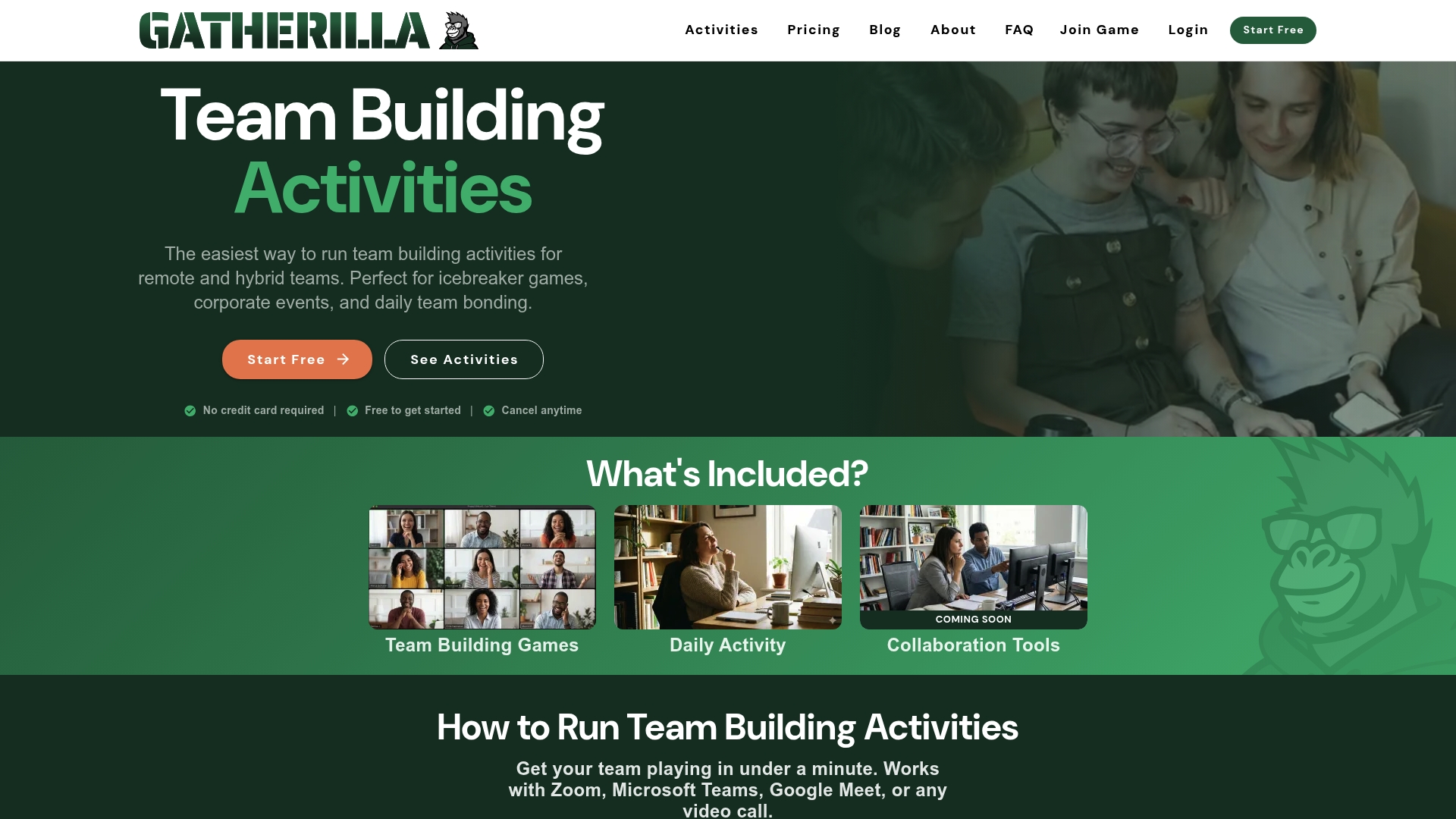
The platform runs in any browser, connects to Zoom, Google Meet, and Microsoft Teams without a plugin, and gives HR teams real-time leaderboards and post-session analytics out of the box. You get templates for 30-, 60-, and 90-minute sessions, a free tier to start immediately, and a paid plan that unlocks full reporting and additional game formats.
- No downloads for participants
- Works with any video conferencing tool
- Real-time leaderboards and engagement analytics
- Templates for every session length
- Free tier available; paid plan adds reporting and priority support
Start your first session today at Gatherilla and have a fully structured onboarding game running before your next new hire’s first day.
Useful sources
- 30 Fun Onboarding Activities and Games for New Hires — practitioner-curated list covering the 4 C’s, activity timing, and social integration benefits; the primary research base for this article.
- How to Run a Digital School Orientation Activity for New Students — step-by-step guide to running digital scavenger hunts with photo, video, and GPS missions; directly applicable to employee onboarding formats.
- Orientation Bingo App — explains how bingo-style prompts accelerate casual conversation in both in-person and remote settings.
- 8 Ways to Create the Best Online Student Orientation — covers virtual welcome activities, gamified checklists, and pre-event engagement tactics.
- 26 Tips for Hosting a Successful and Engaging Virtual Orientation — leaderboard and badge strategies, mobile-friendly checklists, and participation metrics.
- 7 Onboarding Icebreakers for New Team Members — quick-reference guide to low-prep icebreakers including Two Truths and a Lie and Would You Rather for small teams and breakout rooms.
- New Employee Orientation Ideas That Are Actually Good — covers small-team, large-team, and virtual icebreaker formats with facilitation notes.
- Gatherilla: Browser-Based Team Building Games — explains the no-download approach and how browser-first setup reduces participation friction in remote onboarding.
- 50 Virtual Scavenger Hunt Ideas for Remote Teams — a prompt library for building custom scavenger hunt missions into orientation agendas.