

Employee Engagement Trends 2026: What HR Leaders Must Know

What’s actually driving employee engagement in 2026?
The defining shift in employee engagement trends 2026 is not a single technology or policy. It’s a structural break: AI-powered continuous listening has overtaken the annual engagement survey as the primary measurement tool, manager engagement has collapsed by nine points since 2022, and global engagement hit 20% in 2025, its lowest since 2020. For HR leaders, this is not a moment for incremental adjustments.
The trends reshaping 2026 workplace engagement fall into five urgent priorities:
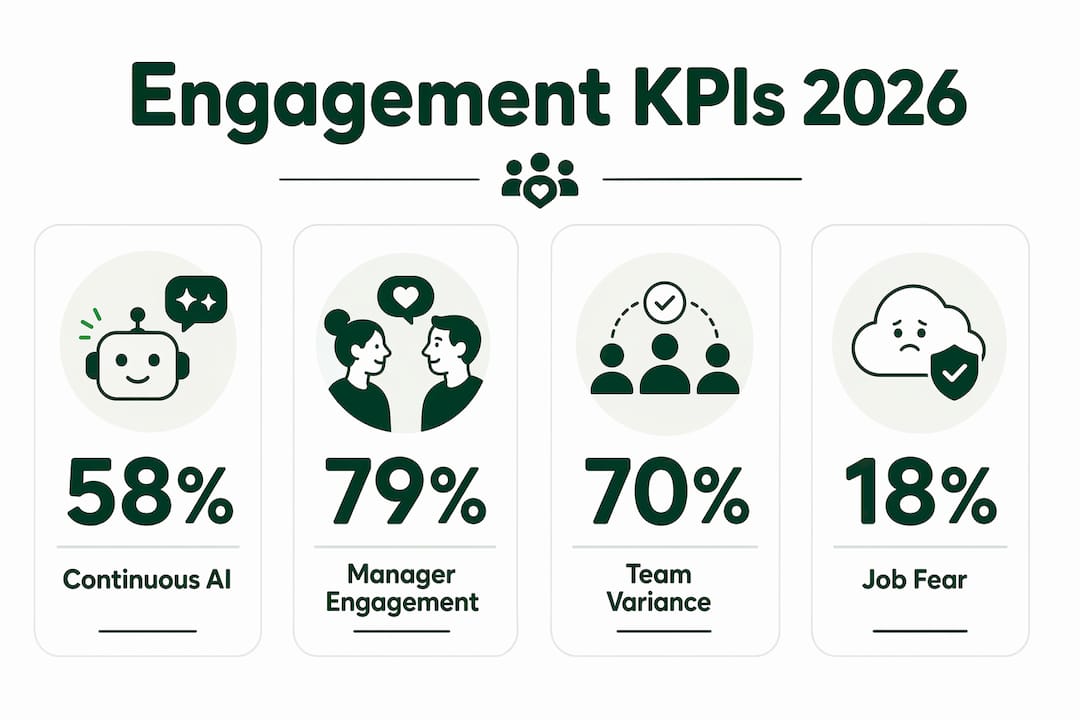
- AI-powered continuous conversations are replacing annual surveys, with 58% of large employers now running continuous AI conversation programs, while 44% still use annual surveys and 23% have discontinued their annual survey entirely
- Personalized recognition has become the top motivator, cited by 73% of employees, with recognition efforts up nearly 70% year over year
- Manager enablement through AI coaching tools is now critical, given that managers account for 70% of variance in team-level engagement
- Hybrid and remote workforce strategies require intentional rituals and multi-channel communication, not just flexible scheduling
- Employee wellbeing and mental health have moved from a benefit category to a core engagement driver
How AI and technology are reshaping engagement measurement
The annual engagement survey is losing its grip. A notable share of Fortune 1000 HR organizations have retired their annual survey cycle entirely in fiscal 2026, redirecting budget into continuous AI conversation programs. The reason is straightforward: a brief voice or text conversation about a real situation generates far richer insight than a lengthy survey that employees rush through once a year.
Continuous AI programs achieve participation rates well above the annual survey baseline, and the speed advantage is dramatic. Insight latency has dropped from weeks to days in organizations that have made the switch. One mid-cap SaaS company trimmed its annual survey from 64 items to 12, ran continuous AI conversations for everything else, and cut its time-to-insight from 11 weeks to 3 days.
Prescriptive analytics are pushing this further. Rather than delivering a report that managers read and file, today’s platforms push real-time recognition nudges and check-in prompts directly into collaboration tools like Slack or Microsoft Teams, before attrition risk surfaces. The unit of analysis has shifted from a score to a story.
Key technology capabilities HR leaders are deploying in 2026:
- Sentiment analysis embedded in communication platforms to detect disengagement signals in real time
- AI interviewer agents that follow up on vague answers and probe for the “why” behind any score
- Prescriptive nudges delivered to managers inside existing workflows, not separate dashboards
- Lifecycle-triggered conversations at onboarding, promotion, manager change, and exit
Pro Tip: Migrating from annual surveys to continuous AI conversations typically takes 9–15 months when done well. Run both in parallel for at least one full annual cycle to protect your trend line and maintain C-suite confidence in the data.
Why personalized recognition is now the strongest retention lever
Recognition efforts have increased substantially in the past year, with most employees citing personalization as a key motivator, and 88% report that gifts increase engagement and collaboration. Generic “employee of the month” programs do not move those numbers. What does move them is recognition that reflects an individual’s actual contribution, delivered through a channel they prefer, tied to a value they hold.

Peer-to-peer recognition is gaining ground on top-down programs because it scales without requiring manager bandwidth. When a colleague calls out a specific behavior in a team channel, it carries social proof that a manager’s quarterly shoutout often lacks. The most effective programs in 2026 combine both layers: manager-led recognition for milestone moments and peer-driven recognition for day-to-day wins. Explore peer-to-peer recognition strategies to see how that combination plays out in practice.
Recognition programs integrated with HRIS and collaboration platforms show measurable improvements in retention scores. The ROI of belonging is no longer theoretical. For practical ideas your team can act on immediately, the employee recognition ideas that consistently outperform in 2026 share one trait: they are specific, timely, and tied to something the employee actually cares about.
How leadership and management shape team engagement
Managers are the single biggest lever in engagement, and right now that lever is broken. Manager engagement has declined notably since 2022, with the steepest decline occurring between 2024 and 2025. This is not an attitude problem. It’s a structural design failure: organizations flattened their management layers, expanded manager spans of control, and then added AI adoption responsibilities without removing anything from the plate.
The consequence ripples down. Since managers account for roughly 70% of variance in team engagement, a disengaged manager almost guarantees a disengaged team. The fix is enablement, not pressure. Programs focused on coaching, empathy training, and recognition skill development measurably boost manager confidence and team morale, especially when supported by AI video training that reduces turnover significantly. AI copilots that deliver personalized coaching prompts and recognition nudges inside existing tools are the most scalable version of that support.
Urgency without clarity lowers productivity and engagement. HR leaders who push managers to “drive results faster” without giving them clear expectations and decision-making authority are compounding the problem. Trust and transparency are not soft skills in 2026. They are the operating conditions under which engagement either survives or collapses.
Strategies that are working for leadership development right now:
- AI copilots that surface recognition opportunities and flag at-risk team members before a manager has to ask
- Coaching programs built around empathy and psychological safety, not just performance metrics
- Reduced reporting burdens so managers spend time on people, not dashboards
- Clear role expectations that distinguish manager accountability from individual contributor work
Pro Tip: In best-practice organizations, 79% of managers are engaged at work, nearly four times the global average. The gap between best-practice and average is almost entirely explained by how well those organizations support and develop their managers, not by who they hire.
What actually works for hybrid and remote workforce engagement
Hybrid work has settled into a recognizable pattern: three days in-office, two days remote, with connection and clarity mattering more than location. The organizations that are getting this right are not the ones with the most sophisticated technology. They are the ones with the most intentional rituals.
Inclusive leadership and transparent communication correlate directly with higher engagement in distributed teams. That means feedback loops that reach remote employees as readily as in-office ones, meeting formats that do not systematically disadvantage people on video, and communication channels that match the diversity of how people actually work. The connected loneliness paradox is real: employees can be technically connected all day and still feel isolated by end of week.
Concrete strategies for distributed teams in 2026:
- Weekly async video updates from leadership that invite responses, not just views
- Rotating small-group virtual sessions that mix departments and seniority levels
- Explicit “no-meeting” blocks that protect deep work time for remote employees
- Structured onboarding rituals that introduce new hires to culture, not just process
A practical sequence for building engagement rituals in hybrid teams:
- Audit which communication channels remote employees actually use versus which ones leadership assumes they use
- Identify the moments where remote employees feel most excluded (all-hands, project kickoffs, social events)
- Design a parallel experience for each moment that does not require physical presence
- Measure participation and sentiment separately for in-office and remote cohorts
- Adjust quarterly based on what the data shows, not what feels right
For teams managing hybrid meeting engagement, the biggest gains come from small structural changes: camera-on norms, shared digital whiteboards, and rotating facilitation so remote voices lead the room sometimes.
How Gatherilla supports connection for remote and hybrid teams

One of the persistent gaps in remote engagement is the absence of low-stakes, fun interaction. Work conversations have a purpose. What remote employees often miss is the hallway chat, the lunch table, the spontaneous moment that builds actual relationships. Gatherilla fills that gap without adding logistical complexity.
The platform runs entirely in a browser, requires no downloads, and works with every major video conferencing tool. That matters because the biggest barrier to team-building activities in distributed organizations is friction. If employees have to install something, create an account, or wait for IT approval, participation drops before the activity starts.
What Gatherilla offers for remote and hybrid teams:
- Customizable multiplayer games designed for team bonding during virtual meetings
- Daily word and trivia challenges that give teams a shared touchpoint without requiring a scheduled call
- Icebreaker activities built for meeting openers, reducing the awkward silence that kills energy at the start of a session
- Onboarding games that help new hires connect with colleagues in their first weeks
- Real-time leaderboards that add friendly competition and keep teams coming back
- Company-wide event solutions for larger gatherings that need structure and energy
Pro Tip: Use Gatherilla’s daily challenge as a lightweight engagement ritual. Teams that share a quick result in a Slack channel before their morning standup report stronger social cohesion without adding meeting time. The team building ROI data supports this: consistent low-effort touchpoints outperform occasional high-effort events.
Preparing for what comes next in employee engagement
The next phase of engagement strategy is not about adding more tools. It’s about making the tools you have work together, governed by principles employees can trust. Ethical AI adoption with transparent data usage is becoming a differentiator. Employees who understand how their feedback is collected, stored, and used are more likely to participate honestly.
Continuous feedback and real-time performance management are replacing the annual review cycle in the same way AI conversations replaced annual surveys. The logic is identical: waiting 12 months to tell someone how they are doing is not management. It’s documentation. Organizations moving to quarterly or monthly check-ins, supported by AI-generated talking points, are seeing measurable improvements in manager-employee trust.
Flexible work policies are expanding beyond the hybrid model. Four-day workweeks, flexible start times, and results-only work environments are moving from pilot programs to standard offerings at a growing number of U.S. employers. The engagement case for flexibility is not just about preference. Employees with genuine schedule control report lower stress and higher commitment, two variables that feed directly into engagement scores.
What HR leaders should be building toward:
- Continuous feedback loops that replace annual reviews with ongoing, documented conversations
- Psychological safety programs that give employees a language for raising concerns without fear
- Transparent AI governance policies that explain how engagement data is used and protected
- Flexible work structures that go beyond location to include time and output-based arrangements
Why AI fluency is now a core enterprise competency
AI fluency is no longer a technical skill. It is a workplace literacy issue. Among U.S. workers in organizations that have implemented AI, 65% say AI has had a positive impact on their individual productivity, yet only 12% strongly agree that AI has transformed how work gets done in their organization. That gap between individual experience and organizational impact is where AI fluency programs need to focus.
The organizations closing that gap are treating AI adoption the way they once treated digital literacy: as a shared responsibility, not a specialist function. LinkedIn has embedded AI skill-building into its learning platform. Shopify has made AI tool proficiency part of its standard onboarding. Zapier has built AI workflow training into its product documentation. BlackRock has formalized AI fluency expectations across its analyst population. The pattern is consistent: fluency spreads fastest when it is modeled from the top and practiced in daily work, not delivered in a one-time training module.
How skills development is changing with AI expansion
AI is not eliminating jobs uniformly. It is reshaping them, and the organizations that communicate that distinction clearly are retaining talent that others are losing. The Harvard Business Review’s analysis of future HR roles identified a wave of new functions emerging at the intersection of human judgment and AI capability, including roles focused on AI ethics, workforce experience design, and human-AI collaboration management.
Skills development programs in 2026 are shifting from competency frameworks built around current job descriptions to learning pathways built around adjacent capabilities. The question is no longer “what does this person need to do their current job?” It is “what can this person learn that keeps them valuable as the job changes?” The CIPD’s research on skills development consistently shows that employees who see a clear learning pathway report higher engagement and lower intent to leave.
How to address employee fear of job obsolescence
18% of U.S. employees say it is very or somewhat likely their job will be eliminated in the next five years due to AI or automation. In organizations where AI has already been implemented, that likelihood is higher, with some industries reporting higher perceived risk of job elimination Fear at that scale does not stay contained. It shows up in disengagement, resistance to AI adoption, and quiet quitting.
The most effective response is not reassurance. It is transparency paired with investment. Employees who see their employer actively building their AI-adjacent skills are significantly less likely to report fear of obsolescence. The message that lands is not “your job is safe” but “we are investing in your ability to adapt.” That shift from protection to preparation changes the psychological contract in a way that generic communication about AI strategy never does.
Why DEI remains central to engagement strategy
Diversity, Equity, and Inclusion initiatives are not separate from engagement strategy. They are a precondition for it. Employees who do not feel included do not engage, regardless of how sophisticated the recognition program or how frequent the pulse survey. The SHRM’s 2026 employee experience research consistently places belonging among the top three drivers of engagement, alongside manager quality and growth opportunity.
The DEI programs gaining traction in 2026 are the ones with measurable outcomes tied to business results, not just representation metrics. Pay equity audits, inclusive hiring practices, and structured mentorship programs for underrepresented groups all connect to retention and productivity in ways that are now quantifiable. Organizations that treat DEI as a compliance exercise are seeing it reflected in their engagement scores.
How sustainability and CSR affect employee engagement
Employees, particularly those under 40, increasingly choose employers based on whether the organization’s values match their own. Sustainability commitments and corporate social responsibility programs are now engagement variables, not just marketing ones. When an organization’s stated values and its actual behavior diverge, employees notice, and disengagement follows.
The engagement lift from genuine CSR programs comes from participation, not just communication. Employees who volunteer through company programs, contribute to sustainability initiatives, or see their employer take a public position on issues they care about report higher connection to the organization. The key word is genuine. Performative commitments that do not survive scrutiny tend to backfire harder than saying nothing at all.
Using data analytics and sentiment analysis to measure engagement
Sentiment analysis has moved from a research tool to an operational one. HR teams are now embedding it in email platforms, collaboration tools, and feedback channels to detect disengagement signals before they become attrition. The shift from descriptive to prescriptive analytics means the output is not a report. It is a recommendation: “This manager’s team shows declining sentiment. Schedule a check-in this week.”
The engagement crisis data makes the case for real-time measurement. When global engagement fell to 20% and the estimated cost hit $10 trillion in lost productivity, the organizations that detected the decline earliest were the ones with continuous listening infrastructure already in place. Annual surveys told them what had already happened. Continuous analytics told them what was happening now.
What the research says about mental health and resilience at work
Employee wellbeing has not recovered to pre-pandemic levels. Gallup finds that daily negative emotions among workers remain elevated compared to before 2020, even as some wellbeing metrics have ticked upward. Stress, anger, sadness, and loneliness are all above their pre-pandemic baselines. For HR leaders, this means wellbeing programs are not a nice addition to the benefits package. They are load-bearing infrastructure for engagement.
The mental health programs gaining traction in 2026 go beyond EAP access and meditation apps. They include manager training in psychological safety, structured resilience programs that teach specific coping skills, and workload audits that address the root causes of burnout rather than its symptoms. The CIPD’s employee health and wellbeing research points consistently to one finding: preventive investment in mental health costs far less than reactive intervention after burnout occurs.
Key Takeaways
The single most important shift in 2026 is that AI-powered continuous listening has structurally replaced the annual survey as the primary engagement instrument, while manager engagement collapse has become the most urgent threat to overall workforce performance.
| Point | Details |
|---|---|
| AI conversations outpace surveys | 58% of large employers now run continuous AI programs, while 44% still use annual surveys and 23% have retired their annual survey entirely. |
| Personalization drives recognition ROI | 73% of employees cite personalization as a key motivator; recognition efforts rose nearly 70% in the past year. |
| Manager engagement is the critical gap | Manager engagement has declined notably since 2022; managers account for a substantial portion of variance in team engagement. |
| Hybrid demands intentional design | High-engagement organizations use transparent communication and inclusive feedback loops, not just flexible scheduling. |
| Gatherilla reduces remote isolation | Browser-based multiplayer games and daily challenges give distributed teams consistent, low-friction connection points. |
What HR leaders are still getting wrong about engagement
The conventional wisdom says engagement is a measurement problem. Measure more frequently, measure more accurately, and the engagement scores will improve. That logic is backwards. Measurement tells you where the fire is. It does not put it out.
The real problem in 2026 is that organizations have invested heavily in listening infrastructure and almost nothing in the conditions that make engagement possible: manager support, psychological safety, genuine flexibility, and the sense that one’s work connects to something that matters. The engagement crisis is not a data deficit. It is a trust deficit, and no AI tool closes a trust gap on its own.
What I find most underestimated is the role of low-stakes social connection in distributed teams. The research on remote work engagement focuses almost entirely on formal programs: recognition systems, feedback tools, learning platforms. But the texture of engagement, the part that makes people actually want to show up, comes from the informal moments that remote work systematically eliminates. Organizations that deliberately recreate those moments, through shared challenges, casual virtual gatherings, and team rituals that have nothing to do with work output, consistently outperform those that do not. The data on remote team culture strategies backs this up. Fun is not a distraction from engagement. It is often the mechanism.
Gatherilla brings team connection to where your people already are
Remote and hybrid teams face a specific problem that most engagement platforms do not solve: the absence of the informal, unstructured moments that build real relationships. Gatherilla is built for exactly that gap.
The platform runs in any browser, works with Zoom, Teams, Google Meet, and every other video conferencing tool your team already uses, and requires zero downloads or IT setup. HR leaders can launch a team trivia session, a daily word challenge, or a full company event in minutes. The free tier gives smaller teams immediate access, and the premium plan unlocks additional games, analytics, and priority support as your needs grow. For organizations serious about building team engagement that lasts beyond the next all-hands, Gatherilla offers a practical, low-friction starting point. Start with Gatherilla and give your distributed team the connection layer that engagement surveys cannot provide.