

Change Management Activities for Teams: 12 Ready-to-Run

Use these 12 ready-to-run change management activities for teams to build readiness, reduce resistance, and rehearse new behaviors before they’re required. Prosci research shows that projects with excellent change management are far more likely to meet objectives — and structured activities are how you get there. Whether you’re rolling out a new system, restructuring a department, or shifting culture, the activities below map directly to the Prosci ADKAR model (Awareness, Desire, Knowledge, Ability, Reinforcement) so you’re not just filling time — you’re moving people through the change curve.
Quick-pick guide:
- Force-field analysis — best for surfacing drivers and barriers before launch
- Change story workshop — best for building Awareness and shared narrative
- Emotion mapping — best for diagnosing team readiness safely
- Vision board session — best for creating Desire and buy-in
- Role reversal — best for empathy and cross-team understanding
- Stakeholder mapping — best for identifying influence and resistance risk
- Change readiness survey debrief — best for data-driven conversation starters
- Skill rehearsal role-play — best for building Knowledge and Ability
- Change Spectrum icebreaker — best icebreaker for change management at session opens
- Feedback wall — best for surfacing concerns without public confrontation
- Reinforcement recognition sprint — best for embedding new behaviors post-launch
- Team retrospective — best for 30/60/90-day follow-up and course correction
| Activity | Duration | Complexity |
|---|---|---|
| Force-field analysis | Medium (45–60 min) | Low |
| Change story workshop | Medium (60 min) | Low |
| Emotion mapping | Short (20–30 min) | Low |
| Vision board session | Medium (45–60 min) | Medium |
| Role reversal | Medium (45 min) | Medium |
| Stakeholder mapping | Long (60–90 min) | Medium |
| Change readiness survey debrief | Short (30 min) | Low |
| Skill rehearsal role-play | Long (60–90 min) | High |
| Change Spectrum icebreaker | Short (15–20 min) | Low |
| Feedback wall | Short (20–30 min) | Low |
| Reinforcement recognition sprint | Short (15–20 min) | Low |
| Team retrospective | Medium (45–60 min) | Low |
Table of Contents
- Copy-paste activity templates you can run this week
- Why these activities actually change behavior
- How to run these activities without losing the room
- Handling resistance and difficult dynamics mid-activity
- How to measure whether the activities are working
- The research-backed levers that make activities succeed
- Key Takeaways
- What actually works in the field
- Gatherilla makes virtual change activities faster to run
- Useful sources
Copy-paste activity templates you can run this week
Each template below follows the same micro-structure: objective, group size, duration, materials, numbered facilitator steps, a three-question debrief, and expected outcomes. Remote/hybrid notes appear at the end of each entry.
1. Force-field analysis

Objective: Map what’s driving and blocking the change so the team can prioritize actions. Group size: 4–20 | Duration: 45–60 min | Cost: Free
Materials: Whiteboard or Miro board, sticky notes (two colors), markers.
- Draw a vertical line down the center. Label left “Driving Forces,” right “Restraining Forces.”
- Give each participant two sticky-note colors. Five minutes of silent writing: one force per note.
- Participants place notes on the board, then cluster duplicates.
- Vote on the top three restraining forces to address first.
- Assign an owner and a target date to each priority.
Debrief: What surprised you? Which restraining force is most within our control? What’s one thing we can do before the next meeting?
Outcomes: Shared picture of risk, named owners, reduced “nobody told us” complaints.
Remote/hybrid: Use Miro or MURAL for the shared board. Assign a tech lead to manage sticky-note placement. Breakout rooms of 4–5 for initial brainstorm, then reconvene for voting with a polling tool like Mentimeter.
2. Change story workshop
Objective: Build a shared narrative that explains the “why” behind the change. Group size: 6–25 | Duration: 60 min | Cost: Free
Materials: Slide template with three frames: “Where we were / What changed / Where we’re going.”
- Share the three-frame template. Give pairs 10 minutes to draft their version of the story.
- Each pair presents in 90 seconds.
- Facilitator synthesizes common themes on a shared doc in real time.
- Group agrees on one canonical story sentence.
Debrief: Whose version felt most honest? What’s missing from the official narrative? How would you explain this to a new hire?
Outcomes: Consistent messaging, reduced rumor, increased Awareness (ADKAR stage 1).

Remote/hybrid: Use Google Slides or Notion for collaborative drafting. Record the 90-second pitches asynchronously in Loom for teams across time zones.
3. Emotion mapping
Objective: Diagnose team sentiment before it surfaces as resistance. Group size: 4–30 | Duration: 20–30 min | Cost: Free
Materials: Feeling cards or a printed emotion wheel; sticky notes; a shared wall or Jamboard.
- Distribute feeling cards (or show the emotion wheel on screen).
- Each person selects one to three words that describe how they feel about the change. Anonymous placement on the wall.
- Facilitator reads the distribution aloud without attributing names.
- Group discusses: “What would need to be true for more of us to feel confident?”
Debrief: What patterns do you see? What’s driving the most common feeling? What’s one thing the team can control?
Outcomes: Facilitator gets a real-time readiness gauge; team feels heard before being asked to act.
Remote/hybrid: Use a Jamboard or Mentimeter word cloud. Anonymous digital sticky notes work better than verbal check-ins for distributed teams.
4. Vision board session
Objective: Create Desire by helping the team picture what success looks like after the change. Group size: 6–20 | Duration: 45–60 min | Cost: Low (printed images or Canva)
Materials: Magazines or printed image sets, glue sticks, poster boards. Digital: Canva or Miro image library.
- Frame the prompt: “What does our team look like six months after this change succeeds?”
- Individuals build a small board (10 minutes), then share in pairs.
- Pairs combine into one team board, explaining each image choice.
- Post the board where the team can see it daily.
Debrief: What image surprised you most? What does this board tell us about what we value? What’s the first step toward this picture?
Outcomes: Increased Desire (ADKAR stage 2), shared aspiration, reduced “what’s in it for me” friction.
Remote/hybrid: Canva collaborative boards work well. Give participants a shared folder of pre-selected images to keep the session moving.
5. Role reversal
Objective: Build empathy by having team members argue the perspective they resist. Group size: 6–24 | Duration: 45 min | Cost: Free
Materials: Role cards describing stakeholder perspectives (e.g., IT lead, frontline employee, customer).
- Assign roles randomly. Give 5 minutes to prepare a 2-minute argument from that perspective.
- Run a structured “fishbowl” debate: inner circle argues, outer circle observes.
- Debrief with the full group.
Debrief: What argument surprised you? What did you learn about the people most affected? Where did your own position shift?
Outcomes: Reduced us-vs-them dynamics, stronger cross-team understanding, surfaced blind spots.
Remote/hybrid: Breakout rooms of 4 for preparation. Use the main room for the fishbowl with observers in chat.
Pro Tip: Assign the most resistant team member to argue the pro-change position. It rarely converts them immediately, but it almost always softens the edge.
6. Stakeholder mapping
Objective: Identify who has influence, who is at risk of resistance, and who needs targeted support. Group size: 4–15 | Duration: 60–90 min | Cost: Free
Materials: 2×2 grid (Influence vs. Attitude), sticky notes, markers.
- List all affected stakeholders on separate notes.
- Plot each on the grid: high/low influence, supportive/resistant.
- For each high-influence/resistant stakeholder, draft one specific engagement action.
- Assign owners and dates.
Debrief: Who is most likely to derail the change? Who are your hidden champions? What’s the one conversation you’ve been avoiding?
Outcomes: Targeted engagement plan, reduced surprise resistance, diagnostic clarity on adoption risks.
Remote/hybrid: Miro 2×2 template. Use dot-voting to prioritize the top five stakeholders to act on first.
7. Change readiness survey debrief
Objective: Turn survey data into a team conversation rather than a management report. Group size: 4–20 | Duration: 30 min | Cost: Free (Google Forms or SurveyMonkey)
Materials: Pre-run survey results (anonymized), slide with top three findings.
- Share the top three findings without editorializing.
- Small groups (3–4 people) discuss: “Does this match your experience? What’s missing?”
- Each group reports one insight and one suggested action.
- Facilitator captures actions in a shared doc.
Debrief: What finding was most unexpected? What does this tell us about where to focus first? What would change these numbers in 30 days?
Outcomes: Data-driven conversation, team ownership of readiness gaps, concrete next steps.
Remote/hybrid: Share the slide deck in advance. Use breakout rooms for small-group discussion, then report back in the main room.
8. Skill rehearsal role-play
Objective: Build Knowledge and Ability by practicing new behaviors in a low-stakes environment. Group size: 6–20 | Duration: 60–90 min | Cost: Low (scenario cards)
Materials: Scenario cards describing realistic situations the team will face post-change.
- Pairs draw a scenario card and role-play the interaction for 5 minutes.
- Observer gives structured feedback: one thing that worked, one thing to adjust.
- Pairs switch roles and repeat.
- Full group debrief on patterns.
Debrief: Where did you feel most uncertain? What’s the one skill gap that came up most? What would you do differently in a real situation?
Outcomes: Increased Ability (ADKAR stage 4), reduced anxiety about new processes, peer coaching habits.
Remote/hybrid: Breakout rooms of 3 (two role-players, one observer). Use a shared Google Doc for observer notes.
9. Change Spectrum icebreaker
Objective: Open a session by surfacing where individuals sit on the change acceptance spectrum. Group size: 5–50 | Duration: 15–20 min | Cost: Free
Materials: A line on the floor (in-person) or a polling tool (virtual). Labels: “Fully on board” to “Not convinced yet.”
- Read a statement about the change: “I feel confident about what this change means for my role.”
- Participants position themselves on the spectrum physically or via poll.
- Facilitator invites 2–3 people from different positions to share their reasoning briefly.
- No debate — just listening.
Debrief: What range did we see? What would move someone one step closer to “on board”? What does the facilitator need to address today?
Outcomes: Immediate readiness snapshot, normalized range of reactions, psychological safety signal.
Remote/hybrid: Mentimeter slider or a simple 1–5 poll. Display results anonymously before discussion.
10. Feedback wall
Objective: Surface concerns and ideas without requiring public confrontation. Group size: 5–40 | Duration: 20–30 min | Cost: Free
Materials: Sticky notes, a wall or whiteboard divided into three columns: “What’s working / What worries me / What I need.”
- Five minutes of silent writing. One thought per note.
- Participants post anonymously.
- Facilitator reads aloud and clusters themes.
- Group prioritizes the top “worry” and the top “need” for follow-up.
Debrief: What theme surprised you? What’s the one worry we can address right now? Who owns the follow-up?
Outcomes: Hidden resistance surfaced safely, team sentiment mapped before public discussion, clear owner for follow-up.
Remote/hybrid: Jamboard or Padlet with anonymous posting enabled. Use a timer visible to all participants.
11. Reinforcement recognition sprint
Objective: Embed new behaviors by making early adopters visible and celebrated. Group size: 5–30 | Duration: 15–20 min | Cost: Free
Materials: A shared recognition board (physical or digital), nomination cards.
- Facilitator explains the target behavior (e.g., “using the new system for all approvals”).
- Each person nominates one colleague who demonstrated the behavior this week.
- Read nominations aloud. Post them on the board.
- Manager adds one specific reinforcement action (e.g., mention in team meeting, note to HR file).
Debrief: What made this behavior easy to notice? What would make it easier to repeat? What barrier still exists?
Outcomes: Reinforcement (ADKAR stage 5), peer accountability, visible proof that the change is real.
Remote/hybrid: Use a Slack channel or Teams post for nominations. Pin the board in your project management tool.
12. Team retrospective
Objective: Review what’s working, what isn’t, and what to adjust at 30, 60, or 90 days post-launch. Group size: 4–20 | Duration: 45–60 min | Cost: Free
Materials: A retro board (Start / Stop / Continue) in Miro, Notion, or on a physical whiteboard.
- Five minutes of silent writing on each column.
- Cluster and dot-vote on the top three items per column.
- For each top item, agree on one concrete action, owner, and date.
- Facilitator documents and shares within 24 hours.
Debrief: What’s the single biggest thing holding us back? What’s working better than expected? What do we commit to changing before the next retro?
Outcomes: Continuous improvement loop, team retrospective data feeding the next activity cycle, reduced change fatigue.
Remote/hybrid: Miro retro templates work out of the box. Async option: open the board 48 hours early for written input, then use the live session only for discussion and voting.
Why these activities actually change behavior
Activities increase adoption because they create safe practice environments where people can rehearse new behaviors before those behaviors are required. That’s not a soft benefit — it’s the mechanism behind the ADKAR model.
Here’s how the activities above map to specific ADKAR outcomes:
- Awareness: Change story workshop, Change Spectrum icebreaker
- Desire: Vision board session, role reversal
- Knowledge: Skill rehearsal role-play, stakeholder mapping
- Ability: Skill rehearsal role-play, force-field analysis
- Reinforcement: Reinforcement recognition sprint, team retrospective
Employees resist uncertainty, not change itself. Activities reduce that uncertainty by giving people a concrete role in shaping the transition. When someone argues a perspective in a role reversal or places a sticky note on a feedback wall, they’re no longer passive recipients of change — they’re participants. That shift in agency is what moves the needle on adoption.
The Prosci data is direct: 88% of projects with excellent change management met or exceeded objectives, and structured activities are one of the primary drivers of that excellence.
Pro Tip: Sequence activities to match ADKAR stages. Run emotion mapping and the Change Spectrum icebreaker early (Awareness/Desire). Save skill rehearsal and reinforcement sprints for after the change goes live (Ability/Reinforcement). Running a reinforcement activity before people have the Knowledge to act creates frustration, not momentum.
How to run these activities without losing the room
Good facilitation determines success more than the activity itself. A well-designed exercise falls apart with poor setup; a simple sticky-note exercise lands perfectly with the right framing.
Pre-session facilitator checklist:
- Send a one-paragraph context note 48 hours before: what the session is, why it matters, and what participants should bring.
- Confirm room setup (in-person: tables in clusters, not rows; virtual: breakout rooms pre-assigned).
- Assign roles: timekeeper, scribe, tech lead (virtual), and a co-facilitator for groups over 15.
- Test all digital tools 30 minutes before the session starts.
- Prepare a “parking lot” space for off-topic concerns that deserve follow-up.
Sample opening script (paste into your meeting invite or say aloud):
“Today’s session is about [change name]. There are no wrong answers and no grades. The goal is to hear from everyone, not just the loudest voices. We’ll use [activity name] to structure the conversation. You’ll have time to think before you speak.”
Virtual tools that work:
- Shared whiteboards: Miro, MURAL, Jamboard
- Polling and sentiment: Mentimeter, Slido
- Async input: Padlet, Notion, Loom
- Breakout management: Zoom breakout rooms, Microsoft Teams channels
Accessibility considerations: provide captions for all virtual sessions, share materials 24 hours in advance for participants who need processing time, and offer an async input option for every activity so time-zone splits don’t exclude anyone.
Pro Tip: For mixed-experience groups, pair a skeptic with an early adopter in breakout rooms. The skeptic gets a peer perspective instead of a management pitch; the early adopter practices articulating the change’s value. Both leave more aligned.
“Managers are the primary bridge for change because employees trust their immediate manager more than top-down executive messages. Transparent, realistic communication about likely short-term productivity dips builds durable trust rather than temporary optimism.” — Timecraft Advisory
When an exercise starts to generate real heat, stop it early rather than push through. A session that ends with unresolved conflict sets back the next three. Call a break, acknowledge the tension, and offer a private channel for follow-up.
Handling resistance and difficult dynamics mid-activity
Psychological safety is the primary enabler of open feedback during transitions. When it breaks down, activities stop producing insight and start producing theater.
Red flags to watch for:
- Silence after an open question (shutdown, not reflection)
- One person dominating every sticky-note cluster
- Side conversations that stop when the facilitator approaches
- Forced laughter or sarcasm in response to prompts
- Strong subgroup clustering — the same four people always agreeing with each other
Scripts for common situations:
Hostile challenge: “That’s a fair concern. Let’s put it on the parking lot so we can give it the time it deserves after this exercise.”
Shutdown silence: “Take 60 more seconds to write one word on a note. You don’t have to share it — just get it out of your head.”
Subgroup polarization: “Let’s mix up the breakout groups. I want [Name] and [Name] in the same room for this next round.”
Forced humor deflecting real concern: “I hear the humor, and I also want to make sure we don’t skip past something real. What’s underneath that?”
Escalation path: private 1:1 with the individual after the session, then a sponsor intervention if the concern is structural (role loss, compensation impact, policy conflict). Don’t try to resolve structural concerns in a group activity.
Do/Don’t when tension rises:
- Do name the tension without attributing it to a person.
- Do use anonymous tools (feedback wall, feeling cards) to lower the stakes.
- Don’t push for consensus before people feel heard.
- Don’t skip the debrief to save time — it’s where the real learning happens.
Pro Tip: Proactively map team faultlines before the session — latent subgroups that share a grievance or identity. Deliberately mix those subgroups in breakout assignments. Polarization during change is almost always a faultline problem, not a personality problem.
How to measure whether the activities are working
Measure both leading indicators (participation, readiness scores, training completion) and lagging indicators (process cycle time, error rates, performance metrics). Leading indicators tell you if the change is taking hold; lagging indicators tell you if it’s sticking.
| Metric | What it measures | How to collect | Cadence |
|---|---|---|---|
| Activity participation rate | Engagement and reach | Attendance log | Per session |
| Pre/post readiness score | Shift in confidence | 5-question survey | Before and after each phase |
| Training completion rate | Knowledge acquisition | LMS or HR system | Weekly |
| Process error rate | Ability in practice | System logs or QA reports | Monthly |
| Manager check-in completion | Reinforcement cadence | Calendar audit | Weekly |
| 30/60/90-day adoption score | Sustained behavior change | Pulse survey | 30, 60, 90 days post-launch |
Sample post-activity survey questions:
- How confident do you feel about [specific new behavior] on a scale of 1–5?
- What’s the single biggest barrier you still face?
- What support would help you most in the next two weeks?
- How well did today’s session address your concerns? (1–5)
- What’s one thing you’ll do differently starting tomorrow?
30/60/90-day check-in additions:
- “What’s working better than you expected?”
- “What habit has been hardest to change?”
- “What does your manager do that helps most?”
Use results to sequence follow-ups: low readiness scores at 30 days trigger a skill rehearsal session; high participation but low adoption scores at 60 days signal a reinforcement gap, not a knowledge gap. Measure team building effectiveness with the same rigor you’d apply to any performance metric.
Pick one routine to reset the morning after a structural change — decision-making cadence, handoff process, or status update format — rather than trying to fix everything at once. That single reset prevents cascading failures and gives the team a visible proof point that the change is real.
The research-backed levers that make activities succeed
Psychological safety and leader behavior are the two largest levers for activity-driven adoption. Get those wrong and even the best-designed exercise produces polite compliance instead of real behavior change.
“Employees rarely resist the change itself — they resist uncertainty and loss of control. Psychological safety is the primary enabler of open feedback and learning during transitions.” — EdStellar
The manager’s role is specific and irreplaceable. Employees trust their immediate manager more than executive sponsors, which means the manager’s tone in the debrief matters more than the activity design. A manager who says “I don’t know yet, but I’ll find out” builds more trust than one who delivers a polished answer that doesn’t match reality.
Post-activity psychological safety check (for managers):
- Did quieter team members contribute, or did the same voices dominate?
- Did anyone express a concern that went unacknowledged?
- Was there any moment where someone was visibly shut down?
Reinforcement alignment check:
- Are performance reviews still rewarding the old behavior?
- Do team rituals (standups, 1:1s) reference the new behavior explicitly?
- Has anyone been recognized publicly for adopting the change?
Treat transitions as coaching processes and align recognition, performance conversations, and policies with the new behaviors. Without that alignment, activities create temporary enthusiasm that old incentive structures quietly extinguish.
Pro Tip: Build psychological safety before you run any diagnostic activity. If the team doesn’t believe it’s safe to be honest, the feedback wall becomes a performance, not a signal.
Key Takeaways
The most effective change management activities for teams combine structured facilitation, ADKAR-aligned sequencing, and consistent reinforcement — without those three elements, even well-designed exercises produce compliance rather than lasting behavior change.
| Point | Details |
|---|---|
| Start with diagnostics | Run emotion mapping or the Change Spectrum icebreaker first to gauge real readiness before any skill-building activity. |
| Sequence to ADKAR | Match activities to the stage: awareness/desire activities early, knowledge/ability activities mid-change, reinforcement sprints post-launch. |
| Measure leading and lagging | Track participation and readiness scores weekly; check process error rates and adoption scores at 30, 60, and 90 days. |
| Manager behavior is the lever | Post-activity reinforcement from the direct manager sustains behavior change more than any single workshop. |
| Gatherilla for virtual delivery | Gatherilla’s browser-based platform runs the remote/hybrid variants of these activities with no downloads and quick lobby setup. |
What actually works in the field
The conventional wisdom on change management activities is that the activity itself is the intervention. Run a vision board session, check the box, move on. That framing misses the point entirely.
The activity is the opener. What happens in the 72 hours after the session determines whether anything changes. A team that builds a feedback wall and never sees the results acted on learns one thing fast: honesty is performative here. The next activity gets polite silence.
What I see working consistently is the combination of a low-stakes diagnostic activity early (emotion mapping, feedback wall) followed by a manager who does something visible with the output within 48 hours. It doesn’t have to be a policy change. It can be a single email: “You told us X was the biggest worry. Here’s what we’re doing about it.” That loop — input, visible response, input again — is what builds the psychological safety that makes every subsequent activity more honest and more useful.
The other thing most guides skip: remote team engagement during change requires more structure, not less. In-person teams have ambient signals — body language, hallway conversations, who’s eating lunch alone. Remote teams have none of that. You have to design the diagnostic into the session explicitly, or you’ll run a perfectly structured activity and have no idea whether anyone actually believes in the change.
Start small. Pick one activity from this list, run it in your next team meeting, and measure one thing before and after. That’s the whole experiment.
Gatherilla makes virtual change activities faster to run
Running the remote and hybrid variants of these activities usually means juggling three tools, a breakout room setup, and a polling link — before anyone has even joined the call. Gatherilla cuts that friction significantly.
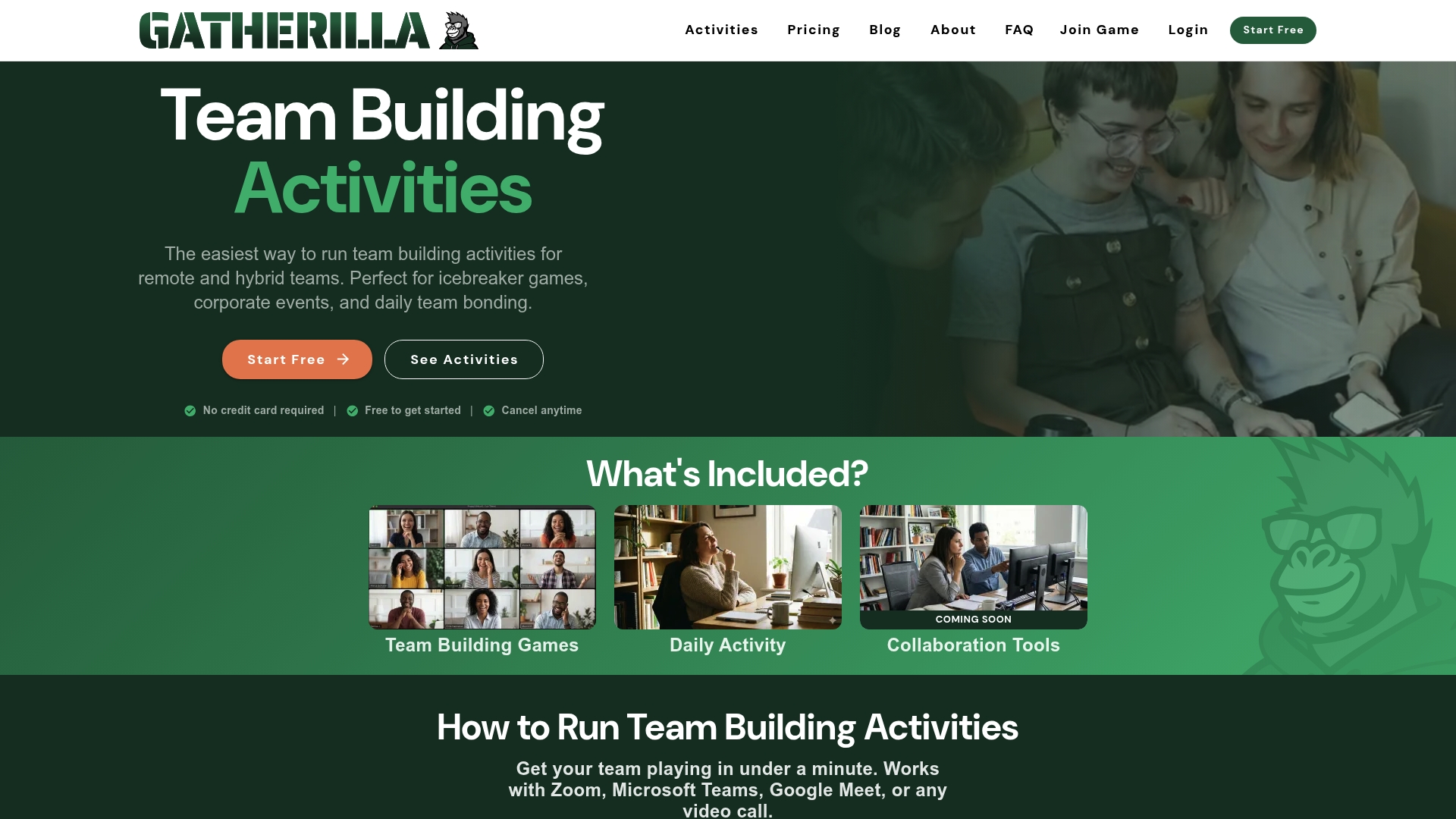
The platform is browser-based, so there are no downloads and no IT tickets. Participants join from any device, and the lobby is live in under two minutes. For the activities in this article, that means you can run a Change Spectrum icebreaker or a feedback wall equivalent as a multiplayer game at the start of any virtual meeting without a separate setup session. Gatherilla’s customizable multiplayer formats let you adapt the activity to your team’s specific change context, and the built-in analytics show participation rates and engagement patterns so you have a leading indicator without a separate survey.
For HR teams running change initiatives across distributed workforces, the daily challenge feature keeps the team connected between the larger structured sessions — which is exactly the reinforcement cadence the research recommends.
Try a 15-minute micro-activity in your next team meeting. Start with Gatherilla’s free tier and see what your team’s real readiness looks like before you plan the next phase.
Useful sources
- Prosci: 8 Change Management Activities You Should Implement Now — Prosci’s own list of structured activities tied to ADKAR, with data on change management effectiveness.
- EdStellar: 45 Change Management Activities, Games & Exercises — A curated library covering readiness, resistance, and embedding activities with remote/hybrid variants.
- Atlassian: 5 Critical Steps in the Change Management Cycle — Atlassian’s practitioner framework covering stakeholder engagement, phased rollouts, and diagnostic tools.
- MindTools: Discussing Reactions to Change With Your Team — A structured emotion-mapping exercise with action-plan templates and review-date guidance.
- Timecraft Advisory: Change Management for Team Leaders — Manager-focused guidance on candid communication, trust-building, and realistic expectation-setting during transitions.
- Gammatica: Managing Change in Teams — Strategies That Actually Work — Covers reinforcement alignment, faultline diagnosis, and coaching-style change management.
- Cloverleaf: Change Management Coaching Teams — Practitioner advice on post-change routine resets and preventing cascading failures after launch.
- The Big Team: Change Workshop Icebreaker — Visual sentiment tools and facilitator techniques for surfacing readiness before verbal discussion.